


Last Tuesday around 2pm, a woman rushed into a shelter I was visiting with a golden retriever she'd found wandering near a highway exit. The front desk coordinator spent 23 minutes on intake — filling forms, creating records, explaining protocols — while four other people waited in line. The dog's actual owner showed up 8 minutes into that process, but couldn't get anyone's attention until the paperwork wrapped up.
This scenario plays out daily across shelters. Good samaritans find lost pets, bring them in, and get stuck in administrative quicksand while reunification opportunities slip away. Most shelters need a fast lost pet intake checklist that isn't about being thorough — it's about capturing essentials in under 3 minutes so you can focus on getting that animal home.
The broken intake loop eating your front desk alive
Your intake coordinator probably handles 12-20 lost pet drop-offs daily during busy seasons. Each one traditionally takes 15-25 minutes when you factor in:
-
Full intake forms with finder contact details
-
Creating detailed animal records
-
Taking multiple photos from specific angles
-
Explaining hold periods and claiming procedures
-
Processing temporary custody paperwork
-
Answering finder questions about what happens next
Meanwhile, the actual owner might be calling every shelter within 30 miles, posting on neighborhood Facebook groups, or literally standing in your parking lot checking cars for their missing cat.
Twenty lost pet intakes at 20 minutes each means nearly 7 hours of front desk time daily — just for animals that might reunite within hours if you had better systems. That's before counting follow-up calls, status checks, and coordination with animal control officers who bring in additional strays.
Most shelters try solving this with more detailed procedures. They create comprehensive intake packets, develop elaborate photo protocols, draft lengthy finder agreements. But this creates the exact bottleneck it's meant to prevent.
Why traditional intake fails lost pets and finders
The standard lost pet intake process assumes you need complete information immediately. This breaks down in three ways:
Streamline your shelter operations effortlessly.
Animlly helps you manage every pet, volunteer, and adoption step with ease and accuracy.
- Comprehensive pet profiles
- Volunteer scheduling & communication
- Adoption tracking & reporting
No credit card required
Finders aren't prepared for complexity Someone who just corralled a panicked dog in a grocery store parking lot doesn't have 20 minutes for paperwork. They're often on lunch breaks, have kids in the car, or simply didn't expect the process to take this long. About 30% abandon the intake process halfway through, either leaving the animal without proper documentation or taking it home to "figure it out later" — creating shadow populations of found pets that never enter the system.
Front desk staff juggle competing priorities Your intake coordinator isn't just processing lost pets. They're answering phones, handling walk-in adoptions, managing volunteer check-ins, and fielding questions from the public. When a complex lost pet intake blocks the desk for 20+ minutes, everything else backs up. Phone calls go to voicemail, potential adopters leave without meeting animals, and stress levels spike across the entire front office.
Owners miss narrow reunification windows The first 4 hours after a pet goes missing represent your best reunification opportunity. Owners actively search, check shelters, and monitor online posts during this window. But if intake takes 25 minutes and photo uploads lag another hour behind, you've potentially missed the optimal connection point. Perfect documentation tomorrow is worthless if it prevents reunification today.
The 3-minute temporary ID protocol
Here's what actually needs to happen in those first 180 seconds:
Minute 1: Capture finder and location
-
Finder's phone number (just the number, nothing else yet)
-
Exact location found (cross streets or address)
-
Time found
-
Assign temporary ID number (simple sequential
L-2024-0847)
Minute 2: Document identifying features
-
Species and breed guess
-
Color and markings
-
Collar/tag details if present
-
Any obvious injuries requiring immediate care
-
One clear face photo on finder's phone
Minute 3: Set expectations and release
-
Hand finder a half-sheet with temporary ID and your shelter's found pet URL
-
Explain 72-hour hold basics
-
Get verbal confirmation they'll answer if you call
-
Release them with thanks
That's it. No lengthy forms, no detailed medical observations, no complex legal agreements. You've captured enough to start the reunification process while freeing your desk for the next intake.
Keep pre-printed temporary ID slips and half-sheets by the intake area for fastest handoff.
The details you're skipping — finder's address, detailed behavioral notes, multiple photo angles — can all be collected later through follow-up if needed. Roughly 65% of lost pets reunite within 72 hours, meaning most of that additional documentation never serves any purpose except slowing down your operation.
Photo protocols that actually work
Forget the multi-angle professional photography session. You need one usable photo that owners can recognize, captured in under 30 seconds:
The single-photo standard:
-
Face and chest visible
-
Natural lighting when possible (near a window or door)
-
Finder can use their own phone
-
Text or email to shelter immediately
-
Skip editing, filters, or corrections
Traditional shelters often require 4-6 photos: front, both sides, identifying marks, full body. This photography session alone can take 5-10 minutes and requires staff assistance. But owners recognize their pets from facial features and general appearance, not standardized angle documentation.
Speed beats perfection. A slightly blurry photo posted within 5 minutes beats a professional portrait uploaded tomorrow. Let finders text photos directly to a dedicated shelter phone or upload through a simple web form — whatever gets that image into circulation fastest.
Lost Pet Reunification Workflow
[START: Intake with Finder] → [3-Min Temporary ID Protocol] ↓ [Assign ID & Capture Basic Info] → [Single Photo Documentation] ↓ [Release Finder with Info Sheet] → [Upload Photo to Website] ↓ [Cross-check Missing Pet Reports] → [Post to Social Channels] ↓ [Monitor for Owner Contact] → [Reunification or Standard Intake]
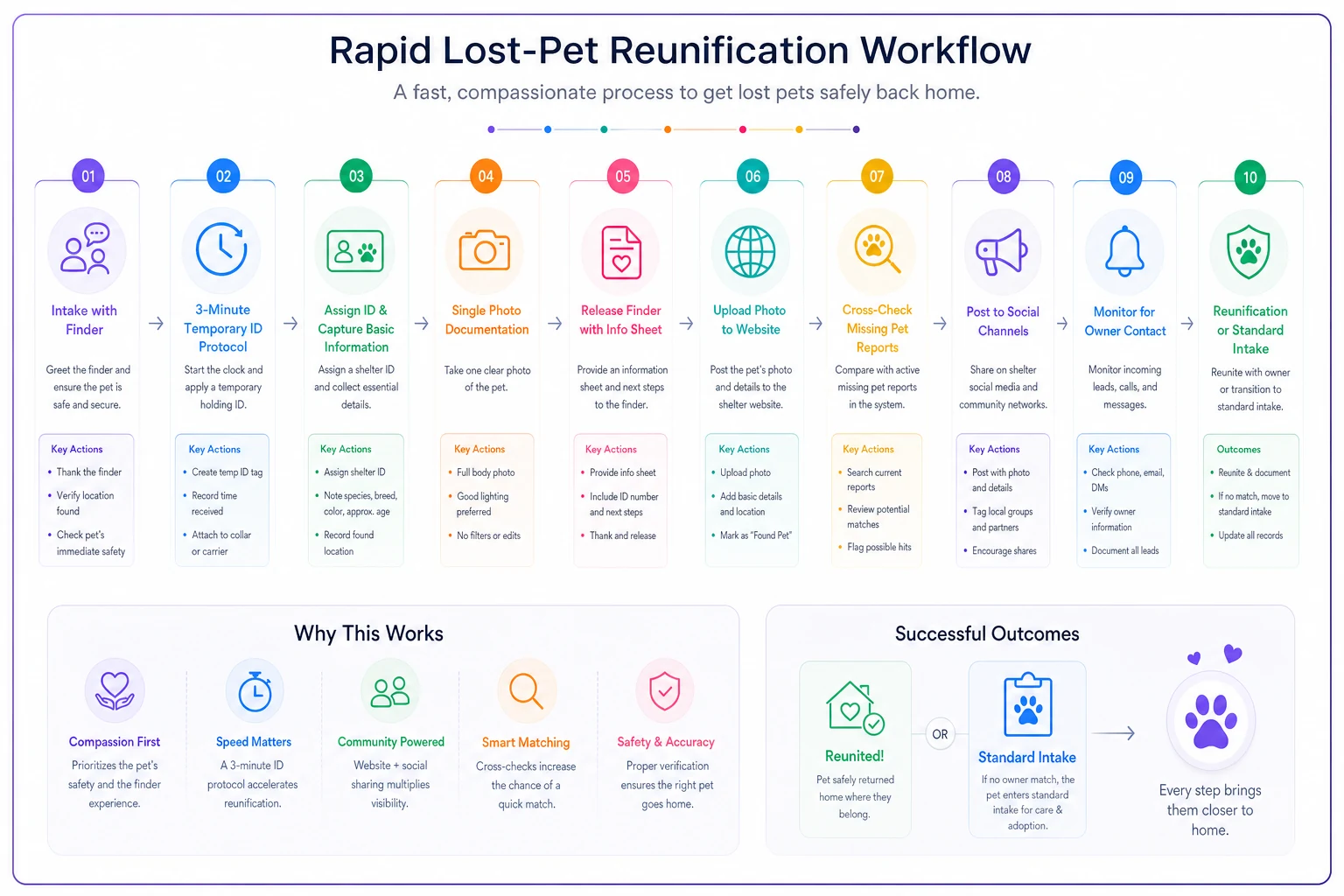
A simple flowchart showing the rapid reunification steps helps staff follow the process quickly.
Finder communication templates that prevent confusion
Most intake delays happen because finders don't understand what comes next. They ask questions, need reassurance, want to know specifics about the process. Having pre-written response templates eliminates this back-and-forth:
Initial text to finder (sent immediately): "Thanks for bringing in [temporary ID]. We'll post photos online within 30 minutes at [URL]. If owner contacts you directly, please let us know. We'll text updates to this number."
If owner claims within 4 hours: "Great news! The owner of [temporary ID] has arrived. Thank you for helping reunite them. No further action needed."
At 24 hours if unclaimed: "[Temporary ID] is still safe with us. Posted on Petfinder and local lost pet groups. We'll continue posting for 72 hours minimum."
At 72 hours for next steps: "[Temporary ID]'s stray hold expires today. Moving to adoption floor tomorrow unless you're interested in fostering/adopting. Let us know by 5pm."
These templates handle 90% of finder communications without any customization. Your staff can send them in seconds, keeping finders informed without lengthy phone conversations.
Building the rapid reunification workflow
The temporary ID system only works if it connects to actual reunification processes:
0-5 minutes: Intake complete, temporary ID assigned
5-15 minutes: Photo uploaded to website and social channels
15-30 minutes: Cross-check against missing pet reports from last 7 days
30-60 minutes: Post to partner networks and local Facebook groups
Every 2 hours: Flag walks through lost pet holding to check for owners
This compressed timeline means more animals reconnect with owners before even entering the full shelter system. You're not housing them overnight, not scheduling medical exams, not processing them through standard intake flows.
Maintain parallel tracks: the rapid reunification track for the first 4-6 hours, then the standard intake track if no owner appears. The temporary ID bridges both systems, preventing duplicate records while keeping documentation minimal until actually needed.
When the 3-minute system breaks down
Not every lost pet fits the rapid intake model. These scenarios require standard procedures:
| Situation | Why Standard Intake Needed | Key Considerations |
|---|---|---|
| Medical emergencies | Immediate vet assessment required | Safety over speed |
| Aggressive/fearful animals | Liability and handling risks | Behavioral documentation critical |
| Multiple animals together | Potential neglect investigation | May indicate larger issues |
| Repeat finders | Possible hoarding/theft concerns | Pattern recognition important |
| High-value breeds | Theft risk and false claims | Legal protection needed |
The rapid intake works for straightforward cases — roughly 75% of your lost pet traffic. The remaining 25% still need comprehensive documentation, but segmenting these populations prevents complex cases from slowing down simple ones.
Measuring front desk impact
Track these metrics after implementing rapid intake:
-
Average intake time per lost pet
-
Number of intakes processed per hour
-
Time from intake to photo posting
-
Reunification rate within 4 hours
-
Finder callback/follow-up volume
Most shelters see intake time drop from 20+ minutes to under 5 minutes for standard cases. That's 15 minutes returned to your front desk per transaction, multiplied by dozens of daily interactions during busy seasons.
The downstream effects matter too. Faster intake means shorter wait times for adopters, more time for counseling conversations, and less stress on front desk staff. One shelter in Virginia tracked a 40% reduction in front desk overtime hours after implementing rapid intake protocols — saving roughly $2,400 monthly in labor costs.
Common implementation mistakes
Trying to digitize the entire process immediately Many shelters attempt to launch apps, QR codes, or online forms before establishing the basic workflow. Start with paper and verbal protocols. Once those work smoothly, layer in digital tools.
Skipping staff training on the "why" Front desk staff trained on traditional intake often resist the minimal documentation approach. They worry about liability, completeness, and "doing it right." Spend time explaining how rapid intake actually serves animals better by prioritizing reunification speed over paperwork perfection.
Not communicating changes to regular finders Good samaritans who regularly bring in strays expect the old lengthy process. When you suddenly process them in 3 minutes, they might feel dismissed or worry you're not taking the situation seriously. Create signage and handouts explaining the new system focuses on faster reunification.
Maintaining too many exceptions Some shelters create so many "except when" rules that staff default to full intake for everything. Keep exceptions minimal and clear. If staff need to debate whether something qualifies for rapid intake, the system's too complex.
The software coordination advantage
Manual tracking of temporary IDs, photo uploads, and finder communications creates its own administrative burden. Modern shelter management software can automate the entire rapid intake flow instead of juggling paper forms, phone photos, and text messages.
The system assigns temporary IDs instantly, sends photo upload links to finders' phones, and triggers your communication templates automatically. More importantly, it maintains the parallel tracking between rapid intake and standard processing — preventing duplicate records while ensuring nothing falls through cracks.
AI automation handles the routine coordination: matching found pet photos against missing pet reports, posting to social channels, and flagging potential matches for human review. Your staff focuses on actual reunification conversations instead of data entry and photo management.
Integration creates real efficiency. When an owner calls about a missing pet, the system immediately flags any potential matches from recent intakes. When animal control brings in multiple animals from one location, it links those records for investigation. The technology handles the operational complexity while your team handles the human connections.
Beyond intake: The full reunification system
Rapid intake only works within a comprehensive reunification strategy. The 3-minute process gets animals into your system fast, but you need equally efficient processes for:
Owner verification protocols — How to confirm ownership without lengthy proof requirements
Payment processing — Handling fees without creating reunification barriers
Medical release procedures — Managing animals that received treatment during their stay
Data retention requirements — Meeting legal obligations without overcomplicating initial intake
Each component needs the same optimization mindset: capture what's essential, defer what's not, prioritize reunification over documentation.
Most successful shelters treat lost pet intake as a completely separate operational track from owner surrenders or stray holds. Different goals require different processes. Lost pets with searching owners need speed, not thoroughness.
Making rapid intake stick
Start with a two-week pilot during your slower season. Choose your most experienced front desk coordinator to champion the system. Track everything: times, complications, feedback from finders. Adjust the protocol based on actual friction points, not theoretical concerns.
Once refined, roll out gradually. Train one shift at a time. Create simple job aids — a laminated checklist, pre-printed temporary ID slips, template cards for common situations. The system should feel easier than the old way, not like another burden to remember.
Celebrate the wins. When a dog reunites with its owner in 45 minutes instead of 4 hours, share that story. When your front desk processes 20 lost pets before lunch without backing up, recognize that achievement. Building momentum requires showing staff how the new system serves their goals: helping more animals with less stress.
This isn't about cutting corners or reducing service quality. It's recognizing that the best service for lost pets is getting them home quickly. Every minute saved on unnecessary documentation is a minute available for actual reunification work. That's the operational improvement that matters — for the animals, the finders, the owners, and your increasingly stretched team trying to serve them all.
Ready to enhance your shelter’s impact?
Join 500+ shelters using Animlly to improve care coordination, increase adoptions, and engage communities effectively.