



Every October, shelter managers face the same math problem. Holiday surrenders will spike 40% between Thanksgiving and New Year's. Kitten season starts ramping in March. Summer vacation boarding overflow hits in June. You need coverage for three adoption counselors, two kennel techs, and at least one more intake specialist. But your board approved exactly zero seasonal hires in the budget.
The standard panic response? Pull volunteers into roles they're not trained for. Have your vet tech cover adoptions between appointments. Ask kennel staff to handle intake forms they've never seen before. Then watch error rates climb while your core team burns out trying to supervise people doing jobs they barely understand.
Most shelters treat seasonal peaks like natural disasters - unexpected, unpreventable, and something to just survive. The ones that thrive share something specific: they start cross-training six weeks before the rush, not during it.
The six-week countdown nobody talks about
Shelters typically scramble to cross-train when they're already drowning. That's like teaching someone to swim while they're being swept downstream.
A kennel tech learning basic intake procedures needs about 12 supervised interactions to handle straightforward surrenders confidently. At two practice sessions per week, that's six weeks. An adoption counselor picking up medication administration requires 8-10 supervised med rounds before they stop making dosage mistakes. Your intake coordinator learning adoption counseling basics needs to shadow at least 15 adoption conversations to understand the screening questions that actually matter.
These timelines reflect how long it takes someone to move from conscious incompetence (knowing they don't know) through conscious competence (doing it right while thinking hard) to unconscious competence (doing it right automatically). Rush that progression and you get medication errors, failed adoptions, and intake forms missing critical behavioral notes.
The shelters that handle seasonal spikes smoothly start their cross-training exactly six weeks before their historical peak begins. Not five weeks. Not seven. Six weeks creates enough runway for genuine skill development without people forgetting what they learned before they need it.
Mapping tasks by cognitive load, not job titles
Traditional cross-training follows org charts instead of cognitive patterns. Teaching a kennel tech "adoption counseling" means nothing. Teaching them to identify three specific red-flag behaviors during meet-and-greets? That's trainable in two sessions.
Streamline your shelter operations effortlessly.
Animlly helps you manage every pet, volunteer, and adoption step with ease and accuracy.
- Comprehensive pet profiles
- Volunteer scheduling & communication
- Adoption tracking & reporting
No credit card required
Automatic tasks (learnable in 1-2 sessions):
-
Basic cleaning protocols
-
Feeding schedules
-
Visitor sign-in procedures
-
Simple data entry
-
Supply restocking
Procedural tasks (learnable in 3-5 sessions):
-
Intake paperwork for owner surrenders
-
Basic behavior assessments
-
Standard adoption applications
-
Routine medication logging
-
Volunteer coordination
Judgment tasks (learnable in 6-10 sessions):
-
Behavioral red flag identification
-
Medical triage decisions
-
Adoption counseling for special needs animals
-
Intake decisions for aggressive animals
-
Foster placement matching
Complex decision tasks (requires 10+ sessions):
-
Full behavioral evaluations
-
Medical treatment planning
-
Cruelty case documentation
-
Euthanasia decisions
-
Legal hold determinations
Start with automatic tasks to build early wins and confidence before moving to procedural and judgment tasks.
Your cross-training matrix shouldn't list "Karen learns cat adoptions." It should specify "Karen masters automatic cat adoption tasks weeks 1-2, procedural tasks weeks 3-4, judgment tasks weeks 5-6."
The priority matrix that actually reflects shelter chaos
Generic priority matrices assume stable environments. Shelters during seasonal peaks look more like triage units. Your priority matrix needs three dimensions:
| Task Category | Peak Season Priority | Cross-Training Complexity | Coverage Requirement |
|---|---|---|---|
| Intake processing | Critical | Medium (3-4 weeks) | 2 people minimum |
| Basic medical care | Critical | High (5-6 weeks) | Cannot cross-train fully |
| Adoption counseling | High | Medium (3-4 weeks) | 3 people minimum |
| Kennel cleaning | High | Low (1 week) | Everyone capable |
| Behavioral assessment | Medium | High (5-6 weeks) | 1 specialist + 1 backup |
| Foster coordination | Medium | Low (2 weeks) | 2 people minimum |
| Volunteer management | Low | Low (1 week) | Anyone can emergency cover |
| Social media | Low | Low (1 week) | Delay acceptable |
Notice what's missing? Everything that sounds important but doesn't directly impact animal flow during peaks. Grant writing? Community outreach? Fundraising events? Cross-training for peak season means ruthless focus on operational continuity, not organizational completeness.
Week-by-week implementation that assumes everything goes wrong
Week 1: Baseline competency mapping
Skip the skills inventory surveys. Instead, run a "shadow audit." For three days, track what each person actually does versus what their job description claims. Your adoption counselor spends 30% of their time doing informal behavior assessments that aren't in their role. Your kennel tech handles intake overflow every Tuesday. Your volunteer coordinator somehow became the backup medication person.
Document these hidden responsibilities first. They're the gaps that'll break your operation when someone calls in sick during peak season.
Week 2: Task decomposition and pairing
Match people based on complementary stress responses, not just skills. Your high-anxiety intake coordinator who triple-checks everything pairs with your laid-back kennel tech who stays calm during chaos. Your detail-oriented vet tech shadows your big-picture adoption counselor who sometimes misses paperwork specifics.
Create "task cards" for the 20 most critical procedures. Not lengthy SOPs - index cards with the five essential steps that prevent disasters. Intake surrender: verify ID, check for microchip, document aggression history, assign kennel, enter tracking system. That's it.
Week 3-4: Supervised repetition
Supervisors treat cross-training like orientation - watch once, maybe twice, then you're trained. Real competency requires repetitions under varying conditions.
-
A straightforward owner surrender
-
An aggressive dog surrender
-
A hoarding case surrender
-
A stray with no history
-
An injured animal surrender
-
A surrender during a power outage when systems are down
Each scenario teaches different decision points. More importantly, it builds pattern recognition for when to escalate versus when to handle independently.
Visualize the six-week sprint workflow:
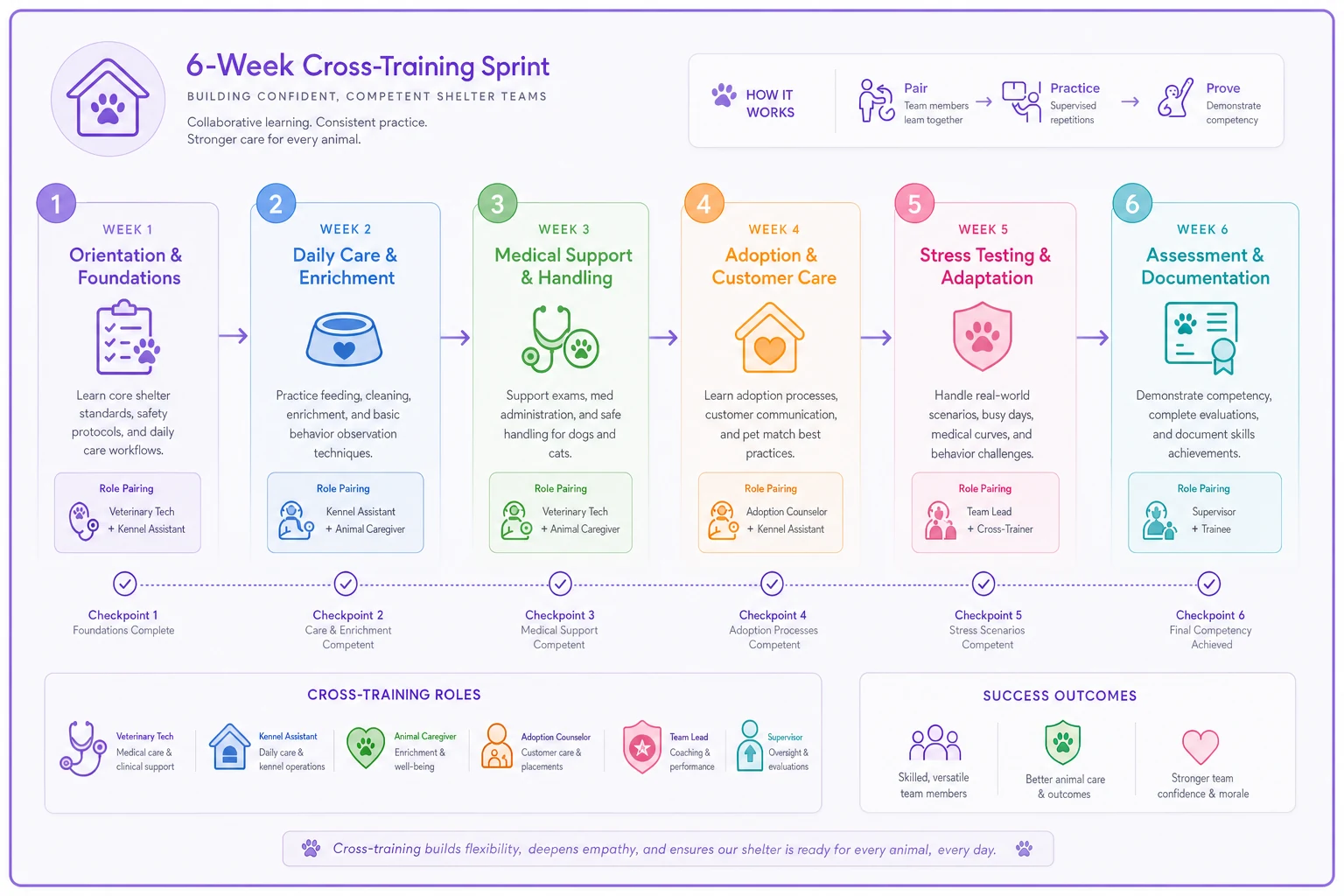
This visual maps trainers, trainees, practice repetitions, and stress-test checkpoints across six weeks.
Week 5: Stress testing
Run deliberate crisis scenarios. Not fire drills - operational stress tests.
Tuesday: Your intake coordinator doesn't show up (planned, but team doesn't know). Who steps up? What breaks?
Thursday: Process double your normal intake volume. Where do bottlenecks form? Who freezes? Who thrives?
Saturday: Your adoption system crashes during peak hours. Can your cross-trained team handle paper processing?
These controlled failures teach your team to adapt before real crises hit during peak season.
Week 6: Documentation and adjustment
Every cross-trained person documents their "cheat sheet" - the five things they're most likely to forget under pressure. These become laminated quick-reference guides posted at each station. Your cross-trained adoption counselor's card might read:
-
Always verify address matches ID
-
Landlord approval needed for rentals
-
Dog intro required even if they have dogs
-
Check DO NOT ADOPT list
-
Manager approval for special medical needs
Simple? Yes. But during holiday chaos when they're covering adoptions between other duties, these reminders prevent the mistakes that lead to returns.
Building redundancy without building resentment
Cross-training often fails because it feels like punishment. "Congratulations, now you get to do two jobs for one paycheck."
Track "skill badges" like scouts. Master basic intake? You get an intake badge (literally, a small pin or patch). Complete medication certification? Medication badge. These visible markers of expanding competency transform cross-training from extra burden to professional development.
Rotate premium tasks along with grunt work. Yes, you're learning to clean kennels as backup. But you're also learning adoption counseling, which is more interesting and less physically demanding. Balance the desirable cross-training opportunities with the necessary ones.
Money helps too. Some shelters pay a small monthly bonus ($50-100) for each additional area where someone maintains active certification. Others offer comp time - complete cross-training in two areas, earn an extra PTO day. The investment pays for itself the first time you don't have to close adoptions because someone called in sick.
Technology that actually helps (without replacing humans)
The shelters that handle seasonal peaks smoothly use technology for information access, not decision-making. Their cross-training tech stack includes:
Digital task cards accessible by phone - When covering an unfamiliar role, staff can pull up step-by-step guides instantly. Not 40-page manuals - quick references that fit on a phone screen.
Automated escalation triggers - The system flags when someone cross-trained is handling a complex case. Aggressive dog surrender by someone usually doing adoptions? Automatic alert to the behavior team for backup.
Role-based dashboards - When your vet tech covers adoptions, they see a simplified adoption dashboard, not the full system. Less overwhelming, fewer mistakes.
Cross-training progress tracking - Who's trained on what? When did they last practice? Which skills need refresh? Automated tracking means you know your coverage gaps before crisis hits.
This operational software approach means cross-trained staff can focus on doing the job, not remembering how to navigate unfamiliar systems. The technology handles the information management while humans handle the judgment calls.
The honest conversation about what won't work
Some cross-training combinations consistently fail.
Shy, introverted staff rarely succeed at adoption counseling, no matter how much training. The emotional labor of public interaction during peak season will break them.
Detail-oriented perfectionist personalities struggle with the controlled chaos of intake during surrenders. They'll spend twenty minutes getting perfect paperwork while the lobby fills with increasingly angry people.
Staff with their own trauma histories around animal loss shouldn't cross-train for euthanasia support, even if they volunteer. Peak season euthanasia decisions are hard enough without personal triggers.
Physical limitations matter too. Your 65-year-old volunteer coordinator might intellectually understand large dog handling, but asking them to cover kennel tech duties during peak season invites injury.
Better to acknowledge these limitations during planning than discover them during December's holiday surrender surge.
Measuring success beyond survival
Most shelters measure peak season success by what didn't happen. We didn't turn away animals. We didn't have mass staff quits. We didn't make headlines for the wrong reasons.
Response time to role coverage - How quickly can someone step into an absent colleague's role? Under 30 minutes means true operational resilience.
Error rates by cross-trained staff - Are cross-trained staff making more mistakes than specialists? If yes, your training needs work. If no, you've built genuine redundancy.
Staff stress scores - Survey your team weekly during peak season. Stress should stay relatively stable with good cross-training, not spike exponentially.
Cross-training utilization rate - What percentage of cross-trained skills actually get used? Below 40% means you're over-training. Above 80% means you're cutting it too close.
Time to competency - How long before a cross-trained person performs at 80% of a specialist's level? This number should decrease each season as your program matures.
Creating your own six-week sprint
Start by identifying your shelter's specific peak patterns. Not all shelters follow identical seasonal curves. College towns see spikes at semester ends. Tourist areas peak during vacation seasons. Military base shelters surge during deployment cycles.
Pull your intake data for the past three years. Mark your peak periods. Count backward six weeks. That's your cross-training launch date. Put it on next year's calendar now, before you forget.
Choose three critical roles that must have coverage no matter what. Not ten. Not five. Three. These become your focus for the first season. You can expand later, but starting with three ensures you do them properly instead of everything poorly.
Identify one person per role who can serve as primary trainer. They need teaching ability, not just expertise. Your best adoption counselor might be terrible at explaining their intuitive process. Your second-best counselor who can break down their decision-making step by step makes a better trainer.
Build your task decomposition for those three roles. Remember: cognitive load, not job titles. What can someone learn in a day? A week? What requires extended practice?
Design your stress tests now, while you're calm. During week five, you won't have mental bandwidth to create realistic scenarios. Write them down. Schedule them. Tell your supervisor so they don't panic when planned chaos ensues.
The compound effect of seasonal preparation
Shelters that consistently execute six-week cross-training sprints see compound benefits beyond surviving peak seasons.
Staff develop broader understanding of shelter operations. The adoption counselor who covers intake develops more realistic expectations about animal histories. The kennel tech who learns basic medical care spots health issues earlier. The volunteer coordinator who covers fostering builds better volunteer-foster pipelines.
Organizational resilience increases. Instead of depending on specific individuals, you build system strength. When your lead adoption counselor takes a better job (and they will), you have three partially trained replacements ready to step up, not zero.
Peak seasons become less peak. With proper cross-training, a 40% volume increase might only require 20% more effort. The math improves each year as your cross-trained pool expands and their skills deepen.
Most importantly, staff burnout decreases when everyone shares the load. Nobody bears the total weight of their specialized role during crisis. The shared struggle builds team cohesion instead of individual exhaustion.
Your shelter cross training seasonal staffing system will never be perfect. Animals don't follow training schedules. Staff get sick at the worst times. Volunteers vanish without warning. But the difference between shelters that thrive during peaks and those that merely survive comes down to preparation.
Six weeks of intentional cross-training beats six months of reactive scrambling. Start your countdown for next season today. Your future overwhelmed self will thank you when the holiday surrenders start rolling in and your cross-trained team handles them smoothly.
The animals don't care who processes their intake or handles their adoption as long as someone competent does it. Building that competency across your team, systematically and strategically, transforms seasonal peaks from crises to manageable challenges. The six-week investment pays dividends for years.
Ready to enhance your shelter’s impact?
Join 500+ shelters using Animlly to improve care coordination, increase adoptions, and engage communities effectively.