


Running an animal shelter with six staff members means everyone does everything, until suddenly no one knows who's doing what. The cats need feeding, a dog bite incident needs documenting, three volunteers showed up unscheduled, and someone forgot to order medical supplies because they thought someone else was handling it this month.
This operational mess kills more shelter programs than funding shortages ever will.
Most shelters start with good intentions and zero systems. A passionate founder rescues animals, recruits a few helpers, and operates on pure dedication. Works great until you're managing 47 animals, coordinating with four partner vets, juggling county contracts, and trying to remember who authorized that emergency surgery last Tuesday.
The breaking point hits around 30-40 animals. Below that, you can hold everything in your head. Above it, things start slipping. Medications get missed. Adoption paperwork disappears. Foster families get conflicting instructions. The shelter director spends 14-hour days firefighting problems instead of actually directing anything.
Why shelter operations fall apart differently than other businesses
Shelters face a unique operational nightmare that retail stores and restaurants never deal with: every single "inventory item" requires different handling procedures that change daily.
Dog #24 needs anxiety medication twice daily, can't be housed near males, requires special diet for allergies, and has a court hold until Thursday. Cat #31 is FIV positive, scheduled for dental surgery, only eats wet food, and has an adoption pending background check. Meanwhile, seven new intakes just arrived and nobody documented their initial conditions properly.
Traditional business playbooks assume stable products and predictable workflows. A coffee shop's operational manual covers maybe 20 drink variations. A shelter's operational reality involves hundreds of unique cases with medical histories, behavioral assessments, legal statuses, and placement requirements that shift constantly.
The typical shelter "system" looks like this:
-
WhatsApp groups for urgent updates
-
Shared Google Drive with 400 unorganized files
-
Sticky notes on kennel doors
-
One person's notebook with critical information
-
Email chains where important decisions get buried
Three common breaking points destroy shelter operations:
The information bottleneck. Sarah handles all intake documentation because she "knows the system best." When Sarah gets sick for a week, intake processing stops. New animals arrive but nobody captures their medical history, temperament notes, or special requirements. By the time Sarah returns, you're dealing with mystery animals and scrambling to reconstruct their stories.
The decision vacuum. A dog bites a volunteer during Saturday adoption event. Who decides the next steps? The adoption coordinator thinks the behavior team should assess. The behavior team thinks management should make the call. Management is off-site at a fundraiser. Three days pass with the dog in isolation while everyone waits for someone else to make a decision that should take 30 minutes.
The accountability gap. Everyone assumed someone else was monitoring the ringworm quarantine animals. Turns out nobody was. Now you've got fungal infections spreading through three kennel sections, $4,000 in unexpected vet bills, and 12 animals that can't be adopted until treatment completes. The worst part? This same thing happened eight months ago.
Building your modular shelter operations playbook
A functional shelter operations playbook isn't a 200-page manual that nobody reads. It's a living system of templates, role maps, and decision trees that actually match how your shelter operates today, not how you wish it operated.
Streamline your shelter operations effortlessly.
Animlly helps you manage every pet, volunteer, and adoption step with ease and accuracy.
- Comprehensive pet profiles
- Volunteer scheduling & communication
- Adoption tracking & reporting
No credit card required
Start with your five most chaotic processes. Usually that's:
-
Intake and assessment
-
Medical treatment tracking
-
Behavioral incident response
-
Foster coordination
-
Adoption processing
Don't try to document everything at once. Pick intake first, since that affects everything downstream.
Core SOP template structure
Trigger conditions - What starts this process? New animal arrives at door, animal control drops off, owner surrender appointment, transfer from partner shelter. Each trigger might need slightly different handling.
Decision points - Where does the process branch? Healthy adult dog goes one direction. Injured kitten goes another. Aggressive animal requires different protocols. Map these branches explicitly.
Required documentation - What must be recorded? Photos from three angles, weight, visible injuries, temperament during intake, vaccination history if available. Missing any creates problems weeks later during adoption.
Tool/system references - Where does information live? Intake forms in PetPoint, photos in shared drive, medical notes in shelter buddy, behavior observations in daily logs. Stop making people hunt for data.
Escalation triggers - When does this jump levels? Signs of abuse require immediate supervisor notification. Certain breeds need special handling per county ordinances. Pregnant animals need veterinary assessment within 24 hours.
A basic intake SOP section looks like this:
| Intake Type | Initial Handler | Documentation Required | System Location | Escalation Triggers |
|---|---|---|---|---|
| Walk-in surrender | Front desk staff | Surrender form, ID copy, intake photos | ShelterLuv + Drive folder | Previous owner history, signs of neglect |
| Animal control transfer | Intake coordinator | Transfer paperwork, case number, initial assessment | County portal + ShelterLuv | Bite history, legal holds |
| Emergency after-hours | On-call staff | Basic intake form, photos, temp housing assignment | Paper form → next day entry | Severe injury, aggressive behavior |
Here's a quick visual of the intake workflow.
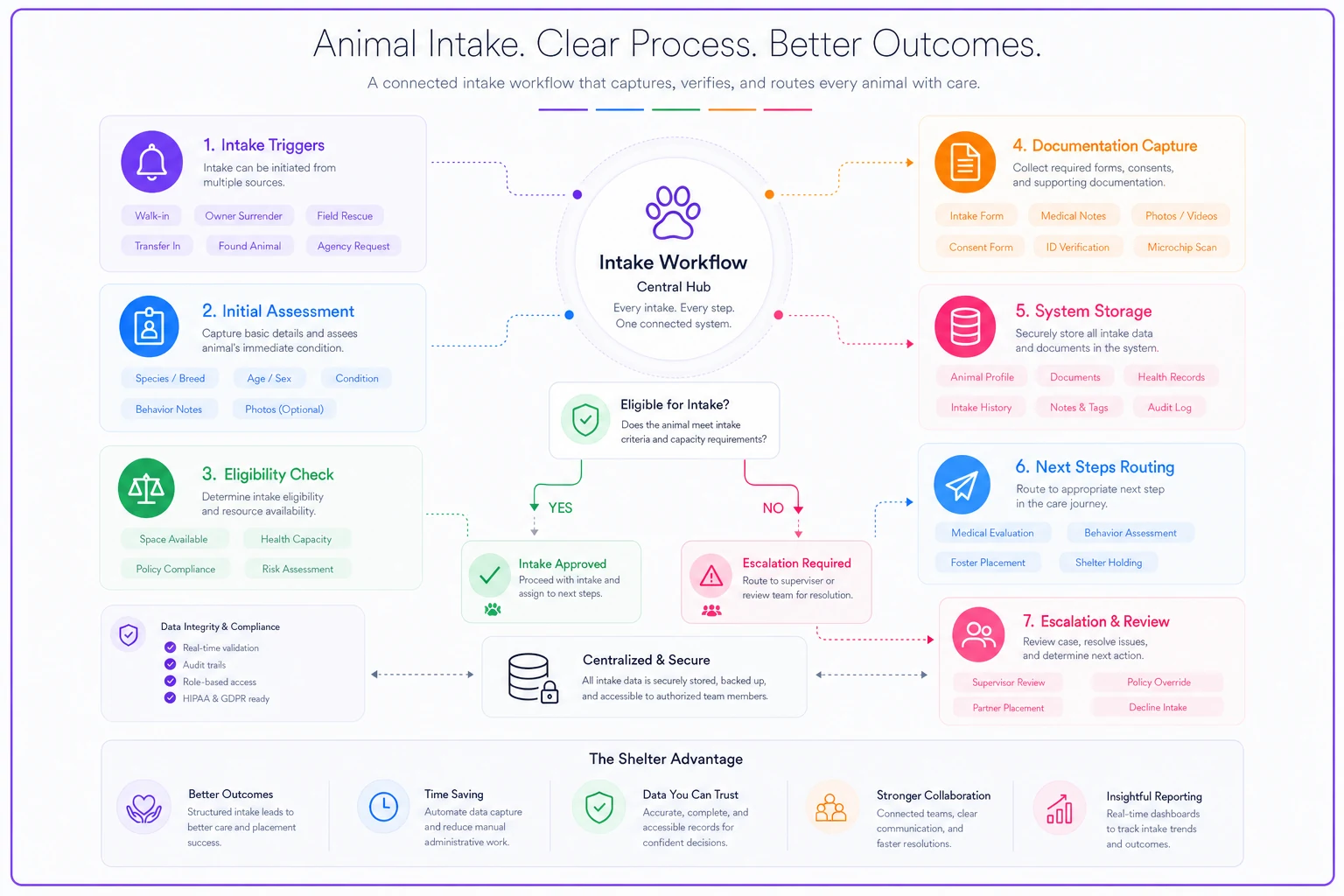
This diagram maps how an intake moves from arrival to documentation to storage and escalation so teams can follow the same steps.
RACI maps for shelters with tiny teams
RACI matrices (Responsible, Accountable, Consulted, Informed) usually assume you have enough people to actually separate these roles. In a six-person shelter, the same person might be Responsible AND Accountable AND doing the actual work.
The key is mapping primary and backup responsibilities, not pretending you have perfect role separation.
Standard RACI fails in small shelters because the "Accountable" person is also cleaning kennels, the "Consulted" expert is a volunteer who shows up twice weekly, and the "Informed" stakeholders include board members who check email monthly.
Instead, build Coverage RACI that shows:
-
Who normally handles this (primary)
-
Who covers when they're unavailable (backup)
-
Who must approve if it exceeds normal parameters (escalation)
-
Who needs updates if something goes wrong (notification)
Example for medical decisions:
Routine medications (under $50)
-
Primary
Veterinary technician
-
Backup
Shelter manager
-
Escalation
Not needed
-
Notification
Weekly report to board
Emergency treatment ($200-$1000)
-
Primary
Veterinary technician
-
Backup
Shelter manager
-
Escalation
Executive director approval required
-
Notification
Board treasurer within 48 hours
Major surgery (over $1000)
-
Primary
Executive director
-
Backup
Board president
-
Escalation
Board vote if over $2500
-
Notification
Full board, major donors if crowdfunding needed
This structure acknowledges your real staffing constraints while ensuring coverage gaps don't create emergencies.
Change control that actually works with high turnover
Shelter staff turnover averages 38% annually. Your carefully trained intake coordinator leaves for better pay. Their replacement has different ideas about process. Within three months, nobody follows the original SOP because "Jessica does it differently now."
Traditional change control assumes stable teams and formal review cycles. Shelters need version control that survives constant staff changes and actually gets used during crisis moments.
The monthly playbook review involves picking the first Tuesday of each month and spending 45 minutes reviewing what broke last month. Not what you wish worked better - what actually failed operationally. Document three things:
-
What process failed?
-
Why did current SOP not prevent this?
-
What's the minimum change to prevent recurrence?
Keep changes minimal. Don't redesign the entire intake process because one aggressive dog situation went badly. Add a single decision point: "If dog shows signs of resource guarding during intake, move to isolation kennel and schedule behavior assessment within 24 hours."
Version your templates simply:
-
Intakev1Jan2024
-
Intakev2March2024 (added aggressive dog protocol)
-
Intakev3May2024 (updated foster coordination section)
Old versions stay accessible but clearly marked as superseded. When someone says "but we used to do it this way," you can show exactly when and why it changed.
The authorization matrix
Small shelters can't wait for board meetings to approve every process change. Build an authorization matrix showing who can approve what level of change:
Daily adjustments (feeding schedules, kennel assignments)
-
Any staff member can modify
-
Document in daily log
-
Review weekly in staff meeting
Process modifications (intake form updates, medication protocols)
-
Manager approval required
-
Update SOP within 48 hours
-
Notify all staff via group message
Policy changes (adoption requirements, euthanasia decisions)
-
Executive director approval
-
Board notification required
-
Full staff training before implementation
Small shelters can't wait for board meetings to approve every process change.
Real scenario: 42-animal shelter reorganization
County Animal Services operated with four full-time staff managing 35-50 animals continuously. Their "system" was the shelter manager's memory plus random paperwork scattered across three computers.
When the manager had emergency surgery, operations collapsed within 72 hours. Nobody knew which animals were on medical holds. Foster coordinators had different placement lists. Two dogs almost got euthanized because paperwork showed them as aggressive when they were actually just scared during intake.
Week 1-2: Documented the five critical processes that failed during the crisis. Created basic one-page SOPs for each.
Week 3-4: Built RACI coverage maps showing primary and backup responsibilities. Identified four areas where only one person knew critical information.
Week 5-6: Implemented simple change tracking. Created shared folder with versioned templates. Established Tuesday morning 30-minute reviews.
Results after three months included intake processing time dropping from 55 minutes to 35 minutes average, medication errors reducing by roughly 70%, foster placements increasing because coordinators could access real-time availability, and staff reporting feeling "way less stressed" about coverage during absences.
The playbook wasn't perfect. They still struggled with volunteer coordination and special event planning. But the core operations held steady even when two staff members left and had to be replaced.
Technology integration without overwhelming small teams
Most shelter management software promises to solve everything then becomes another abandoned system. The playbook approach works because it starts with your actual processes, then adds technology where it genuinely helps.
Don't try to digitize everything immediately. Start with the highest-error processes:
-
Medical administration tracking (missed medications can kill)
-
Legal hold monitoring (releasing the wrong animal creates lawsuits)
-
Adoption application processing (lost applications frustrate adopters)
Your playbook should specify exactly which system handles what:
-
Paper intake forms for walk-ins (entered to system within 24 hours)
-
Digital medical records for all prescription medications
-
Shared calendar for surgery schedules and transport coordination
-
WhatsApp for urgent real-time updates only
Modern shelter operation platforms can centralize these workflows, automatically routing tasks based on your SOPs and maintaining audit trails for compliance. But the playbook comes first - technology just executes what you've already mapped.
Making the playbook stick
The best shelter operations playbook becomes invisible because everyone just knows how things work. Getting there requires deliberate adoption strategies.
Start with pain relief. Don't begin with abstract process improvement. Pick the thing that makes everyone curse under their breath daily. Maybe it's finding foster contact information. Maybe it's tracking who's on special diets. Fix that first, and people will trust the system for bigger changes.
Make it faster, not just "better." If your intake SOP adds 10 minutes to processing time for "better documentation," it'll get abandoned within a week. Show how standardized templates actually save time by eliminating duplicate questions and confusion.
Build it together. The person cleaning kennels knows things about workflow that management never sees. Include their input in the playbook. They'll follow processes they helped create way more than mandates from above.
Fix the daily pain point first to build trust before rolling out broader process changes.
Accept imperfection. Your first version will have gaps. Some processes won't fit the template structure. That's fine. A 70% complete playbook that people actually use beats a perfect manual gathering dust.
The compound effect of operational clarity
Shelters with functioning playbooks don't just run smoother - they scale their impact. When basic operations stop consuming everyone's mental energy, you can focus on what matters: saving more animals.
Clear SOPs mean new volunteers can contribute immediately instead of shadowing for weeks. Defined RACI maps mean decisions happen quickly instead of stalling in confusion. Change control means improvements stick instead of reverting to chaos when staff changes.
The difference shows up everywhere. Grant applications get submitted on time because someone owns that process. Medical treatments happen consistently, improving recovery rates. Foster families stay engaged because communication is reliable. Adoption rates increase because the experience isn't chaotic.
Most importantly, staff burnout decreases. Shelter work remains emotionally demanding, but operational chaos doesn't need to compound that stress. When everyone knows their role, has backup coverage, and trusts the system to catch problems, they can focus on animal care instead of organizational dysfunction.
Building your shelter operations playbook takes effort upfront. Start small with your worst pain point. Document what actually happens, not what should happen. Map who does what, including backup coverage. Create simple change tracking. Review and adjust monthly.
Within six months, you'll wonder how you ever operated without it. The animals in your care deserve operational excellence just as much as they deserve medical care and love. A modular playbook makes that possible, even with limited staff and resources.
Ready to enhance your shelter’s impact?
Join 500+ shelters using Animlly to improve care coordination, increase adoptions, and engage communities effectively.