


Most adoption disputes don't come from bad adopters. They come from paperwork that looked complete at the desk but couldn't answer a single question when it mattered.
Here's the pattern. An adopter returns after four months claiming the shelter "never told them" the dog had a bite history. Or a family member shows up saying the adoption was done in their name without consent. Or an adopter demands their fee back because the cat "was already sick when we got it." In each case, the coordinator goes to the file and finds a signed contract — but it's missing the one field, initial, or note that would have ended the argument on the spot.
Why paperwork that looked fine at the desk falls apart six months later
That's the real problem with adoption contracts. Not whether you have one. Whether it can defend a decision six months after the person who processed it has forgotten the interaction entirely.
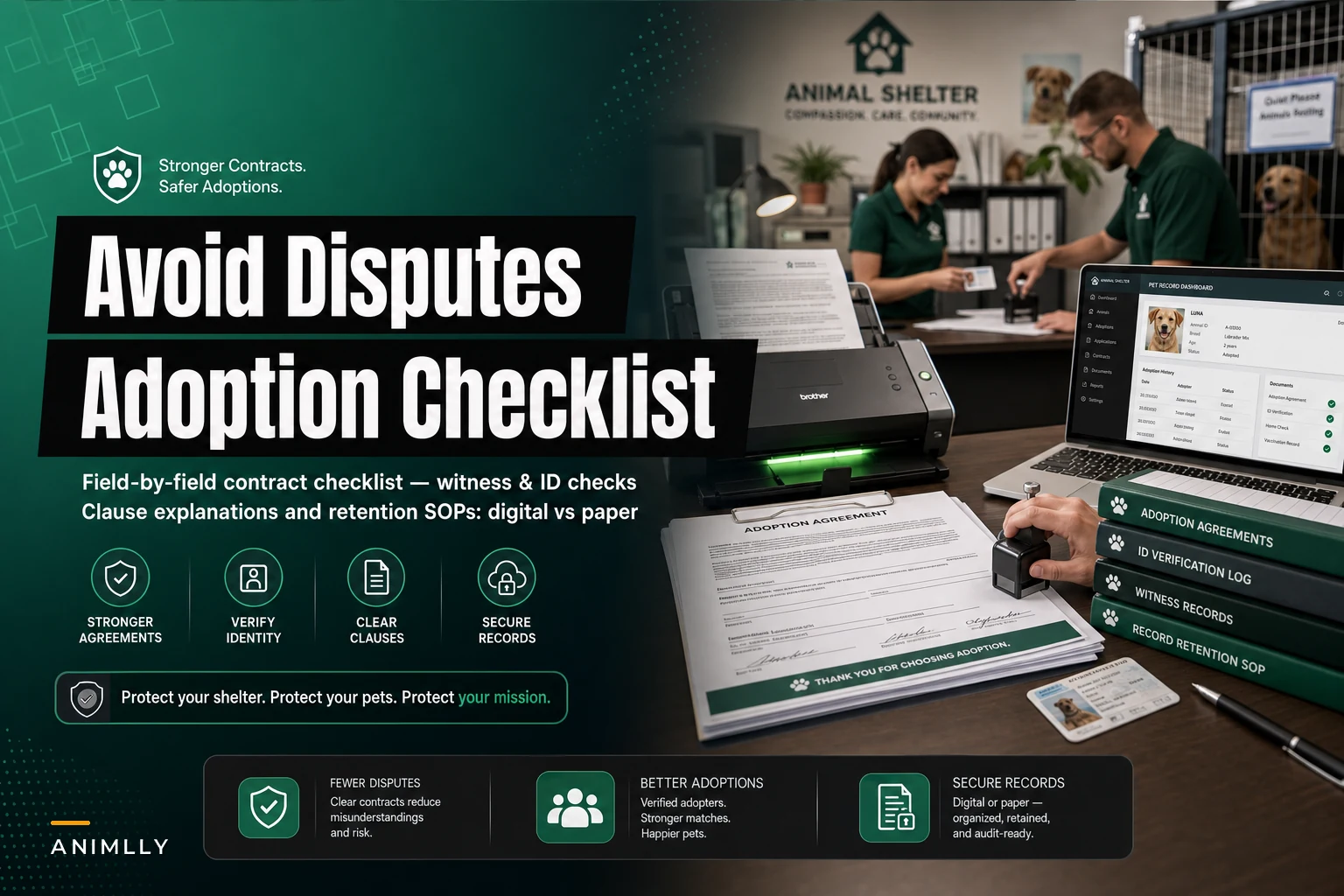
This is a tight operational guide: what fields your contract actually needs, how to run witness and ID checks without slowing the floor down, what the tricky clauses really mean, and how to decide between digital and paper retention. The goal is a paper trail that holds up — not a longer form nobody fills out.
Start with the fields that actually get contested
A lot of shelters build their contract around what feels legally impressive. In practice, disputes cluster around a small number of fields, and those are the ones people skip when it's busy.
Streamline your shelter operations effortlessly.
Animlly helps you manage every pet, volunteer, and adoption step with ease and accuracy.
- Comprehensive pet profiles
- Volunteer scheduling & communication
- Adoption tracking & reporting
No credit card required
When you look at where contracts fail, it's rarely the adopter's name or the fee amount. It's the fields that require a second of judgment or a conversation:
-
Animal identifier tied to a photo — microchip number and a dated photo. A chip number alone doesn't prove which animal walked out the door. Adopters have returned a different animal (same breed, same color) and argued about it.
-
Disclosed medical and behavioral conditions — written out specifically, not "see notes." "Resource guards food bowl, snapped at handler 6/12" beats "some behavior issues."
-
Spay/neuter status and the deposit/voucher terms — whether it's done, scheduled, or contractually required, with the date and dollar amount.
-
Who is legally taking the animal — full legal name matching the ID, not just a first name and phone number.
-
Adopter's acknowledgment initials next to each disclosed condition — a signature at the bottom is weak. Initials beside the specific bite-history line are hard to walk back.
-
The return/surrender clause acknowledgment — separately initialed, because this is the clause adopters most often claim they never read.
The single most useful thing you can add costs nothing: a line that records what was verbally discussed at the desk. Something like "Staff reviewed: medical history, behavior notes, return policy — adopter questions answered." One initialed line closes off the "nobody told me" argument, which is the root of a surprising share of disputes.
A missing field pattern worth watching: contracts filled out in the morning are cleaner than contracts filled out in the last hour before closing. When staff are trying to get someone out the door, the discretionary fields — the disclosure acknowledgments, the verbal-review line — are the first to go blank. If you audit your files by time of day, that pattern usually jumps out.
Witness and ID checks without turning the desk into the DMV
The friction point everyone worries about is ID verification. Nobody wants to interrogate a family who just fell in love with a beagle. But the alternative — no verification — is where the ugliest disputes live.
The trick is tiering it. Not every adoption needs the same scrutiny.
| Adoption type | ID requirement | Witness needed? | Extra step |
|---|---|---|---|
| Standard adult, standard fee | Photo ID, name matched to contract | No | Verbal-review line initialed |
| Adopting on behalf of household member | Photo ID + household member's consent noted | Coordinator initials as witness | Note who the animal actually lives with |
| Fee-waived / sponsored adoption | Photo ID, address confirmed | No | Confirm sponsor terms in writing |
| Behavioral or medical special-needs animal | Photo ID, name matched | Second staff signs as witness | Separate signed disclosure sheet |
| Adopter under 18 or gifting arrangement | Adult of record's ID | Yes, always | Adult of record must be the signer |
The reason to witness the harder cases specifically: when a dispute goes formal, it almost always involves a special-needs animal or a "someone else signed for me" situation. Those are exactly the interactions where a second staff signature and a matched ID turn a he-said-she-said into a closed case.
One quiet mistake worth naming — checking ID but never recording that you did. Staff glance at a license, hand it back, and move on. Six months later there's no record the check ever happened. The fix is a checkbox: "Photo ID verified, name matched — staff initials." You're not photocopying the license (that creates its own storage and privacy headache). You're recording that the check occurred.
Add a checkbox "Photo ID verified, name matched — staff initials" on the form so the ID check is recorded without photocopying.
For the household and gifting scenarios, the pattern that causes problems is an animal going home to a person who never signed anything. A daughter adopts for her elderly father; three months later the father surrenders and disputes the medical disclosure he never saw. Record who the animal actually lives with, even when someone else is signing. It costs one line and saves an argument.
What the tricky clauses actually mean
Coordinators enforce these clauses daily but often can't explain them clearly when an adopter pushes back. That gap is where disputes escalate — an adopter who doesn't understand a clause feels tricked, and a feeling of being tricked is what turns a phone call into a formal complaint.
Right of return / no-resale clause. This says the animal comes back to you, not Craigslist, if it doesn't work out. Its real operational value isn't legal — it's that it gives you a reason to stay in contact and gives the adopter a clear path back. When adopters understand this clause is for the animal's safety, not to trap them, they use it correctly instead of dumping the animal.
Spay/neuter compliance clause. For animals adopted before the procedure, this obligates the adopter to complete it and often ties a deposit to proof. The enforcement failure here is almost always tracking, not language — the clause is fine, but nobody follows up. If you're going to include it, you need a tickle system to actually chase the proof.
Medical disclosure and "as-is" acknowledgment. This clarifies that the shelter disclosed what it knew and isn't warrantying the animal's future health. The mistake is treating "as-is" as a shield that lets you skip disclosure. It doesn't. An "as-is" clause with a blank disclosure section is worse than no clause — it looks like you're hiding something. The two work together or not at all.
Alteration-of-terms clause. States that side agreements ("the manager said I could bring him back for a refund anytime") aren't binding unless written on the contract. This is the clause that protects you from well-meaning staff making verbal promises. Worth explaining to staff more than to adopters.
Reclaim/misrepresentation clause. Allows the shelter to reclaim the animal if the adopter lied on the application. Use it sparingly and document heavily — this is the one that generates counter-disputes if applied loosely.
The takeaway across all of these: a clause the adopter understands is enforceable in practice. A clause they don't understand becomes the centerpiece of the dispute. Reading the return and disclosure clauses out loud — even in fifteen seconds — does more to prevent conflict than adding three more paragraphs of legal text.
Digital vs paper retention: the decision that actually matters
This is where a lot of shelters lose the game they thought they'd already won. The contract was perfect. It's just… in a filing cabinet, in a folder that got refiled wrong, three years ago.
The real question isn't philosophical. It's: when someone disputes an adoption from eighteen months ago, how fast can you produce a legible, complete, tamper-evident copy? Everything else is secondary.
| Factor | Paper only | Digital only | Hybrid (recommended for most) |
|---|---|---|---|
| Retrieval speed | Slow, depends on filing discipline | Fast, searchable | Fast digital, paper backup |
| Tamper evidence | Physical, but easy to lose | Strong if timestamped | Strong |
| Signature validity | Widely accepted | Accepted in most jurisdictions | Best coverage |
| Disaster risk | Fire/flood = total loss | Backup dependent | Redundant |
| Cost | Cheap upfront, expensive in staff time | Low ongoing | Slight overhead |
| Audit ease | Manual, painful | Filterable in seconds | Easy |
For most shelters, the winning setup is digital-primary with a signed paper copy scanned in. You want the searchability of digital for the day a dispute lands, plus a physical signed original for the rare case where a jurisdiction or a lawyer wants wet ink.
-
Scan the signed contract the same day, named by animal ID and date — not "scan001.pdf." A file named
A2291Boston-terrier2026-03-14.pdfis findable.IMG_4402.jpgis not. -
Store adopter ID-verification confirmation with the contract, not separately. Split records are how the ID check "disappears."
-
Set a retention period and write it down — commonly three to seven years depending on local requirements. Then actually honor it; don't purge early and don't keep everything forever, which creates its own privacy exposure.
-
Keep the spay/neuter proof attached to the original contract once it comes in, so the compliance record lives in one place.
-
Back up off-site. A shelter that lost its records to a burst pipe learned that a single filing cabinet is a single point of failure.
Where digital record systems earn their keep here isn't the signing — it's the finding. When your contracts, ID confirmations, medical disclosures, and follow-up notes live in one searchable record tied to the animal, an eighteen-month-old dispute becomes a thirty-second lookup instead of an afternoon in the archive room. That's also where post-adoption follow-up records connect naturally, so the full history of an adoption — contract, disclosure, and every contact after — sits in one place when you need to defend a decision.
A simple workflow diagram can make it obvious who does what and when for retention and follow-up.
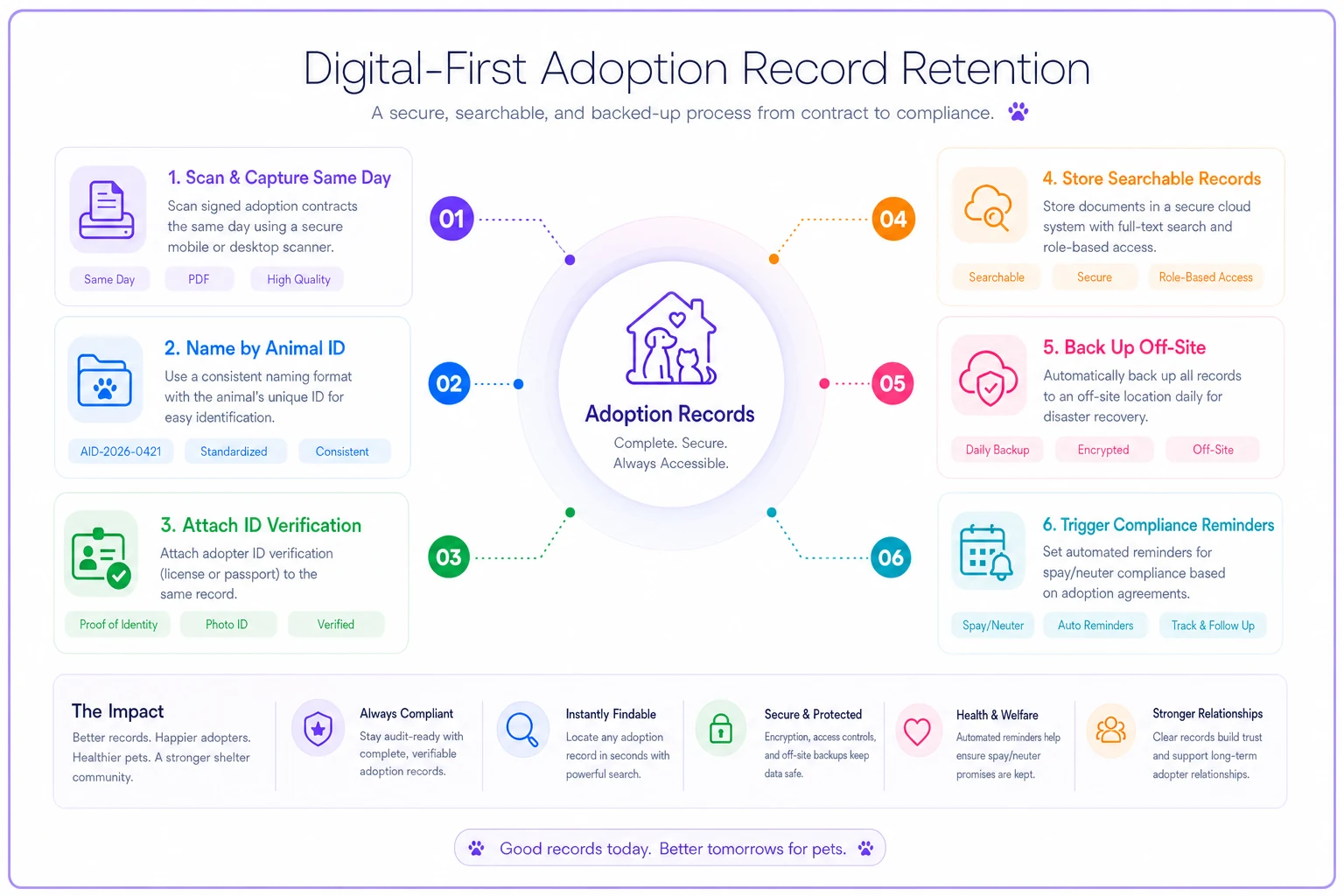
AI-powered operational software can help here by centralizing these records and automating follow-up reminders for things like spay/neuter compliance checks, so nothing falls through the cracks between the desk and the filing system.
A real scenario: the disclosure that wasn't recorded
A mid-size municipal shelter processing somewhere around 90–110 adoptions a month had a run of disputes over undisclosed behavior. Adopters kept returning dogs and claiming they were never told about known issues. The contracts were signed. The behavior notes existed — in a separate system.
When they pulled a sample of contested files, the pattern was consistent: the contract had no line acknowledging that behavior had been discussed. So even when staff had absolutely reviewed the bite history verbally, there was no record of it on the signed document. In a dispute, "we always tell people" isn't evidence. The signed initial is.
They made two changes. First, they added a single initialed line to the contract: "Behavior and medical notes reviewed with adopter." Second, they started scanning the signed contract the same day, filed by animal ID.
Over the next few months, formal disputes dropped noticeably — the return conversations still happened, but they no longer escalated into "you hid this from us," because the file answered the question immediately. Staff also reported the desk process got faster, not slower, because the initialed line replaced a vague habit of "I think I mentioned it" with a concrete step everyone did the same way.
The lesson wasn't a better contract. It was a contract that recorded what already happened.
When to keep it simple, and when not to
When a lean contract makes sense: small shelter, low adoption volume, standard adult animals, tight staff. Don't build a fifteen-field form you can't consistently complete. A short contract fully filled out beats a long one with blanks. The discretionary fields you skip are exactly the ones that lose disputes.
When you need the full apparatus: any shelter handling behavioral or medical special-needs placements, high volume, or a history of disputes. Once you've had even one adoption go legal, the cost of the extra witness signature and same-day scan looks tiny.
Who should not lean on "as-is" language: shelters that haven't nailed down their disclosure step. As-is without real disclosure isn't protection — it's a liability that looks like concealment. Fix disclosure first, add the clause second.
The through-line
Adoption disputes rarely turn on the quality of your legal language. They turn on whether the document can prove what happened at the desk — who signed, what was disclosed, that ID was checked, that the adopter acknowledged the terms — and whether you can find that document quickly enough for it to matter.
Get the contested fields right, tier your ID and witness checks so you're not slowing the floor for routine cases, explain the clauses that adopters push back on, and set up retention so an old contract is a lookup instead of a scavenger hunt. Do that, and most disputes end before they start — quietly, at the file, with an initial that says exactly what everyone needs to know.
Get the contested fields right, tier your ID and witness checks so you're not slowing the floor for routine cases, explain the clauses that adopters push back on, and set up retention so an old contract is a lookup instead of a scavenger hunt. Do that, and most disputes end before they start — quietly, at the file, with an initial that says exactly what everyone needs to know.
Ready to enhance your shelter’s impact?
Join 500+ shelters using Animlly to improve care coordination, increase adoptions, and engage communities effectively.