


Three weeks ago, a small shelter in Pennsylvania called me about their return rate problem. They'd just gotten their quarterly numbers—28% of adoptions coming back within 90 days. Not unusual, but what caught my attention was their follow-up "system": a sticky note on the adoption coordinator's monitor that said "check on new adoptions sometimes."
Why traditional follow-up fails (and costs you thousands)
Shelters try follow-up. Maybe a courtesy call after a week. Maybe an email if someone remembers. The problem is these random touchpoints miss the critical intervention windows where returns actually happen.
Returns cluster around specific timeframes. Days 3-7 when the initial adjustment stress peaks. Days 21-30 when behavioral issues surface. Days 60-75 when the novelty wears off and reality sets in. Miss these windows, and you're basically waiting for the animal to show back up at your door.
Each return costs roughly $400-600 in direct expenses—medical recheck, behavioral assessment, kennel space, staff time. A shelter processing 500 adoptions annually with a 25% return rate is burning through $50,000-75,000 just cycling animals back through the system. That's before counting the emotional toll on staff who watch the same animals bounce back repeatedly.
Returns don't schedule themselves conveniently. They show up during intake rushes, right before closing, during staff shortages. They disrupt workflow, delay new intakes, and create cascading bottlenecks throughout your operation.
Building your 30/60/90 framework from scratch
A staged follow-up system works because it anticipates problems before they become returns. Instead of reactive damage control, you're proactively supporting adopters through predictable friction points.
Streamline your shelter operations effortlessly.
Animlly helps you manage every pet, volunteer, and adoption step with ease and accuracy.
- Comprehensive pet profiles
- Volunteer scheduling & communication
- Adoption tracking & reporting
No credit card required
Your Day 3 contact isn't a welfare check—it's a structured touchpoint designed to catch immediate red flags. You're looking for eating issues, excessive hiding, aggression triggers, or complete household disruption. These early indicators predict roughly 40% of eventual returns if left unaddressed.
Your script needs to be diagnostic, not conversational. No small talk about the weather—you're extracting actionable data that tells you whether this adoption will survive or crash.
The Day 7 follow-up shifts focus to integration patterns. By now, acute stress should be diminishing. If it's not, you need intervention protocols. This call identifies animals stuck in fear responses or households struggling with basic management.
Day 14 targets routine establishment. Most successful adoptions show clear routine patterns by two weeks—feeding schedules, walking routes, sleeping arrangements. Adoptions without established routines by Day 14 have triple the return risk. Your 30-day checkpoint is where hidden incompatibilities surface. Allergies that took time to develop, conflicts with existing pets that escalated slowly, lifestyle mismatches that weren't obvious initially. Miss this window and these issues calcify into return decisions.
The 60-day follow-up catches behavior regression. Many adopters report everything going well initially, then sudden behavior changes around week 8. Without intervention, these often spiral into returns by day 75.
Your 90-day contact serves two purposes: catching late-stage issues and closing the intensive monitoring period. Adoptions stable at 90 days rarely return unless major life circumstances change.
Scripts that actually get results
Generic scripts produce generic responses. "Everything's fine" tells you nothing. You need scripts that extract specific, actionable information without feeling like an interrogation.
Day 3 Script: "Hi [Name], quick follow-up on [Pet Name]. Three specific things we track: eating status, primary location choice, and any unexpected behaviors. Takes 60 seconds—can you give me a quick update on those three?"
Day 7 Script: "[Name], checking our one-week markers for [Pet Name]. Is there a consistent feeding schedule established? Any concerning interactions with family members or other pets? Any house-training or litter box issues developing?"
Day 30 Script: "Hi [Name], this is our 30-day assessment call for [Pet Name]. We track four stability indicators: health concerns that have appeared, behavior changes from week one, household adjustment status, and any resource challenges—food, supplies, vet access. Can you update me on these four areas?"
Each script builds on previous data. You're not starting fresh each call—you're tracking progression or regression from established baselines. This lets you catch patterns that individual calls would miss.
Notice what's not in these scripts: "How are you?" or "How's everything going?" These open-ended questions waste time and generate useless responses.
Escalation triggers and response protocols
Not every issue requires the same response. You need clear escalation triggers that determine whether you offer advice, schedule intervention, or prepare for return.
Tier 1 Issues (Phone Support):
-
Mild food pickiness without complete refusal
-
Normal adjustment anxiety (hiding first day only)
-
Minor house-training accidents (fewer than 3 daily)
-
Basic training questions about commands or leash walking
Response: Email resources, schedule follow-up in 3 days
Tier 2 Issues (Active Intervention):
-
Not eating for 48+ hours straight
-
Excessive hiding beyond day 5 with no improvement
-
Snap reactions without actual bite contact
-
Destruction when alone that escalates daily
Response: Behavior specialist consultation within 24 hours, daily check-ins until resolved
Tier 3 Issues (Immediate Action):
-
Bite incident with any injury requiring medical attention
-
Severe resource guarding preventing normal household function
-
Attempting to escape repeatedly despite secure environment
-
Complete household shutdown where animal won't interact at all
Response: Same-day intervention, possible temporary return for assessment
Document every escalation in your operational platform. Pattern recognition across multiple adoptions reveals systemic issues—maybe certain dog breeds need different prep, or cat adoptions require modified timelines.
Each escalation should trigger automatic follow-up scheduling. A Tier 2 issue resolved doesn't mean you're done—it means increased monitoring for the next two weeks to prevent regression.
Partner referrals that prevent returns
Most returns happen because adopters don't know where to turn for help. Build your referral network before you need it, not during crisis calls.
Map out local resources systematically:
Behavior Support:
| Service Type | Contact | Cost Range | Typical Timeline |
|---|---|---|---|
| Basic obedience trainers | 3-5 certified options | $80-150 for group classes | 6-8 week programs |
| Fear/anxiety specialists | 2-3 behavior consultants | $100-200 per session | 2-4 sessions typical |
| Aggression specialists | 1-2 certified professionals | $150-300 per assessment | Same week availability |
| Virtual consultations | Online behavior platforms | $50-100 per session | 24-48 hour response |
Medical Issues:
| Service Type | Contact | Cost Range | Notes |
|---|---|---|---|
| Low-cost clinics | 3-4 local options | $40-80 basic exam | Limited appointment availability |
| Payment plan veterinarians | 2-3 full-service vets | Standard rates with financing | Credit check required |
| Emergency care facilities | 24-hour animal hospitals | $200-400 emergency fee | After-hours only |
| Breed-specific specialists | Referral network | Variable | For genetic conditions |
Don't just list these—establish relationships. When you call a trainer with a referral, they should know your shelter's adoption process, typical animal profiles, and return policies. This creates seamless handoffs instead of cold referrals.
Create referral tracking in your system. Which trainers actually prevent returns? Which vets do adopters follow through with? This data shapes future partnerships and recommendations. You might discover that expensive specialists have worse follow-through than accessible group classes.
Measuring what matters: return reduction metrics
Overall return rate tells you nothing actionable. You need granular data on when, why, and which animals return.
Track returns by timeline, primary reason category, intervention attempted (if any), and follow-up compliance rate. A 25% return rate where 80% happen in days 1-7 requires different solutions than the same rate spread evenly across 90 days. The first suggests inadequate adoption counseling; the second indicates missing support structures.
Set realistic targets. A shelter implementing structured follow-up typically sees 15-20% return reduction in first 90 days, 30-40% reduction by month six, and 50% reduction achievable within one year. But only if you maintain protocol compliance above 85%. Sporadic follow-up produces sporadic results.
Monitor intervention success rates separately. If your Day 3 calls identify issues but referrals don't prevent eventual returns, your partner network needs work. If adopters report problems but don't follow referral advice, your recommendations might be unrealistic or poorly targeted.
The automation advantage (without losing the human touch)
Manual follow-up systems fail because they rely on human memory during chaotic operations. Sarah's supposed to call five Day-7 adopters, but she's covering intake because Tom called in sick. Those calls don't happen. Returns spike next week.
AI-powered operational software changes this by ensuring contact actually happens. Not replacing human interaction—automating the scheduling and tracking that makes human interaction possible. The platform tracks adoption dates, schedules follow-ups automatically, sends scripts to staff phones, and escalates non-responses.
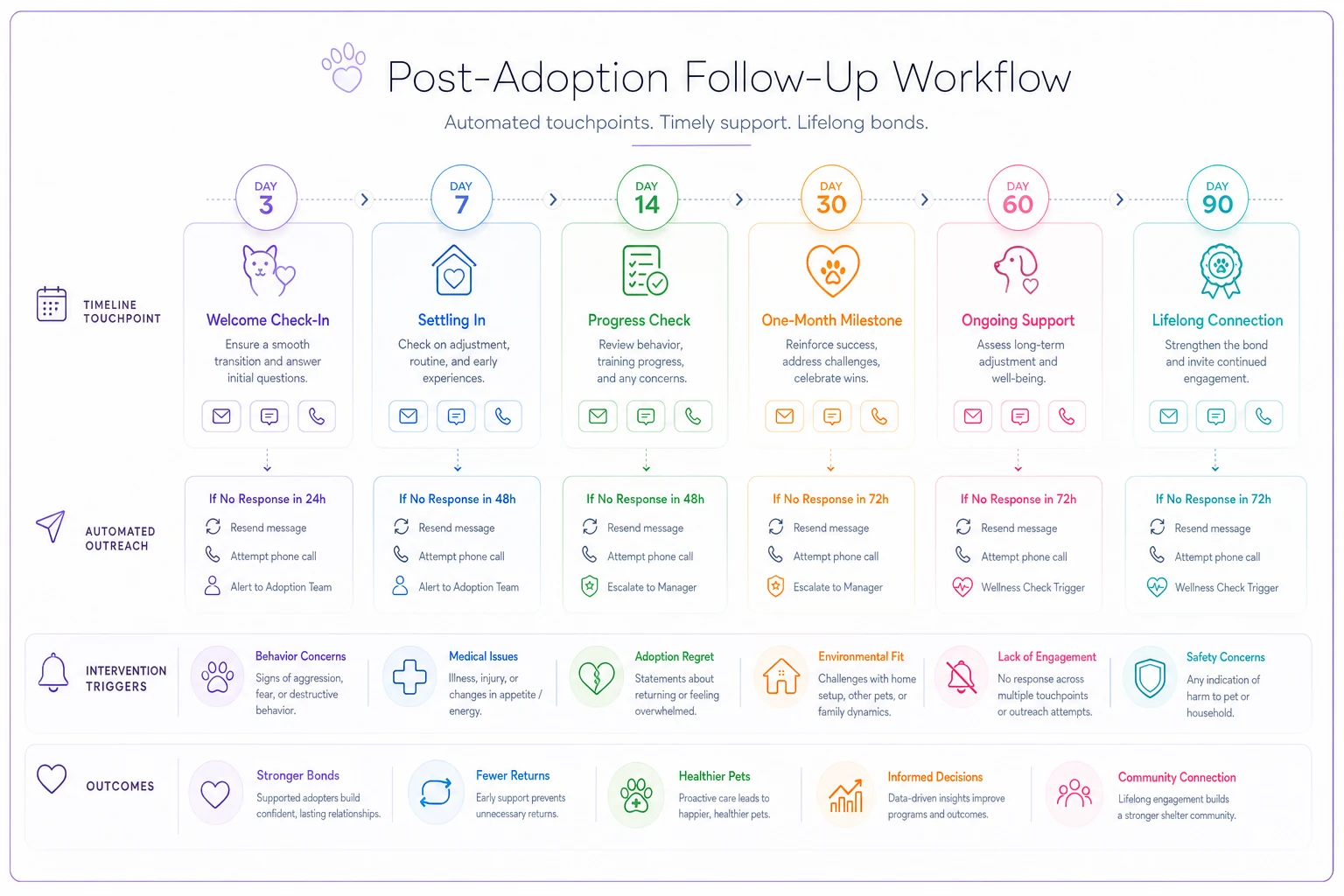
Your Day 3 calls trigger automatically. No response? The system schedules a Day 4 retry. Still nothing? It escalates to email and text, then flags for manual intervention by Day 5. No adopted animal falls through cracks because someone forgot to check the spreadsheet.
The system handles administrative burden that makes follow-up unsustainable. Conversation notes auto-populate. Referral contacts integrate directly. Return risk scores calculate based on response patterns. Staff spend time talking to adopters, not updating seven different tracking sheets.
Pattern recognition capabilities identify trends humans miss. Maybe orange cats adopted on Tuesdays have higher return rates (sounds ridiculous, but data reveals surprising correlations). Or perhaps adoptions processed by certain staff members consistently struggle at the 30-day mark, indicating training needs.
[GRAPH: Post-Adoption Follow-Up Workflow Timeline - Shows automated touchpoints at Days 3, 7, 14, 30, 60, and 90 with escalation paths and intervention triggers at each stage]
Pattern recognition capabilities identify trends humans miss. Maybe orange cats adopted on Tuesdays have higher return rates (sounds ridiculous, but data reveals surprising correlations). Or perhaps adoptions processed by certain staff members consistently struggle at the 30-day mark, indicating training needs.
Implementation roadmap for resource-strapped shelters
Starting a comprehensive follow-up program feels overwhelming when you're already understaffed. Incremental implementation with quick wins builds momentum.
Week 1-2: Framework Design
-
Choose your contact points (start with just 3, 30, and 60 days if resources are tight)
-
Write initial scripts focusing on specific behavioral markers
-
Assign primary responsibility to specific staff member
-
Create basic tracking method (even paper works initially)
Week 3-4: Pilot Testing
-
Run pilot with 10-15 adoptions only
-
Focus on script refinement and timing adjustments
-
Document what works and what creates confusion
-
Adjust escalation triggers based on real responses
Week 5-8: Scaling
-
Scale to 50% of adoptions to reveal operational friction points
-
Identify when calls bunch up and create scheduling conflicts
-
Test which scripts need work under real-world conditions
-
Refine escalation protocols when they break down
Week 9-12: Full Implementation
-
Launch with all adoptions once systems are proven
-
Monitor compliance rates and adjust staffing as needed
-
Track return reduction and celebrate early wins
-
Build long-term sustainability protocols
Don't try to launch perfectly on day one. Start messy, iterate quickly, and build sustainability gradually. A basic follow-up system running consistently beats an elaborate program that collapses after two weeks because it's too complex to maintain.
Troubleshooting common implementation failures
Every shelter hits the same roadblocks implementing follow-up programs. Most aren't motivation problems—they're workflow problems.
"Staff don't make the calls" Follow-up calls competing with intake emergencies always lose. Solution: Dedicated follow-up time blocks, not "when you get a chance." Tuesday and Thursday, 9-10 AM, no exceptions. Treat these like mandatory meetings.
"Adopters don't answer" Traditional shelter hours mean calling when people work. Evening follow-up shifts, text-first contact for initial touchpoints, or weekend follow-up blocks solve this. Consider that many adopters prefer texts over calls now.
"We can't track everything" Perfect tracking is impossible without proper tools. Focus on capturing return prevention successes rather than comprehensive data collection. Every prevented return justifies program investment, even if your tracking is basic.
"It doesn't reduce returns" Usually means inconsistent implementation or wrong intervention timing. Audit your actual follow-up completion rate—it's probably under 50%. Fix compliance before declaring failure. Also check if your escalation triggers are actually triggering interventions.
Building long-term sustainability
A follow-up program that depends on one dedicated person fails the moment they take vacation. Cross-train at least three staff members on follow-up protocols. Rotate responsibility weekly to prevent burnout. Document everything—scripts, escalation triggers, referral contacts—in a central operational guide.
Create feedback loops between follow-up data and adoption counseling. If Day 3 calls consistently reveal food transition issues, modify your adoption packet information. If Day 30 calls show integration problems with existing pets, strengthen your meet-and-greet protocols.
Follow-up programs typically cost $15-25 per adoption when fully loaded with staff time. But preventing just one in four returns saves $100-150 per adoption. The math works strongly in favor of structured follow-up, even accounting for staff time.
Consider volunteer integration for lower-tier touchpoints. Volunteers can handle Day 60 and 90 "wellness checks" while staff focus on early intervention calls. But maintain quality control—one bad volunteer interaction can destroy adoption relationships you've spent weeks building.
Real adoption outcomes: what 90 days of structured follow-up actually achieves
A mid-sized shelter in Ohio started tracking outcomes after implementing their staged protocol. Processing around 600 adoptions yearly, they saw their return rate drop from 31% to 19% within four months.
What's interesting wasn't just fewer returns. They discovered that 70% of their "crisis calls" happened between days 4-8, exactly when their old system had no contact scheduled. By inserting a Day 5 check-in, they caught issues while they were still manageable—house training confusion, food transition problems, minor anxiety behaviors.
The financial impact was immediate. Fewer returns meant roughly $65,000 less spent on re-processing animals annually. But they also saw unexpected benefits. Adoption counselors reported less emotional burnout when animals stayed in homes. Kennel space opened up for new intakes instead of cycling returns.
The data revealed patterns that surprised them. Cat returns clustered around Day 12-15, often related to litter box issues that escalated quickly. Dogs returned most often at Day 25-30, usually behavior problems that emerged after the initial honeymoon period. Armed with this data, they adjusted their intervention timing and saw another 8% reduction in returns.
Staff morale improved when they saw their work actually keeping animals in homes instead of just processing them through revolving doors. Volunteers became more engaged when they could see measurable impact from their efforts.
Getting started this week
Start with these three concrete steps:
First, analyze your last 30 returns. Document exact return dates post-adoption and stated reasons. You'll likely find clear patterns that inform your initial follow-up schedule. Don't assume you know where problems cluster—the data often surprises shelters.
Second, draft your Day 3 and Day 30 scripts. Keep them under 90 seconds, focus on specific behavioral markers, and include clear escalation triggers. Test them on your next five adoptions and refine based on actual responses.
Third, assign follow-up responsibility explicitly. Not "whoever has time"—name the person, block the time, and track completion. Even 15 minutes daily for follow-up calls can prevent multiple returns weekly.
The difference between shelters with sustainable low return rates and those constantly cycling animals isn't resources or staff size. It's whether they treat post-adoption support as an operational priority rather than an optional courtesy when time allows. Your return rate directly impacts every other shelter metric—capacity, staff morale, budget efficiency, community reputation. A structured post-adoption follow-up program isn't just about helping individual animals succeed. It's about transforming your entire operational efficiency.
Ready to enhance your shelter’s impact?
Join 500+ shelters using Animlly to improve care coordination, increase adoptions, and engage communities effectively.