


Most shelter managers think their adoption problem happens at the meet-and-greet stage. The real bottleneck starts the moment an animal comes through intake and compounds through every handoff, data entry, and medical check, leaving adoptable animals sitting while kennels overflow.
I mapped workflows at a mid-sized municipal shelter taking ~180 animals monthly and found seventeen choke points. Fixing four of them increased adoptions by 40% in six weeks. Many shelters run on outdated, patched workflows that create invisible barriers between animals and homes.
Why traditional shelter workflows break at exactly 150 animals
Below ~150 monthly intakes, institutional memory and manual coordination can paper over gaps. Above that threshold, missing processes become obvious: coordinators can't track every case, clearances get lost between shifts, and adopters see animals that aren't actually ready.
The real damage happens in the 'shadow workflow'—all unofficial processes staff create to work around broken systems (texts, notebooks, multiple chat groups). These feel like solutions but are symptom of a broken intake-to-adoption workflow. One Arizona shelter used nine unofficial channels and had a 70% deviation from official SOPs.
Mapping your actual workflow (not the one in your manual)
Start with observation. Pick a sample of recent animals and trace each one's journey from intake to adoption or outcome. Document every touchpoint, form, person, and system where data lives—you want to surface hidden wait time, wasted steps, and handoff failures.
Streamline your shelter operations effortlessly.
Animlly helps you manage every pet, volunteer, and adoption step with ease and accuracy.
- Comprehensive pet profiles
- Volunteer scheduling & communication
- Adoption tracking & reporting
No credit card required
-
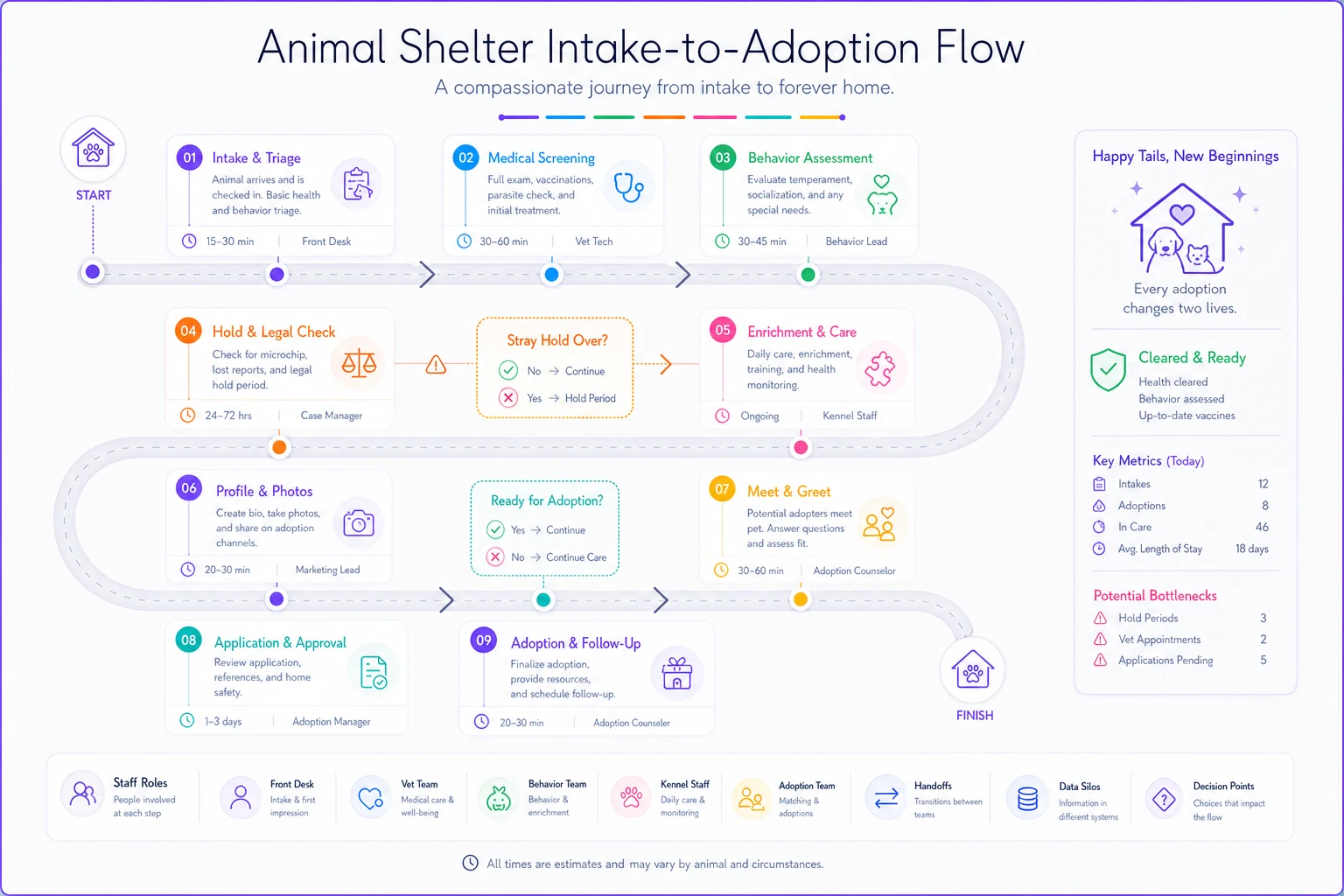
Handoff delays — where paperwork or decisions wait for the next person
-
Data silos — where the same fact is recorded in multiple unconnected systems
-
Decision bottlenecks — stages that stop until a specific person signs off
Downloadable measurement asset — ready-to-use CSV (T0–T7)
Download the Small‑Shelter Timestamp Log & PDSA checklist
-
animal_id — unique local ID for the animal (string)
-
intakedatetime_utc — ISO 8601 timestamp (YYYY-MM-DDTHH
MM:SSZ) for intake; store in UTC
-
intake_timezone — local timezone name or offset (e.g., America/Chicago or -05
00)
-
T0arrivalaccepted — ISO 8601 when animal accepted into care
-
T1intakecomplete — ISO 8601 when intake paperwork & ID completed
-
T2medicaltriage_start — ISO 8601 when medical triage begins
-
T3medicalcleared — ISO 8601 when medically cleared for adoption (or MISSING)
-
T4behaviorassessed — ISO 8601 when basic behavior check/notes are posted
-
T5clearedfor_listing — ISO 8601 when photo/listing is posted
-
T6firstinquiry — ISO 8601 of first adopter contact or inquiry
-
T7adoptioncompleted — ISO 8601 when animal leaves shelter (adopt/transfer)
-
recordedby — role or initials of who logged the row (e.g., intakestaff, vet_tech)
-
notes — short reason for delay or other context (free text)
Timezone & missed-timestamp rules: store timestamps in ISO 8601 and include intaketimezone so imports can be validated. If a timestamp is unavailable, enter MISSING and, if needed, add an estimated timestamp in a parallel field suffixed EST and note the reason in notes.
Assign ownership for each timestamp: intake staff record T0–T1, medical records T2–T3, behavior/adoption staff T4–T7. For clinical or regulatory questions, consult your veterinary lead or local regulator and see our minimum intake dataset for recommended fields Stop missing intake fields.
-
Handoff delays — paperwork or information waiting for the next person
-
Data silos — the same information entered in multiple unconnected places
-
Decision bottlenecks — stages that stop until a specific person makes a call
The four bottlenecks that destroy 80% of adoption efficiency
Across dozens of shelters, four bottlenecks consistently account for most lost adoption velocity. They are small, common, and fixable—but each directly reduces online visibility or delays movement to the adoption floor.
Bottleneck 1: The intake photo delay — Animals without photos are invisible to most adopters. Taking smartphone intake photos immediately (then improving later) cut one facility's average length of stay by five days.
Bottleneck 2: The medical clearance void — Medical clearances often don't reach adoption teams. A visual flag system (green card for cleared animals) eliminated multi-day checking delays at one shelter.
Bottleneck 3: The foster coordination mess — Poor coordination loses placements. Delays or missed notifications cause shelters to lose ~30% of foster matches to timing and communication failures.
Bottleneck 4: The behavioral assessment backlog — Limited assessors create queues. Tiered assessments (basic checks any trained staff can do, detailed assessments only for flagged animals) reduced backlogs by ~60% in several shelters.
Building your bottleneck identification matrix
Track three metrics for every stage to prioritize fixes: wait time, touch points, and downstream impact. Score each factor on a 1–10 anchor scale and calculate a priority score to rank stages for improvement.
-
Wait time — active plus idle time at the stage
-
Touch points — number of people or systems interacting with the stage
-
Downstream impact — how many later stages are affected if this stage delays
| Workflow Stage | Average Wait Time | Touch Points | Downstream Impact | Priority Score |
|---|---|---|---|---|
| Intake processing | 35 min active + 2 hr wait | 3 people, 2 systems | Delays medical exam scheduling | 7 |
| Medical exam | 20 min active + 18 hr wait | 2 people, 3 systems | Holds adoption placement | 9 |
| Photo upload | 5 min active + 72 hr wait | 2 people, 1 system | Prevents online visibility | 10 |
| Behavior assessment | 30 min active + 4 day wait | 1 person, 1 system | Blocks adoption floor placement | 8 |
Priority score formula: Priority = (Wait time impact × Touch points × Downstream impact) ÷ 10. Use 1–10 anchors for each factor so scores remain comparable across stages and pilot runs.
Worked example (synthetic): Medical exam assumptions → Wait impact = 8, Touch points = 6, Downstream impact = 9. Calculation: (8 × 6 × 9) ÷ 10 = 43.2 → numeric score 43. Use these numeric scores comparatively to rank bottlenecks.
Creating SOPs that actually prevent bottlenecks
Real SOPs must reflect chaos, not ideal conditions. Design for the 80% common cases, allow parallel tasks, specify exact handoff mechanics, and include short verification checkpoints to catch missing steps before they cascade.
-
The 80% rule — handle the common cases and keep clear escalation for exceptions
-
Parallel processing — enable simultaneous tasks while waiting for long steps
-
Clear handoff protocols — specify the visible artifact and system update required
-
Built-in catch points — short checks that verify critical steps before moving on
The change control checklist that prevents implementation failure
Even good SOPs fail without a phased rollout and measurement. Use shadow testing, partial implementation, a controlled full rollout, then optimization with ongoing measurement and staff feedback.
Phase 1: Shadow Testing (Week 1–2) — Run the new workflow in parallel with the old, document deviations, and avoid pressuring staff to be perfect.
Phase 2: Partial Implementation (Week 3–4) — Apply the workflow to a subset (e.g., cats or owner surrenders), assign champions per shift, and hold daily 5-minute debriefs to adapt SOPs.
Phase 3: Full Rollout with Escape Valves (Week 5–6) — Implement across all animals, keep the old workflow as backup for overwhelming days, and review weekly metrics on bottleneck reduction.
Phase 4: Optimization (Week 7+) — Remove the old workflow, conduct monthly metric reviews, update SOPs quarterly, and celebrate public wins to build buy-in.
Measuring what matters: KPIs for workflow optimization
Replace feel-good metrics with operational KPIs that show workflow health and where to focus improvement effort.
-
Intake to availability time — true workflow efficiency from arrival to adoptable status
-
Stage completion rate — percent of animals completing a stage within target time
-
Handoff success rate — percent of correct first-time transfers between teams
-
Shadow workflow indicators — counts of texts, sticky notes, and off-channel coordination
When workflow automation makes sense (and when it makes things worse)
Automate only stable, proven processes. Automating a broken workflow only speeds failures. Fix the process first, then automate the fixed version.
Sweet spots for automation: auto-generating adoption packets, auto-scheduling medical appointments, and connecting intake data to medical and behavior records. Start small—automated status updates for clearance and foster confirmations deliver big wins with minimal change.
Common implementation failures and how to avoid them
-
Hero dependency — avoid single-person ownership of the change
-
Perfect system trap — start with 70% solutions and iterate
-
Technology-first approach — map workflows before buying software
-
All-or-nothing rollout — phase changes to maintain operational stability
-
Measurement desert — track data to prove improvements and maintain funding
Your 30-day bottleneck elimination plan
-
Week 1
Observation and mapping — track 10 animals and build the bottleneck matrix
-
Week 2
Quick wins — fix one bottleneck that needs no new SOPs and measure impact
-
Week 3
SOP development — draft procedures for your top priority and test with a flexible team
-
Week 4
Gradual expansion — roll to all teams, monitor metrics daily, and document lessons
After 30 days you should see measurable improvement in at least one major bottleneck; use that success to build momentum for the next cycle.
The compound effect of incremental improvements
Small improvements compound across stages. A 10% speedup in intake cascades through medical and adoption placement, magnifying overall impact. Consistent weekly elimination of small bottlenecks delivers far more capacity than occasional big changes.
Your intake-to-adoption workflow doesn't need to be perfect—just 10% better next month than today. Stack enough 10% gains and you'll transform life-saving capacity without adding kennels or staff.
Start with observation, identify your biggest bottleneck, fix it, then repeat. The animals in your care can't wait for perfect solutions—implement incremental improvements tomorrow and save more lives.
Ready to enhance your shelter’s impact?
Join 500+ shelters using Animlly to improve care coordination, increase adoptions, and engage communities effectively.