


Most shelters handle lost pet reports wrong from minute one. Not because staff don't care, but because the standard intake process treats every scared animal like they're abandoned instead of just temporarily separated from their family.
The gap between when someone reports their pet missing and when shelter staff actually check against incoming animals can stretch to 48-72 hours. Meanwhile, that "stray" golden retriever who arrived yesterday morning? Already moved through medical intake, behavioral assessment, and onto the adoption floor because nobody connected the dots between Tuesday's frantic voicemail and Wednesday's intake form.
The three-system problem that breaks reunification
You've got lost reports coming through at least four channels: website forms, Facebook messages, phone calls, and walk-ins. Each lands in a different place. Website forms dump into an email folder that gets checked twice a week. Facebook messages sit unread because the volunteer who manages social media only works Saturdays. Phone calls get scribbled on sticky notes that may or may not make it to the intake coordinator's desk.
Animal control brings in 60% of your strays, but they're using their own database that doesn't talk to yours. The local vet clinics who scan chips? They email you, sometimes. Neighborhood watch groups post on their own Facebook pages. By the time all these reports filter through to the right person, that scared husky has already been adopted out to a new family.
The coordination templates most shelters use — if they use any — are Word documents from 2015 that nobody updates. Partner scripts don't exist. Intake flags consist of highlighting cells in a spreadsheet that three different people maintain three different versions of.
What actually happens during intake chaos
Tuesday afternoon: Maria's beagle Pepper escapes through a broken fence. She calls animal control, posts on Facebook, and fills out your website's lost pet form.
Wednesday morning: Animal control picks up a beagle four blocks away and brings him to your shelter at 11 AM. The intake volunteer, rushing through seven new arrivals before lunch, logs him as "stray beagle, no collar, friendly" and moves on.
Thursday: Maria calls again. The front desk volunteer promises to check but gets pulled into helping with adoptions. The note gets passed to intake.
Friday: Intake finally cross-references and realizes the beagle from Wednesday matches Maria's description. But Pepper's already been neutered (he wasn't before), given all his shots, and there's a family coming at 2 PM to adopt him.
This happens roughly 30-40 times a month in mid-size municipal shelters. Smaller rescues see it 8-10 times. The pattern never changes: multiple data entry points, zero real-time coordination, and a lost pet reunification workflow that exists mostly in theory.
Building intake flags that actually work
Forget color-coding spreadsheets. Real intake flags need to trigger immediate action across every system and partner.
Streamline your shelter operations effortlessly.
Animlly helps you manage every pet, volunteer, and adoption step with ease and accuracy.
- Comprehensive pet profiles
- Volunteer scheduling & communication
- Adoption tracking & reporting
No credit card required
Start with location-based matching. When animal control picks up a pet in zip code 78704, that should automatically flag against any lost reports from a 3-mile radius in the past 72 hours. Not next week when someone remembers to check — immediately.
-
Unique markings (white chest star, black tail tip, one blue eye)
-
Approximate weight ranges (not just small/medium/large)
-
Behavioral quirks mentioned by owners (only responds to Spanish commands, afraid of men in hats)
-
Medical conditions (limps on back left leg, needs daily medication)
Create time-sensitive escalation. A lost report for a diabetic cat needs different handling than a healthy young lab. Your flags should automatically escalate medical cases to shift leads within 2 hours, not wait for the weekly lost-and-found review.
The municipal shelter in Austin started using a three-tier flag system:
| Flag Level | Criteria | Response Time |
|---|---|---|
| Red | Medical urgency or reported from within 1 mile | Check immediately |
| Yellow | Match on 3+ characteristics | Check within 4 hours |
| Green | Possible match on breed/color | Check within 24 hours |
Their reunion rate jumped from around 35% to nearly 60% in four months. Not because they got better at finding pets, but because they got faster at connecting the dots.
Partner notification scripts that eliminate confusion
Your animal control officers, vet clinics, and rescue partners need exact language, not suggestions. Generic "please check for missing pets" emails get ignored. Specific, actionable scripts get results.
For animal control at pickup:
"We're transporting a [specific description] found at [exact location]. Please check active lost reports for: [list 3 key identifiers]. Intake scheduled for [time]. Priority flag if match found."
For vet clinics scanning chips:
"Chip #[number] scanned at [time]. Pet description: [details]. Owner info shows [what the chip says]. If this doesn't match, immediately check: [your database URL/phone]. Hold animal for 2 hours pending verification."
For social media groups:
"FOUND PET ALERT - Please share only this information: [breed/color/size], found [location], [date/time]. Do NOT post photos yet (prevents false claims). Direct all responses to: [single point of contact]. Case #[number] for reference."
These scripts give specific actions, clear timelines, and single points of contact. No interpretation needed.
The problem with most partner communication is that everyone thinks they're helping by adding information. Your animal control officer mentions the dog seemed friendly. The vet clinic adds that he looked well-fed. The Facebook group moderator shares that someone thought they saw him last week. By the time this telephone game reaches you, the actual facts are buried under speculation.
Municipal coordination templates beyond email chains
Email threads with 47 replies don't reunite pets. You need structured coordination that moves information, not just shares it.
Build a single intake coordination form that every partner uses:
-
Date/time found (not when reported, when physically found)
-
Exact location (GPS coordinates or specific address, not "near the park")
-
Intake pathway (who has the animal right now)
-
Physical holder location (which vet, which officer's truck, which good Samaritan's garage)
-
Hold deadline (when they need you to take possession)
-
Special circumstances (injured, aggressive, with other animals)
Create a 48-hour countdown template. From the moment a pet enters any part of your network:
-
Hour 0-2
Photo uploaded, initial database check
-
Hour 2-6
Expanded radius search, partner notification sent
-
Hour 6-12
Social media post with case number (not photo yet)
-
Hour 12-24
Photo released to verified lost pet groups
-
Hour 24-48
Expanded geographic search, breed-specific rescue notification
The countdown creates urgency. Staff know exactly what should happen when, instead of "whenever someone gets to it."
One Georgia shelter created laminated cards for every partner vehicle with this countdown and their intake hotline. Simple, but animal control started calling immediately instead of waiting until end of shift. Their hold-to-intake time dropped from 6 hours average to under 2. The structured approach eliminated the guesswork that typically delays reunification efforts.
The owner verification process everyone skips
About 15% of "found pet" claims are from people who just want a free dog. Your verification process can't be "sounds about right."
-
Photo identification (but accept that scared pets photograph differently)
-
Unique knowledge (what command makes them sit, what treat they refuse)
-
Vet records (even partial ones help)
-
Home environment proof (photos showing pet beds, toys, feeding area)
When someone can't provide traditional proof, use behavioral verification. Have them demonstrate the pet's response to their voice through a door first, before visual contact. Real owners trigger immediate recognition — ears up, tail wagging, vocalization. False claimants get polite interest at best.
Tracking what works: reunion metrics that matter
Stop measuring just reunion percentage. That tells you nothing about where your process breaks.
-
Lost report to intake match time (how fast you connect the dots)
-
Partner notification to response rate (who actually checks your alerts)
-
Geographic accuracy (how often pets are found near where reported)
-
Verification failure rate (false claims caught)
-
Post-reunion returns (did you match the right pet to the right owner)
A shelter I visited last month in Denver discovered their biggest reunion barrier wasn't identification — it was timing. They reunited 70% of pets where the lost report came in before intake, but only 20% where intake happened first. That one insight changed how they prioritized incoming reports.
When intake flags create more problems
Not every shelter should implement complex flagging systems. If you're processing fewer than 20 intakes weekly, elaborate workflows might slow you down rather than speed reunions.
Small rescues often do better with a single person owning the entire lost-and-found process rather than distributed flags. One person who knows every animal, every report, every partner contact — that beats sophisticated systems when volume is low.
If you're processing fewer than 20 intakes weekly, try assigning one person to own the lost-and-found process before building complex flags.
Rural shelters covering huge geographic areas need different approaches. A flag for "within 1 mile" means nothing when pets travel 20 miles of farmland. These shelters need date-based rather than distance-based matching.
The worst mistake is implementing partner notification scripts without training partners first. Sending structured templates to organizations that don't understand why they matter just creates confusion. Start with one willing partner, prove the system works, then expand.
The tech integration that changes everything
Manual cross-referencing between lost reports and intake forms is where most reunification efforts die. Even the most dedicated intake coordinator can't instantly match every scared tabby against 47 active lost cat reports while processing new arrivals every hour.
A quick visual can help teams understand the flow from intake to match to partner notification.
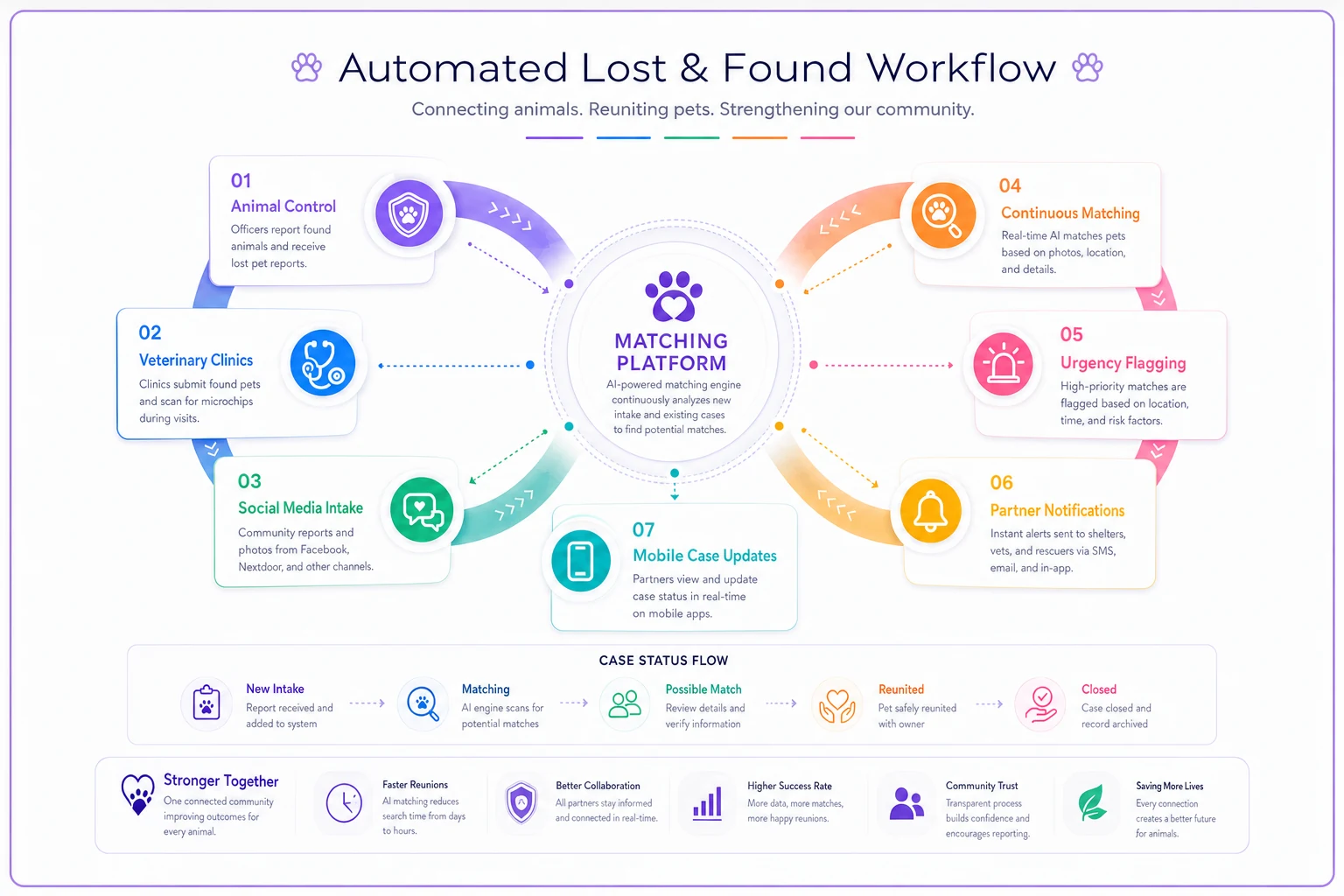
AI-powered operational software transforms the lost pet reunification workflow. Instead of staff manually comparing descriptions, automated matching runs continuously against every new entry. When animal control uploads a "found brown pit mix near downtown," the system instantly flags three possible matches from lost reports, ranked by proximity and description similarity.
The coordination between partners becomes seamless when everyone works from the same platform. Animal control sees pending lost reports on their mobile intake app. Vet clinics get automatic alerts when they scan a chip that matches an active case. Social media volunteers receive pre-approved posts with correct case numbers and verified photos. No more email chains, no more sticky notes, no more "I thought someone else checked that."
What typically takes 48-72 hours of manual checking happens in minutes. Staff spend time actually reuniting pets instead of juggling spreadsheets and phone calls.
Starting your reunification overhaul
Don't rebuild everything at once. Pick your highest-volume intake source and fix that workflow first. If animal control brings in 60% of your strays, start there. Create their scripts, test their flags, measure their results. Get one pathway working smoothly before adding complexity.
Build templates gradually. Week one: create the basic intake coordination form. Week two: add partner scripts for your top three partners. Week three: implement time-based flags. Small improvements compound faster than massive overhauls that overwhelm everyone.
Track reunion stories, not just statistics. When Maria gets Pepper back because your new location flag caught the match in 30 minutes instead of 3 days, that story motivates staff more than any metric dashboard. The shelters seeing 60%+ reunion rates didn't get there through complicated technology or massive budgets. They got there by treating every intake as potentially lost, not presumed abandoned. By creating clear communication channels instead of hoping partners figure it out. By building workflows that assume pets have families looking for them.
Your lost pet reunification workflow shouldn't be an afterthought tagged onto intake processing. It should be the first consideration, the default assumption, the priority that drives how you handle every scared animal who comes through your door. Because somewhere, there's a kid crying themselves to sleep, missing their best friend who's sitting in your kennel, waiting for someone to connect the dots.
Ready to enhance your shelter’s impact?
Join 500+ shelters using Animlly to improve care coordination, increase adoptions, and engage communities effectively.