

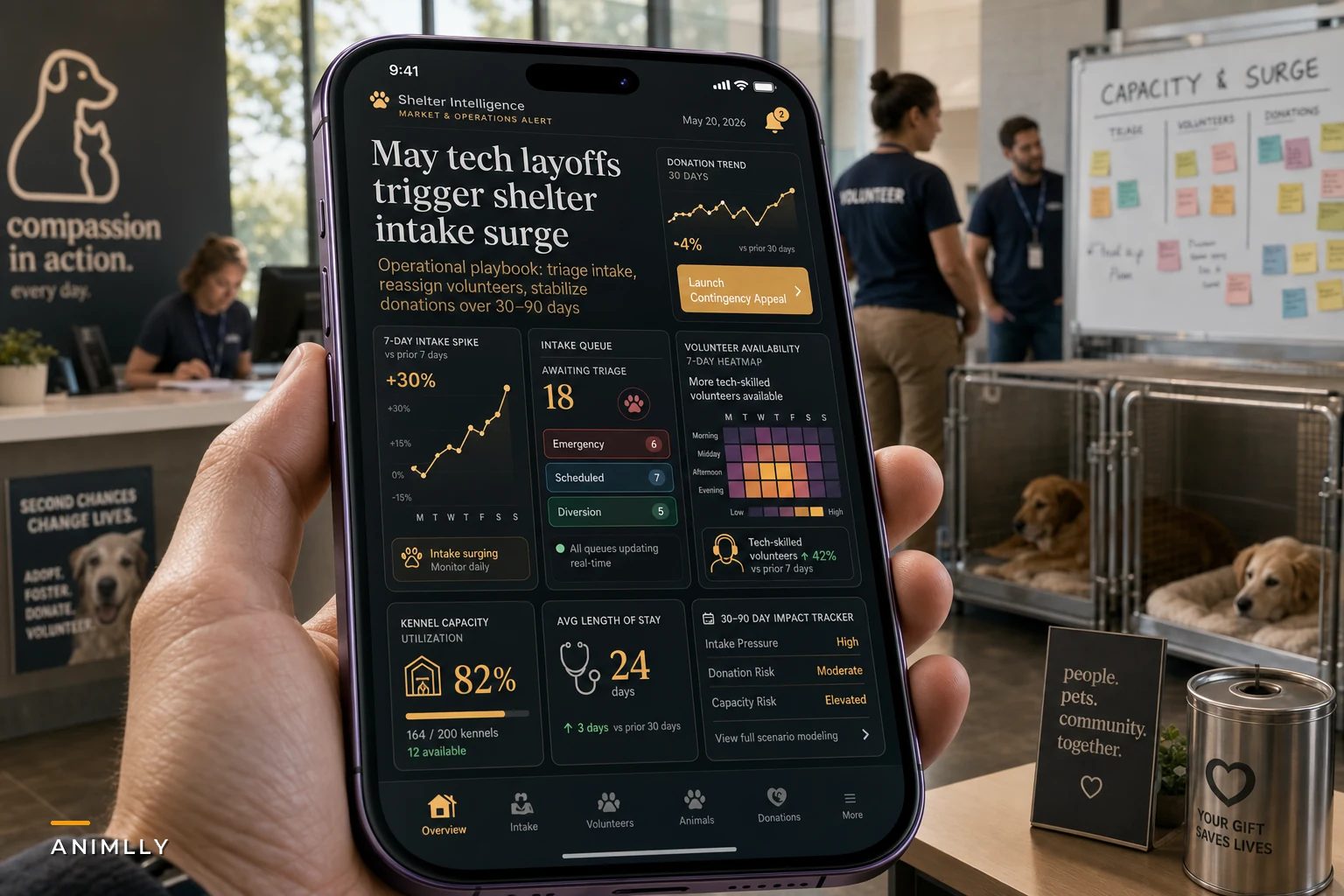

The conversation around shelter capacity planning changed last week. Meta dropped another 8,000 employees, part of the broader wave hitting tech companies as they restructure around AI capabilities. According to CNBC, these cuts started mid-May, concentrated in California, Texas, and Washington — places where shelters already run close to capacity.
The signs are showing up already. More owner surrender calls asking about waitlists. Monthly donations from tech workers drying up. Professionals appearing for weekday volunteer shifts, laptop bags still in their cars from cleaning out their desks.
This goes beyond tech workers losing jobs. When major employers cut thousands of positions at once, everything shifts fast. Landlords lose tenants. Local businesses see revenue drop. Charitable giving patterns change overnight. Shelters — already stretched thin — absorb both increased intake pressure and unstable funding.
The three-wave impact pattern hitting shelters right now
Economic disruptions don't slam shelters all at once. They come in waves, each with different operational challenges.
Wave One (Weeks 1-4): The donation freeze
Corporate matching programs stop first. You'll see this in your tracking before anything else changes. Companies laying off workers freeze charitable programs immediately. That monthly $500 match from the local software company? Gone. The quarterly supply drive their employees ran? Cancelled.
An Austin shelter coordinator told me their corporate donations dropped 40% within two weeks of Dell's February cuts. Not because people stopped caring — companies just paused everything non-essential during restructuring.
Wave Two (Weeks 3-8): The volunteer surge
This part gets odd. Your volunteer availability actually improves temporarily. Marketing directors want to redesign your website. Data analysts offer to clean up your donor database. Project managers pitch streamlining your intake process.
The problem? These aren't regular volunteers. They're stressed, dealing with their own crisis, and often overcommit then disappear when job hunting gets intense. Plus they're used to corporate environments with different communication styles.
Wave Three (Weeks 6-12): The intake avalanche
Owner surrenders spike around week six. Not immediately — people try everything else first. They move in with family, negotiate with landlords, max out credit cards. When unemployment benefits delay or savings run out, pets become impossible to keep.
The math is harsh. Someone making $120k at Meta who gets laid off still owes $3,400 monthly rent in San Jose. Even with severance, the timeline to financial crisis happens faster than most realize. Bloomberg's analysis shows these AI-driven layoffs hit mid-career professionals hardest — exactly the people most likely to have multiple pets and expensive housing.
Building surge capacity without burning out staff
Most shelter surge planning focuses on space and supplies. The real bottleneck during economic disruptions? Processing capacity.
Streamline your shelter operations effortlessly.
Animlly helps you manage every pet, volunteer, and adoption step with ease and accuracy.
- Comprehensive pet profiles
- Volunteer scheduling & communication
- Adoption tracking & reporting
No credit card required
You can stack crates in hallways and convert offices to isolation rooms, but if your intake team can't process animals fast enough, everything backs up.
Start with intake triage categories. Not all surrenders are equal during crisis periods. Create three pathways:
Emergency intake: True crisis situations where animals face immediate harm. Process same-day, no questions. This includes evictions happening today, domestic violence situations, or owners entering emergency medical care.
Scheduled surrender: Owners who can hold animals for 7-14 days with support. Offer food assistance, temporary fostering connections, or behavior resources to buy time. Schedule these during slower periods.
Diversion candidates: Situations where keeping the pet remains possible with intervention. Connect to rental assistance programs, pet food banks, or low-cost veterinary care. Track these carefully — many circle back in 30-60 days if the underlying issue isn't resolved.
Clear criteria for each category matters. Any staff member should be able to apply them consistently. During the 2020 surge, shelters with structured triage reduced intake volume by roughly 30% through better routing and timing.
Processing speed improves when you eliminate redundant paperwork and automate routine tasks. The administrative burden during surge periods can triple if you're not careful about workflow design.
Insert interactive workflow diagram showing the three intake pathways (Emergency → Scheduled → Diversion) with decision points, timeframes, and resource requirements for each pathway during surge periods.
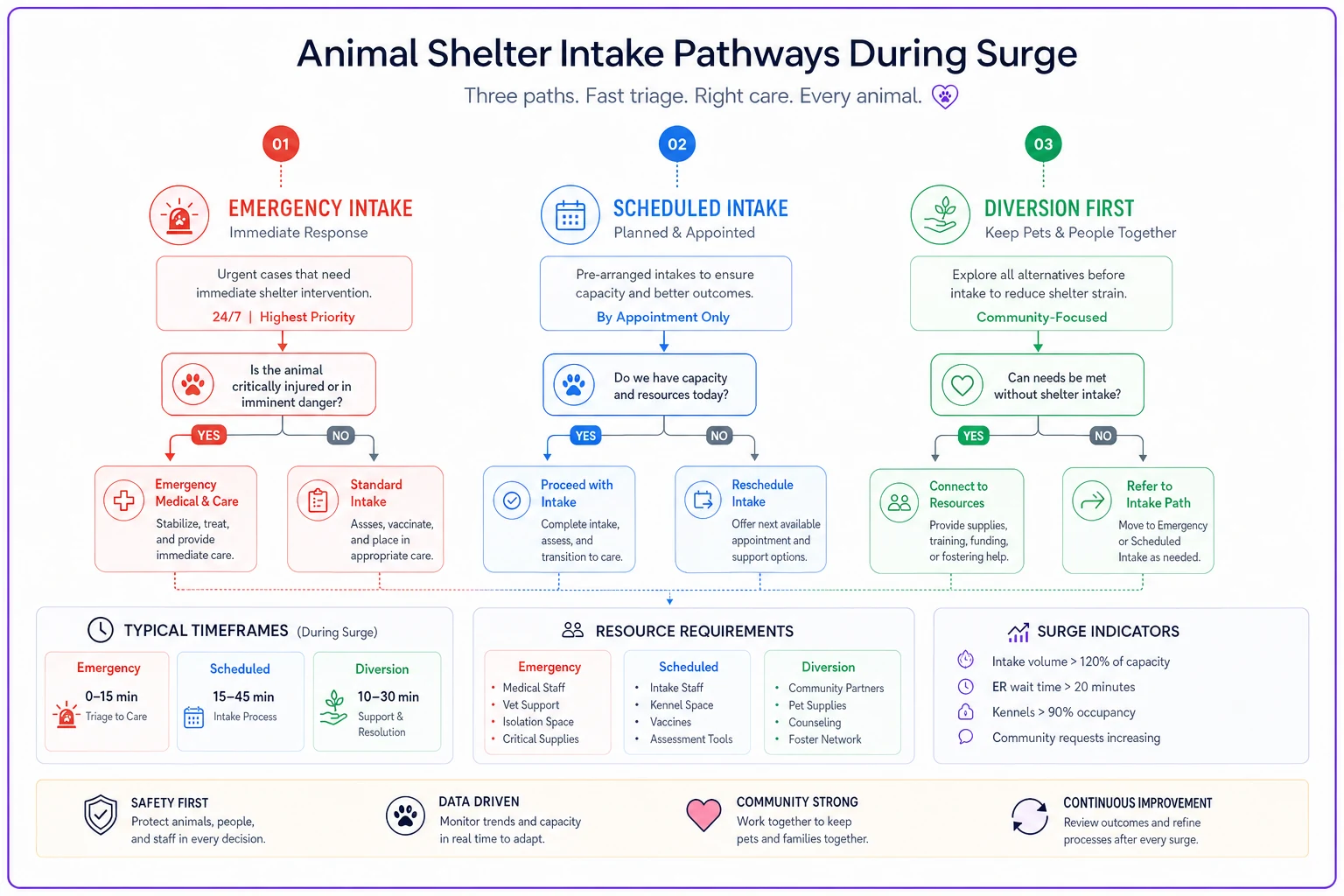
Make triage criteria clear and visible to every intake staff member so routing decisions are consistent under pressure.
Automating routine tasks and minimizing paperwork frees skilled staff to make the harder diversion and foster-placement decisions that reduce shelter intake pressure.
Managing volatile donations with scenario planning
Traditional shelter budgeting assumes stable donation patterns. That model breaks completely during rapid economic shifts. You need dynamic scenario planning that adjusts monthly.
Create three donation scenarios and operational plans for each:
| Scenario | Monthly Donation Level | Operational Adjustments | Trigger Points |
|---|---|---|---|
| Baseline | 90-110% of normal | Standard operations | Current state |
| Restricted | 70-89% of normal | Pause non-critical programs, reduce adoption events, shift to volunteer labor | Two consecutive months below 90% |
| Crisis | Below 70% of normal | Emergency foster push, intake restrictions, staff furloughs | One month below 70% or cash reserves under 45 days |
Most shelters wait too long to shift between scenarios. By the time you're in crisis mode, you've burned through reserves that could have extended your runway.
Track leading indicators weekly: corporate donation confirmations, monthly recurring donor churn rate, and average individual donation size. When any two indicators drop 20% month-over-month, start preparing for the restricted scenario even if total donations haven't fallen yet.
The timing of these transitions can make or break your response. Acting early feels uncomfortable but saves resources when things get worse.
Converting surge volunteers into sustainable help
That flood of newly-available professionals looks like a gift, but without structure, it becomes chaos. These aren't your typical retiree volunteers who show up every Tuesday for dog walking. They're dealing with identity crisis, financial stress, and unpredictable schedules.
Build a separate "skills-based volunteer" track for this population. Instead of asking them to clean kennels or socialize cats, tap their professional expertise:
-
Marketing professionals
Social media management, adoption profiles, campaign creation
-
Tech workers
Database cleanup, website updates, workflow automation setup
-
Finance professionals
Grant writing, donor analysis, budget modeling
-
Operations experts
Process documentation, volunteer coordination, inventory management
Create discrete, project-based work they can complete remotely or on flexible schedules. A laid-off product manager won't commit to Wednesday morning kennel cleaning for six months. But they might redesign your entire adoption flow process over three weeks while job hunting.
Set clear expectations upfront. These volunteers typically engage intensely for 4-8 weeks, then disappear suddenly when they land new roles. Plan for this churn. Document everything they create. Have them train a permanent volunteer or staff member before they leave.
The foster network expansion playbook
When intake surges hit, your building's physical capacity becomes the hard constraint. The fastest expansion? Foster homes. But recruiting fosters during economic uncertainty requires different messaging and support structures.
Recent job-loss households: Counter-intuitively, newly unemployed professionals often make excellent temporary fosters. They're home all day, need emotional support, and want to feel useful. Position fostering as mental health support during transition, not a burden.
Remote workers with flexibility: The shift to remote work means more people can provide daytime care. Focus on employees at stable companies who've gone permanently remote.
Retirement-transition professionals: Older workers taking buyout packages often aren't ready for full retirement. Fostering provides structure and purpose during their transition.
The operational change needed? Reduce foster barriers dramatically. Provide everything: food, supplies, veterinary care, even transportation. Make it easier to say yes than no. One Seattle shelter grew their foster network by 400% in eight weeks by delivering weekly supply boxes to every foster home.
Financial barriers kill more potential fosters than housing restrictions. When people are worried about their own finances, asking them to pay for pet food feels impossible even when they want to help.
Adoption acceleration through strategic fee adjustments
The standard shelter response to intake surges? Reduce or waive adoption fees. This works, but only partially. The real barrier during economic uncertainty isn't the $150 adoption fee — it's the perceived ongoing cost.
Instead of blanket fee waivers, create adoption packages that address total cost concerns:
-
"Starter Package" adoptions Include 3 months of food, basic supplies, and a voucher for one veterinary visit. Price this at your normal adoption fee. Adopters feel like they're getting value, not charity.
-
"Foster-to-adopt" programs Let potential adopters foster for 30 days with full support before committing. This removes the risk element during uncertain times.
-
"Senior for Senior" matches Pair older pets with older adopters, including lifetime veterinary support through partnerships with local clinics. Market this as responsible planning, not desperation.
Track your adoption funnel metrics weekly during surge periods. Where are people dropping off? Usually it's not at initial interest — it's at the financial discussion. Address that friction directly rather than hoping fee waivers solve everything.
The psychology of adoption changes during economic stress. People want security and predictability more than bargains.
Real scenario: Austin shelter's response to February tech layoffs
Austin Pets Alive faced exactly this in February when Dell, Indeed, and several startups announced layoffs affecting roughly 3,000 local workers. Their intake calls jumped 45% within two weeks.
Instead of panic expansion, they implemented a three-tier response system. First, they created an "economic hardship foster" program, providing all supplies plus $200 monthly support payments to fosters. This moved 180 animals out of the shelter within three weeks.
Second, they partnered with three local tech companies not laying off workers to create "office foster" programs. Employees could bring foster animals to work, with the company covering all costs. This placed another 60 animals.
Third, they converted intake to appointment-only with mandatory pre-screening calls. This reduced actual intake by 35% through better diversion to support resources.
The result? Despite a 45% increase in surrender requests, actual intake only increased by 12%. They maintained their live-release rate above 95% and actually reduced staff overtime hours.
Their success came from acting fast and having systems that could scale quickly. Other shelters in the same region struggled because they waited to see how bad things would get.
Technology and workflow optimization during crisis periods
Manual processes that work fine during normal operations completely break during surge periods. That spreadsheet tracking intake appointments? It fails when you're scheduling 50+ assessments daily. Paper-based foster applications? Too slow when you need to onboard 100 new fosters this week.
Operational software becomes critical infrastructure during these periods, not nice-to-have. Modern shelter management platforms handle surge periods by automating the repetitive tasks that bog down staff during crisis:
-
Auto-scheduling intake appointments based on capacity and urgency criteria
-
Matching animals to appropriate fosters using behavioral and household data
-
Tracking donation patterns and triggering alerts when indicators drop
-
Coordinating volunteer shifts across multiple skill-based tracks
-
Managing multi-channel adoption inquiries without dropping leads
The shelters that weathered 2020 best had already digitized core workflows. They could shift strategies quickly because they had real-time data, not week-old reports. They could coordinate hundreds of volunteers because scheduling was automated. They could process double the normal intake because assessment data flowed directly into their system.
Your existing intake workflow analysis becomes even more critical during surge planning. Those bottlenecks you identified during normal operations? They become complete blockages when volume doubles.
Staff burnout during crisis periods usually comes from repetitive administrative tasks, not the actual animal care work. Smart automation handles the data entry and coordination so your team can focus on what matters.
Building resilience beyond the current crisis
The May layoffs won't be the last economic shock your shelter faces. Whether it's AI-driven restructuring, climate events, or the next pandemic, disruption is becoming normal, not exceptional.
Diversify revenue streams aggressively. Any single source representing over 30% of your budget is a vulnerability. Build monthly recurring donor programs, add fee-for-service programs like training or grooming, create enterprise partnerships beyond simple donations.
Create modular operational capacity. Design your operations to scale up and down quickly. This means cross-trained staff, flexible foster networks, and partnerships with other shelters for overflow capacity.
Invest in data and systems. You can't manage what you can't measure in real-time. Modern shelter operations require the same technological foundation as any other complex operation.
Build community before crisis. The relationships you need during surge periods take months to develop. Start those conversations now — with corporations, volunteers, fosters, and partner organizations.
The shelters that thrive through economic disruption aren't necessarily the biggest or best-funded. They're the ones that can adapt quickly, make data-driven decisions, and maintain operational flexibility while others scramble to react.
Moving forward with confidence
The current wave of tech layoffs creates immediate pressure, but it also exposes operational weaknesses that have existed for years. Shelters running on paper processes, Excel spreadsheets, and hero-effort from overworked staff were always vulnerable. This crisis just makes it obvious.
Use this moment as a catalyst for operational improvements you've been postponing. The infrastructure you build to handle this surge becomes your competitive advantage during normal operations. The foster network you expand now becomes your capacity buffer forever. The volunteer management system you implement becomes your force multiplier.
Economic disruption isn't slowing down. The question for shelter leadership isn't whether you'll face another surge — it's whether you'll be ready with systems, processes, and technology that can handle whatever comes next. The playbook is clear. The tools exist. The only decision is whether you'll act before the next wave hits or scramble to respond after it's already overwhelming your operation.
The current wave of tech layoffs creates immediate pressure, but it also exposes operational weaknesses that have existed for years. Shelters running on paper processes, Excel spreadsheets, and hero-effort from overworked staff were always vulnerable. This crisis just makes it obvious.
The playbook is clear. The tools exist. The only decision is whether you'll act before the next wave hits or scramble to respond after it's already overwhelming your operation.
Ready to enhance your shelter’s impact?
Join 500+ shelters using Animlly to improve care coordination, increase adoptions, and engage communities effectively.