

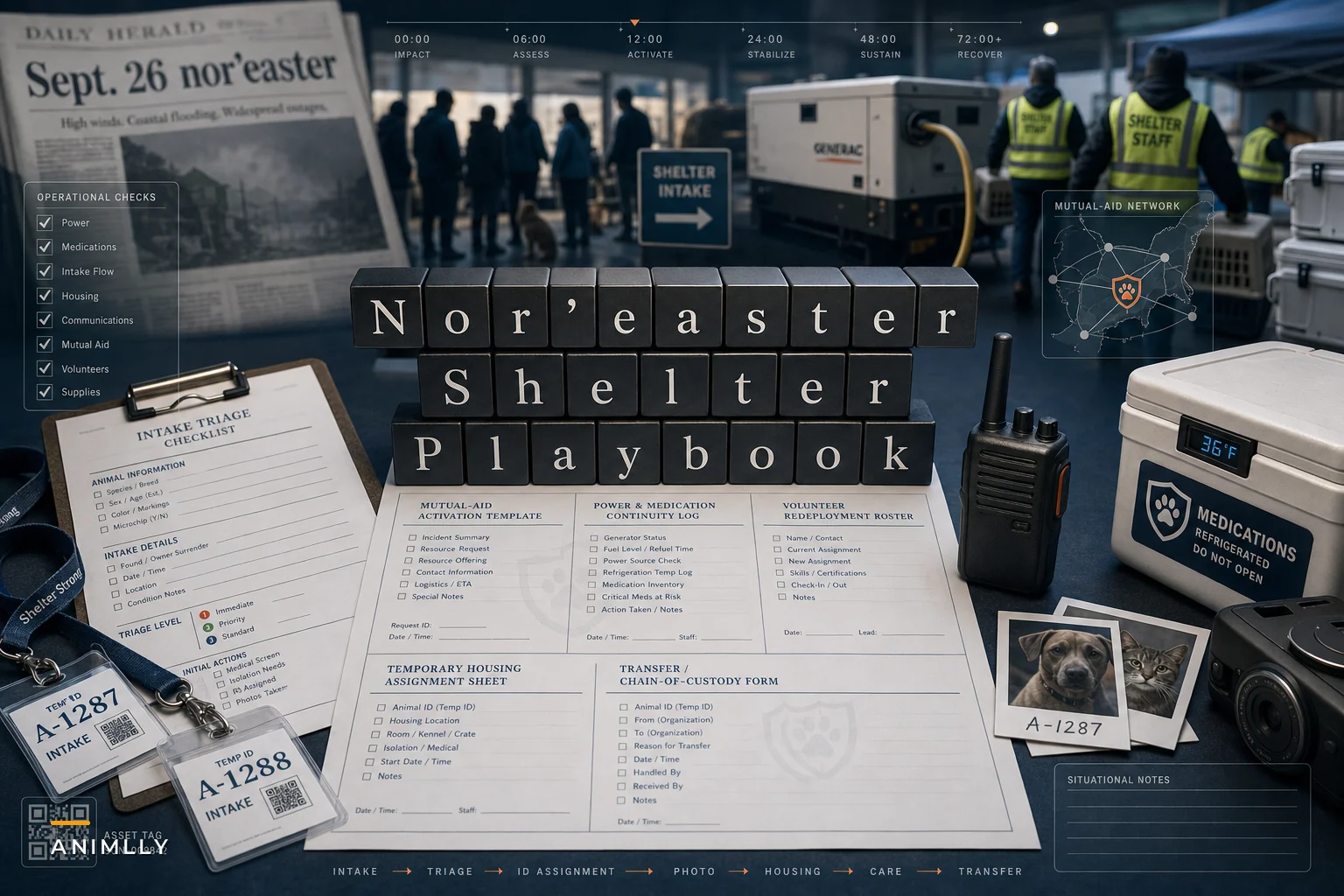

When the Sept. 26 nor'easter pushed across New England and the mid-Atlantic, it didn't just knock out power to more than 100,000 customers at peak. For shelters, it created a very specific kind of chaos: coastal flooding and localized evacuations pushing animals into your care faster than you can log them, while the tools you'd normally rely on to log them are offline.
That combination — surge plus outage plus a disrupted supply chain — is what most shelter emergency plans underestimate. A lot of plans are written for one of those problems. The nor'easter delivered all three at once, which is exactly where a real storm shelter surge plan earns its keep.
This isn't a generic disaster-prep lecture. It's about the sequencing, the decision points, and the things that fall apart at hour six — the operational detail that separates a shelter that absorbs a surge from one that gets buried by it.
First, understand what a storm surge actually does to your operation
A storm doesn't hit your shelter as one event. It hits as a staggered series of operational shocks, and if you treat it as a single emergency you'll allocate people and supplies wrong.
Here's the sequence that tends to play out over roughly 72 hours:
-
Hours 0–12 Power and connectivity drop. Lost-pet intakes start arriving as animals bolt during the storm. Staff can't get in because of flooded roads or canceled transport.
-
Hours 12–36 The surrender wave hits. Displaced families who evacuated or lost housing start arriving, often with pets they genuinely love but can't take into a hotel or a relative's spare room.
-
Hours 36–72 Supply reality sets in. Food deliveries are delayed, medication cold-chain is at risk, and your medical fridge has been running on whatever backup you had — or no backup at all.
The mistake is staffing and stocking for the peak instead of the sequence. You don't need your whole crew at hour two. You need a skeleton crew who can run manual intake in the dark, and your full team at hour 18 when the surrenders start. Shelters that call everyone in immediately burn out their people before the hardest part arrives.
The outage problem nobody rehearses: your records go dark mid-intake
Everyone plans for the animals. Almost nobody rehearses what happens when your cloud-based intake system is unreachable and a line of people is forming at the door with carriers.
Streamline your shelter operations effortlessly.
Animlly helps you manage every pet, volunteer, and adoption step with ease and accuracy.
- Comprehensive pet profiles
- Volunteer scheduling & communication
- Adoption tracking & reporting
No credit card required
This is the quiet failure point. Intake data doesn't just stop — it gets inconsistent. One volunteer scribbles on a legal pad, another uses the back of an old form, a third tries to remember details to enter later. Three days after the storm you've got a reconciliation nightmare: animals with no reliable intake time, duplicate records, finder contact info that's half-legible, and lost-pet reports that can't be matched to found animals because nobody standardized the fields.
A workable outage-mode intake needs three things ready before the storm:
-
A pre-printed paper intake pack with the exact same fields as your digital system, in the same order. If your paper form and digital form don't match, reconciliation takes three times as long.
-
A single intake log sheet that assigns a sequential temporary ID to every animal the moment it arrives — before any other detail is captured. That ID is the thread that lets you reconcile everything later.
-
A photo protocol — one photo per animal against a card showing the temporary ID. Phones hold a charge longer than laptops, and a photo tied to an ID solves half your matching problems once systems come back.
The goal isn't to run beautifully in the dark. It's to capture data cleanly enough that re-entry later is fast and accurate, not a multi-day forensic project.
Medical storage and the cold-chain clock
The refrigeration problem is the one that quietly costs the most money. Vaccines, certain sedatives, insulin for diabetic animals in care — once the fridge loses power, you're on a clock.
A typical small shelter might carry somewhere between $1,500 and $4,000 of refrigerated medication at any given time. Lose that because nobody logged the fridge-off time and you can't prove the cold chain held, and you're replacing most of it on principle.
Keep a simple cold-chain log near the fridge: time power dropped, time a cooler-and-ice transfer happened, a min/max thermometer reading every few hours. A $15 min/max thermometer and a cooler bought ahead of time protect thousands in meds and, more importantly, keep you from administering something you can't verify is still safe.
The surge intake checklist (print this one)
This is the core of your surge plan — the thing you tape to the wall, not the thing you read in a PDF while the power's out.
-
- [ ] Activate outage-mode intake
paper packs out, temporary ID log started, photo station set up
-
- [ ] Log fridge-off time; transfer refrigerated meds to cooler with min/max thermometer
-
- [ ] Switch to skeleton crew for hours 0–12; schedule full team for the surrender wave
-
- [ ] Open a dedicated lost-pet intake lane separate from surrenders (they move at different speeds)
-
- [ ] Pre-stage carriers, towels, and a triage area near the entrance before the line forms
-
- [ ] Assign one person as the reconciliation owner — nobody else enters data later
-
- [ ] Contact mutual-aid partners with your real-time capacity number, not a guess
-
- [ ] Set a capacity trigger
at what headcount do you stop intake and start transferring out?
-
- [ ] Post a simple front-desk script for displaced owners (diversion and temporary-boarding options)
-
- [ ] Log every supply shortfall as it happens — this becomes your reorder list the moment roads clear
The capacity trigger is the one people skip and regret. Decide in advance the number at which you shift from intake to outbound transfer. In the moment, with a crying family at the counter, nobody wants to say no — so the number has to be decided when you're calm, not when you're drowning.
Decide in advance the number at which you shift from intake to outbound transfer.
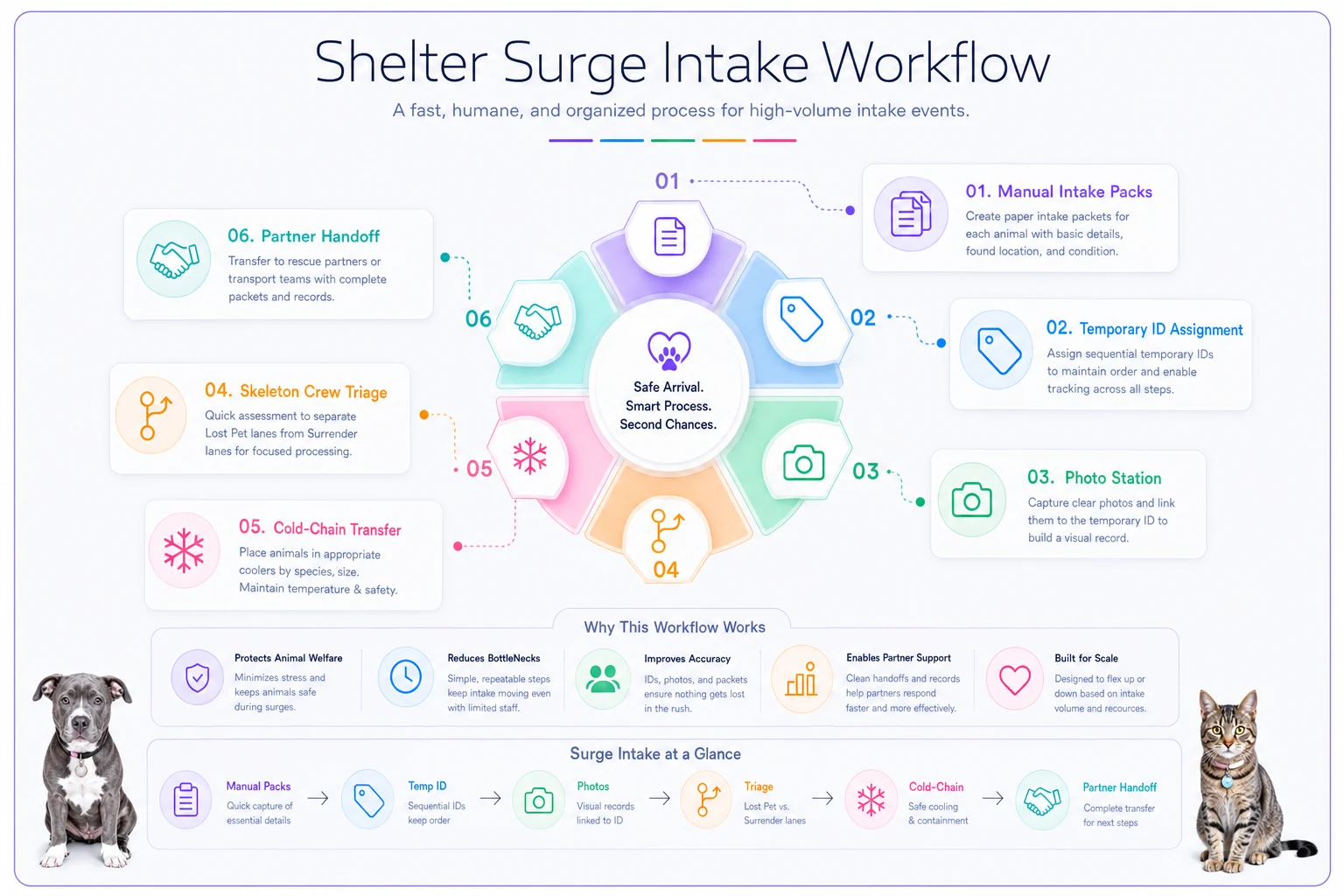
This quick diagram highlights how intake, ID assignment, photo capture, and partner transfer should flow during an outage.
Partner coordination is the real multiplier
A single shelter has a hard ceiling. A network doesn't. The shelters that came through past nor'easters in reasonable shape weren't the biggest — they were the ones with partner relationships that actually functioned under stress.
Most mutual-aid arrangements are handshake deals that evaporate the moment everyone's overwhelmed at the same time. During a regional storm, your nearest partner is often dealing with the same outage and the same surge. The partners who matter are one or two counties outside the storm's worst band — close enough for transport, far enough to still have power and capacity.
This is why formalized coordination matters, and why it's worth reading our deeper breakdown on regional mutual-aid governance for shelter networks before you need it. The short version: you want agreed-upon capacity-sharing rules, a known point of contact at each partner, and a shared understanding of who transports, who pays for what, and how records travel with the animal.
A simple partner-readiness comparison
| Coordination element | Handshake arrangement | Governed mutual-aid network |
|---|---|---|
| Capacity sharing | Ad-hoc, "call and hope" | Pre-agreed thresholds and reserved slots |
| Point of contact | Whoever answers | Named primary + backup per partner |
| Transport | Figured out in the moment | Pre-assigned drivers, vetted and insured |
| Records handoff | Verbal, often lost | Standardized transfer sheet travels with animal |
| Cost responsibility | Argued about later | Settled in advance |
Every row in the right column is a decision you won't have to make at 2 a.m. during an outage. That's the entire point — not bureaucracy for its own sake, but decisions banked in advance so your people aren't improvising under pressure.
A real scenario: the coastal shelter that got the sequence right
Consider a small coastal shelter — maybe 40 kennels, mostly volunteer-run — hit by flooding and a two-day outage. Going into the storm they had a surge plan focused almost entirely on sandbags and animal evacuation. Intake? "We'll figure it out."
They didn't figure it out. In the first day they took in around 25 animals with no consistent IDs, lost track of two finder contacts entirely, and couldn't match three lost-pet reports to found dogs because descriptions were scribbled differently by different volunteers. Reconciliation took the better part of a week, and the cold chain on roughly $2,000 of vaccines was unverifiable because nobody logged the fridge-off time.
The following season, after rebuilding their plan around sequencing and outage-mode intake, a smaller storm brought a comparable wave. Temporary IDs on every animal within a minute of arrival, a single reconciliation owner, a cold-chain log, and a partner two counties inland who took eight transfers off their hands within 36 hours. Reconciliation afterward took an afternoon. Zero med loss. No duplicate records.
Same shelter, same storm category, completely different outcome — and almost none of the difference came from more people or more money. It came from deciding the sequence and the fields before the water came up.
Where software helps — and where it quietly hurts
Digital intake and records systems are genuinely valuable for surge recovery. Clean reconciliation, live capacity visibility across your network, photo-to-record matching — that's where modern operational platforms with AI-assisted matching can turn a week of cleanup into an afternoon.
Honest caveat though: during an active outage, a system you can't reach is worse than no system if your team hasn't rehearsed the paper fallback. The shelters that handle this well treat their software as the recovery and coordination layer, not the thing they lean on during hours 0–12.
The practical setup is to run manual and clean during the blackout, then let the system do the heavy lifting the moment connectivity returns — fast re-entry, deduplication, cross-shelter capacity visibility, and surfacing likely lost-and-found matches from all those photos you captured. The tool earns its value in recovery, not in the dark.
If your shelter is small and your real bottleneck is simply having no paper fallback and no partner on speed-dial, fix those first. No platform compensates for a missing temporary-ID habit or a mutual-aid relationship you never actually built.
When to pull the trigger on outbound transfer
The hardest operational call in a surge isn't intake — it's deciding to stop taking in and start sending out. A few honest signals it's time:
-
You've hit your pre-set capacity number
-
Isolation and medical space is full, so new intakes would compromise disease control
-
Staff are past hour 20 and error rates are climbing
-
Your inland partner still has capacity and the roads to them are passable
Transfer early, while roads are good and your partner has room. Shelters that wait until they're completely full usually wait until transport is also impossible — and then they're stuck absorbing everything with no release valve.
The underlying lesson
A storm surge exposes whichever part of your operation you never stress-tested. For most shelters it's not the animal care — it's data integrity under outage and partner coordination under simultaneous pressure. Both are fixable, cheaply, before the next storm.
The nor'easter will fade from the news cycle fast. The flooding and deaths it caused across the Northeast and the outages it left behind are already a few paragraphs in a recap somewhere. But the operational gaps it exposed at your shelter won't fix themselves — and the next one is only a season away.
Spend an afternoon this month printing the paper packs, assigning a reconciliation owner, and making one real phone call to a partner outside your storm band. That afternoon is the cheapest insurance you'll find.
Ready to enhance your shelter’s impact?
Join 500+ shelters using Animlly to improve care coordination, increase adoptions, and engage communities effectively.