

Most shelter networks don't fail during the calm months. They fail on a Friday afternoon when one facility hits 118% capacity, the shelter forty minutes away has open runs but no formal agreement to accept transfers, and the only person who knows who to call is out sick. By Monday, decisions that should have taken twenty minutes took two days, and three animals that could have been moved never were.
Mutual aid between shelters is one of those things everyone agrees is a good idea and almost nobody has actually operationalized. There's usually a loose understanding — "we help each other out" — but no written trigger for when help kicks in, no shared view of who has space, and no cadence for talking to each other before things go sideways. So the aid happens ad hoc, which means it happens slowly, unevenly, and dependent on personal relationships that walk out the door when staff turn over.
This piece is about building regional mutual-aid governance for shelter networks that actually holds up under pressure — the policy scaffolding, the transfer triggers, the shared bed-tracking discipline, and the meeting rhythm. And critically, doing it in a way that a coalition of small municipal and nonprofit shelters can adopt without hiring lawyers or standing up a bureaucracy nobody has time to maintain.
Why informal mutual aid quietly breaks
The version of mutual aid most regions run on is relationship-based. Your intake coordinator knows their intake coordinator. When you're drowning, you text them. Sometimes it works beautifully. But relationship-based aid has three structural weaknesses that don't show up until you're already in trouble.
The first is latency. When there's no pre-agreed trigger, every transfer request starts a negotiation. Do you have room? What kind of room? Can you take a heartworm-positive dog? Who pays for transport? Each of those questions is answerable, but answering them in the moment — while both shelters are busy — burns hours you don't have during a surge.
The second is single points of failure. If the whole arrangement lives in two people's phones, it dies when either of them leaves, goes on vacation, or gets buried. What tends to happen across regional coalitions is that mutual aid peaks with a particular pair of staff members and then quietly atrophies when one of them moves on. There's no institution behind it, just a friendship.
The third is inequity you don't notice. Without a shared policy, the shelter with the most aggressive coordinator gets the most help. The quieter facility — often the smaller rural one with the thinnest staffing — asks less, receives less, and ends up carrying more overpopulation risk. Informal systems reward assertiveness, not need.
None of this means relationships don't matter. They absolutely do. But relationships should be the lubricant on top of a system, not the system itself.
The core idea: policy first, tools second
Here's the sequencing mistake nearly every coalition makes. They start by trying to buy or build a shared database. "If we could all just see each other's capacity, this would fix itself." So they spend six months arguing about software, integrations, and who owns the data, and the governance questions — who decides, when, and on what terms — never get answered.
Streamline your shelter operations effortlessly.
Animlly helps you manage every pet, volunteer, and adoption step with ease and accuracy.
- Comprehensive pet profiles
- Volunteer scheduling & communication
- Adoption tracking & reporting
No credit card required
The order should be reversed. Write the policy first. Once you know what triggers a transfer, what the standard terms are, and who has authority to say yes, the tooling becomes almost trivial. A shared spreadsheet with disciplined updates outperforms an expensive platform nobody agrees on how to use.
So the playbook has four layers, built in this order:
-
Threshold-based transfer triggers — the objective conditions that turn "we should help" into "aid is now activated."
-
Standard MOU language — a lightweight, reusable agreement so nobody renegotiates terms mid-crisis.
-
Centralized bed-tracking protocol — one shared source of truth for available space, updated on a schedule.
-
A recurring coordination cadence — regular, boring meetings that keep the whole thing alive.
So the playbook has four layers, built in this order:
Layer 1: Threshold-based transfer triggers
The point of a trigger is to remove judgment from the activation decision, not from the animal-level decisions that follow. You still decide which specific animals move. But whether the region is in a "mutual aid active" posture should be a math question, not a debate.
Triggers work best when they're tied to capacity ratios you already track. If you've built out a capacity-planning framework with surge buffers, your triggers should hang directly off those same numbers so you're not maintaining two separate definitions of "full."
A workable trigger tier looks like this:
| Tier | Condition | Posture | Action |
|---|---|---|---|
| Green | Below 85% of working capacity | Normal | Routine communication only |
| Yellow | 85–100% for 3+ consecutive days | Watch | Flag in shared tracker, notify network coordinator |
| Orange | 100–115%, or any single-species overflow | Request | Formal transfer request activated to network |
| Red | Above 115%, or intake freeze imminent | Priority | Network-wide priority; receiving shelters commit within 24h |
A few things that make this actually work in practice.
Use working capacity, not physical kennel count. Working capacity accounts for isolation needs, medical hold, and the fact that you can't safely run every kennel full. A shelter that reports "we're at 90%" on physical count might be functionally at 110%.
Build in a duration requirement for the lower tiers. A single busy day isn't a crisis. Yellow requiring three consecutive days prevents the network from crying wolf every Saturday.
And define species-specific overflow separately. Total capacity can look fine while your cat side is underwater. Regional aid should be able to activate for one population without waiting for the whole building to fill.
The trigger tiers do something subtle but important: they give the smaller, quieter shelter permission to ask. When the policy says "Orange means you activate a request," the coordinator who'd normally tough it out has an objective reason to raise their hand. That alone fixes a lot of the inequity problem.
Layer 2: MOU language you can adopt without a legal team
This is the part that scares people off, and it shouldn't. A mutual-aid MOU between shelters doesn't need to be a contract in the sue-you sense. It's an operational agreement — a written statement of how partners intend to work together. Most of the fear comes from imagining liability battles that, in practice, rarely materialize between mission-aligned organizations.
Keep the MOU short and put operational detail in appendices you can revise without re-signing anything. The core agreement covers intent and authority; the appendices cover the mechanics that change over time.
Here's sample framing language you can adapt. This is a starting point, not legal advice — but it's the kind of plain-language structure that gets small coalitions moving.
> Purpose. The parties agree to provide mutual aid in the form of animal transfers, temporary housing, and shared resources during periods of capacity strain, as defined by the shared transfer-trigger tiers in Appendix A. > > Activation. Mutual aid may be requested by any party upon reaching Orange or Red tier as defined in Appendix A. Receiving parties are not obligated to accept any specific transfer but agree to respond to requests within the timeframes in Appendix A. > > Animal condition and disclosure. The sending party agrees to disclose known medical and behavioral information for each transferred animal using the shared transfer record in Appendix B. Animals will be transferred current on the vaccinations and documentation listed therein except in documented emergencies. > > Ownership and outcomes. Upon transfer, the receiving party assumes custody and full authority over outcome decisions, unless a written hold-for-return arrangement is specified for that animal. > > Costs. Each party bears its own costs unless otherwise agreed in writing per transfer. Transport responsibility defaults to the arrangement in Appendix C. > > Liability. Each party is responsible for the animals in its custody at the time. Neither party assumes liability for the other's operations. > > Term and exit. This agreement continues until terminated by any party with 30 days' written notice. Termination does not affect animals already transferred.
Notice what's deliberately not in the main body: which vaccines, how fast the response window is, who drives. Those live in appendices precisely because they'll change. When your coalition decides to tighten the response window from 48 hours to 24, you update Appendix A — you don't reopen the whole agreement across six signatories.
The single biggest MOU mistake is over-specifying the main document. Coalitions write a beautiful ten-page agreement, one operational detail becomes outdated, and now nobody wants to trigger a re-signing marathon, so the whole thing goes stale. Keep the spine short and flexible.
Layer 3: A centralized bed-tracking protocol
You cannot coordinate aid across a region if nobody can see who has space. But "shared visibility" is where good intentions go to die, because visibility requires discipline, and discipline requires the update to feel nearly effortless.
The protocol matters more than the platform. What breaks bed-tracking isn't the tool — it's that updating it feels like extra work, so it drifts out of date, so people stop trusting it, so they go back to texting. A tracker nobody trusts is worse than no tracker, because it creates false confidence.
Two rules keep a shared tracker alive:
-
One update per day, at a fixed time, is mandatory even when nothing changed. The "no change" update is what tells partners the data is fresh. Silence should never be ambiguous.
-
The person who does intake owns the number. Not a manager who updates it when they remember — the person closest to the actual movement of animals.
At minimum, a shared bed-tracking record should show, per shelter:
-
Working capacity by species (dogs, cats, other)
-
Current census by species
-
Available beds by species (the number people actually act on)
-
Any restrictions (e.g., "no bottle babies," "isolation full," "no large dogs this week")
-
Last-updated timestamp
-
Current tier (Green/Yellow/Orange/Red)
That "restrictions" field does more work than people expect. A shelter can have four open kennels and still not be a viable destination for the dog you need to move. Surfacing restrictions up front kills the back-and-forth that eats your afternoon.
Make the mandatory daily update part of the intake shift handoff so it feels like part of the workflow rather than an extra task.
For coalitions running shared operational tooling, this is where AI-assisted operational platforms earn their keep — not by making decisions, but by removing the update friction that kills these systems. When your census updates as intake and outcomes are logged, the shared tracker can populate itself and flag when a shelter crosses into a new tier automatically, so a coordinator gets notified instead of discovering it three days late. The governance still lives with people. The software just makes sure the number everyone's looking at is actually current, which is the whole ballgame.
Visualized workflow of daily updates and automatic tier flags.
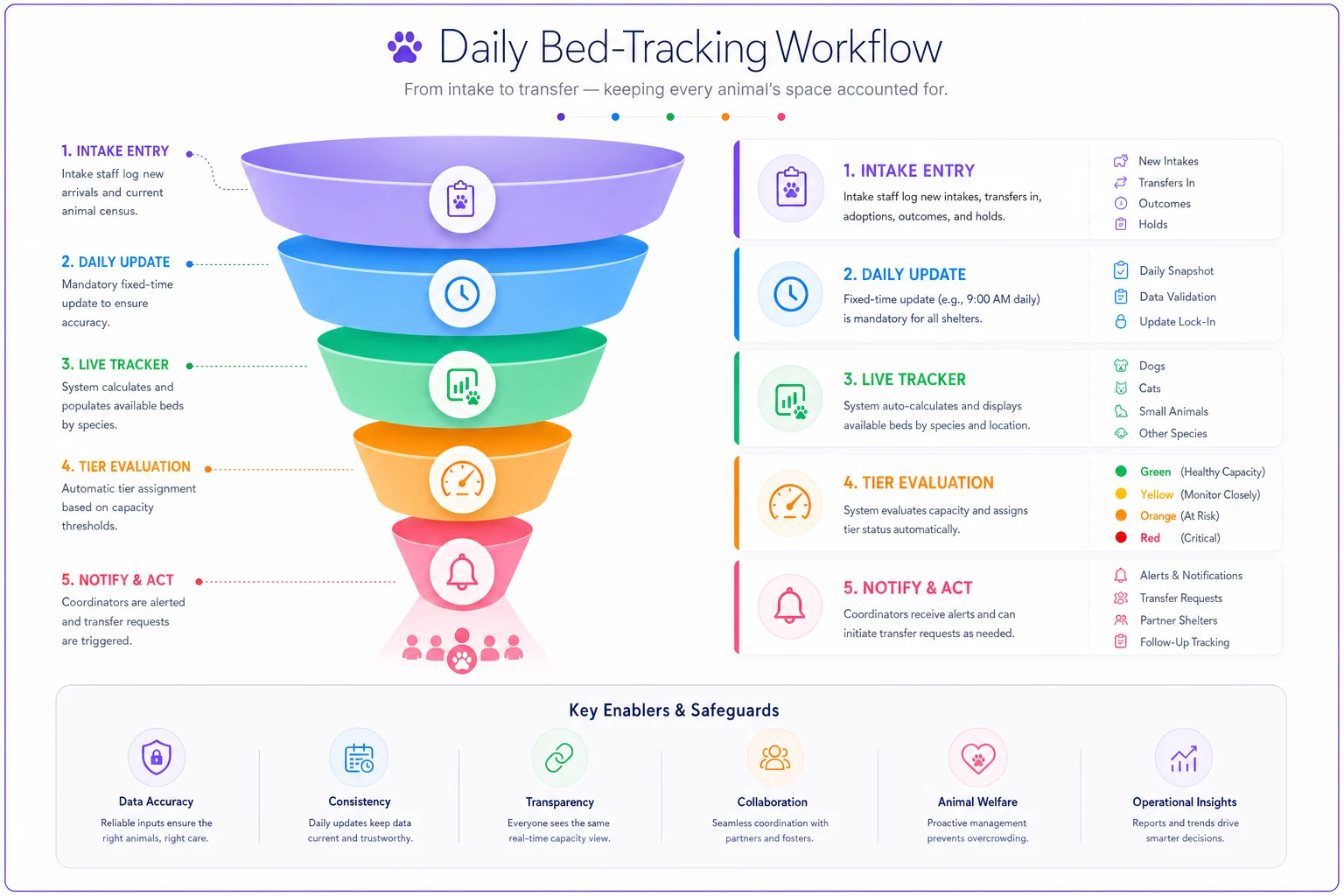
For coalitions running shared operational tooling, this is where AI-assisted operational platforms earn their keep — not by making decisions, but by removing the update friction that kills these systems. When your census updates as intake and outcomes are logged, the shared tracker can populate itself and flag when a shelter crosses into a new tier automatically, so a coordinator gets notified instead of discovering it three days late. The governance still lives with people. The software just makes sure the number everyone's looking at is actually current, which is the whole ballgame.
Layer 4: A coordination cadence that survives busy weeks
Every part of this system decays without a heartbeat. The heartbeat is a recurring meeting — short, predictable, and boring by design. The coalitions that keep mutual aid alive for years are the ones that meet whether or not there's a crisis, because that's how you build the muscle memory and the relationships that make crisis-time coordination fast.
A cadence that holds up over time usually looks like:
-
Weekly, 15 minutes, async or standing. A quick tier check across the network. Who's climbing? Who has room? Anything expected next week — a hoarding case, a transport, a big adoption event? This can be a short written thread most weeks.
-
Monthly, 45 minutes, live. Review the month's transfers — what moved, what got stuck, what nearly went wrong. Update appendices if needed. This is where you catch the slow drift before it becomes dysfunction.
-
Quarterly, longer, all partners. Re-examine the triggers, the equity of aid flows (is one shelter always giving and never receiving?), and any MOU changes. Bring in new partners here.
The monthly review is the one people skip and the one that matters most. That's where you notice the rural shelter has requested aid four times and received it once. Or that transfers keep stalling on transport because nobody actually owns the driving. Patterns that are invisible in the moment become obvious when you look at a month of them together.
Upstream diversion work belongs in this conversation too. Coalitions that pair transfer coordination with strong community diversion pathways reduce the number of animals that ever need to move in the first place. Mutual aid is the release valve; diversion is what keeps the pressure from building.
When this makes sense — and when it doesn't
Regional mutual-aid governance is worth the setup effort when you have three or more shelters within reasonable transport distance, meaningfully correlated intake pressure (you tend to fill up around the same times), and at least one person per organization who can own the cadence. That's the sweet spot where coordination overhead pays for itself many times over.
It's a bad idea when you try to force it before there's trust. If the underlying relationships are adversarial — a history of dumped animals, unpaid transport, or a shelter that transfers only its hardest cases and never accepts any — a written MOU won't fix that. Sort out the relationship first, or start with a two-party pilot and expand once it works.
And it's genuinely the wrong move for a single well-resourced shelter that could just build internal foster and capacity buffers instead. If you rarely hit Orange tier on your own, you don't need a regional apparatus — you need better internal planning. Don't build coalition infrastructure to solve a problem one organization could handle alone.
A real scenario
A three-shelter coalition in a mid-sized county — one municipal facility and two nonprofits — ran on pure texting for years. During a rough stretch one summer, their municipal shelter hit around 120% capacity for the better part of two weeks. Transfers happened, but slowly: each request meant a fresh round of "do you have room, what can you take, who's driving." Several dogs that could have moved didn't, and euthanasia decisions got made under pressure that a faster transfer might have avoided.
They spent about a month building the four layers. No lawyers — one board member with contract familiarity reviewed the MOU, which took an afternoon. They set trigger tiers off their existing capacity numbers, adopted a shared daily bed-tracker with a mandatory noon update, and put a 15-minute weekly check on the calendar.
The next surge, the difference wasn't dramatic in a headline way — it was operational. When the municipal shelter hit Orange, the request went out to the network the same morning, both nonprofits could see they had roughly a dozen open beds between them before anyone asked, and transfers were confirmed within the day instead of over several. Over the following season, the coordinator estimated they moved animals days faster on average. More tellingly, the smaller nonprofit — historically the one that never asked for help — activated a request for the first time in years. That last part was the real win. The system gave the quiet shelter permission to raise its hand.
The point isn't the paperwork
It's easy to read all of this as bureaucracy — more forms, more meetings, more agreements. But the governance isn't the goal. The goal is that when a shelter forty minutes away has space and you're overflowing, an animal moves in hours instead of days, and it doesn't depend on whether two specific people happen to be at their desks that afternoon.
Good mutual-aid governance turns generosity into infrastructure. Relationships still carry the weight — the trust, the willingness to say yes at 4pm on a Friday. But underneath them sits a system that doesn't collapse when someone's on vacation, doesn't quietly favor the loudest coordinator, and doesn't force a fresh negotiation every time the region gets tight. Build the policy first, keep the documents short and flexible, maintain one number everyone trusts, and keep meeting even when nothing's on fire. That's the whole playbook, and it's well within reach for a coalition of small shelters that never wants to touch a legal department to get it done.
It's easy to read all of this as bureaucracy — more forms, more meetings, more agreements. But the governance isn't the goal. The goal is that when a shelter forty minutes away has space and you're overflowing, an animal moves in hours instead of days, and it doesn't depend on whether two specific people happen to be at their desks that afternoon.
Good mutual-aid governance turns generosity into infrastructure. Relationships still carry the weight — the trust, the willingness to say yes at 4pm on a Friday. But underneath them sits a system that doesn't collapse when someone's on vacation, doesn't quietly favor the loudest coordinator, and doesn't force a fresh negotiation every time the region gets tight. Build the policy first, keep the documents short and flexible, maintain one number everyone trusts, and keep meeting even when nothing's on fire. That's the whole playbook, and it's well within reach for a coalition of small shelters that never wants to touch a legal department to get it done.
Ready to enhance your shelter’s impact?
Join 500+ shelters using Animlly to improve care coordination, increase adoptions, and engage communities effectively.