

Most shelters don't have a diversion problem. They have a decision problem at the front desk.
Someone walks in with a 4-year-old lab mix, says they're moving and can't take the dog. The staff member on shift has a full lobby, two return-adoption calls waiting, and a foster coordinator asking about kennel space. So the dog gets surrendered. Fast, clean, no friction. Except that dog might have been divertible in eight minutes if anyone had asked the right two questions and handed over the right piece of paper.
That's the gap this article is about. Not the philosophy of diversion — you already believe in it — but the operational machinery that makes it happen consistently even when your best person is off that day.
Why "just ask if they've considered other options" fails
The soft version of diversion — where staff are told to "explore alternatives before accepting a surrender" — collapses under pressure almost every time.
When diversion depends on individual judgment, it gets inconsistent fast. The empathetic staffer who's been there six years might divert 30% of walk-in surrenders. The new hire who's terrified of being pushy diverts almost none, because saying "have you thought about keeping the dog?" feels like guilting a stranger. So your diversion rate swings based on who's working the desk, not on whether the animal was actually divertible.
There's a second problem. Even when a staffer wants to divert, they often don't have the specific answer ready. Someone surrendering because of a $600 vet bill doesn't need encouragement — they need the name of the clinic that does payment plans and the phone number of the assistance fund that covers emergency dental. If staff have to Google that mid-conversation, the diversion dies. The owner is already emotionally committed to walking out without the dog.
Diversion isn't about willpower or scripts. It's about removing judgment calls and lookup delays from the moment of highest stress.
The decision tree: sort in under two minutes
The point of a diversion decision tree isn't to be exhaustive. It's to route the person to one of a small number of known pathways so your staff stops improvising. Keep it to a single laminated page at the front desk.
Streamline your shelter operations effortlessly.
Animlly helps you manage every pet, volunteer, and adoption step with ease and accuracy.
- Comprehensive pet profiles
- Volunteer scheduling & communication
- Adoption tracking & reporting
No credit card required
-
Is this a safety issue for the animal or a human right now? Bites, severe medical emergencies, hoarding cases, or an owner in crisis go straight to intake. No diversion attempt. Don't make staff soft-sell someone whose dog just bit their kid.
-
Why are they surrendering? Narrow it to the real reason, not the first reason given. "Moving" is almost never just moving — it's usually a no-pets lease or a deposit they can't afford. "Behavior" is usually one specific behavior, not a bad dog.
-
Is the reason temporary or permanent? A 6-week housing gap is temporary. A permanent disability that makes dog-walking impossible is not. These route completely differently.
Only after those three do you pick a pathway.
Here's how the common reasons map to pathways:
| Surrender reason | Temporary or permanent | Primary pathway | Backup pathway |
|---|---|---|---|
| Can't afford vet care | Usually temporary | Assistance fund + partner clinic payment plan | Vaccine/spay voucher |
| Housing / no-pets lease | Often temporary | Pet-friendly housing list + deposit assistance | Short-term boarding/foster network |
| Behavior (one issue) | Usually solvable | Free training hotline + behavior packet | Trainer referral |
| Moving out of area | Sometimes temporary | Rehoming support (owner keeps custody) | Managed intake by appointment |
| New baby / allergy | Mixed | Allergy management info / rehoming support | Intake if genuine |
| Owner deceased/hospitalized | Permanent | Direct intake | — |
The tree does one job: it stops staff from treating every surrender the same way. A vet-cost surrender and a behavior surrender need totally different responses, and the front desk shouldn't have to figure that out on the spot.
Here's a quick visual of how the decision tree routes common front-desk surrender cases to specific pathways and packets.
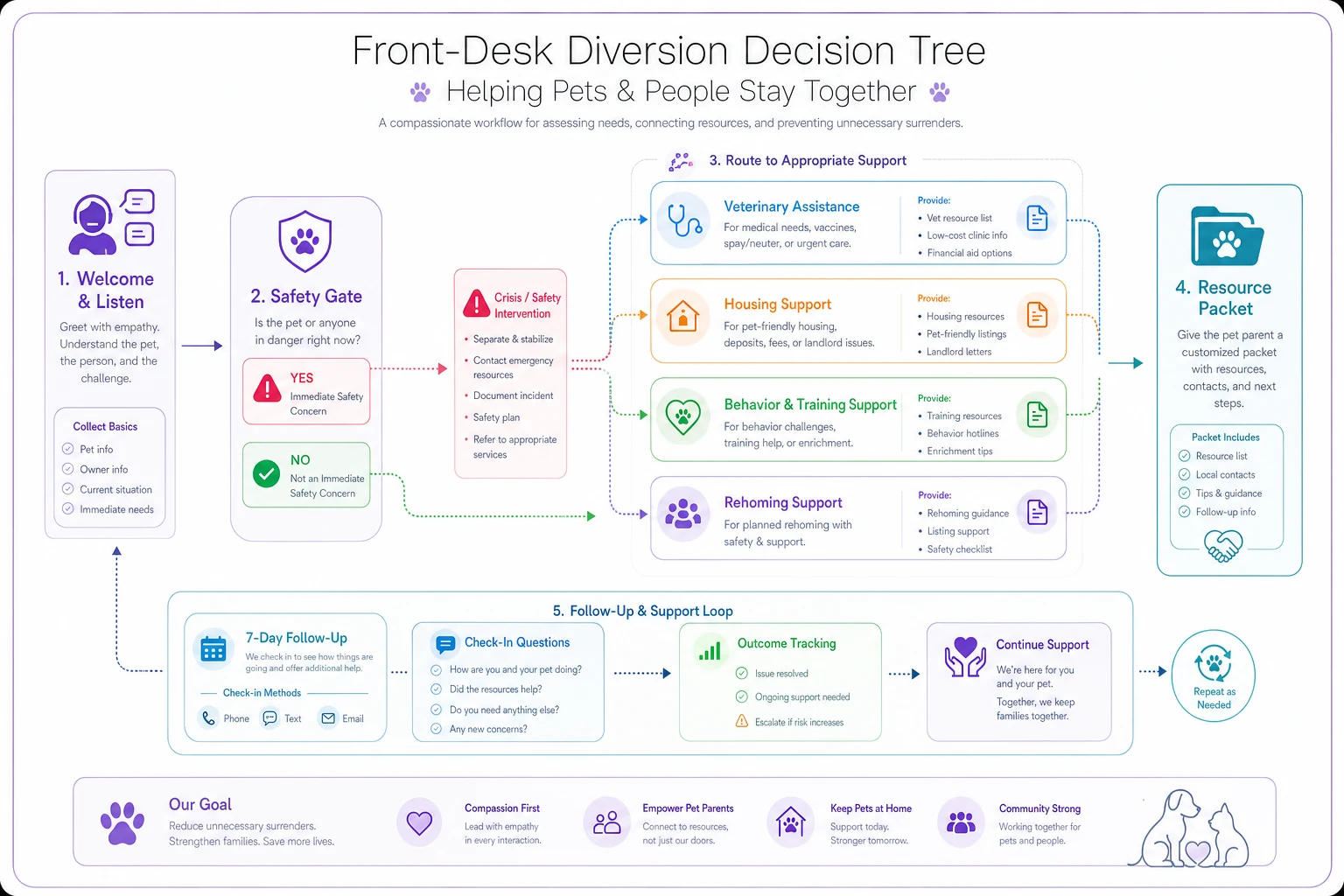
Keep the tree to a single laminated page at the front desk.
Templated resource packets: the 90-second handoff
A decision tree is useless if the pathway it points to is a vague "give them some resources." Staff need a physical or digital packet they can hand over immediately, matched to the reason.
Build one packet per pathway. Not a giant binder — a single sheet or a two-page insert, printed and stocked at the desk, plus a digital version you can text or email on the spot. The moment the tree says "vet-cost pathway," the staffer grabs the vet-cost packet without thinking.
Each packet should contain:
-
The specific local resource, with a real phone number and a name if possible — "Ask for the assistance coordinator" beats a general line.
-
What the person needs to do next, in one or two steps. "Call Monday–Thursday before noon, bring proof of income."
-
What the resource actually covers, so you don't send someone chasing help that won't apply. If the emergency fund maxes out at $250, say so.
-
A realistic timeline. "Applications reviewed within 48 hours" prevents the owner from giving up on day one.
-
A fallback. If the first option doesn't work out, what's next. This keeps a "no" from becoming an automatic re-surrender.
A common mistake is packing the sheet with every organization in the county. That's not helpful — it's overwhelming. A person in a stressful moment can act on two options, not twelve. Curate hard. Pick the partners you actually trust to pick up the phone.
The other overlooked piece: date-stamp and version your packets. Assistance programs run out of money mid-year, clinics change their sliding-scale rules, phone numbers get disconnected. A packet handed out with a dead number does real damage — the owner tries once, hits a wall, and surrenders anyway, now more convinced there was no other option.
Date-stamp packets and re-verify partner contact info quarterly to avoid handing out dead referrals.
Assign someone to re-verify every packet quarterly.
Where the referral partners come from
Diversion packets are only as good as the partners behind them, and this is where most programs quietly fail. You can't divert a vet-cost surrender if you don't have a clinic that offers payment plans or reduced-cost care already primed to take your referrals.
Diversion partners need to be pre-agreed, not cold. When a staffer hands someone a packet, that partner should already know your shelter refers to them and roughly how many people to expect. The mechanics of setting that up — outreach, expectations, tracking — mirror what we covered in turning local clinics into reliable partners, and the same referral-tracking habits apply directly here.
For rehoming and lost-pet-adjacent pathways, there's meaningful overlap with the flagging and partner-script approach in our partner-integrated lost-and-found workflows — especially when a "surrender" is actually a found stray the person assumed was abandoned. Running a quick found-animal check before starting the diversion conversation catches those before they turn into unnecessary intakes.
The tracking sheet: prove it's working (or fix it)
This is the part almost everyone skips. They build the tree, print the packets, and never find out whether diversion actually reduced surrenders — or just delayed them by a week.
Diversion that isn't tracked tends to look successful and quietly fail. The person leaves without surrendering, everyone feels good, and three weeks later they're back because the packet didn't pan out. Without a follow-up loop, you'd never know.
Keep the tracking sheet simple enough that desk staff will actually fill it in. Anything more than about 30 seconds per entry gets ignored during busy hours. Track:
-
Date and staff member (spot who's diverting well and who needs coaching)
-
Surrender reason category (matches your tree)
-
Pathway offered
-
Outcome at contact diverted / surrendered anyway / declined help
-
7-day follow-up outcome still has animal / surrendered later / unreachable
-
Which specific resource worked (this is gold for pruning dead partners)
That 7-day follow-up column is the one that matters most and the one that gets dropped first. A single volunteer making follow-up calls two afternoons a week is usually enough to keep it alive. Without it, your "diversion rate" is just a count of conversations, not a count of animals that stayed home.
The pattern worth watching: if a pathway shows lots of "diverted at contact" but lots of "surrendered later" on follow-up, that resource is broken, not the concept. Maybe the fund ran dry, maybe the clinic stopped taking referrals. The tracking sheet tells you which pathway to fix instead of scrapping diversion entirely.
A real scenario
A mid-size municipal shelter — roughly 3,000 intakes a year — was taking in owner surrenders at the front counter with no real structure. Staff diverted when they had the time and energy for it, which meant almost never during summer.
They built a one-page tree, four resource packets (vet cost, housing, behavior, rehoming support), and a tracking sheet with a 7-day follow-up call handled by two volunteers. Nothing fancy. The clinic and assistance-fund partnerships were mostly ones they already had but had never been organized into actual packets.
Over about four months, owner-surrender intake dropped somewhere in the 15–20% range. The bigger surprise was in the tracking data: the behavior packet had a terrible follow-up rate — people diverted at the desk but surrendering anyway within two weeks — because the "free training hotline" they'd listed had quietly cut its hours. They swapped in a different partner and the behavior pathway started holding. Without the follow-up column, they'd have assumed diversion just didn't work for behavior cases and moved on.
When diversion is the wrong call
Don't divert when the animal's welfare is at risk. If someone is surrendering because they genuinely can't or won't provide basic care, handing them a packet and sending them home is worse than intake. The tree's safety gate exists for this reason.
Don't divert someone who's already decided. If you ask "would you keep them if we solved the barrier?" and they say no, respect it. Grinding on a committed surrender just makes the person feel judged and slows your lobby.
Don't build diversion on partners you can't verify. A packet full of unreliable referrals produces delayed surrenders and eroded trust. If you don't have a real partner for a pathway, leave that pathway out rather than fake it.
Getting it running without a big project
You don't need a committee. One person can draft the tree in an afternoon using your last three months of surrender reasons — you probably already know the top five. Build packets for those five, verify every phone number yourself before printing, and start the tracking sheet the same week. Add the 7-day follow-up as soon as you have someone to make the calls, even if it's only for one pathway at first.
The mistake is trying to launch the perfect version. A rough tree with four solid packets and honest tracking beats a polished binder nobody uses.
Diversion works when the decision is easy for a tired staffer at 4pm on a Saturday. Everything in this article exists to make that one moment easier — the reason so many good intentions never turn into fewer surrenders is that the moment itself was never made simple enough to survive a busy day.
Ready to enhance your shelter’s impact?
Join 500+ shelters using Animlly to improve care coordination, increase adoptions, and engage communities effectively.