

Most shelters don't fail at capacity planning because they lack heart or hustle. They fail because the plan lives in someone's head, and that someone is currently juggling three intakes, a sick foster, and a board email about next quarter's budget. Capacity decisions end up getting made in the moment, under pressure, with whatever cash and cage space happens to be left.
That's the real problem. Not "how many animals can we hold" — you already know that number. The problem is: at what point does each surge level force an operational response, and who decides what gets cut, deferred, or spent? A good shelter capacity planning framework answers that in advance. It turns vague dread into pre-agreed triggers and actions. This piece lays out three surge scenarios, the lead indicators that tell you which one you're in, the buffers worth holding back, and a decision matrix that ties capacity thresholds to actual budget tradeoffs.
Why capacity planning quietly breaks at small shelters
What separates shelters that ride out a surge from the ones that spiral isn't size. It's whether the response was designed or improvised.
The pattern repeats itself. A shelter runs comfortably at 70–80% occupancy for months. Everyone settles into that rhythm. Then a hoarding case, a weather event, or a slow adoption month pushes things to 95% almost overnight. Nobody had defined what happens at 95%, so the first few days are spent debating instead of acting — should we pause intake? Call fosters? Discount adoptions? By the time a decision lands, the shelter is at 105% and the options are worse.
The deeper issue is that capacity isn't one number. It's a stack of interconnected constraints:
-
Physical space (kennels, crates, iso rooms)
-
Medical throughput (how many spay/neuters, vaccines, and treatments you can actually process per week)
-
Staff and volunteer hours available to walk, clean, and handle animals
-
Foster network depth — how many placements you can activate quickly
-
Cash for food, medical, and boarding overflow
You can have open kennel space and still be at capacity because your one vet tech is maxed out. Or have medical bandwidth but no clean kennels. Small shelters that only track occupancy percentage miss this constantly. The bottleneck moves, and if your plan only watches one variable, you'll be blindsided by the others.
Three scenario templates: mild, moderate, major
The point of pre-built scenarios is speed. When indicators trip, you shouldn't be inventing a response — you should be pulling a template off the shelf and adjusting the details.
Streamline your shelter operations effortlessly.
Animlly helps you manage every pet, volunteer, and adoption step with ease and accuracy.
- Comprehensive pet profiles
- Volunteer scheduling & communication
- Adoption tracking & reporting
No credit card required
These are structured around what actually changes operationally at each level, not just headcount.
Mild surge
A manageable bump. The system absorbs it with small adjustments. Think occupancy creeping into the mid-80s to low-90s, or intake running maybe 15–25% above your rolling average for a week or two.
-
Lean on your existing foster list, but no emergency callouts
-
Nudge adoptions with modest promotion, not fire-sale pricing
-
Ask staff for a little schedule flexibility, not overtime commitments
-
Watch medical queue length daily instead of weekly
The mistake here is overreacting. Some shelters hit a mild surge, panic, and burn through their emergency foster goodwill on something the system could have absorbed on its own. Then when the real surge comes six weeks later, the fosters are worn out and stop answering.
Moderate surge
Now the system is straining. Occupancy is sitting in the low-to-mid 90s and holding, or intake is running 30–50% over baseline with no clear end in sight. This is where the interconnected constraints start colliding — animals waiting on medical clearance while new intakes need the space those animals are occupying.
-
Emergency foster callout with a specific ask ("we need 12 placements this week")
-
Adoption fee reductions or fee-waived events targeted at your longest-stay animals
-
Intake triage — managed intake appointments, owner-surrender diversion, redirecting healthy strays through partner channels
-
Reallocating staff hours toward throughput (medical processing, adoption counseling) and away from lower-priority tasks
Major surge
This is the scenario that keeps managers up at night. Occupancy over 100%, animals doubled up or in temporary housing, intake running 60%+ over baseline, or a single event dumping 40 animals on you at once. At this level the framework isn't about optimizing — it's about protecting welfare and cash while you shed load.
-
Formal intake pause or strict managed intake for non-emergencies
-
Emergency transport to partner shelters with room
-
All-hands adoption push plus fee waivers
-
Board notification and emergency spending authorization
-
Daily capacity huddles instead of weekly reviews
The critical thing about a major surge is that declaring it should be nearly automatic once indicators hit. The organizations that struggle are the ones where calling a major surge feels like admitting failure, so they delay. And that delay is what turns a hard week into a genuine crisis.
Lead indicators: the numbers that tell you what's coming
Occupancy percentage is a lagging indicator. By the time it spikes, you're already in it. Shelters that plan well watch leading signals that give them a few days to a couple weeks of warning.
Worth tracking:
-
Intake velocity vs. rolling average — daily intake compared to your trailing 4-week average. A sustained jump is your earliest signal.
-
Length-of-stay creep — if average length of stay is climbing, animals aren't cycling out, and space will tighten even without an intake spike.
-
Adoption rate slowdown — a two-week dip in adoptions is often invisible day-to-day but compounds fast.
-
Foster availability ratio — active fosters divided by fosters you'd need at moderate surge. When this drops below roughly 1, your safety net is thin.
-
Medical queue depth — number of animals waiting on spay/neuter or treatment before they can be listed. A growing queue means the exit is clogged.
-
Return rate — a bump in returns eats capacity you thought you had.
If you want a deeper structure for which of these should trigger action and at what threshold, the prioritized shelter KPI dashboard maps specific metrics to capacity and foster responses.
The pattern most small shelters miss: they track intake and occupancy but not the exits. Length-of-stay creep and medical queue depth are the quiet killers. You can have completely flat intake and still hit capacity because animals stopped leaving.
Surge buffers: what to hold back on purpose
A buffer is capacity you deliberately don't use so you have room to absorb a shock. The instinct at a full shelter is to use every kennel, spend every dollar, and place every animal you can. That instinct is exactly what removes your ability to respond when things actually go sideways.
Recommended buffers to build into normal operations:
-
Physical buffer aim to run steady-state around 80–85% occupancy, not 95%. That headroom is what absorbs a mild surge without triggering emergency actions.
-
Foster buffer keep a "reserve" list of fosters you don't tap during normal operations, specifically so their goodwill is fresh when you need an emergency callout.
-
Cash buffer a dedicated surge fund — even a modest reserve covering a couple weeks of overflow food, medical, and emergency boarding — changes what options you can afford mid-surge.
-
Medical buffer a small amount of reserved vet capacity per week (or a standing partner clinic agreement) so a surge doesn't instantly clog your exit.
Label your surge fund clearly in budgeting so it's visible to decision-makers rather than quietly reallocated.
The counterintuitive part: buffers look like waste on a spreadsheet. Empty kennels, unspent funds, unused fosters. A well-meaning board member will ask why you're not "fully utilizing" capacity. The answer is that a shelter running at 95% has no shock absorber, and the cost of running out of room mid-surge — emergency boarding, transport, welfare compromises — dwarfs the cost of maintaining the buffer.
The decision matrix: tying actions to thresholds and budget
This is where the framework becomes usable. The matrix connects each surge level to specific operational actions and the budget tradeoff each one implies. When you're at moderate surge on a Tuesday morning, you don't debate — you execute the row.
Below is the matrix that maps surge levels to triggers, actions, and budget tradeoffs.
| Surge level | Trigger indicators | Operational actions | Budget tradeoff |
|---|---|---|---|
| Mild | Occupancy 85–92%; intake 15–25% over baseline for 1–2 weeks | Standard foster outreach; light adoption promotion; monitor daily | Minimal — normal spend, maybe small promo cost |
| Moderate | Occupancy 92–100%; intake 30–50% over baseline; foster ratio near 1; medical queue growing | Emergency foster callout; targeted fee reductions; managed intake; reallocate staff hours | Moderate — lost adoption revenue from fee cuts, possible overtime, some overflow supply spend |
| Major | Occupancy 100%+; intake 60%+ over baseline; single mass-intake event | Intake pause/strict triage; transfers out; fee-waived events; emergency authorization; daily huddles | High — transport costs, waived revenue, emergency boarding, but avoids welfare crisis |
The budget column is the part shelters usually leave undefined, and it's the part that causes paralysis mid-surge. When you reduce adoption fees during a moderate surge, you're accepting less revenue per animal in exchange for faster throughput and freed space. That's a rational tradeoff — but only if you decided in advance that it's acceptable. Deciding it at 96% occupancy while your director is on the phone with a vet is how reasonable calls turn into bad ones.
One practical rule: assign each action an owner and a pre-authorized spending ceiling. Your team should already know that at moderate surge, the ops lead can authorize up to a set amount for overflow supplies without a board email. Spelling out that authority in your SOPs — the same way you'd document any repeatable decision in a modular shelter operations playbook — removes the hesitation that costs you days.
A short process for standing this up
You don't need a consultant or a quarter-long project. A workable sequence:
-
Pull your baselines. Calculate your rolling 4-week average for intake, adoptions, and length of stay. This is your "normal."
-
Define your three thresholds. Set the occupancy and intake numbers that move you from mild to moderate to major, using your actual constraints, not generic percentages.
-
Assign lead indicators. Pick 4–6 leading signals and decide who checks them and how often.
-
Write the action rows. For each surge level, list the specific actions, the owner of each, and the spending authority attached.
-
Set your buffers. Decide your steady-state occupancy target, reserve foster count, and surge fund amount.
-
Run one tabletop drill. Walk the team through a pretend moderate surge before a real one hits. You'll find gaps immediately.
The tabletop drill is the step people skip and shouldn't. The first time you run through a moderate-surge scenario out loud, you'll discover that two people think they have authority to pause intake and a third thinks nobody does. Better to find that in a conference room than at 105% occupancy.
[WORKFLOW GRAPH: Capacity surge decision flow — intake velocity triggers threshold check → mild/moderate/major classification → action row execution → buffer status review → escalation or resolution]
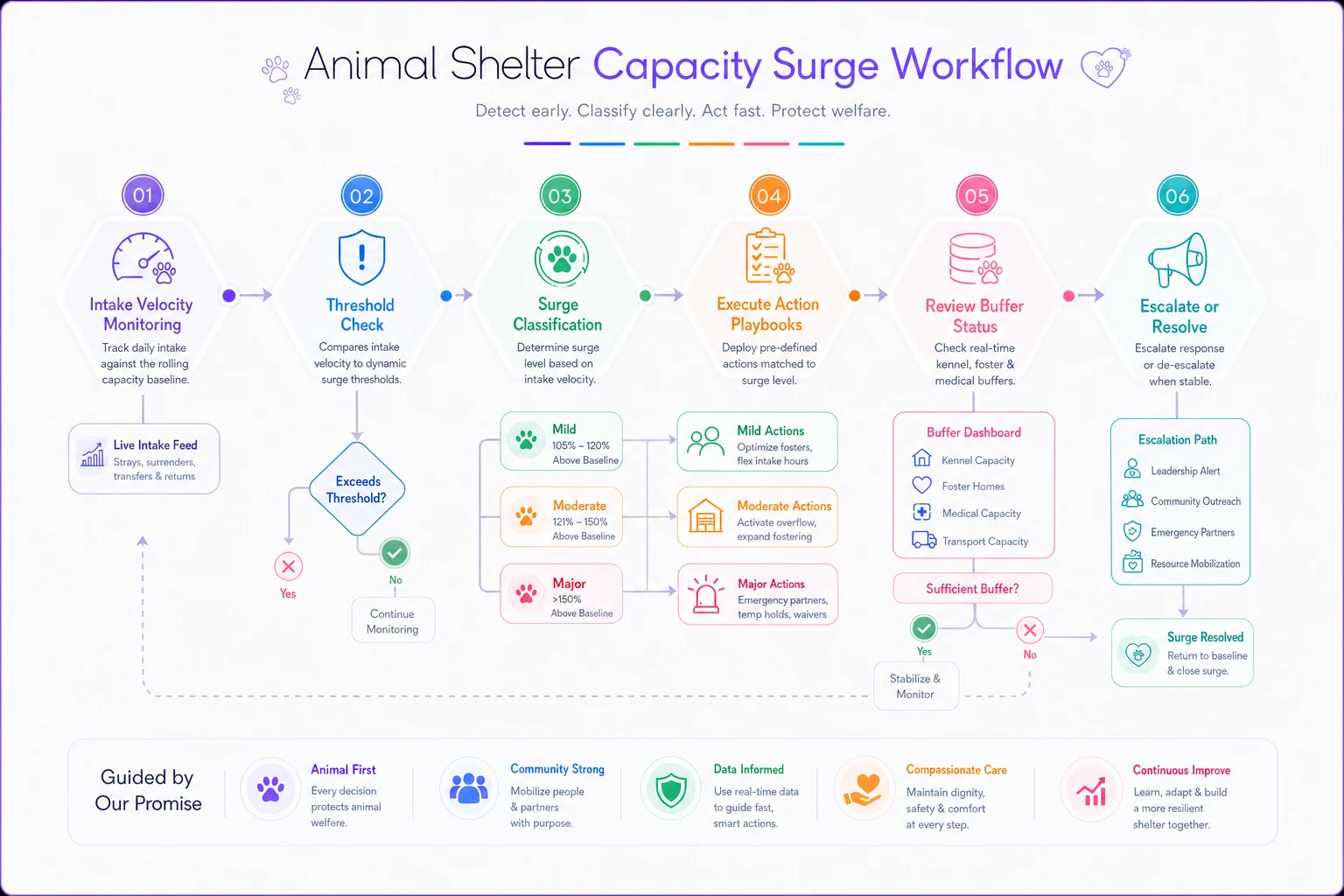
Use this flow as a visual reference when you build your SOPs and run tabletop drills.
Where this tends to go wrong
A few failure points worth naming, because they show up across shelters of very different sizes.
Thresholds set once and never revisited. Your baseline shifts seasonally. If your "normal" was set in a slow winter, your moderate trigger will fire constantly in summer. Recalculate baselines at least quarterly.
Watching intake, ignoring exits. Covered above, but worth repeating — it's the most common blind spot. A clogged medical queue can put you at capacity with completely flat intake.
Buffers that erode silently. Nobody decides to eliminate the buffer. It just gets used, kennel by kennel, until it's gone and no one noticed. Someone has to own protecting it.
No pre-authorized spending. The framework is only as fast as your slowest approval. If every surge action needs a board vote, you don't have a framework, you have a suggestion.
These aren't edge cases. They're the most common reasons a well-intentioned capacity plan ends up sitting in a Google Doc nobody opens when things get busy.
When this framework makes sense — and when it doesn't
Worth building if you run a shelter that experiences meaningful variation in intake and occupancy, and where capacity calls currently depend on one or two people's instincts. If decisions are consistently made late or inconsistently, the structure pays for itself in avoided crises.
It's overkill if you're a tiny foster-based rescue with no physical facility and stable, small intake. Your "framework" might just be a foster availability tracker and a group text. Don't build machinery you don't need.
And it's genuinely counterproductive to build the matrix without the authority structure behind it. A decision matrix nobody is empowered to execute is worse than no matrix, because it creates the illusion of a plan while still leaving you paralyzed when it matters.
A realistic scenario
A mid-sized municipal shelter — around 90 kennels — kept hitting capacity crises every summer. Their pattern was textbook: they'd notice they were full, scramble for fosters who were already tapped out, and end up paying somewhere between $2k and $4k in emergency boarding on a bad month. Intake pauses came too late and always felt like a fight.
They spent an afternoon defining three surge levels tied to their actual numbers, set a steady-state target of about 82% occupancy, held back a reserve list of roughly a dozen fosters, and gave their ops coordinator authority to spend up to a set amount on overflow supplies without escalation.
The change wasn't dramatic on paper. But the following summer, they declared moderate surge twice — early, based on intake velocity rather than a full building — and activated fosters while goodwill was still fresh. They avoided the emergency boarding spend almost entirely and, more importantly, stopped burning a week arguing every time things tightened. Staff described it as the difference between reacting and just following the plan.
The takeaway
Capacity planning isn't really about numbers. It's about deciding, in a calm moment, what your shelter will do when it's not calm — and giving specific people the authority to act without calling a meeting first. The scenarios, indicators, buffers, and matrix above are just a structure for moving those decisions out of the crisis and into the plan.
Build the thresholds around your real constraints, protect your buffers even when the spreadsheet complains, and run the drill before you need it. The shelters that handle surges well aren't the ones with the most space or money. They're the ones that already knew what they'd do.
Capacity planning isn't really about numbers. It's about deciding, in a calm moment, what your shelter will do when it's not calm — and giving specific people the authority to act without calling a meeting first. The scenarios, indicators, buffers, and matrix above are just a structure for moving those decisions out of the crisis and into the plan.
Build the thresholds around your real constraints, protect your buffers even when the spreadsheet complains, and run the drill before you need it. The shelters that handle surges well aren't the ones with the most space or money. They're the ones that already knew what they'd do.
Ready to enhance your shelter’s impact?
Join 500+ shelters using Animlly to improve care coordination, increase adoptions, and engage communities effectively.