


Nobody trains for this properly. New coordinators learn intake, adoption matching, how to run a vaccine clinic — but the euthanasia process usually gets passed down verbally, half-remembered, inconsistent from one shift to the next. That inconsistency is where the real damage happens. A missed rabies observation hold. A family that gets three different answers from three different staff members. A tech who assisted with five procedures in one week and nobody checked in on her afterward.
This isn't a philosophical piece about when euthanasia is justified. Your organization already has values around that. What most small shelters are actually missing is the operational structure underneath the decision — a repeatable process that protects the animal, the family, the staff, and the organization all at once. That's what a real shelter euthanasia SOP aftercare system does. Here's how to build one that holds up on a bad day.
The decision itself needs guardrails, not gut calls
The problem with "we decide case by case" is that case-by-case decisions drift. On a slow Tuesday with two empty kennels, an animal with a manageable behavioral issue gets weeks of runway. On a Saturday after a hoarding seizure drops 40 animals on you, that same animal gets a very different outcome — and the difference had nothing to do with the animal.
A decision tree doesn't remove judgment. It forces judgment to happen in the open, with the same inputs every time. Here's a structure that works for small teams without a full-time behavior department or on-staff vet.
Step through it in order, and require a second signature before the medical branch:
-
Medical status. Is there a diagnosed condition causing untreatable suffering, or a treatment path the shelter genuinely cannot fund or provide? "Cannot fund" must be documented with an actual cost estimate, not a vague sense that it's too expensive.
-
Behavioral status. Has the animal had a structured behavior evaluation, not just a kennel-card note? A dog labeled "aggressive" by a stressed intake volunteer is not the same as a dog that failed a repeated, documented assessment.
-
Rescue and transfer options. Have breed-specific rescues, partner shelters, and your foster network been contacted with a real timeline — not just "we'll see if anyone bites"?
-
Time and capacity reality. Is the pressure driving this decision the animal's condition, or your census? These need to be named separately, because conflating them is the single most common failure point.
-
Second reviewer sign-off. A person who was not part of the initial recommendation reviews the file. Their job is to catch drift.
The reason step four matters so much: when capacity pressure quietly bleeds into a medical or behavioral justification, the paperwork ends up saying one thing while the actual driver was another. That gap is where staff moral distress festers, and where you become legally exposed if anyone ever pulls the file.
When the fast track is appropriate — and when it absolutely isn't
There are genuine emergency cases. An animal hit by a car, non-responsive, in obvious agony at 11pm with no vet reachable. You don't run the full tree for that. You need a clearly defined emergency humane euthanasia pathway with a named authorized person, and you document it thoroughly afterward rather than delaying relief.
Where shelters get into trouble is letting the emergency pathway creep into ordinary decisions because it's faster. If more than a small fraction of your euthanasia events are running on the emergency exception, the exception has quietly become your process — and that needs a hard look.
Here's a visual of the decision workflow.
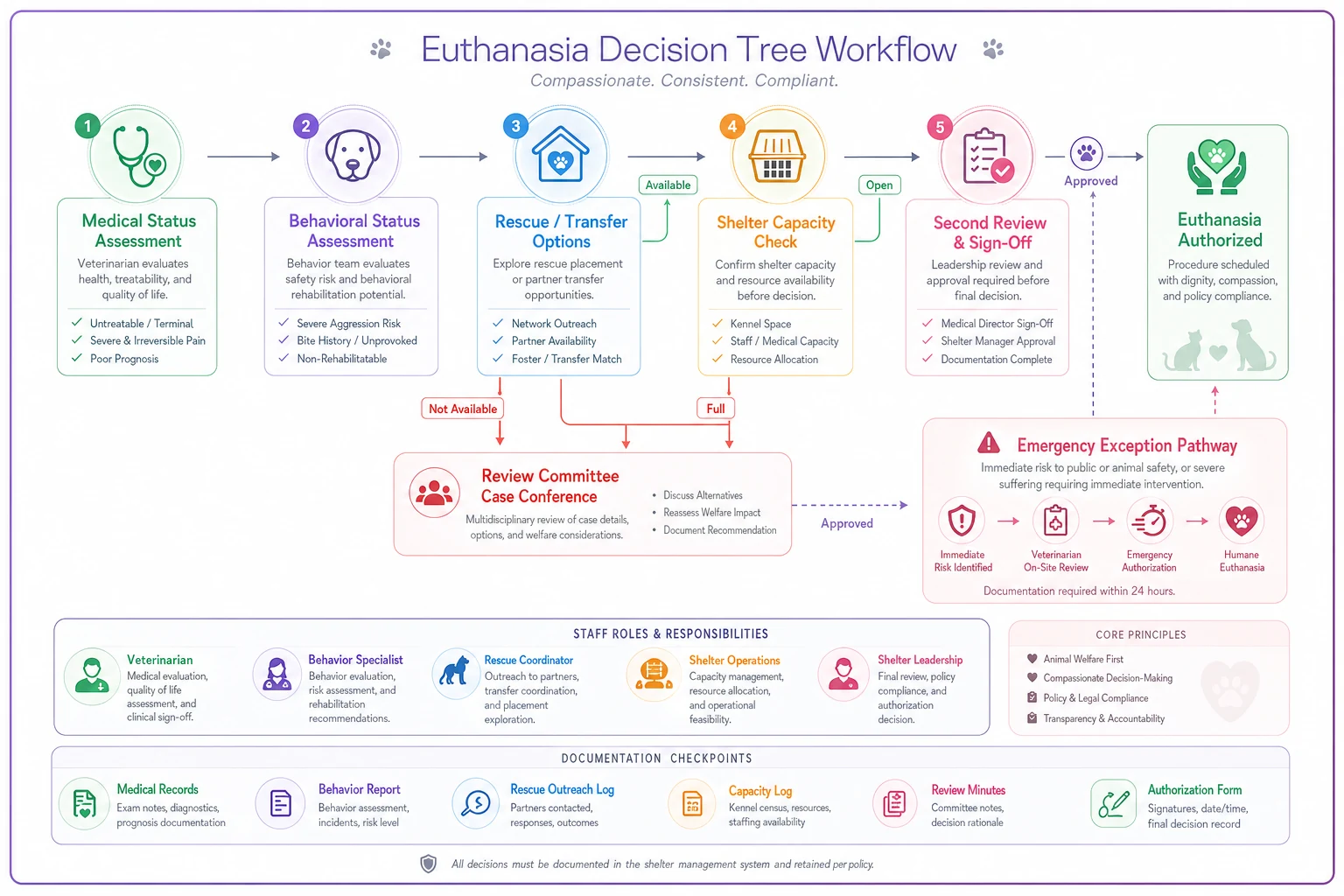
Keep the tree simple and visible so staff can follow it in the moment.
Documentation: the checklist that protects everyone later
Euthanasia records in small shelters are usually the thinnest files in the building, and they're the ones most likely to get scrutinized. A complaint, an open-records request, a disgruntled former volunteer posting online, a state inspection. The file is your entire defense, and "we all remember it was the right call" is not a file.
Streamline your shelter operations effortlessly.
Animlly helps you manage every pet, volunteer, and adoption step with ease and accuracy.
- Comprehensive pet profiles
- Volunteer scheduling & communication
- Adoption tracking & reporting
No credit card required
Build a single checklist that must be complete before the drug log gets signed. Not after. Before.
-
Animal identification — microchip scan result (even if negative), photos, intake ID, description
-
Reason category — medical / behavioral / owner-requested / emergency, with the specific documented basis for that category
-
Supporting records — vet notes, behavior assessment scores, cost estimates for declined treatment
-
Stray/hold clearance — legal hold period expired, owner-search steps documented, rabies observation status confirmed
-
Authorization signatures — recommending party, second reviewer, and the authorized decision-maker per your policy
-
Owner consent form (for owner-requested cases) — signed, with the requestor's ID verified
-
Drug log entry — controlled substance accounting reconciled the same day
-
Method and personnel — who performed it, who assisted, method used
-
Body disposition — cremation (private vs communal), return to owner, or other, with the family's choice recorded
The stray-hold clearance line is the one people skip when they're busy, and it's the one that ends careers. In most jurisdictions, euthanizing a stray before the mandated hold expires — even by a day — is a real violation. Tie that check to a hold clock, not to someone's memory of when the animal came in.
Tie that check to a hold clock, not to someone's memory of when the animal came in.
The controlled substance reconciliation nobody enjoys
Euthanasia drugs are DEA-regulated, and the paperwork discipline around them is non-negotiable. The pattern in small shelters is a drug log that's technically maintained but reconciled weekly instead of per-event — which means a discrepancy discovered on Friday could have originated any time in the prior five days. Reconcile per event. It takes about ninety seconds and it's the difference between catching an error and hunting for one.
If you're standardizing this alongside your other core procedures, it fits naturally into the same framework as your other editable SOPs and role assignments. This is exactly the kind of high-stakes, multi-signature process the approach in our modular shelter operations playbook was built to handle, with clear RACI mapping so nobody's guessing who signs what.
Family communication: scripts that hold up under grief
Owner-requested and owner-present euthanasia is where front-line staff feel most exposed, because there's no undo on the words. A clumsy phrase in that room gets remembered forever and sometimes ends up in a review or a lawyer's letter. Scripts aren't about being robotic — they give a shaking staff member language to fall back on when their own words fail.
Here's a comparison of what tends to go wrong versus what actually lands:
| Situation | What staff often say | What works better |
|---|---|---|
| Confirming the decision | "Are you sure you want to do this?" | "I want to make sure you feel ready. We can take a few minutes, or we can begin when you're comfortable." |
| Explaining the process | "The first shot is just a sedative and then the second one stops the heart." | "The first injection helps them relax and drift off. The second is peaceful and usually very quick. You can stay as long as you like." |
| When the family is second-guessing | "It's really the kindest thing." | "This is one of the hardest choices a person makes. From what the vet's notes show, you're doing right by him." |
| After it's done | "So did you want cremation or…" | "Take whatever time you need. When you're ready, I'll quietly walk you through the next steps." |
The left column isn't wrong information. It's the timing and register that fail. "Stops the heart" is accurate and brutal in the moment. "Peaceful and usually very quick" carries the same truth without the image that person will replay for weeks.
For phone conversations — declining owner-surrender requests, or informing an owner that a stray match was found too late — the rule is simple: deliver the hard fact early, then stop talking. People fill the silence themselves. Staff who rush to soften it with extra words almost always make it worse.
The disposition conversation, handled once
Body disposition is a small logistical question wrapped in an enormous emotional one, and asking it at the wrong moment feels callous. Build it into a single form the family reviews before the procedure when possible — private cremation, communal, or return of remains, with pricing stated plainly. Deciding this up front means you're not standing over a grieving person asking about invoices.
What happens to your staff after
This is the part that gets skipped entirely, and it's why good people burn out and leave. A tech who performed or assisted with a euthanasia doesn't clock out and reset. The cumulative weight — especially the capacity-driven ones, especially the healthy-but-unadoptable ones — is a documented cause of compassion fatigue and turnover in this field.
Post-event staff support doesn't require a therapist on retainer. It requires a few structured, non-optional steps:
-
Immediate release from other duties. Whoever performed or assisted gets 15–20 minutes away from the floor. Not "if it's slow." Always.
-
A same-shift check-in. A supervisor, not to debrief the case clinically — just to ask how the person is doing and mean it.
-
A rotation ledger. Track who's been assigned to these procedures. When one tech has assisted with several in a short span, rotate deliberately. Small shelters where the same two soft-hearted people quietly absorb nearly every procedure because they never say no — both usually gone within a year.
-
A no-questions mental health day allowance. A defined number of days per year that staff can use after hard events without justifying them.
-
A quarterly review of the emotional load, not just the operational numbers. If procedures are climbing, your people are carrying it whether they say so or not.
The rotation ledger point deserves emphasis because it's invisible until it isn't. Nobody schedules it deliberately — it just accretes onto whoever is willing. Making the load visible is the only way to distribute it fairly.
A real scenario
A small municipal-contract shelter, roughly 900 intakes a year, four full-time staff and a foster bench of about 25. Their euthanasia process lived entirely in one long-tenured tech's head. When she went out on medical leave for six weeks, everything wobbled — a stray got flagged for euthanasia two days before its hold actually expired (caught by luck when someone re-scanned the microchip), and two owner-present procedures went badly enough that both families left complaints.
They rebuilt it over about a month. Nothing fancy: a printed decision tree taped inside the med room cabinet, a one-page pre-signature checklist, laminated family scripts, and a whiteboard rotation ledger for staff assignments. The changes were unglamorous but real — documentation completeness on euthanasia files went from "usually missing something" to essentially complete, zero hold-clock errors over the following eight months, and the two techs who'd been silently absorbing most procedures started actually rotating. Turnover on that team, which had been a revolving door, stabilized for the first time in a while.
None of that required more money. It required the process to exist somewhere other than one person's memory.
Where to start if you have nothing written down
Don't try to author the perfect policy in one sitting — you'll stall on the philosophy and never get to the operations. Start with the three things that stop the worst outcomes:
-
The pre-signature checklist, because it prevents the legal and hold-clock errors
-
The decision tree with a second reviewer, because it stops capacity pressure from masquerading as medical necessity
-
The staff rotation ledger, because it keeps your best people from quietly breaking
Add the family scripts and the disposition form next. Then set a recurring review, because a euthanasia SOP that never gets revisited slowly drifts back into "how we've always done it" — which is exactly what you were trying to fix.
The organizations that handle this well aren't the ones with the biggest budgets. They're the ones that took the hardest part of the job and refused to leave it to memory, mood, and whoever happened to be on shift. Write it down, sign it twice, and take care of the people who carry it out.
Ready to enhance your shelter’s impact?
Join 500+ shelters using Animlly to improve care coordination, increase adoptions, and engage communities effectively.