

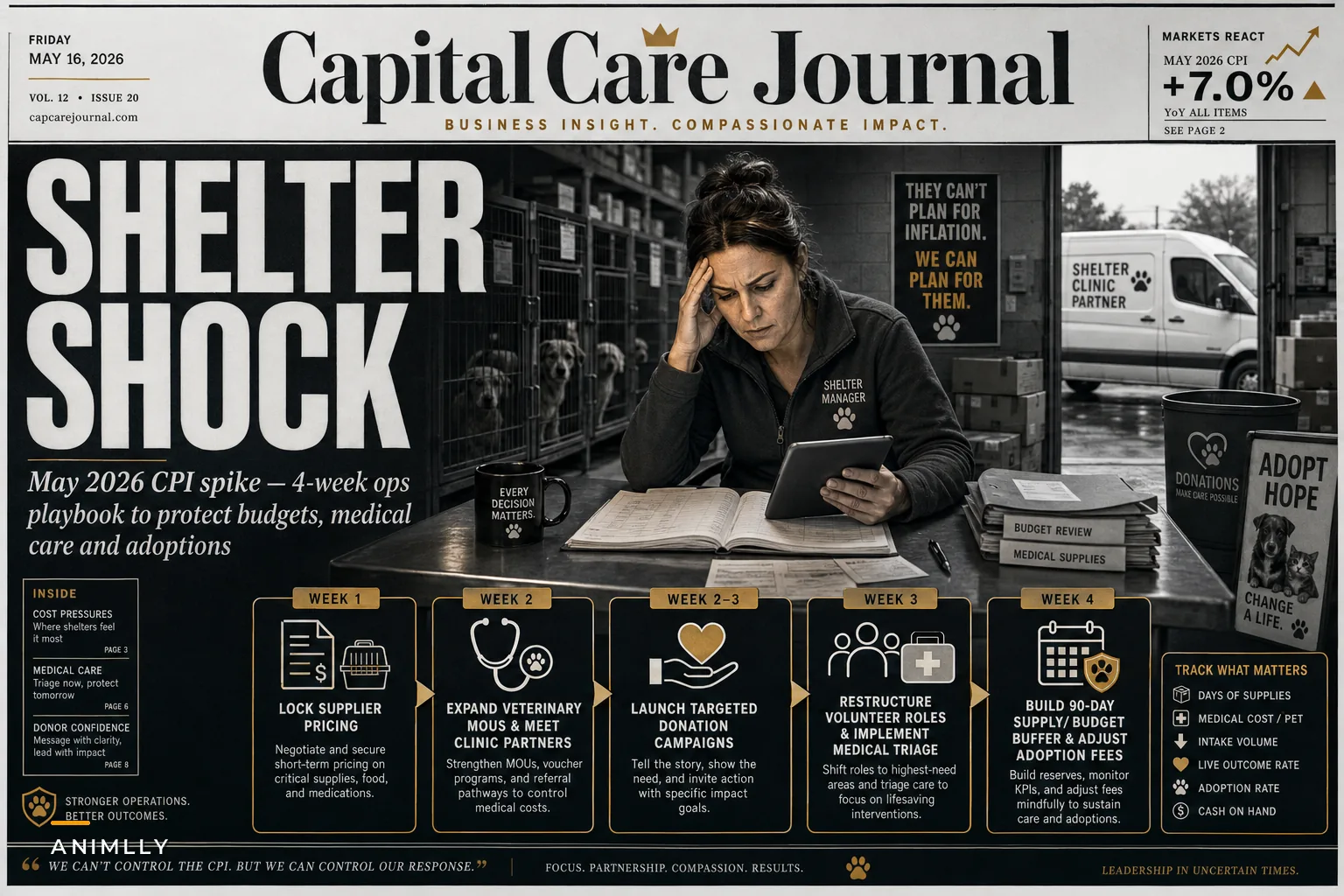

The May 2026 Consumer Price Index jumped to 4.2% year-over-year, the steepest climb since early 2023. For shelter managers already dealing with rising veterinary costs and supply shortages, this isn't just another economic headline—it's an immediate operational problem that needs attention this week.
I spent yesterday afternoon on calls with three shelter directors, and each one said basically the same thing: their Q2 budgets are already blown. One shelter in Ohio saw monthly medical supply costs jump around $1,800 between March and May. Another in Texas is watching fuel costs for their transport van eat up what used to cover two weeks of dog food.
And this shelter budget inflation 2026 spike is hitting right as kitten season ramps up. Perfect timing.
Move 1: Lock in supplier pricing through November (but only for these categories)
Most shelters wait too long to renegotiate supplier contracts. By the time you're seeing price increases on invoices, your leverage is already gone. Right now there's probably a three-week window before your suppliers start passing along their own increased costs.
Focus negotiation efforts on three categories that typically see the worst inflation spikes:
Medical supplies: Specifically syringes, bandages, and basic medications. These have predictable shelf lives and stable demand through fall. One shelter in Michigan locked in a six-month deal on basic medical supplies last week at only 2% above current pricing—their supplier was happy to guarantee volume through the slower winter months.
Cleaning products: Disinfectants and sanitizers always spike during inflation. Industrial suppliers are more willing to lock pricing than retail sources. Skip pet-specific brands and go direct to commercial cleaning suppliers.
Dry food (not wet): Wet food pricing is too volatile with aluminum costs, but dry food manufacturers will often commit to 90-day pricing if you can guarantee minimum orders.
Prioritize suppliers willing to guarantee volume through slower months to get the most favorable locked pricing.
Don't bother trying to lock in fuel prices or utility rates—those markets move too fast for small organizations to get favorable terms.
The Ohio shelter I mentioned tried to negotiate everything at once. They ended up with nothing locked in because their supplier got overwhelmed. Pick your battles.
Move 2: Create medical triage protocols that actually get followed
Every shelter has some version of medical prioritization, but inflation forces you to get brutally specific about what procedures happen when. The difference between managing through inflation and running out of medical supplies in August is having clear protocols staff actually follow when making daily decisions—not just a policy document sitting in a binder somewhere.
Streamline your shelter operations effortlessly.
Animlly helps you manage every pet, volunteer, and adoption step with ease and accuracy.
- Comprehensive pet profiles
- Volunteer scheduling & communication
- Adoption tracking & reporting
No credit card required
A three-tier medical response system tied to your current census and supply levels works better than one based purely on medical urgency.
Tier 1 (Immediate): Life-threatening conditions, severe pain, infectious disease risks to the population. These always get treated regardless of budget.
Tier 2 (Scheduled within census thresholds): Non-emergency surgeries, dental work, chronic condition management. These only happen when your census is below 80% capacity AND you have at least 45 days of medical supplies on hand.
Tier 3 (Postpone or refer): Cosmetic procedures, non-critical diagnostics, quality-of-life improvements for animals not yet in the adoption pipeline. These get scheduled only after successful adoption events or during donation surges.
The painful part is enforcement. Your medical team will resist this because it conflicts with their training instincts. But running out of antibiotics in July because you did elective procedures in June helps nobody.
One shelter coordinator in Arizona built a simple tracking board where each morning the medical team marks current census percentage and days of supplies remaining. Green on both? Tier 2 procedures can proceed. Either one yellow or red? Only Tier 1 that day. No debates, no exceptions.
Move 3: Restructure volunteer schedules around actual cost centers
Most volunteer programs center on animal interaction—dog walkers, cat socializers, adoption counselors. During inflation, you need volunteers covering your highest-cost operational tasks.
Transport assistance saves more money than almost any other volunteer role right now. With fuel costs driving inflation higher according to Reuters, every mile your staff drives costs roughly 40% more than it did in January. A volunteer who can do one transport run weekly saves you $60-80 in fuel and over $100 in staff time.
Shift volunteer recruitment specifically toward people with vehicles who can commit to regular transport schedules. Create a dedicated transport volunteer role with its own training, not just "whoever's available."
Supply organization and inventory volunteers also matter more than they used to. Shelters typically waste somewhere around 15% of supplies through poor organization—expired medications buried in back cabinets, duplicate orders because nobody knew what was in stock, supplies forgotten in wrong areas. A weekly inventory volunteer can cut that waste significantly.
The intake assistance role needs rethinking too. Instead of volunteers just comforting animals during intake, train them to handle the full data collection. This frees staff to process more animals without adding payroll. Every intake volunteers can fully handle saves 30-40 minutes of staff time.
Move 4: Implement cash-preferred donation campaigns (without alienating in-kind donors)
When inflation hits, the purchasing power gap between retail and wholesale becomes massive. Your dollar can buy roughly three times more supplies through commercial vendors than donors can buy at PetSmart. But telling donors to "just send cash" kills the emotional connection that drives giving.
Instead, create a "Shelter Buying Power" campaign that shows exactly how their cash multiplies. A simple comparison chart works well here:
-
$20 at retail = 1 bag of dog food
-
$20 through shelter purchasing = 3 bags of dog food
-
$50 at retail = basic medical supplies for 1 animal
-
$50 through shelter purchasing = medical supplies for 4 animals
Post these comparisons on social media weekly with real photos of your bulk purchases. Show actual wholesale invoices with vendor info blacked out. Make it tangible.
For donors who insist on bringing physical items, create a "Premium Needs List" of only items where the retail-wholesale price gap is smallest: specific prescription foods, specialized medical equipment, comfort items like blankets. This keeps them engaged while steering most resources toward cash.
A Pennsylvania shelter tested this in April when they saw early inflation indicators. Their cash donations increased around 35% while in-kind donations only dropped about 10%. The key was constant communication about buying power, not just asking for money.
Move 5: Renegotiate your veterinary partnerships before they do
Veterinary clinics face the same inflation pressures, but not all of them have adjusted pricing yet. The ones that move first will lock in higher rates for the rest of the year. You need to move faster.
Approach your partner clinics this week with a proposal: you'll guarantee them a specific number of procedures monthly in exchange for locked pricing through December. Most clinics prefer predictable revenue over potentially higher but uncertain spot pricing.
Structure the guarantee around your minimum needs, not your average. If you typically need 40-60 spay/neuters monthly, guarantee 40. You can always add more at the locked rate, but you're not obligated beyond the minimum.
For clinics hesitant about long-term pricing commitments, offer a quarterly review with a maximum 3% increase cap. This gives them some protection while preventing the 10-15% jumps we're seeing in spot pricing.
Your existing clinic partnerships become even more valuable during inflation periods, especially if you've already established referral protocols and trust. Clinics with existing relationships are far more likely to work with you on pricing than new ones.
Move 6: Adjust adoption fees strategically (not uniformly)
The knee-jerk reaction during inflation is to raise all adoption fees by some flat percentage. This actually reduces adoptions and increases your per-animal costs through longer stays.
Dynamic pricing based on length of stay and real carrying costs works better. Animals in your shelter 0-14 days can carry premium adoption fees—they're moving quickly anyway. Animals at 15-30 days get standard fees. Beyond 30 days, fees should drop weekly.
The math that matters: every additional week an animal stays costs roughly $140-180 in food, medical, cleaning supplies, and staff time depending on your region and how hard shelter budget inflation 2026 has hit you. Dropping an adoption fee by $50 to move an animal one week sooner actually saves you $90-130.
Some shelters resist this because it feels like certain animals are "worth less." That framing misses the point. You're optimizing flow-through rates to serve more animals with the same resources.
A North Carolina shelter implemented length-of-stay pricing in March when they saw inflation starting to impact their budget. Their average length of stay dropped from 24 days to 19, and their cost per adoption actually decreased despite inflation.
Move 7: Build a 90-day supply buffer for these five items only
Emergency supply buffers sound smart until you calculate carrying costs and expiration waste. During inflationary periods, holding too much inventory is nearly as dangerous as running out.
Buffer stock should focus only on items with long shelf life and guaranteed need:
| Item |
|---|
| Basic antibiotics: Amoxicillin and Clavamox have 12-18 month shelf lives and you'll use every dose. Buy 90 days worth at today's prices. |
| Syringes and needles: No expiration if stored properly, and prices are climbing. A 90-day supply runs roughly $200-400 depending on shelter size. |
| Paper products: Puppy pads, paper towels, toilet paper. These never expire and prices track directly with inflation. |
| Bleach and disinfectant concentrate: Buy concentrates, not ready-to-use products. Cheaper per use and less storage space required. |
| Dry prescription foods: For common conditions like kidney disease or food allergies. These have 8-12 month shelf lives and you'll definitely use them. |
Don't stockpile regular food, most medications, or medical equipment. The carrying costs and waste risk outweigh the inflation protection.
Creating your inflation response timeline
The shelters that get through inflation without major service cuts move fast on the operational basics while others are still reading economic reports.
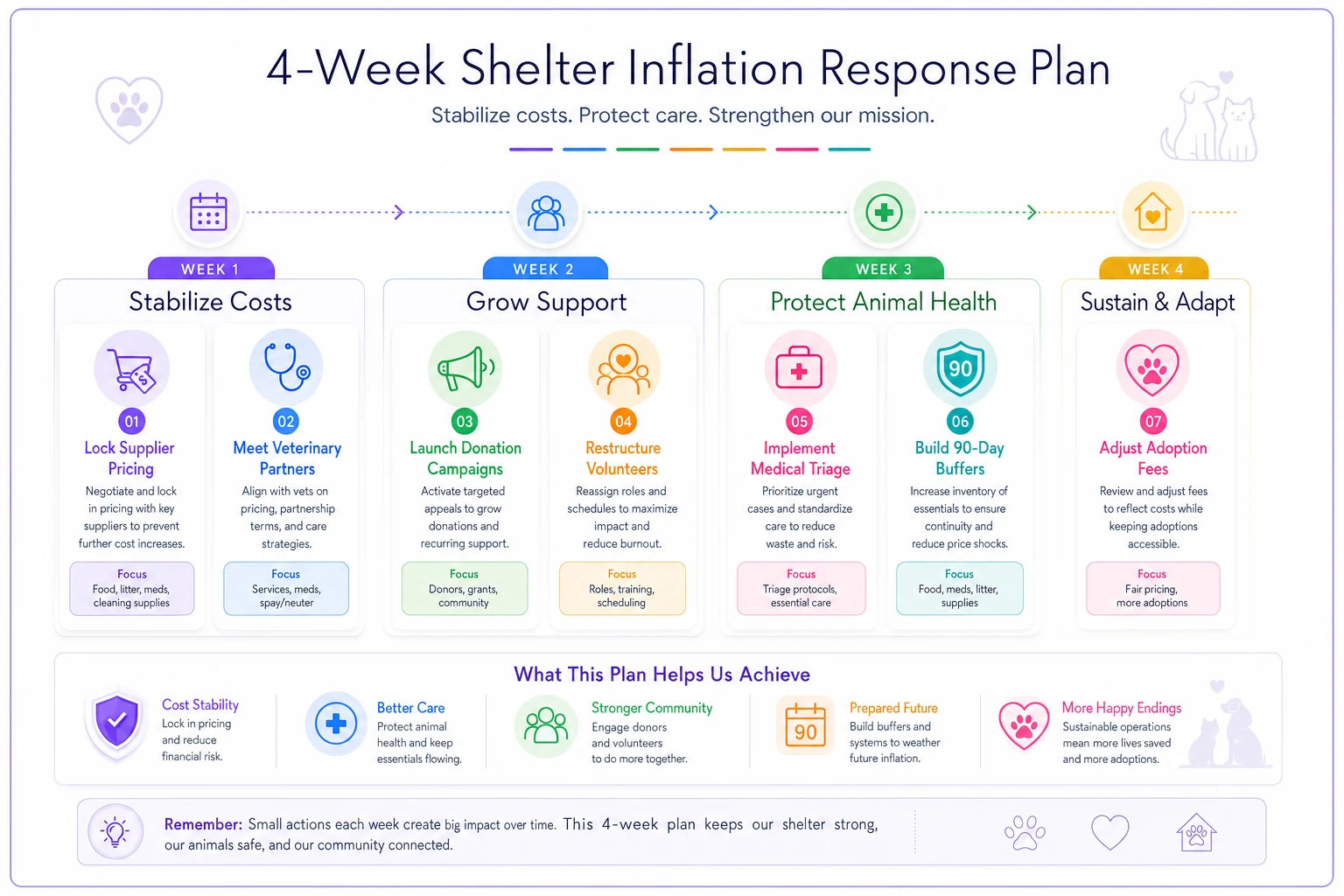
Week 1 (this week): Lock in supplier pricing for critical categories. Meet with veterinary partners about guaranteed procedure agreements.
Week 2: Launch cash-preferred donation campaigns with buying power comparisons. Restructure volunteer schedules toward cost centers.
Week 3: Implement medical triage protocols and train staff. Begin building 90-day buffers for the five critical items.
Week 4: Adjust adoption fee structure based on length of stay. Review early results and revise.
This timeline breaks down the first month into clear weekly priorities.
The shelter budget inflation 2026 spike isn't going away anytime soon. Economic indicators suggest sustained higher prices through at least Q4. But shelters that act on operational fundamentals—rather than hoping for more donations—can maintain service levels without burning through reserves.
The technology piece nobody talks about
Most inflation advice focuses on cutting costs or raising revenue. There's a third lever though: operational efficiency through better information flow.
When prices spike, a hidden cost is all the time spent managing chaos—calling suppliers for quotes, tracking inventory across multiple spreadsheets, coordinating volunteer schedules through group texts, manually calculating adoption pricing. It adds up fast.
A shelter in Florida started using AI-powered operational software to centralize their vendor communications and automate reorder triggers. What used to take their manager around six hours weekly now happens automatically. That's six hours redirected to adoption events and fundraising.
The same platform tracks actual supply usage patterns, so instead of guessing when to reorder, they know exactly when supplies will run out based on current census and historical data. During inflation, avoiding emergency orders—which come with premium pricing—saves 15-20% on supplies.
Small shelters sometimes assume operational software is just for larger organizations. But when your team is already stretched thin and every purchasing decision carries more weight, having AI handle routine coordination and tracking is often the difference between proactive management and reactive scrambling.
What happens if you wait
Shelters that don't act quickly on inflation face a predictable pattern. First, they run low on medical supplies and start postponing routine procedures. Then they can't cover transport fuel and reduce their intake radius. Adoption events get cancelled because there's no budget for venues or marketing.
By August, these shelters are running emergency fundraising campaigns, implementing temporary intake stops, or considering staff layoffs. The community loses confidence. Donors shift to other causes. It compounds.
Meanwhile, shelters that locked in pricing and restructured operations are picking up transfers from struggling neighbors, attracting more consistent donors, and quietly becoming the regional resource while others struggle.
The moves outlined here aren't complicated or revolutionary. They're the unglamorous, systematic adjustments that separate well-run shelters from ones that are always one crisis away from a funding emergency. The only question is whether you make them now, when you have some leverage, or in three months when you're reacting to shortages.
Your animals don't care about CPI statistics. They need food, medical care, and a path to adoption. These seven moves keep all three intact regardless of what inflation does next month.
Ready to enhance your shelter’s impact?
Join 500+ shelters using Animlly to improve care coordination, increase adoptions, and engage communities effectively.