

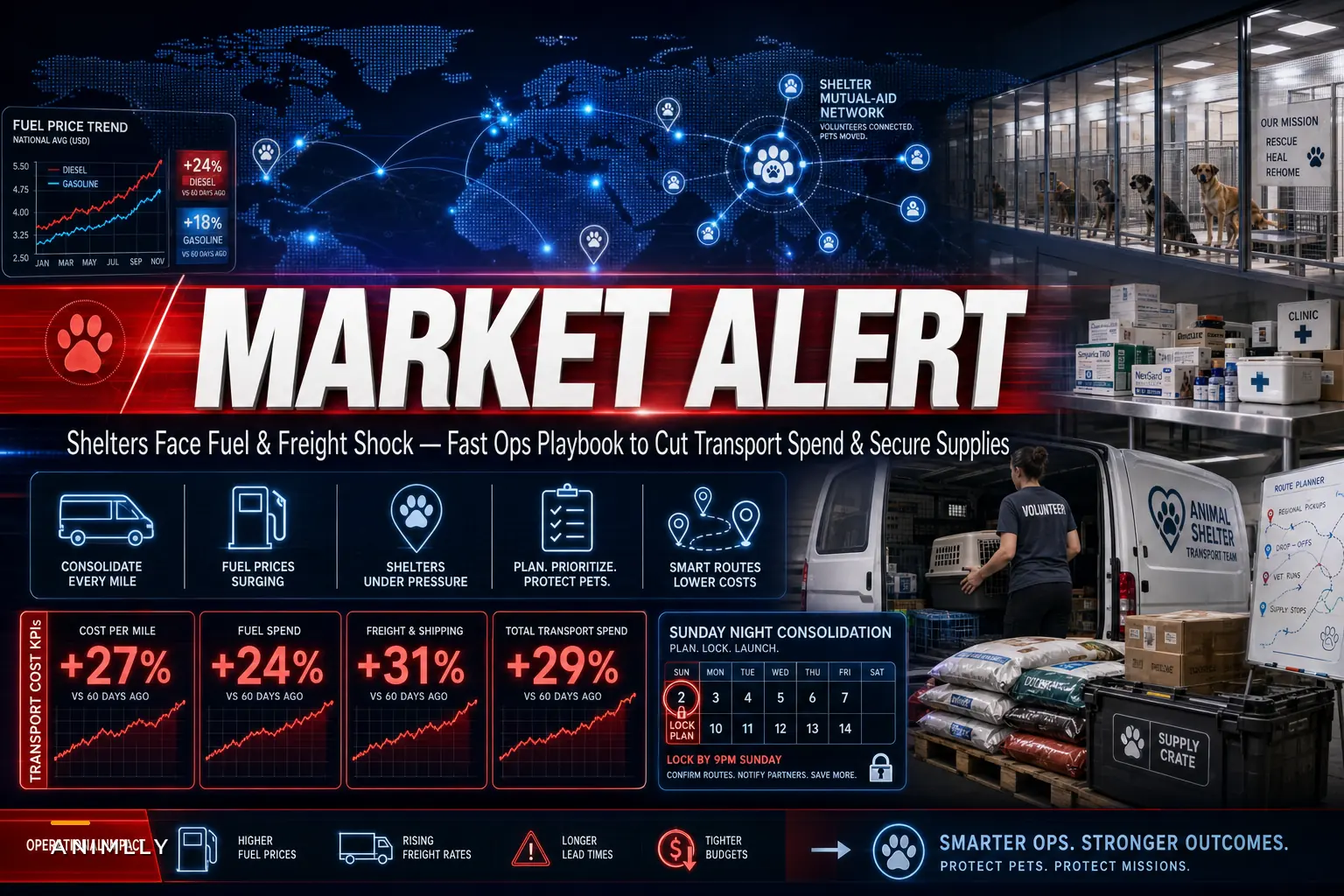

The late-October fuel situation hit shelters at just about the worst time of year — right as cold-weather intake starts climbing and holiday adoption events ramp up. Reuters reported in a late-October study on fuel price spikes that U.S. consumers are absorbing unusually sharp gasoline and diesel increases, with Middle East supply concerns keeping prices elevated. Markets have been jumpy too — oil moved on peace talks one day and Saudi facility concerns the next, as covered in another Reuters piece on oil volatility.
For most people that reads as "gas is expensive again." For a shelter, it means something more specific: every long-distance transfer, every mobile vaccine clinic, every volunteer driving 30 minutes each way to walk dogs, and every pallet of kibble on a freight truck just got more expensive at the same time. And unlike a restaurant that can nudge menu prices, you can't pass that cost to anyone.
This isn't a "tighten your belt" piece. Fuel spikes are temporary, but they expose permanent weaknesses in how transport-dependent operations are wired. Below is what actually breaks — and the concrete moves that hold things together.
Start by figuring out what fuel actually costs you — because most shelters don't know
Ask most shelter managers what they spend per mile on transport and you'll get a shrug or a gut-feel number. Fuel gets buried inside a vague "vehicle expenses" line, freight gets absorbed into supply invoices as "shipping," and volunteer mileage never appears on any ledger because volunteers eat it personally.
That invisibility is the real problem a fuel spike reveals. You can't defend a budget you can't see, and you can't reprioritize transports when you don't know which ones are cheap and which are bleeding you.
Before you change anything, pull three numbers for the last 60 days:
-
Owned-vehicle cost per mile — total fuel plus maintenance divided by miles driven
-
Freight surcharge creep — compare the "shipping/fuel surcharge" line on your last three supply invoices
-
Volunteer travel exposure — roughly how many of your active volunteers drive more than 20 minutes one way
A typical mid-size shelter running one van and a couple of staff cars is often surprised to find their blended cost sitting somewhere around $0.70–$0.95 per mile once maintenance is folded in. That diesel transfer run of 300 miles round-trip isn't a $40 problem — it's closer to a $120–$160 problem after recent price jumps.
Getting this visibility is a prerequisite for everything else. Without it, you're making cuts based on guesswork.
The transfer run is usually the first thing people cut — and usually the wrong first cut
When budgets tighten, the instinct is to cancel or shrink long-distance transfers. Sometimes that's right. Often it quietly backfires, because the transfer partner on the receiving end has higher adoption velocity than you do, and animals that stay with you sit longer, eat more, and occupy kennel space you need for incoming strays.
Streamline your shelter operations effortlessly.
Animlly helps you manage every pet, volunteer, and adoption step with ease and accuracy.
- Comprehensive pet profiles
- Volunteer scheduling & communication
- Adoption tracking & reporting
No credit card required
So the question isn't "should we cut transports." It's "which transports earn their fuel."
A simple way to triage:
| Transport type | Keep / consolidate / pause | Why |
|---|---|---|
| Transfer to high-adoption partner | Keep | Faster outcomes outweigh fuel cost; LOS savings usually exceed per-mile spend |
| Routine supply pickup | Consolidate | Batch into fewer, fuller trips instead of weekly small runs |
| Mobile clinic in low-turnout area | Pause / relocate | High fuel + low throughput = worst ratio |
| Foster transport within town | Keep | Short distance, high welfare value |
| Adoption event 90+ min away | Evaluate | Only if historical adoptions-per-event justify the diesel |
The pattern worth noticing: the cheapest transports to run — short, local, foster-related — are almost never the ones on the chopping block. The ones people instinctively protect (big recurring events far away) are sometimes the least defensible per animal moved.
The triage process itself should take one meeting, maybe 45 minutes with your transport lead and whoever manages volunteers. You don't need a consultant. You need a whiteboard and honest numbers.
Route consolidation is boring and it's where the real savings live
Nobody gets excited about combining trips, but this is the single highest-ROI move during a fuel spike. The waste in most shelter transport isn't the long transfers — it's the dozens of small, half-empty, uncoordinated runs nobody's tracking.
In practice it usually looks like this: a volunteer drives to pick up a donated crate Monday, staff runs to the vet partner Tuesday, someone grabs supplies Wednesday, a foster drop-off happens Thursday — four separate trips covering overlapping geography, each burning fuel to move something small. Nobody planned it that way. It just accumulated.
A workable consolidation workflow:
-
Create a single "trips this week" board that everyone adds to — pickups, drop-offs, vet runs, supply errands.
-
Assign a trip coordinator (can be a volunteer) who looks at the board every Friday for the week ahead.
-
Cluster by geography and day, not by who requested it.
-
Fill the vehicle — if the van's going north for a transfer, what supplies, fosters, or pickups can ride along?
-
Lock the schedule by Sunday night so volunteers can plan and you're not making last-minute solo runs.
Shelters that go from ad-hoc to even loosely coordinated routing often shave 15–25% off total miles within a month. Fewer trips also means less wear and fewer volunteer hours lost to driving.
Use a shared Google Sheet to track trips; it's enough to start.
This is also where keeping your trip data in one place — rather than scattered across texts and whiteboards — pays off. Not because of fancy software, but because you literally cannot consolidate trips you can't see together on one screen. A shared Google Sheet is enough to start.
Here's a visual workflow for consolidating trips.
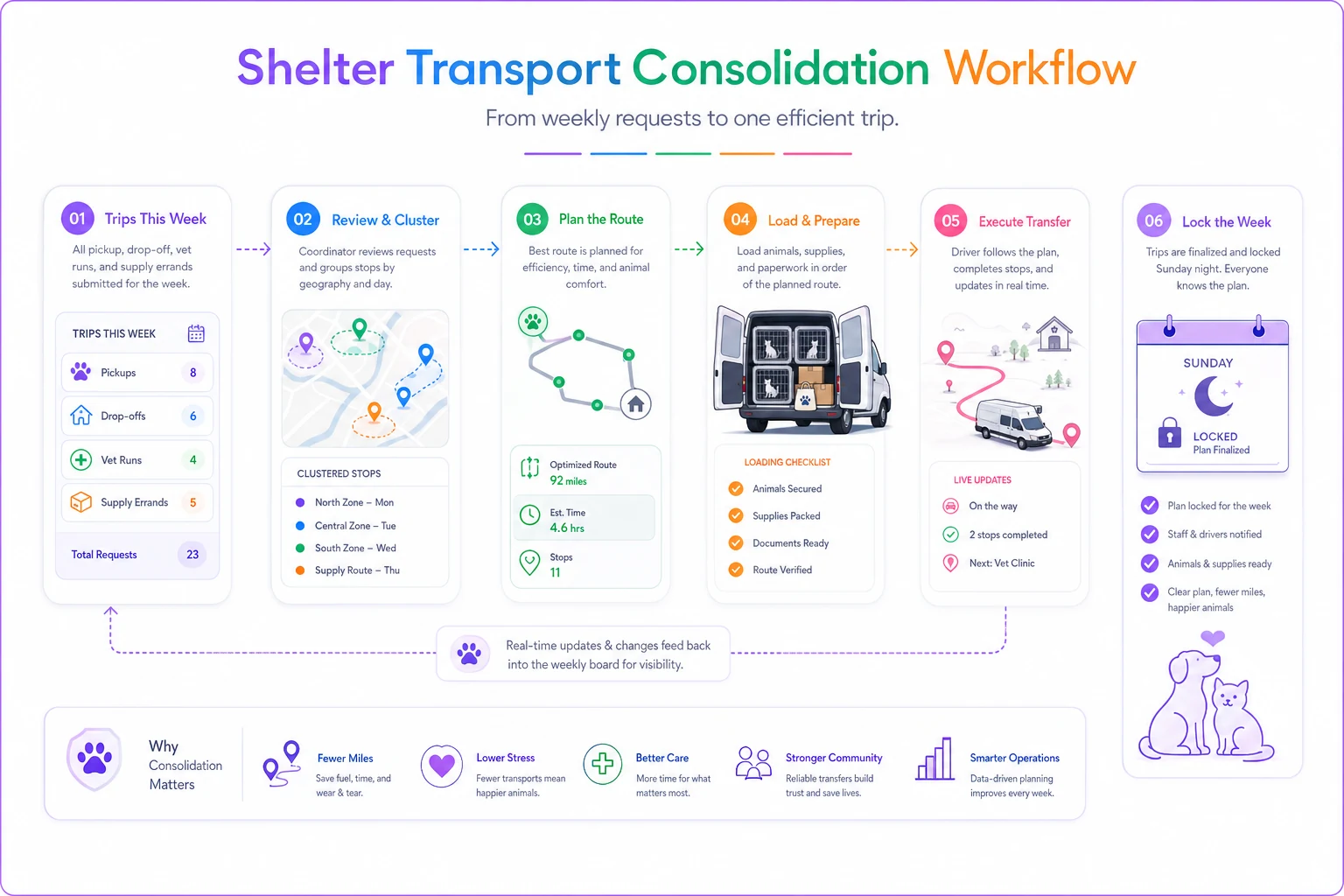
Keep it simple; the goal is one screen showing all trips.
Freight and supply costs: renegotiate before you reorder
Vendor fuel surcharges are the quiet killer here. They show up as a small percentage line that most shelters pay without blinking. During a diesel spike those surcharges climb, and because they're framed as "just the fuel adjustment," nobody pushes back.
A few moves that actually work:
-
Call your top 2–3 suppliers directly. Ask what the surcharge is pegged to and whether nonprofit or bulk-order terms can offset it. Vendors rarely volunteer discounts but frequently grant them when asked.
-
Shift to fewer, larger orders. Freight is often priced per shipment, not per pound. Two big deliveries beat five small ones on surcharge math — just make sure you have storage and that nothing perishable spoils.
-
Build a buffer, not a stockpile. A 3–4 week cushion on food and core meds protects you against delivery delays without tying up cash in inventory you can't afford.
-
Split-source critical items. If one supplier's freight gets ugly, having a second account already open means you're not stuck scrambling.
A small shelter spending roughly $2,800–$3,500 a month on food and medical supplies can often find $200–$400 in monthly surcharge relief just by consolidating orders and making two phone calls. Not glamorous, but over a fiscal year that's real money that stays in medical care.
The volunteer problem nobody budgets for
The impact that doesn't show up in any expense line — and does the most long-term damage — is volunteers quietly dropping off because the commute got too expensive.
Your travel-dependent roles — transport drivers, off-site event staff, mobile clinic helpers — are exactly the people most sensitive to fuel prices, and they're the hardest to replace. When a transfer driver stops showing up, you don't lose an hour; you lose the entire capability.
Watch for the early signs:
-
Transport and event shifts getting harder to fill than kennel shifts
-
The same 2–3 drivers carrying every long run
-
Volunteers who live farther out going quiet without formally quitting
Practical responses that don't require money you don't have:
-
Reimburse mileage for long transport runs specifically, even if you can't do it for everyone. Protecting the drivers you depend on is cheaper than recruiting new ones.
-
Prioritize local volunteers for travel roles and remote-friendly tasks (data entry, follow-up calls, social media) for far-away folks.
-
Carpool your event teams. Four volunteers in one car to an adoption event instead of four cars is good for them and good for coordination.
Most shelters won't do any of this until a key driver disappears. Don't wait for that moment.
A real scenario
A county-adjacent rescue running one diesel van and about 40 active volunteers got squeezed hard in late October. Their big recurring commitment was a weekly 280-mile round-trip transfer plus a twice-monthly mobile clinic 75 minutes out that had been averaging only six or seven animals per visit.
When they ran the actual numbers, the mobile clinic was costing close to $110–$130 in fuel per visit to treat a handful of animals — while the weekly transfer was moving dogs to a partner with far faster adoption rates. They'd been treating both as equally untouchable.
They paused the far mobile clinic, moved those services to a partner clinic closer in, consolidated supply pickups into the transfer route (the van was already going that direction), and started reimbursing their two main transfer drivers for mileage. Net effect over about six weeks: roughly $450–$600 in monthly transport and supply savings, two drivers who stopped grumbling about gas, and no measurable hit to animal outcomes. The clinic relocation actually slightly improved community turnout because the new location was easier to reach.
Nothing in that story required new funding. It required seeing the costs clearly and being willing to question which routes were actually earning their fuel.
When cutting transport is the wrong call
Worth saying plainly, because panic cuts cause real damage: don't pause transfers that feed a high-velocity adoption partner, don't gut local foster transport (it's cheap and keeps animals out of kennels), and don't eliminate reimbursement for your core drivers to save a few hundred dollars — losing them costs far more.
The goal is surgical reprioritization, not across-the-board slashing. There's a big difference between those two things, and it's easy to lose that distinction when cash feels tight.
This spike is a stress test, not the real problem
Fuel will come back down eventually. Markets are already swinging on negotiation headlines. But the next disruption — freight strike, supply recall, weather event, another price shock — will hit the same soft spots: untracked transport costs, uncoordinated routing, fragile volunteer logistics, and supply chains with no buffer.
The shelters that handle this well aren't the ones with bigger budgets. They're the ones that can see their numbers quickly and reallocate without drama. That's less about any one cost-cutting trick and more about having an operating model that bends instead of breaking.
If you want to build that underlying durability so the next shock is a nuisance instead of a crisis, our financial resilience framework for small animal shelters walks through the broader structure — buffers, scenario planning, and the decision rhythms that keep a shelter stable through exactly these kinds of swings.
For right now, the move is simple and unglamorous: find your real per-mile and freight costs, triage your transports by what they actually accomplish, consolidate every trip you can, make two phone calls to your suppliers, and protect the drivers you can't afford to lose. Do those five things this week and you'll ride out this spike in far better shape than you'd expect.
Ready to enhance your shelter’s impact?
Join 500+ shelters using Animlly to improve care coordination, increase adoptions, and engage communities effectively.