


Most shelter managers didn't get into this work to build spreadsheets. They got into it because they couldn't walk past a dog in a crate. But somewhere between the intake surges and the grant deadlines, the money side quietly became the thing that decides whether the mission survives the year.
The uncomfortable part: a shelter can be excellent at animal care and still get financially blindsided. Great save rates, strong adoption numbers, a loyal volunteer base — none of that protects you when a $9,000 HVAC failure hits the same month a major donor delays their pledge. The care side and the money side are two different systems, and when they aren't connected, one of them eventually breaks the other.
This is meant to be a working shelter financial resilience framework — not a lecture on accounting. The goal is to give non-financial leaders a way to think about reserves, budgeting under uncertainty, spending priorities, and small earned-income experiments, all tied together so the whole thing actually holds under pressure.
Why shelter finances break in a specific, predictable pattern
The failure almost never looks like "we ran out of money." It looks like a chain reaction.
A typical example: donations dip 15% over a slow summer. Nobody panics, because summer is always slow. Then an unexpected parvo case forces a partial intake hold, which drops adoption revenue and adds medical costs at the same time. Now the shelter is spending more and taking in less. Two weeks later, payroll is due, the vet invoice is due, and the operating account has about eleven days of cash in it.
None of those events were catastrophic on their own. The problem is they weren't modeled together. Small shelters tend to run their finances reactively — check the balance, pay what's urgent, hope the next appeal does well. That works right up until two or three normal-sized problems stack in the same month.
Financial fragility in small operations isn't usually caused by a lack of money. It's caused by a lack of structure around the money. No clear reserve target, no shared picture of what a bad quarter looks like, no rule for which expenses get protected when things tighten. So every decision becomes an argument, made under stress, with incomplete information.
The rest of this framework is really about removing those in-the-moment decisions and turning them into pre-made ones.
Tier one: three-tier reserve targets you can actually defend
Reserves are where most shelters either overthink it or ignore it entirely. "Three to six months of operating expenses" is the standard advice, and it's basically useless for a shelter running on $180k a year with donations that swing wildly month to month. You need something more granular.
Streamline your shelter operations effortlessly.
Animlly helps you manage every pet, volunteer, and adoption step with ease and accuracy.
- Comprehensive pet profiles
- Volunteer scheduling & communication
- Adoption tracking & reporting
No credit card required
Break your reserve into three tiers, each with a different job:
| Reserve tier | What it covers | Rough target | When you touch it |
|---|---|---|---|
| Tier 1 — Operating float | Normal cash-flow gaps between donations and bills | 4–6 weeks of core operating costs | Routinely, then refill |
| Tier 2 — Disruption buffer | Medical spikes, equipment failure, a slow fundraising quarter | 2–3 months of core costs | Board-notified, specific triggers |
| Tier 3 — Existential reserve | Loss of a major funder, facility damage, prolonged intake crisis | Whatever keeps you alive 90+ days | Board-approved only, rare |
The insight most people miss: these tiers aren't just piles of cash, they're decision permissions. Tier 1 you can spend without a meeting. Tier 2 requires a documented reason. Tier 3 requires the board. That structure prevents the slow-motion mistake where a shelter quietly drains its entire safety net through a series of "just this once" withdrawals nobody flagged.
Shelters that only track one lump reserve almost always spend it down to zero over 18–24 months without noticing, because there's no internal line that says "stop." The three-tier split creates those lines.
One more practical note — define "core operating costs" narrowly. Payroll, essential medical, utilities, food, and insurance. Not the enrichment program, not the new website, not event catering. When you're calculating survival numbers, you want the version of the shelter that keeps animals alive and legal, nothing more.
Tier two: scenario budgets instead of one hopeful budget
Most shelter budgets are a single column of numbers representing the year everyone hopes happens. That's not a budget, that's a wish. Real financial resilience comes from budgeting three versions of the year at once.
You don't need financial software or an MBA for this. You need three scenarios and a couple of hours.
Mild scenario — a normal-ish year with the usual bumps. Donations come in roughly on trend, intake is seasonal but manageable, maybe one surprise expense. This is your baseline plan.
Moderate scenario — something meaningful goes wrong. A 20–25% drop in a key revenue stream, or an intake surge that pushes medical and food costs up by a third for a quarter. Not a disaster, but enough to force choices.
Major scenario — a real hit. A grant doesn't renew, the facility takes damage, or a disease outbreak forces a multi-week intake hold. Revenue down significantly, costs up, timeline uncertain.
-
Start with your mild budget as the base.
-
For each revenue line, write a moderate and major version (e.g., major-donor income at 100% / 75% / 50%).
-
Do the same for your volatile cost lines — medical, food, utilities.
-
Total each scenario and compare it against your reserve tiers.
-
For the moderate and major columns, write one sentence per line describing what you'd cut or delay to close the gap.
That last step is the whole point. When you can look at the major-scenario column and already know "if this happens, we pause the mobile clinic, delay the two seasonal hires, and draw Tier 2 for three months" — you've converted a future panic into a pre-made plan.
A mistake worth calling out: shelters build the scenarios, feel good about being prepared, then never tie them to actual triggers. A scenario budget only works if you know what event flips you from mild into moderate. Write those triggers down. "Operating cash under six weeks" or "major donor pledge slips past 30 days" — concrete, observable, not vibes.
If you've already built out capacity scenarios for animal flow, this should feel familiar. The financial version is the same muscle, just pointed at dollars instead of kennels — and ideally the two are linked, because an intake surge is both an operational and a financial event.
Tier three: protecting the right spending when money gets tight
When cash tightens, the natural instinct is to cut whatever feels non-essential first. That instinct is often wrong, and it's where a lot of shelters quietly damage themselves.
The distinction that matters is recurring spend vs. capital spend, and then within recurring, protected vs. flexible.
-
Protected recurring — payroll for core staff, essential vet care, food, utilities, insurance, licensing. Cutting these breaks the shelter's ability to function or stay compliant.
-
Flexible recurring — enrichment supplies, non-critical software subscriptions, marketing spend, travel, some professional development. Painful to trim, but survivable short-term.
-
Capital spend — HVAC, vehicles, kennel renovations, major equipment. Big, occasional, and deferrable far more often than people assume.
In a cash crunch, delaying capital spend is almost always smarter than cutting protected recurring, even when the capital item feels urgent. A cracked kennel run is a problem. Losing your one experienced medical staffer because you couldn't make payroll is a catastrophe you may never fully recover from.
A realistic mistake pattern: a shelter facing a shortfall cancels its part-time vet tech's hours to save maybe $1,800 a month, then watches medical throughput collapse, length-of-stay climb, and adoption revenue fall — a far bigger hit than the savings. They cut a protected function to preserve a capital timeline. Backwards.
The cleaner priority order, when tightening:
-
Freeze or defer capital projects.
-
Trim flexible recurring.
-
Draw Tier 2 reserves against a written plan.
-
Only then touch protected recurring — and treat that as an emergency, board-level decision.
Building this priority order before you need it is what separates a shelter that navigates a rough year from one that spirals through it. Keeping these decisions documented alongside your other operating procedures — the way you'd handle any modular shelter operations playbook — means the plan survives staff turnover and doesn't live only in the director's head.
The overlooked layer: small earned-income pilots
Reserves and scenario budgets protect you. They don't grow you. For that, most resilient shelters add a modest layer of earned income — revenue that isn't dependent on the next donation appeal or grant cycle.
The key word is small. This isn't about becoming a business. It's about running a few low-risk pilots that diversify income and, ideally, produce metrics your funders like to see.
-
Low-cost microchip or nail-trim clinics — a few hours, existing staff, modest per-service fee.
-
Paid basic training classes — leash manners, puppy socialization, run by a qualified volunteer.
-
Branded merch or a "sponsor a kennel" tier — recurring small dollars with a strong emotional hook.
-
Boarding for a small number of community pets — only if you have genuine surplus capacity and clean infection-control separation.
The discipline is treating each one as a pilot with an ROI question, not a permanent program you commit to blindly. Run it for a defined window — say 8 to 12 weeks — and measure whether the net revenue justifies the staff time and risk.
A rough example: a shelter runs a monthly low-cost microchip clinic. Say 25–35 pets per session at a $20 fee, chip cost plus supplies around $8 each, roughly three volunteer-hours and some staff coordination. Net is maybe $300–$400 a session — not life-changing, but it's a few thousand dollars a year of diversified income, plus a community-engagement story that travels well. The revenue matters less than the fact that it doesn't move with the donation cycle.
That community-engagement angle is where earned income quietly pays off twice. Framed correctly, these pilots feed directly into the metrics funders care about — animals served, community members reached, services delivered outside the shelter walls. If you already track welfare, adoption and community-impact outcomes, fold the pilot numbers into that same reporting. A grant reviewer seeing "served 380 community pets through low-cost clinics" reads it as capacity and reach, not just a revenue line.
When earned-income pilots make sense
Run them when you have spare staff or volunteer capacity, a facility that can safely separate community animals from your population, and a leader willing to actually kill the pilot if the numbers don't work.
When they're a bad idea
Skip them if you're already understaffed, if infection-control separation is questionable, or if the "pilot" is really just a pet project nobody plans to measure. An earned-income program that drains your team's time and produces $50 a month isn't diversification — it's a distraction with better branding.
A short real scenario
A small municipal-contract shelter — roughly a $210k annual budget, three paid staff, heavy volunteer support — kept ending each fiscal year within a few thousand dollars of empty. Not because they were badly run, but because every budget was a single hopeful column and there was no reserve structure at all. One bad month and the director was personally calling donors for emergency cash.
They didn't overhaul anything dramatic. Over about a quarter, they split their small reserve into the three tiers, built mild/moderate/major scenarios with written triggers, and reordered their spending priorities so capital projects got deferred before staff hours got cut. They also started one earned-income pilot — a monthly microchip-and-nail clinic.
By the end of the following year, things looked noticeably different. The operating float meant no more panic-mode donor calls for routine cash gaps. When a summer donation dip hit — right around the moderate-scenario threshold — they followed their own written plan instead of improvising, delayed a kennel resurfacing project, and rode it out without touching payroll. The clinic added somewhere around $3k–$4k over the year and gave them a clean "community pets served" number for their next grant application. Nothing flashy. Just a shelter that stopped lurching from crisis to crisis.
Keeping the system connected
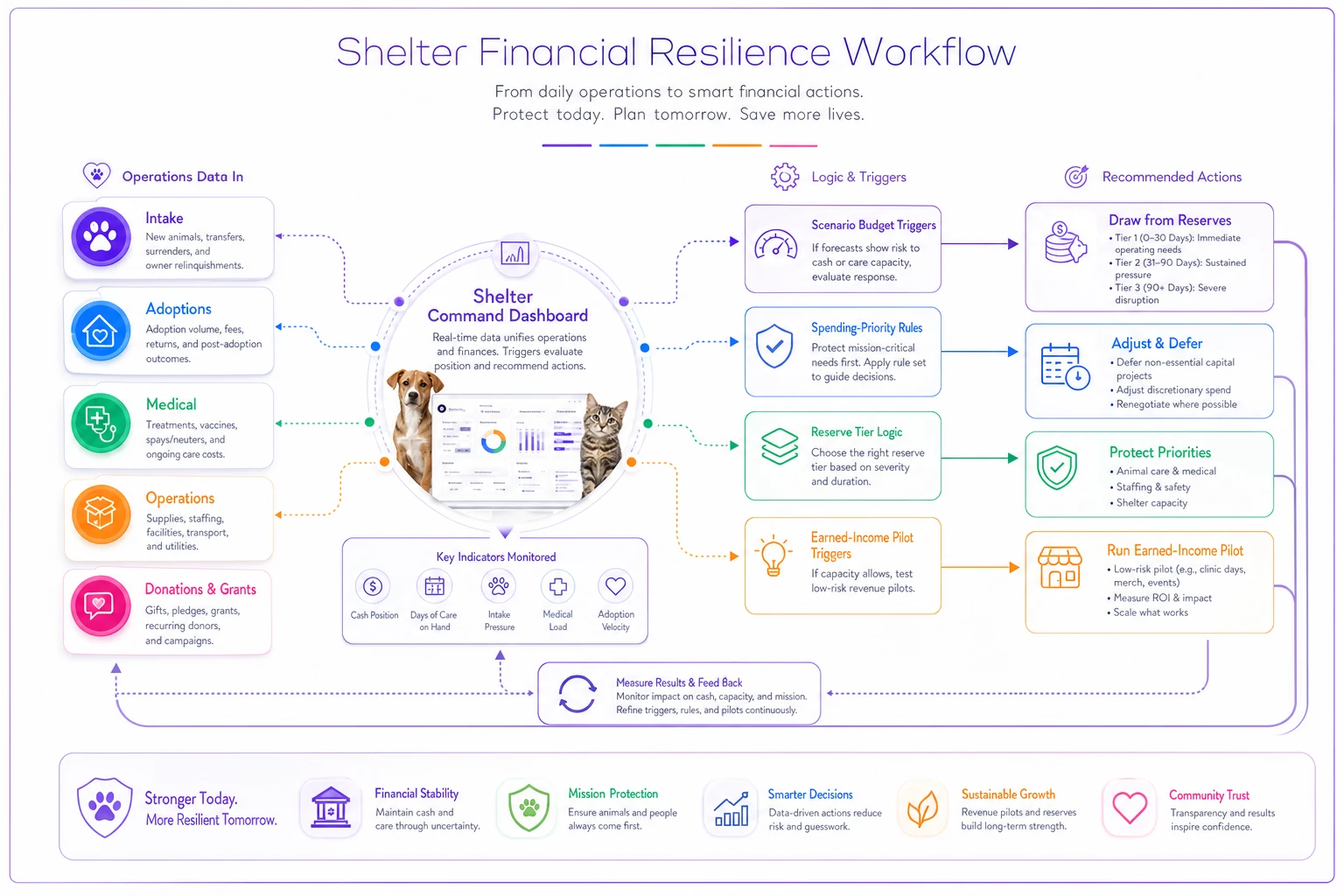
The point of all four layers — reserves, scenario budgets, spending priorities, earned income — is that they function as one system, not four separate initiatives. Your scenario triggers tell you when to draw reserves. Your reserve tiers tell you what permissions apply. Your spending priority order tells you what gets cut first. Your earned-income pilots feed both the reserves and your funder metrics.
Document scenario triggers and reserve permissions in a single, accessible playbook so staff can act without hunting for context.
Where this quietly falls apart is when the numbers live in five different places — a spreadsheet on one laptop, donation data in a fundraising tool, expenses in a shoebox, program stats in someone's head. The financial framework only works if the people making decisions can actually see the current picture in one place. That's less about buying fancy finance software and more about centralizing the operational and financial data you already generate, so a cash trigger fires before the crisis, not after. Modern shelter management platforms help here mostly by pulling intake, adoption, and cost data together so trends surface early — but the framework itself is what does the real work.
Here's a simple workflow that ties the four layers together.
Stop making financial decisions in the moment. Make them now, in a calm room, with your scenarios in front of you — and let the rough month simply follow a plan you already wrote.
Stop making financial decisions in the moment. Make them now, in a calm room, with your scenarios in front of you — and let the rough month simply follow a plan you already wrote.
Ready to enhance your shelter’s impact?
Join 500+ shelters using Animlly to improve care coordination, increase adoptions, and engage communities effectively.