
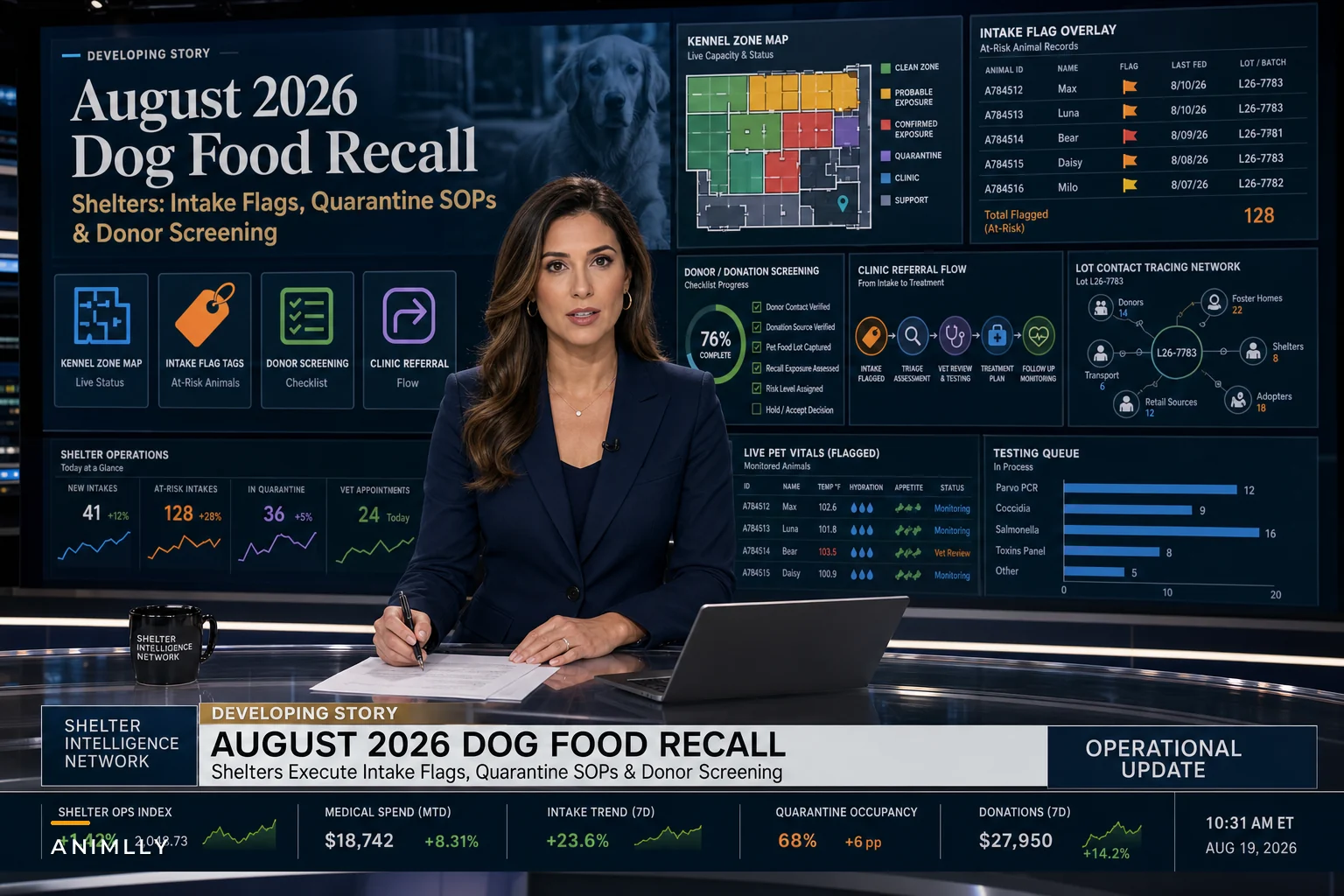

If you accept donated pet food — and almost every shelter does — the Oma's Pride recall this month is your problem whether or not you ever bought a bag. A single lot (BB012729) of Woof Complete Canine Chicken Recipe frozen raw dog food, 639 six‑pound bags, was pulled after a sample came back positive for Salmonella. According to a USA Today report, the product moved through 11 states and three dog illnesses have already been linked to it.
The part that matters for shelter operations: recalled food doesn't sit quietly in a donor's freezer. It gets dropped in your donation bin, handed over during an owner surrender, or fed to a dog three days before someone brings it in as a stray. Salmonella is a zoonotic pathogen — it contaminates bowls, hands, kennel floors, laundry, and the staff member who forgot to wash up before lunch. Raw food recalls are a biosecurity event dressed up as a supply-chain notice.
This is a checklist-first playbook. If you're reading this because a volunteer just found two bags of the recalled lot in your storage room, skip to the triage section and start there.
First 60 Minutes: Contain Before You Investigate
The instinct is to figure out how much recalled product you have before doing anything else. That's backwards. Containment first, inventory second — because every minute the product stays in circulation is another feeding, another contaminated bowl, another handler touching something they shouldn't.
Immediate containment steps, in order:
-
Stop all raw/frozen food distribution. Not just this brand — all raw. You can't visually distinguish a contaminated bag from a clean one, and staff won't reliably remember lot numbers under pressure.
-
Physically isolate suspect product. Bag it, tape it, mark it "DO NOT USE — RECALL," and move it away from any prep or feeding area. Don't throw it out yet; you may need it for lot verification and to document what you had.
-
Post a hold on your donation intake point. A single laminated sign that says "No raw or frozen food donations accepted until further notice" prevents the next batch from walking in.
-
Pull the lot number. BB012729 is the affected lot. Anything else from the same brand isn't recalled, but if your team can't verify lot numbers quickly, treat the whole raw category as suspect until you can confirm otherwise.
-
Assign one person to own this. Recall response falls apart when it's "everyone's job." One coordinator, one decision-maker, one point of contact for clinics.
The failure mode in food-safety events usually isn't panic — it's fragmentation. Three people each handle a piece, nobody has the full picture, and two days later you find a bag that never got flagged because everyone assumed someone else grabbed it.
Triage: Which Animals Actually Need Attention
Not every dog in your building is at risk. The ones that are fall into a few clear buckets, and sorting them fast keeps you from either over-quarantining — burning isolation space you don't have — or missing a sick animal.
Streamline your shelter operations effortlessly.
Animlly helps you manage every pet, volunteer, and adoption step with ease and accuracy.
- Comprehensive pet profiles
- Volunteer scheduling & communication
- Adoption tracking & reporting
No credit card required
| Exposure Category | Who\'s in It | Action |
|---|---|---|
| Confirmed fed | Dogs you know ate the recalled lot | Quarantine, monitor, clinic consult |
| Probable exposure | Dogs from a household that used the brand; dogs fed from a shared donated supply | Monitor closely, separate feeding and handling |
| Environmental only | Dogs housed near contaminated bowls or prep areas but not fed the product | Enhanced cleaning, watch for symptoms |
| No exposure | Everyone else | Normal handling, document as cleared |
Salmonella symptoms in dogs: vomiting, diarrhea (sometimes bloody), fever, lethargy, reduced appetite. Many exposed dogs stay asymptomatic but still shed the bacteria — which is exactly why "he seems fine" is not a clearance criterion. Asymptomatic shedders are how outbreaks move from one kennel run to the next.
Triage checklist for each animal:
-
Did this animal consume the recalled product? (yes / probable / no / unknown)
-
Date of last known exposure
-
Current symptoms, if any
-
Housing location and neighboring animals
-
Shared equipment (bowls, bedding, toys) — flagged for sanitation
-
Assigned monitoring schedule (twice daily temp/appetite/stool checks for confirmed cases)
Flag every one of these in the animal's intake record, not on a sticky note. When a clinic calls back about a dog three days from now, you need to pull that history in seconds. Shelters that track this in a shared operational system rather than scattered paper forms spend far less time reconstructing who ate what — and that reconstruction window is exactly when mistakes start creeping in.
Quarantine Setup That Doesn't Overwhelm Your Space
Most shelters don't have surplus isolation capacity sitting empty. That's the real constraint, and it forces prioritization.
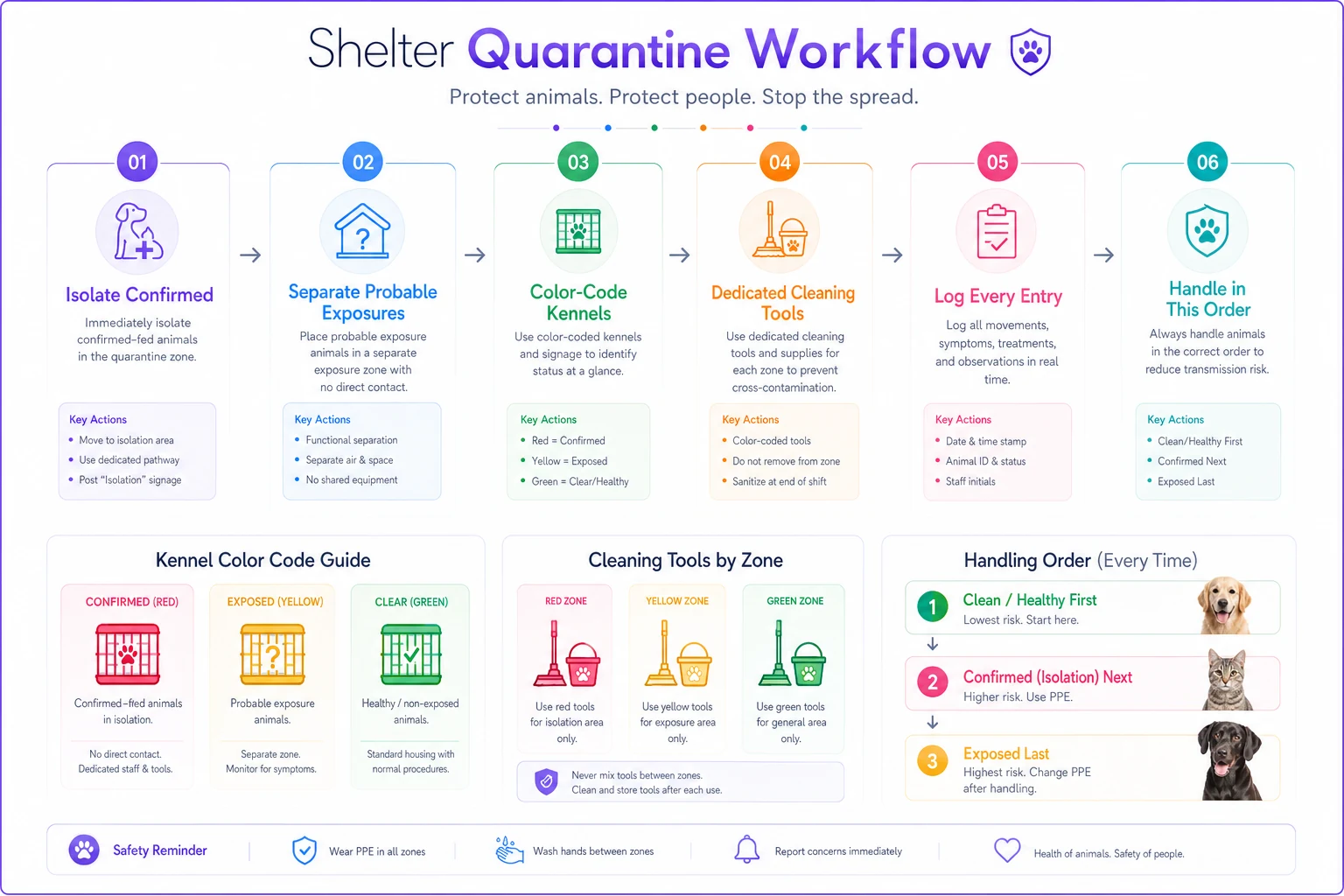
Confirmed-fed and symptomatic animals get true isolation first. Probable-exposure animals get functional separation — dedicated bowls, separate handling order (clean animals first, exposed animals last), no shared equipment. You don't always need a separate room; you need a separate workflow.
A few things that hold up under pressure:
-
Handle exposed animals last on every cleaning and feeding round. Then the handler changes gloves and gown and washes before touching anything else.
-
Color-code the exposed kennels. A red clip on the cage card removes the "wait, which ones again?" problem during shift changes.
-
Dedicate cleaning tools per zone. A mop that travels between the isolation area and general population defeats the entire quarantine.
-
Log every entry into the isolation zone. Who, when, why. If an animal breaks with symptoms later, you want to know who was in there.
The underlying problem a recall exposes is that most shelters have a cleaning protocol but not a cross-contamination protocol. Day-to-day, that gap is invisible. During a Salmonella event, it's the difference between three sick dogs and thirty.
A quick visual of the quarantine workflow.
The underlying problem a recall exposes is that most shelters have a cleaning protocol but not a cross-contamination protocol. Day-to-day, that gap is invisible. During a Salmonella event, it's the difference between three sick dogs and thirty.
Coordinating With Clinics: This Is Where the Recall Gets Expensive Fast
Testing, treatment, fecal cultures, supportive care — real money, hitting with no warning in your budget. A single symptomatic dog needing diagnostics and a few days of supportive treatment can run a few hundred dollars. Multiply that across a cluster and you're looking at unplanned medical spend that can crack $2k–$5k in a bad week for a mid-sized shelter.
The shelters that get through this cleanly are the ones that had clinic relationships in place before the emergency. When you have a standing partner, the conversation is "we have a possible Salmonella exposure cluster, here's our count, what's your testing turnaround" — not "hi, do you have any openings and what do you charge?"
If you haven't formalized those relationships yet, this recall is a reasonable place to start. Our guide on turning local clinics into reliable partners with outreach scripts and MOUs walks through the agreements that make emergency coordination fast instead of frantic — priority scheduling, agreed pricing, and referral tracking so nothing falls through when you're managing a cluster.
What to line up with your clinic partner during a recall:
-
Confirm who tests fecal samples and expected turnaround time
-
Agree on which animals get tested vs. monitored — you can't test everyone
-
Establish a treatment protocol for confirmed cases
-
Clarify billing — is there a shelter rate, a cap, a donation offset?
-
Set a reporting loop so results flow straight into your animal records
One detail that often gets missed: ask your clinic partner whether human exposure guidance is warranted for staff who handled product or symptomatic animals. Salmonella doesn't distinguish between dogs and people.
Donation Screening: The Gap That Let This In
Reporting from Good Morning America noted the recall was voluntary and precautionary after a positive sample — exactly the kind of event most donation intake processes are completely blind to. Food comes in, someone eyeballs the expiration date, and it goes on the shelf. Nobody logs the brand, lot, or source.
That's the deeper problem this recall surfaces. Donated supplies are usually your least-controlled inventory. You track medical supplies, you track animals, and then a volunteer accepts an open bag of frozen raw food with zero paperwork.
A minimum donation-screening standard for food:
-
Record brand, product, and lot number at intake — no lot number, no acceptance for raw/frozen
-
Reject opened, unlabeled, or repackaged food outright
-
Log the donor's name and contact so you can trace and notify if a recall hits later
-
Separate raw/frozen into a clearly labeled zone it never leaves without a check
-
Cross-reference incoming brands against active recall lists weekly
That last point sounds tedious, but it's a five-minute task if someone owns it. The donor contact log is what turns a recall from a guessing game into a phone call: "You donated Woof Complete last month — do you happen to remember the lot number?"
A Real Scenario
A mid-sized municipal shelter — around 80 animals in-house, heavily reliant on community food donations — discovers two bags of the recalled lot in their freezer, both partially used. They can't immediately confirm which dogs were fed from them because feeding was logged as "donated raw" with no brand detail.
Without lot-level tracking, they had to treat 14 dogs as probable exposures instead of the 4 that actually ate the product. That's ten extra animals under enhanced monitoring, three isolation setups they didn't have room for, and roughly $1,800 in precautionary clinic consults and testing that better records would have avoided.
The fix wasn't complicated. They added two fields to donation intake — brand and lot — and started logging which food source each dog was fed. The next time a recall came through, they narrowed exposure to the exact animals in under an hour instead of quarantining a fifth of the building.
The lesson isn't really about this one recall. Poor traceability costs show up all at once, at the worst possible time.
Documentation: Closing the Loop for Follow-Up
The animals you quarantine today need follow-up in a week or two, and the staff who handled product need a record in case symptoms appear later. Documentation during a recall isn't bureaucracy — it's what lets you stop quarantining safely, with a clear reason why.
Your recall documentation set should capture:
-
Every animal's exposure category and the reasoning behind it
-
Feeding source per animal (going forward, permanently)
-
Clinic communications, test orders, and results
-
Sanitation actions taken, by zone and date
-
Staff and volunteer exposure log
-
Clearance criteria and the date each animal was cleared
Keep this in whatever operational system your team already uses, not a separate binder nobody updates. Shelters that recover fastest are the ones where a coordinator can pull up "all flagged animals from the August recall" and see status at a glance — cleared, monitoring, or under treatment — without hunting through three different spreadsheets.
When to Escalate — and When You're Overreacting
Not every food recall demands full lockdown. Calibration matters.
Escalate to full quarantine protocol when: you have confirmed-fed animals, any symptomatic dogs, or a raw/frozen product with a pathogen — Salmonella, Listeria — rather than a nutritional or labeling issue.
Scale back when: the recall involves a dry or kibble product with a non-infectious problem (vitamin imbalance, foreign material), or you can confirm none of your inventory or animals touched the affected lot. In those cases, remove the product, notify donors, document it — no isolation circus required.
Don't do this: treat every recall notice as a five-alarm fire. If your team burns out on precautionary lockdowns for low-risk kibble recalls, they won't take the next raw-food pathogen recall seriously. Match the response to the actual risk level.
The Bigger Takeaway
A recall like Oma's Pride isn't really a food story for shelters — it's a stress test on your traceability. Shelters that handled it in an afternoon could answer three questions immediately: What food do we have? Which animals ate it? Who do we call? The ones still cleaning up a week later couldn't answer any of them.
You can't prevent the next recall. What you can do is build the intake tracking and clinic-coordination habits that turn it from a crisis into a manageable checklist. Start with donation logging and clinic agreements — those two fixes alone will carry you through most of what a recall throws at your operation.
You can't prevent the next recall. What you can do is build the intake tracking and clinic-coordination habits that turn it from a crisis into a manageable checklist. Start with donation logging and clinic agreements — those two fixes alone will carry you through most of what a recall throws at your operation.
Ready to enhance your shelter’s impact?
Join 500+ shelters using Animlly to improve care coordination, increase adoptions, and engage communities effectively.