

Most shelter training dies in a binder. Someone spends a weekend building a 40-page "new hire manual," it gets printed, it lives on a shelf near the intake desk, and six months later the newest kennel tech still doesn't know who signs off on a bite quarantine or how to read a hold-status board. The knowledge is technically "documented." It's just not usable.
The problem isn't that shelters don't train. It's that training gets treated as an event instead of a system. You throw everything at a new person during their first three shifts, they retain maybe a fifth of it, and the rest gets learned through mistakes — some of which involve live animals, angry adopters, or a legal hold that got released early.
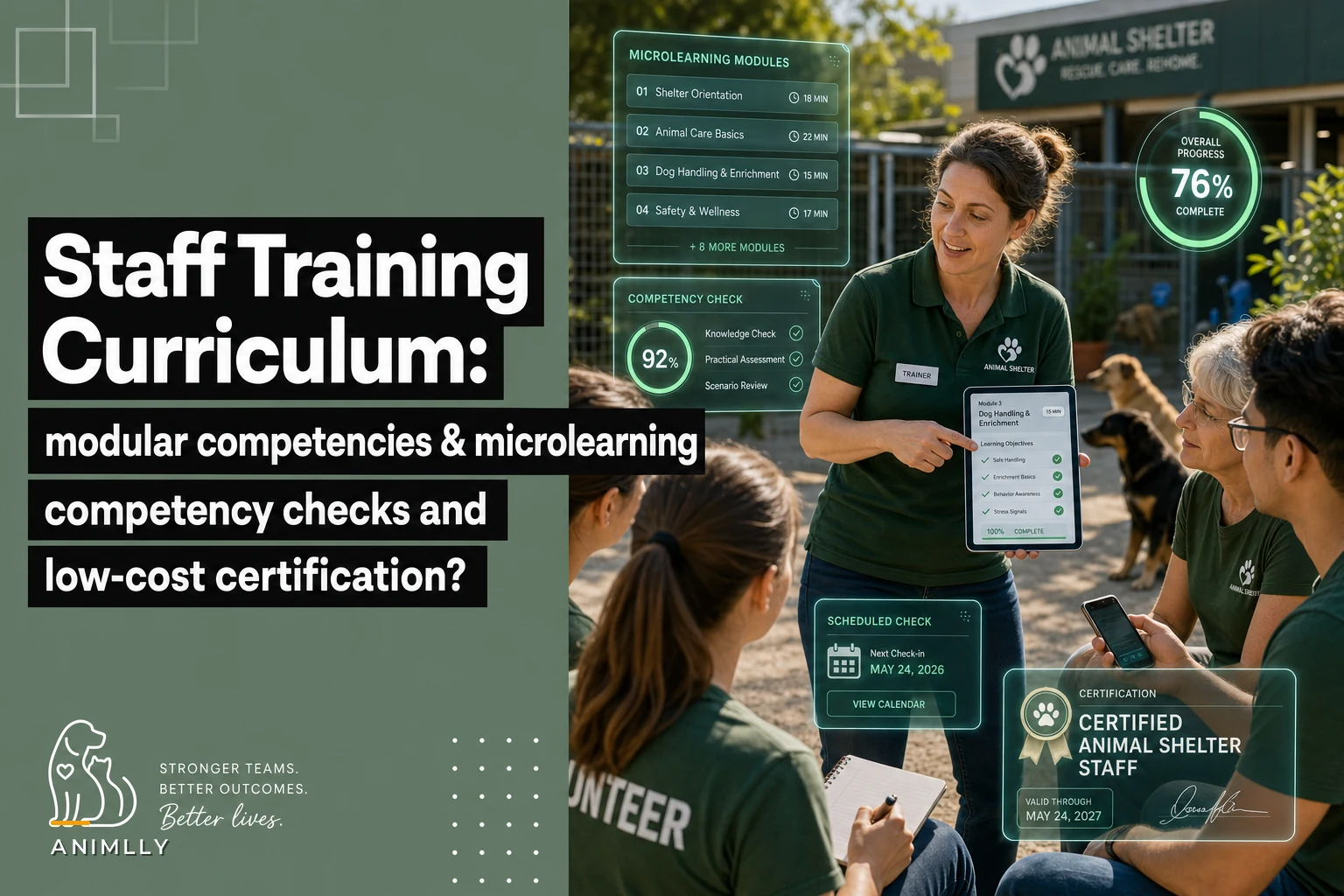
A modular curriculum fixes this by breaking training into small, role-mapped chunks that a person can complete in 15–30 minutes between other tasks, with a real way to check whether they actually learned it. This post walks through how to build that for a small team, tie it to your RACI so people learn only what their role requires, and layer in a certification path that means something.
Why the "one big onboarding" model keeps failing
Walk into most small shelters and you'll find the same pattern: onboarding is front-loaded into the first week, and then nothing. No structured continuation. No refreshers. No verification that the euthanasia decision-tree training from month one actually stuck by month four.
What that produces in real operations:
-
New staff get overwhelmed in week one and quietly develop workarounds that nobody catches until something breaks
-
Cross-trained volunteers do tasks slightly differently every time because there's no shared reference for "the right way"
-
Institutional knowledge lives in two or three long-tenured people's heads, and when one of them takes vacation during a surge, the whole floor slows down
-
Nobody can answer "is this person cleared to do X?" with confidence, so tasks get double-checked constantly, which burns supervisor time
The deeper issue is a mismatch between how humans retain procedural knowledge and how shelters actually deliver it. People learn operational tasks through short, repeated exposure tied to real context — not through a single marathon session. A curriculum that ignores this is fighting biology.
There's also a role problem. In a small shelter, the front-desk coordinator, the kennel tech, the foster coordinator, and the intake lead all need different things. When you train everyone on everything "just in case," you waste hours and dilute the stuff that actually matters for each role. Which is exactly why training needs to be mapped to responsibility, not job title alone.
Start with the RACI, not the content
Before you write a single module, pull your responsibility map. If you already built one alongside your SOPs — the kind covered in the modular shelter operations playbook — you're most of the way there. The RACI tells you exactly who is Responsible, Accountable, Consulted, and Informed for each core process. That directly translates into who needs training on what, and at what depth.
Streamline your shelter operations effortlessly.
Animlly helps you manage every pet, volunteer, and adoption step with ease and accuracy.
- Comprehensive pet profiles
- Volunteer scheduling & communication
- Adoption tracking & reporting
No credit card required
A quick way to think about depth:
| RACI role | Training depth needed | Module type |
|---|---|---|
| Responsible | Full procedural mastery + competency check | Do-it modules with hands-on sign-off |
| Accountable | Full understanding + edge-case judgment | Decision-focused modules + scenario checks |
| Consulted | Working knowledge of the process | Overview module, no hands-on check |
| Informed | Awareness of what exists and where to find it | 5-minute orientation only |
This mapping saves a significant amount of wasted training time. Your foster coordinator doesn't need a hands-on competency check on the vehicle securement SOP — they just need to know it exists and who owns it. Your transport driver absolutely does.
A common mistake: teams build the curriculum first, then try to figure out who takes which parts. That's backwards and it always produces bloat. Start from responsibility, and the curriculum almost writes its own table of contents.
What a "module" should actually look like
The unit of the whole system is the microlearning module — one focused topic, 15 to 30 minutes, completable in a single sitting. Not a chapter. Not a "domain." One task-sized thing.
A good module has four parts and nothing extra:
-
The why (2–3 minutes) — a short reason this matters, ideally with a real example of what goes wrong when it's skipped. People retain procedures far better when they understand the failure they're preventing.
-
The how (8–15 minutes) — the actual steps, tied to the live SOP or form. Not a summary. The real thing they'll use.
-
The edge cases (3–5 minutes) — the two or three exceptions that trip people up. This is where most training is weakest, and it's exactly where mistakes happen on the floor.
-
The check (5 minutes) — a short competency verification. More on this below.
A useful test: if a module can't be completed and checked inside a normal shift's slow window, it's too big. Split it.
Take intake as an example. Don't build one "Intake Training" module. Build four separate ones:
-
Reading the hold-status board (15 min)
-
Minimum required intake fields and why each one matters (20 min)
-
Photographing an animal for the record (15 min)
-
Handling a stray vs. owner-surrender difference (25 min)
Four small modules beat one big one because a person can knock out two on a slow Tuesday, and you can reassign or update just one when a form changes — instead of reworking a monolith.
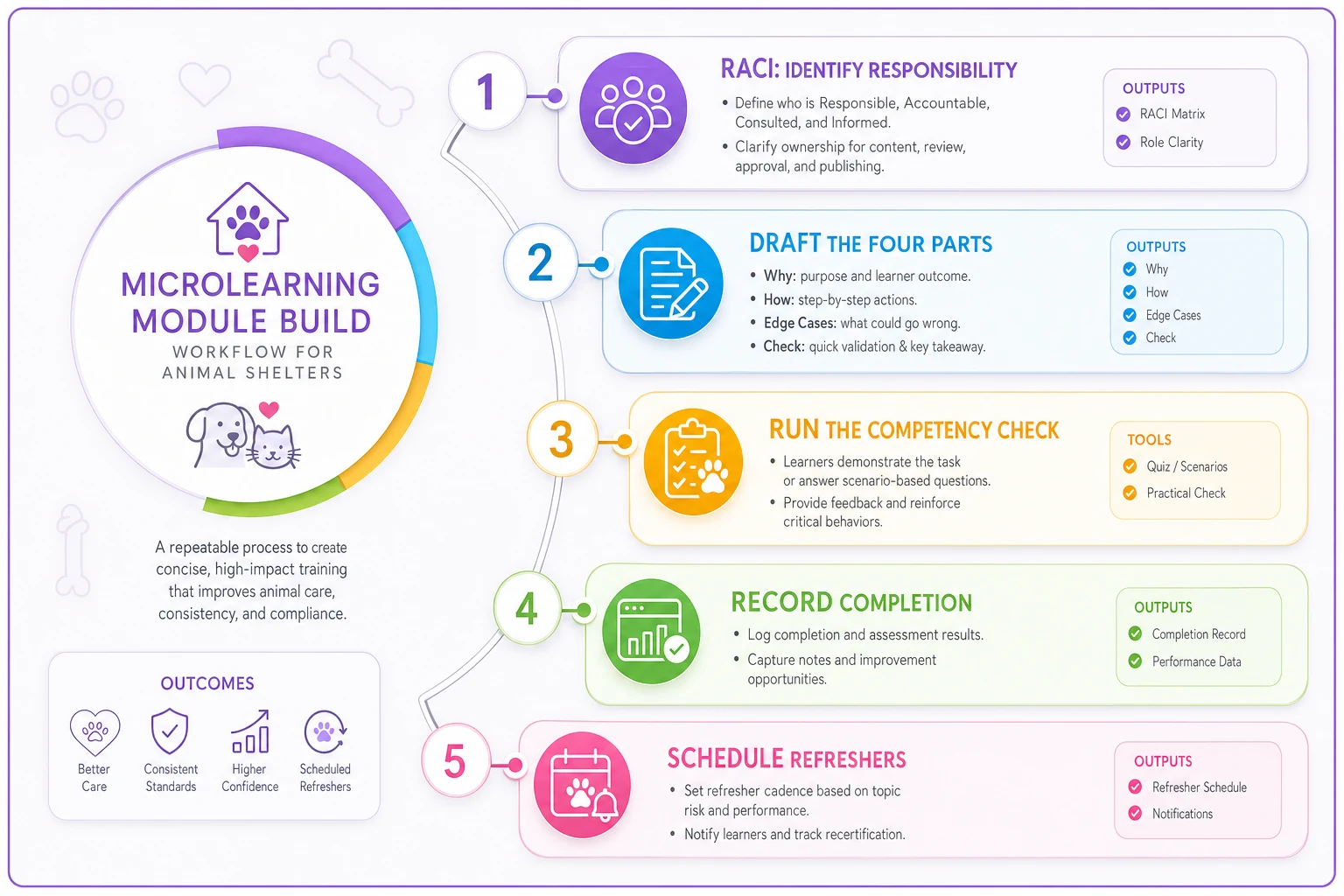
This simple flow shows how a module moves from responsibility mapping to a checked, recorded learning item.
Competency checks that mean something
This is the part almost everyone skips, and it's the part that separates "we have training" from "we can trust people to do the task."
A competency check verifies the person can actually do the thing, not that they read about it. There are three levels, and you match the level to the RACI depth:
-
Knowledge check — a few questions confirming they understood the material. Fine for Consulted-level roles or low-risk tasks.
-
Scenario check — you give them a realistic situation ("a finder brings in a dog with no collar at 4:45pm on a Friday") and they walk through what they'd do. This catches judgment gaps that quizzes miss.
-
Observed check — a supervisor watches them perform the real task once and signs off. Non-negotiable for anything involving animal handling, medication, or legal holds.
The mistake that shows up constantly is treating a completion checkbox as a competency check. "Watched the video" is not the same as "can restrain a fractious cat safely." For high-risk tasks, only an observed check counts. Write that rule into the curriculum and hold it.
Schedule observed checks during normal shift windows to see real work conditions rather than isolated demonstrations.
One practical note: keep a simple record of who passed which check and when. Not for bureaucracy — for coverage decisions. When you're short-staffed and deciding who can cover the medical prep station, you need to glance at a list and know, not guess.
Sequencing across 6 to 12 months
Cramming everything into month one is the original sin. Spread it deliberately.
Month 1 — Survival competencies. The things a person must know to be safe and functional for a single shift: facility safety, animal-handling basics for their role, the intake or care tasks they'll touch immediately, and emergency escalation. Nothing else. Resist the urge to teach the donation database in week one.
Months 2–3 — Core role competencies. The full set of modules for their primary role, one or two per week, each with its check. This is where most of the real depth lands, paced so it sticks.
Months 4–6 — Cross-training and edge cases. Now you widen. This is the phase where the seasonal cross-training approach — the same logic covered in the 6-week ramp-up and cross-training checklist — fits naturally, because you're building coverage for peaks by teaching people adjacent roles.
Months 6–12 — Certification and refreshers. Higher-judgment modules (difficult adopter conversations, complex holds, behavioral assessment support), plus scheduled re-checks on the high-risk stuff from month one. Handling skills degrade. Re-verify them.
The part most teams miss: refreshers matter as much as initial training. Someone certified on safe handling in January is not automatically safe in September. Build the re-check into the calendar or it won't happen.
The certification path — and keeping it honest
A certification is just a defined bundle of completed modules and passed checks that unlocks a role level. Keep it simple:
-
Cleared for [Role] — Level 1 completed all survival + core competencies for that role, all observed checks passed.
-
Cleared for [Role] — Level 2 Level 1 plus edge-case and judgment modules, plus a set period of supervised performance.
-
Cross-trained Level 1 in a second role.
The value isn't a certificate on the wall. It's that "certified" becomes a real operational signal. When your intake lead is out, you look at who's Level 2 certified on intake and you have your answer in seconds.
Guard against certification inflation. If everyone gets certified regardless of actual competency, the label means nothing and you're back to double-checking everyone. A certification the manager doesn't fully trust is worse than none, because it creates false confidence during exactly the moments you can't afford it.
A real scenario
A shelter running around 30–40 animals at a time, with four paid staff and a rotating pool of maybe a dozen volunteers, had the classic problem: onboarding was one long shadowing week, and after that people learned by osmosis. Two experienced staff carried most of the institutional knowledge. When one went on a two-week medical leave during a summer intake bump, floor throughput visibly dropped — tasks got re-checked, new volunteers hesitated, and a couple of hold-status mistakes slipped through.
They rebuilt training as roughly 20 small modules mapped to their RACI, phased over the year, with observed checks on the handling and legal-hold tasks. It took a few weekends to build and a couple of months to roll out.
The change wasn't dramatic on paper, but it was real. New volunteers reached useful independence in about half the time. Supervisor time spent re-explaining and double-checking dropped noticeably. And the next time someone was out, coverage decisions got made off a simple certification list instead of a scramble. No single metric jumped, but the floor stopped depending on two people's memory.
When this makes sense — and when it doesn't
When it's worth building: if you have any turnover, any volunteer rotation, or any dependence on one or two people holding critical knowledge — which is basically every shelter.
When to keep it lightweight: a two-person operation where both people know everything and turnover is near zero. You still want the survival and legal-hold modules documented, but you don't need the full certification apparatus yet. Build the safety-critical parts, skip the rest until you grow.
Who should not over-engineer this: teams that don't have their SOPs written yet. A training curriculum points at your procedures — if the underlying SOPs are vague or don't exist, fix those first. Training people on undocumented processes just formalizes inconsistency.
Keeping it maintainable
The hidden failure mode of any curriculum is drift. A form changes, a process gets updated, and the training module still teaches the old way. Now you're actively training people incorrectly.
The fix is to tie every module to its source SOP, so when the SOP changes there's a clear trigger to update the matching module and re-notify anyone who needs the change. This is where keeping training and procedures in one connected system — rather than scattered across binders, a shared drive, and someone's laptop — quietly pays off. When your SOPs, your RACI, and your training modules live together, an update in one place surfaces what else needs to change, and completion records tell you exactly who to re-check. Tools that centralize this remove the manual chore of tracking who needs retraining, which is usually the reason retraining silently stops happening.
The tooling is secondary, though. The real work is the thinking: break knowledge into role-mapped pieces, verify people can actually do the task, phase it across the year, and re-check the dangerous stuff on a schedule. Do that on paper first if you have to. A modular curriculum isn't about having fancy software — it's about accepting that people learn operational work in small, repeated, verified steps, and building your training to match how that actually works.
Ready to enhance your shelter’s impact?
Join 500+ shelters using Animlly to improve care coordination, increase adoptions, and engage communities effectively.