

Walk into most shelters and you'll find a laminated sign on the isolation door that says something like "STOP. Authorized personnel only. PPE required beyond this point." It's been there for two years. The tape at the corners is yellowing. And three volunteers a day walk right past it to grab a leash off the hook that happens to live inside that room.
The sign isn't working. Not because people don't care, but because the sign is competing against convenience and losing every single time.
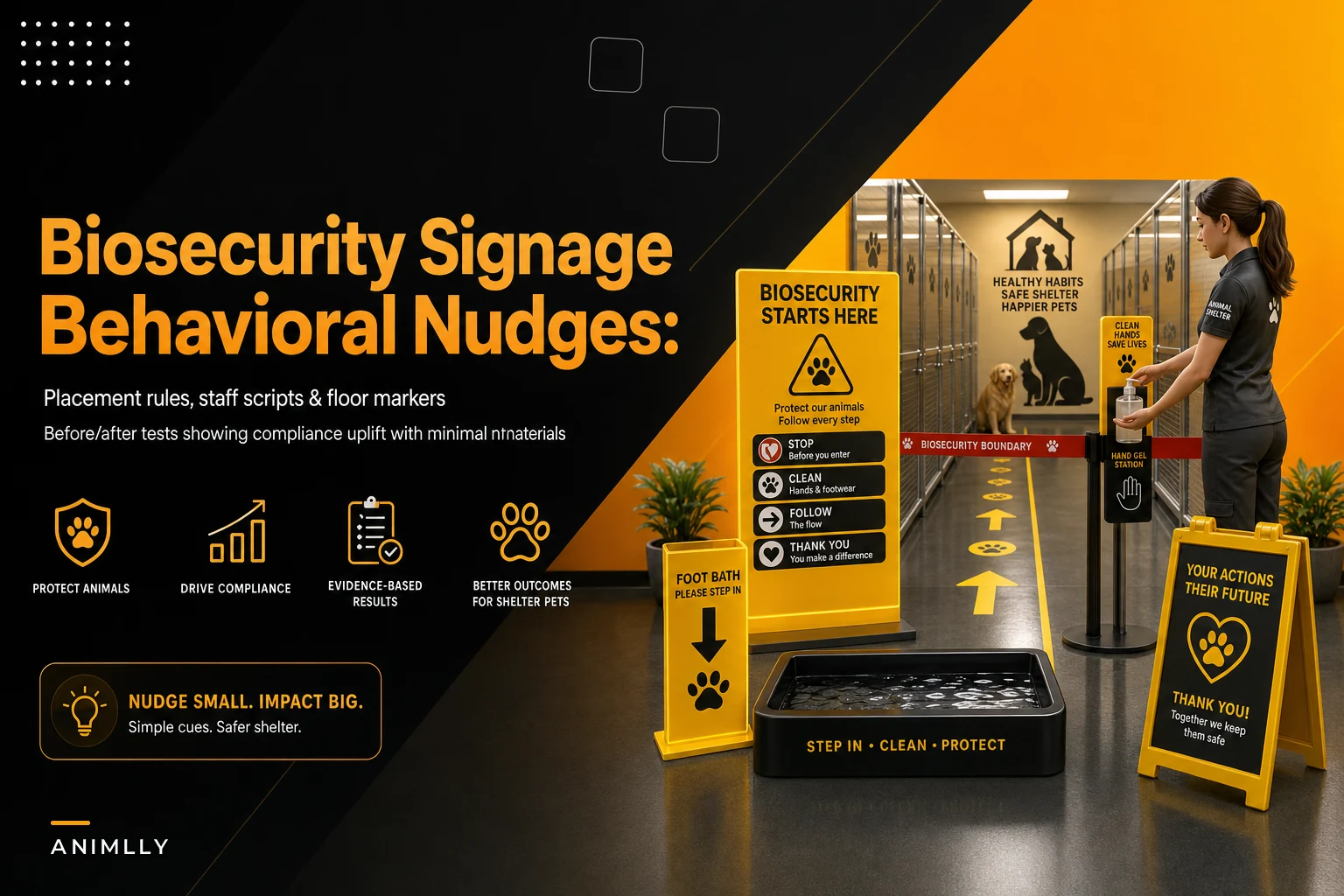
This is a post about fixing that specific problem — compliance at biosecurity points — using signage copy, placement rules, floor markings, short staff scripts, and a quick audit checklist. No new equipment budget required. The whole point is uplift with materials you already own or can print this afternoon.
The real reason biosecurity signage fails
Most shelter biosecurity signs fail for one of three reasons, and usually all three at once.
They're placed where nobody is looking. A sign at eye level on a door is invisible to someone carrying a cat crate in both hands, looking down at the latch. The decision point — "do I glove up or not?" — happens about four feet before the door, not at it.
They describe policy instead of action. "PPE required" tells someone what the rule is. It doesn't tell them what to do, where the gloves are, or what happens next. People skip steps they have to think through mid-task.
They ask for too much at the wrong moment. A sign listing six steps — gown, gloves, booties, log entry, hand gel, door — is a wall of text to someone who has 90 seconds between kennels. If compliance requires reading a paragraph, compliance drops.
In real operations, the pattern looks like this: a staffer who's been there three years knows the drill cold and does it right. A weekend volunteer, a new hire in week two, and the delivery person dropping off donated food are the ones skipping the foot bath. Your signage is written for the person who doesn't need it and ignored by the people who do.
Good biosecurity signage in a shelter isn't about communicating a rule. It's about removing the friction between "I should" and "I did."
Before and after: the same message, re-engineered
Here's a side-by-side of the signage most shelters have versus what actually moves compliance. Same policies — completely different phrasing and placement logic.
Streamline your shelter operations effortlessly.
Animlly helps you manage every pet, volunteer, and adoption step with ease and accuracy.
- Comprehensive pet profiles
- Volunteer scheduling & communication
- Adoption tracking & reporting
No credit card required
| Element | Typical sign (before) | Re-engineered (after) |
|---|---|---|
| Isolation door | "Authorized personnel only. PPE required." | "GLOVE UP before you open this door. Gloves → on the left. Used gloves → red bin." |
| Hand gel station | "Please sanitize your hands." | "Gel in. 10 seconds. Rub until dry. (Dog #s on this hall are immuno-compromised.)" |
| Foot bath / mat | "Foot bath — use before entering." | Floor arrows leading INTO the mat + "Step here. Both feet. 5 seconds." |
| Intake triage area | "Quarantine zone." | "New arrivals = unknown status. Treat every animal here as contagious until cleared." |
| Supply room inside iso | (no sign — this is the leash problem) | "Grab what you need from the CART outside. Do not re-enter in street clothes." |
The "after" column does three things the "before" doesn't: it names the action first, tells you where the supplies are, and gives a one-line reason tied to a real animal. People comply far more readily when the "why" is specific — "dogs on this hall are immuno-compromised" lands harder than a generic "to prevent disease spread."
Notice the last row especially. The leash-in-the-iso-room problem isn't solved by a better door sign. It's solved by physically moving the thing people need to the outside of the barrier. Sometimes the best signage is removing the reason people break the rule in the first place.
Placement rules that actually get read
Copy matters, but placement decides whether the copy is ever seen. A few rules that consistently outperform the default "stick it on the door" approach:
-
1. Put the sign at the decision point, not the barrier. The decision happens where someone chooses the path. Place the glove-up prompt about three to four feet ahead of the door, on the wall people naturally face as they approach.
-
2. Match the sign height to the task. Someone carrying an animal is looking down. A floor-level or waist-level marker beats an eye-level poster for anyone with their hands full.
-
3. One action per sign. If a point requires three actions, use three small signs in the order they happen, spaced along the path — not one dense list.
-
4. Use the floor as a sign. Colored tape, arrows, and footprint decals route behavior without anyone reading a word. A taped box in front of the foot bath that says "both feet" gets used more than a laminated instruction mounted above it.
-
5. Reduce competing clutter. A biosecurity sign surrounded by adoption flyers, a bake-sale poster, and a lost-dog notice disappears. Give critical compliance signs their own clean zone with nothing else nearby.
The floor-marking piece is underrated. A simple strip of red tape across a threshold often does more than a sign ever did — it creates a visible line that people instinctively register as a boundary. Pair it with a color code (red = stop/barrier, yellow = caution/transition, green = clean) and you build a vocabulary people pick up without needing a training session.
Match tape colors to your zoning map before you apply so the meaning is consistent across sites.
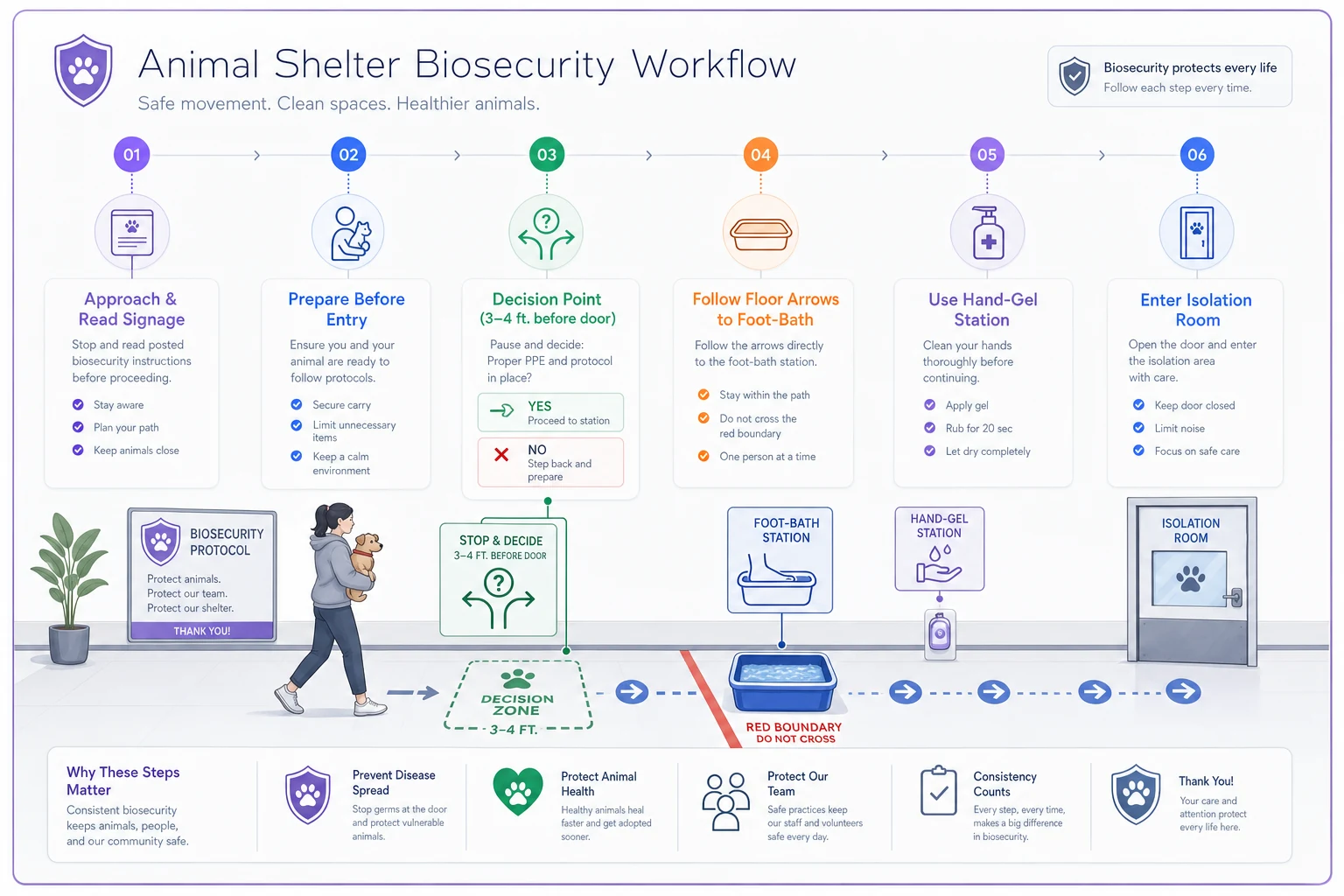
Your zoning logic should drive where these markers go. If you've already mapped clean, transition, and contaminated zones, the signage just makes those lines visible to everyone walking through. If you haven't done that yet, it's the prerequisite — the infection-control zoning maps and cohorting rules walkthrough covers how to draw those lines before you start taping floors.
Staff and volunteer scripts: the human layer
Signs get ignored. A person saying something, in the moment, almost never does. The problem is that correcting a colleague or volunteer feels awkward, so people stay quiet and the breach repeats.
-
Entry prompt (to anyone approaching iso) "Hey — iso hall. Gloves and gown before you go in, cart's right here."
-
Gentle catch (someone skipped a step) "Quick one — grab gel on your way back, that hall's got the parvo pup."
-
New volunteer onboarding (said once, clearly) "Three rules on this side of the red line: gloves on, nothing leaves in your hands, hands gel on the way out. That's it."
-
Delivery/outsider at the door "I'll take that from here — this area's restricted for the animals' health. Thanks for understanding."
That last one matters more than people expect. Delivery drivers, contractors, and even board members wandering through are a quiet, constant source of cross-contamination because nobody feels authorized to stop them. Giving front-desk and floor staff a polite, firm line removes the hesitation.
Keep the scripts posted in the break room, not just said once at orientation. A one-page card with those four lines does more for consistency than a 40-minute training that gets forgotten by Thursday.
A quick compliance audit checklist
You can't improve what you're not watching. The good news is this audit takes about ten minutes and needs no special tools — just a clipboard or a phone, done at random two or three times a week.
-
- [ ] Is every critical sign placed at the decision point, not just the barrier?
-
- [ ] Can someone carrying an animal see the prompt without looking up?
-
- [ ] Is each sign one action, phrased as a verb first ("Glove up," not "PPE required")?
-
- [ ] Does the sign include a specific reason tied to a real animal or hall?
-
- [ ] Are floor markings intact — tape not peeling, arrows visible, foot-bath box clear?
-
- [ ] Are supplies stocked at the point of use (gloves full, gel not empty, bin not overflowing)?
-
- [ ] Is the critical sign free of competing clutter around it?
-
- [ ] During a spot-observation, did the last 5 people entering comply without a prompt?
-
- [ ] Are outsiders (deliveries, contractors) being redirected at the boundary?
-
- [ ] Is anything stored inside a restricted zone that lures people across the line?
That last cluster — the spot-observation and the "what's stored inside" check — tends to surface the real problems. Signs can look perfect and compliance can still be hovering around 50% because the gel dispenser has been empty for a week or someone keeps the spare mop inside iso.
Track the "last 5 people complied" number over time. It's rough, but a trend from 2-out-of-5 to 4-out-of-5 over a month tells you more than any single snapshot ever will.
A realistic before-and-after
Consider a mid-sized municipal-contract shelter, roughly 60–80 animals on site at any time, running mostly on weekend and evening volunteers. Their isolation hall had the classic laminated door sign and a foot bath nobody stepped in correctly. Spot checks suggested maybe 40–50% of people entering iso were gloving up properly, and the foot bath was essentially decorative.
-
Moved the glove-up prompt to a wall four feet ahead of the door, verb-first, with a line naming the hall's current high-risk animal.
-
Taped a red boundary line across the iso threshold and a "both feet, 5 seconds" box in front of the foot bath with arrows leading in.
-
Moved leashes and shared supplies to a cart outside the door so nobody had a reason to pop back in.
-
Printed a four-line script card for staff and posted it at the desk and break room.
-
Ran the ten-minute audit twice a week for a month.
Materials cost was basically a roll of floor tape, a pack of printer paper, and lamination — under $40. Within about three weeks, spot-check glove compliance was sitting around 80–85%, the foot bath was actually being used, and the "someone ducked into iso for a leash" problem had stopped because there was nothing to duck in for.
Where this makes sense — and where it doesn't
This approach works best when your compliance problem is a behavior and friction problem, which it usually is. If people know the rule but skip it when they're busy or hands-full, signage and nudges are the right lever.
It's the wrong fix if the underlying issue is structural — no gel because the budget ran out, no clean path between zones, or your quarantine area doubling as overflow kennels because you're over capacity. No sign fixes a facility that physically forces people to cross contaminated zones. Fix the layout and supply first; signage comes after.
Worth being honest about one other limitation. A shelter in an active outbreak needs more than better signs — it needs enforced access control and someone owning the zone. Nudges reduce casual breaches; they don't replace active management during a crisis. The same logic applies when you're running operations outside your building, like adoption events, where clean/dirty boundaries are improvised and harder to mark. The off-site adoption event operations checklist is a better starting point for those temporary setups.
Keeping it consistent over time
The quiet failure mode is drift. You tape the floors, rewrite the signs, compliance jumps, and then four months later the tape's peeling, the gel's empty, and you're back to a decorative foot bath. Biosecurity signage isn't a one-time project — it's a maintenance item, like checking smoke detectors.
Fold the ten-minute audit into whatever rhythm already exists — a weekly shift-lead task, a line on the opening checklist, a standing item in a Monday huddle. Shelters that keep a simple shared log of spot checks tend to catch the empty-dispenser and peeling-tape problems before they erode compliance, rather than discovering them during the next scare. Whatever system you already use to track tasks and assign ownership is where this belongs, so it doesn't live only in one person's head.
The animals on your immuno-compromised hall don't care whether the sign is laminated or how official the policy sounds. They care whether the person about to open their door actually put gloves on. Everything above is just engineering that one moment to come out right a little more often — cheaply, repeatedly, and without asking anyone to care more than they already do.
Ready to enhance your shelter’s impact?
Join 500+ shelters using Animlly to improve care coordination, increase adoptions, and engage communities effectively.