

Most small shelters don't get outbreaks because staff are lazy or careless. They get them because the building fights them, and nobody ever drew a line on a map that said this is where clean ends and dirty begins. When a panleukopenia case slips through, it usually isn't one dramatic mistake. It's the same mop bucket used in two rooms. It's a volunteer who fed the sick cat's ward last because it was on the way out. It's an intake dog parked in a hallway "just for an hour" that turned into six.
This is a tight operational walkthrough of how to zone your building, assign staff by risk level, set cleaning cadence, and cohort animals so one sick intake doesn't take down your adoption floor. No theory — just the maps, rules, and scripts that hold up when you're short-staffed and the runs are full.
Start with the map, not the mop
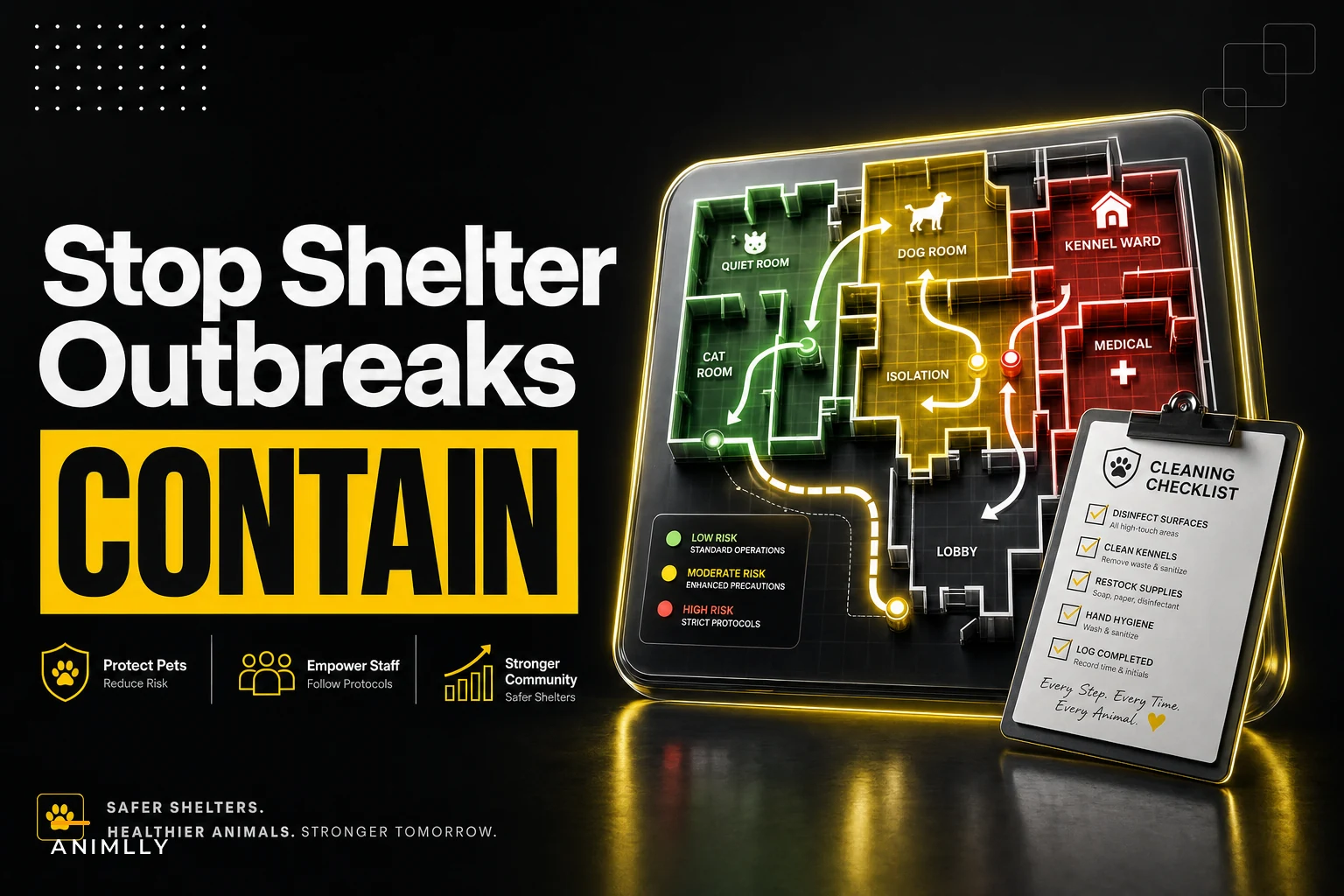
The single most useful thing a small shelter can build is a color-coded zoning map of its floor plan. Not a fancy one. A printed layout with rooms shaded in four colors, laminated, and taped by every entrance and cleaning cart.
Why this matters more than any disinfectant product: staff make dozens of movement decisions a day, and almost none of them are consciously about disease risk. When there's no visual reference, "which room do I clean first" gets answered by convenience, not by risk. A map turns an invisible rule into something you can point at.
| Zone color | What lives here | Movement rule |
|---|---|---|
| Green | Healthy, cleared adoption animals | Clean first, always. Staff enter here before any other zone. |
| Yellow | Intake / not-yet-cleared animals (stray hold, awaiting vet check) | Clean second. Treat as potentially infectious until cleared. |
| Orange | Sick or symptomatic, non-reportable (URI, mild diarrhea, ringworm) | Clean third. Dedicated supplies. |
| Red | Confirmed or suspected high-risk contagious (parvo, panleuk, distemper) | Clean LAST. Full isolation protocol. One assigned person only. |
The workflow rule that flows from this map is simple and almost never followed without it: you always move from green to red, never backward, within a shift. If someone has to return to green after touching orange or red, they change outer layers, wash hands — and ideally, that's a different person entirely.
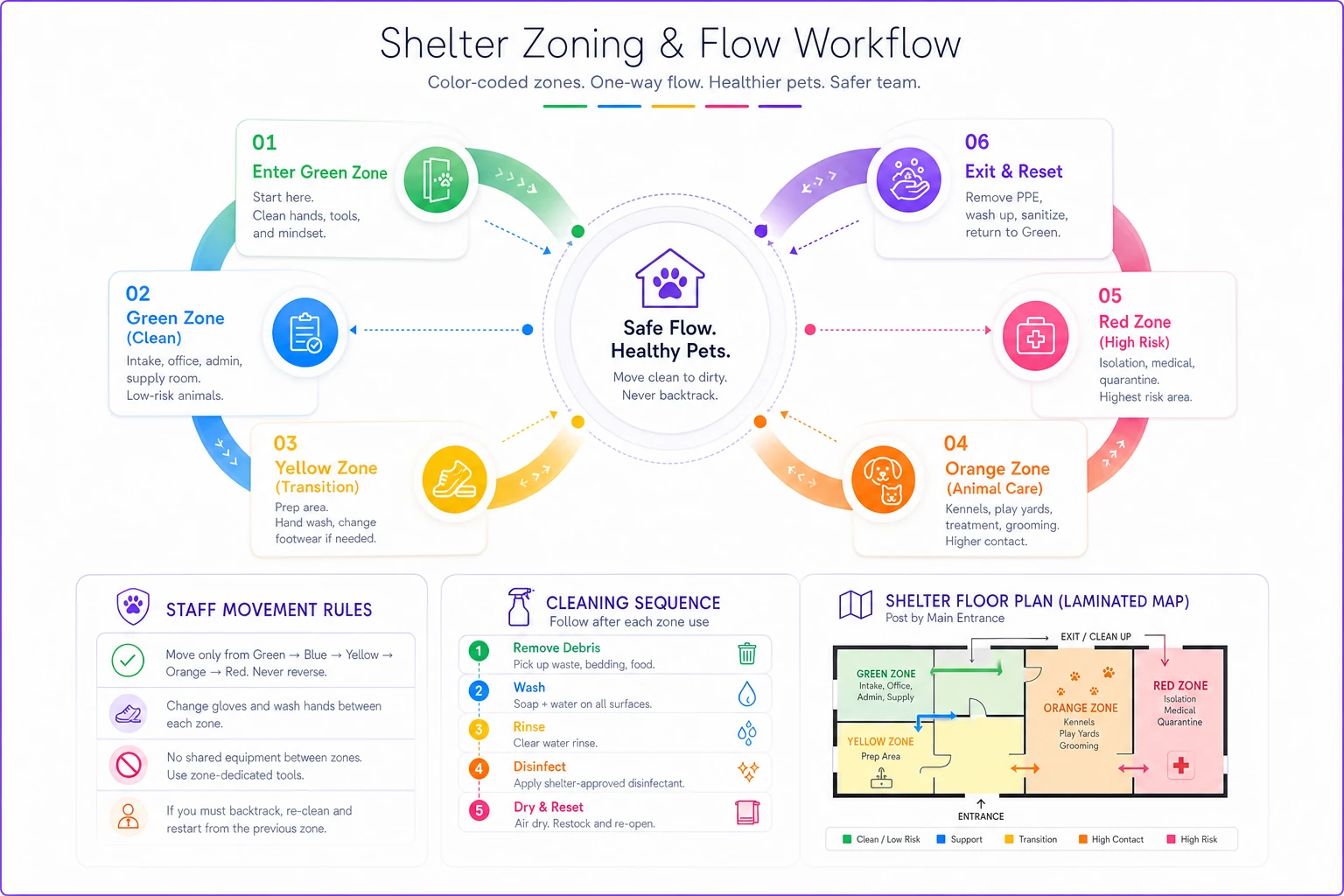
What we've seen across a lot of small facilities is that the map alone cuts cross-contamination noticeably, before anyone buys a single new bottle of disinfectant. The failure wasn't the cleaning. It was the sequence.
Staff assignment rules that survive a short shift
Zoning maps fall apart the second you're down a person and everyone's covering everything. So the assignment rules have to be built for a bad Tuesday, not an ideal week.
Streamline your shelter operations effortlessly.
Animlly helps you manage every pet, volunteer, and adoption step with ease and accuracy.
- Comprehensive pet profiles
- Volunteer scheduling & communication
- Adoption tracking & reporting
No credit card required
The core principle: the higher the risk zone, the fewer people who touch it. Red should ideally be one named person per day. Orange, a small fixed group. Green and yellow can rotate. This is the opposite of how most small shelters instinctively operate, where everyone pitches in everywhere because that feels more efficient.
-
Assign a "clean team" lead each shift. This person handles green and yellow only and does not enter orange or red at all that day. They're your firewall for the adoption floor.
-
Assign one isolation handler for red. They do red last, in dedicated gear, and once they've been in red they're done touching lower-risk zones for the day. If red work happens mid-shift, they finish out in red and orange only.
-
Orange gets whoever's left, with the rule that any orange-to-green transition requires a full change and handwash.
-
Volunteers default to green. Never assign an untrained volunteer to orange or red — not because they can't handle it emotionally, but because they don't carry the movement discipline in their head yet.
The mistake that keeps coming up: the person doing medical treatments in the parvo ward is also the one doing adoption-floor enrichment because they're the most animal-savvy on staff. That's the exact path an outbreak takes. Skill overlap and risk overlap are not the same thing, and small shelters conflate them because the same two or three people can realistically do everything.
If you're formalizing who does what, it helps to have this written into your ops documentation rather than living in someone's head. A modular shelter operations playbook with editable SOP templates and RACI maps is the right place for staff-assignment rules like these, so they don't evaporate when your lead tech is out sick.
Cleaning cadence by risk level
Cleaning "everything twice a day" sounds thorough and is actually a mistake. It burns labor evenly across zones that need wildly different levels of attention, which means your green ward gets over-cleaned while isolation gets a rushed job at 4:55pm.
Cadence should track risk, not fairness:
-
Green (healthy adoption) Spot-clean daily, full clean daily, standard disinfectant with proper contact time. This zone doesn't need aggressive protocols — it needs consistency, and it needs to happen first while gear is cleanest.
-
Yellow (intake/uncleared) Full clean daily, but treat every surface as potentially shedding something. Dedicated tools that never touch green. New intake kennels get a full disinfect between animals, not a wipe-down.
-
Orange (mild sick) Twice-daily spot checks, supplies dedicated per ward, and disinfectant matched to the actual pathogen. Ringworm and URI need different approaches. Foot dips or dedicated footwear at the door.
-
Red (high-risk contagious) Contact time becomes non-negotiable here. Parvo and panleuk survive standard quats — you need accelerated hydrogen peroxide or bleach at the correct dilution, with the full contact time the label requires. A 30-second wipe on a parvo kennel is theater, not disinfection.
Build the cadence as a checklist physically present in each zone, not a policy in a binder somewhere:
If a product needs five to ten minutes of wet contact time, post a visible timer so staff don't wipe it dry early.
-
[ ] Correct disinfectant for THIS zone selected
-
[ ] Contact time posted on the wall (in minutes, for the specific product)
-
[ ] Dedicated tools confirmed — mop, bucket, scrub brush do not leave this zone
-
[ ] Footwear/foot dip in place at zone entry
-
[ ] Zone cleaned in green→red order this shift
-
[ ] Waste bagged and removed via the correct exit, not carried through green
The detail that trips up small teams most: contact time. People spray, wait ten seconds, and wipe because the runs are full and they're behind. Most disinfectants need somewhere between five and ten minutes of wet contact to actually kill parvovirus. If your product dries in 90 seconds in a warm ward, you're not disinfecting — you're moving virus around with a damp cloth.
Cohorting rules: keep the outbreak in one box
Cohorting is where the real disease math lives. If you house animals based on whatever run is open, a single incubating parvo puppy shares air and surfaces with your whole litter population — and now you have twelve sick animals instead of one.
The rule that matters most: cohort by arrival date and health status, not by convenience. Animals that came in together, from the same source, on the same day, are an epidemiological unit. Keep them together and separate from animals that arrived on a different day.
-
Never mix intake dates in the same air space during the incubation window. For parvo, that's roughly a week to ten days. A puppy that looks fine on day two can be shedding by day five.
-
Group by source when possible. Animals from the same hoarding case or transport carry the same exposure history. Splitting them across the building spreads that risk.
-
Keep unweaned litters and neonates in their own protected cohort, separate from general intake entirely. They're your most vulnerable population and the first to die in a panleuk break.
-
Don't move an animal to the adoption floor early just to free up a run. That pressure is the number one way orange animals become green-zone outbreaks. If capacity is forcing early moves, that's a capacity problem to solve upstream — not a cohorting rule to bend.
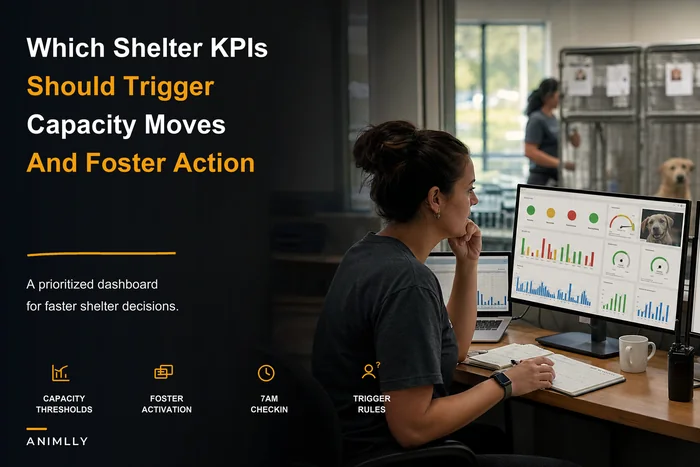
That last point connects to something bigger: outbreaks are often downstream of capacity decisions. When you're over capacity, every safety margin gets shaved, and cohorting is usually the first to go. If you're not already watching the metrics that tell you when to slow intake or push foster, a prioritized KPI dashboard that triggers capacity and foster actions is what keeps you from making the desperate run-freeing decisions that start outbreaks in the first place.
A real scenario: the transport that almost took down the cat ward
A small municipal-adjacent shelter — around 40 animal capacity, four full-time staff, a handful of volunteers — took in a transport of eight cats late on a Friday. No isolation space was open, so the cats went into two available runs in the main adoption cat room "just for the weekend."
By Wednesday, two of the transport cats were lethargic and off food. Panleukopenia confirmed by Friday. By that point they'd shared a room, shared air, and — critically — a shared scoop and litter station with the resident adoptable cats for nearly a week.
The outbreak hit six cats total. The room closed to intake for close to three weeks for deep decontamination. The rough cost — extra medical care, fluids, hospitalization, disposables, lost adoption throughput from a closed ward — landed somewhere in the $4k–$6k range. Most of it avoidable.
What changed afterward wasn't expensive. They laminated a zoning map. They designated the back grooming room as overflow yellow so late transports never landed in green again. And they wrote one rule into the intake SOP: no new arrivals enter a room containing cleared adoptable animals, ever, regardless of how full we are. The next transport that arrived without free isolation space went to the overflow yellow zone and cleared without incident. No second outbreak that season.
The lesson wasn't "buy better disinfectant." It was "we had no line on the map, so a full building made the decision for us."
Partner and public communication scripts
When something breaks out, the second crisis is communication. Foster families, recent adopters, volunteers, and rescue partners all need to hear from you fast and clearly — before they hear a rumor. Small shelters tend to freeze here because nobody wrote the words down in advance.
To a foster or recent adopter of a potentially exposed animal: > "Hi [Name], I'm reaching out with a heads-up. An animal housed near [pet's name] during their time with us has since been diagnosed with [condition]. [Pet] may have been exposed. We wanted you to know right away so you can watch for [specific symptoms] over the next [X days] and contact your vet immediately if you notice anything. We're covering [what you're covering, if anything]. Call me directly at [number] with any questions."
To rescue/transfer partners: > "Flagging a health situation for transparency: we've confirmed [condition] in animals from [intake date/source]. Any animals transferred to you from that group on [dates] should be monitored and cohorted separately on your end. Happy to share exact dates and IDs. We've paused transfers from that population until we're clear."
To volunteers (internal): > "We have a confirmed [condition] case in the [zone]. Until further notice: that ward is red-zone, one assigned handler only, cleaned last. Do not move between that room and the adoption floor. If you worked that area this week, please check in with [lead] before your next shift."
The pattern across all three: name the condition, name the exposure window, name the specific action you want, and give a direct contact. Vague reassurance ("everything's fine, just a precaution") destroys trust when it turns out not to be fine.
When strict zoning is overkill — and when it isn't
Not every situation needs full red-zone protocol, and pretending it does will exhaust a four-person team into ignoring the map entirely.
When full protocol makes sense: any confirmed or suspected parvo, panleuk, distemper, or a fast-spreading URI moving through a ward. Any transport or hoarding intake with unknown vaccine history. Neonate season, when a single break kills fast.
When it's overkill: a single healthy owner-surrender with vet records and no symptoms doesn't need to be treated like a biohazard. A cleared, vaccinated, long-stay adoption animal doesn't need orange-zone handling. Over-applying isolation protocol has a real cost — it burns labor, it isolates social animals unnecessarily, and it trains staff to roll their eyes at the whole system.
Who doesn't get to run a loose version of this: if you routinely take unvaccinated transport, run neonate litters, or operate near capacity, zoning isn't optional. The margin isn't there. The shelters that get hit hardest are almost always the ones that said "we're small, we all know the animals, we don't need formal zones" — right up until they did.
Shelter outbreaks in small facilities are almost never a knowledge failure. Your staff know parvo is dangerous. They know isolation matters. What they usually don't have is a map — a physical, visual, agreed-upon set of lines that tells a tired person at 5pm which room to clean first and which animals can't share air. Draw the map. Assign the fewest possible people to the highest-risk zones. Match cleaning cadence and contact time to actual risk instead of spreading effort evenly. Cohort by arrival date like your animals' lives depend on it, because sometimes they do. Write the communication scripts before you need them, not during the 2am panic. Do those five things and you've built a shelter outbreak SOP that holds up on your worst-staffed day — which is, of course, exactly the day the outbreak shows up.
Ready to enhance your shelter’s impact?
Join 500+ shelters using Animlly to improve care coordination, increase adoptions, and engage communities effectively.