

Most off-site adoption events don't fail on the day. They fail three days earlier, when nobody confirmed which dogs were actually cleared to travel, or when the volunteer sign-up sheet had eleven names but no real clarity on who's handling returns versus who's watching the crate stack in the sun.
The event itself is the visible part. The chaos is almost always upstream.
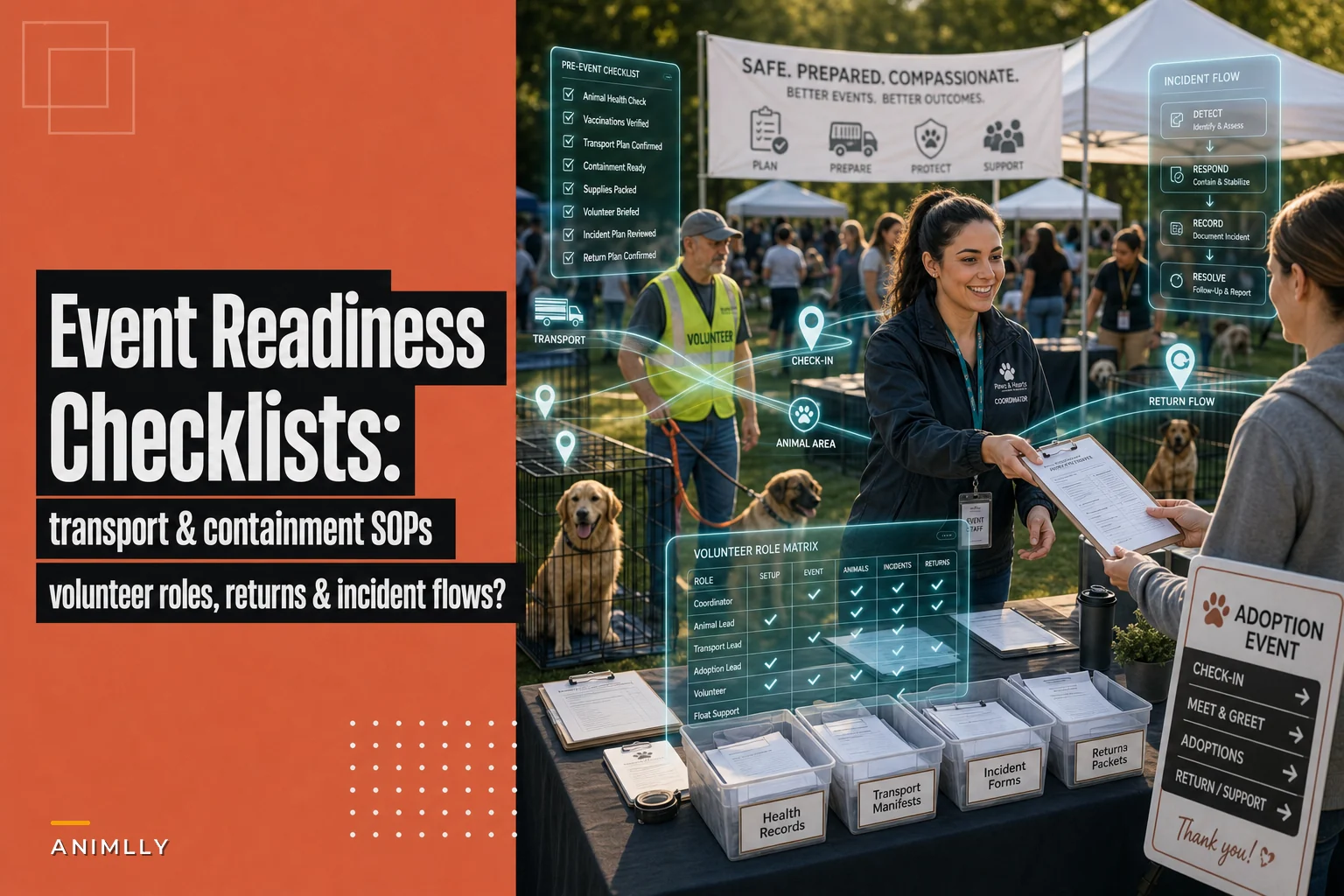
If you run a small shelter and you've done a handful of these, you already know the pattern: great turnout, lots of interest, and then Monday morning hits and two of the adoptions look shaky, one animal came back stressed and off its food, and half your volunteers don't want to do the next one. This post is about the operational layer underneath the event — the readiness, transport, role, and contingency systems that separate a smooth Saturday from a mess you're still untangling a week later.
Start with the animal readiness gate, not the animal list
The most common failure in off-site event operations isn't logistics. It's sending an animal that shouldn't have gone.
Here's how it usually plays out. Someone picks the event animals based on who photographs well or who's been in the shelter longest and needs exposure. That instinct isn't wrong. But the selection gets made off a whiteboard or a quick walk-through, and nobody runs a hard check against medical, behavioral, and paperwork status. So a dog mid-treatment for kennel cough ends up in a crate next to five other animals, or a cat that panics in carriers gets loaded for a four-hour day in a loud parking lot.
The fix is a readiness gate, not a readiness suggestion. An animal doesn't make the transport list until it clears every item. No exceptions on event morning, because event morning is exactly when people start waving things through.
-
Medical clearance current — vaccines complete and past the required window, no active contagious condition, no procedure in the last 48–72 hours
-
Spay/neuter status confirmed and matched to your adoption policy (cleared, scheduled, or contract-required)
-
Microchip present and registered to the shelter, ready to transfer
-
Behavioral flag reviewed — specifically for crowd tolerance, carrier/crate tolerance, and handling by strangers
-
Feeding and medication schedule documented for the day, including any meds that must travel
-
Photo and one-line bio finalized so volunteers aren't improvising histories they don't know
-
Return-to-shelter plan noted if the animal doesn't place (which cage, which team, which cleaning protocol)
That last item gets skipped constantly, and it's the one that bites you. Every animal that leaves needs a defined path back, because most of them are coming back.
One pattern worth naming: the animals that most need exposure are often the ones least suited to the environment. A long-stay dog with mild reactivity gets pushed to events precisely because staff want it seen — and the event setting is the worst possible place for that dog. Readiness gating forces that conversation before the crate gets loaded, not after a nip in a crowd.
Transport is a separate discipline from the event
Shelters tend to treat the drive as a detail. It isn't. It's the highest-risk hour of the whole day and the one with the least supervision.
Streamline your shelter operations effortlessly.
Animlly helps you manage every pet, volunteer, and adoption step with ease and accuracy.
- Comprehensive pet profiles
- Volunteer scheduling & communication
- Adoption tracking & reporting
No credit card required
Vehicle prep and securement mechanics are covered in depth in the shelter transport safety SOP, so no need to re-run all of it here. What matters specifically for events is that transporting animals to an off-site adoption has different pressures than a routine transfer: you're moving multiple animals at once, you're on a schedule tied to an event start time, and you're loading and unloading in a public space full of distractions.
-
Manifest before you load. Every animal on the vehicle is on a written manifest with its readiness status confirmed. If it's not on the manifest, it doesn't get on the vehicle. This is your defense against the "wait, why is this dog here" moment at the venue.
-
Load order matches unload order. Stressed or reactive animals load last and unload first, so they spend the least time in the vehicle and don't sit in a hot lot while you sort carriers.
-
Temperature is a hard checkpoint, not a vibe. Assign one person to own vehicle temperature at departure, mid-transit, and arrival. In summer, a parked transport van in a paved event lot climbs faster than people expect.
-
Meds and records travel in a single labeled bin, not scattered across three volunteers' bags. When you need a vaccine record to answer an adopter's question, you need it in ten seconds.
The piece most small teams miss: the return trip is riskier than the departure. On the way out, animals are freshly fed and rested, and everyone's alert. On the way back, the animals are tired and over-stimulated, the volunteers are drained, and paperwork for same-day adoptions is half-finished. Build your transport SOP around the tired return, not the energetic departure.
The volunteer role matrix (the thing that actually holds the day together)
You've probably lived this version of the problem. You have enough volunteers. On paper you're covered. But everyone assumes someone else is handling the animal that just came back, or three people cluster around the friendly puppy while the shy cat's table sits unstaffed and nobody's checking the water bowls.
The issue isn't headcount. It's undefined roles. When roles are vague, volunteers default to the fun, visible work and quietly avoid the uncomfortable stuff — handling a return, managing an upset adopter, cleaning up an accident.
A role matrix fixes this by assigning named accountability to each function, not just bodies to a location. Here's a simple structure that works for a small shelter running a booth-style event:
| Role | Primary responsibility | Backup? | Key skill needed |
|---|---|---|---|
| Event Lead | Owns the day, makes final calls, holds contingency plans | No — single point | Decision-making, calm under pressure |
| Animal Handler(s) | Direct animal handling, welfare monitoring, rotation | Yes | Body language reading, gentle handling |
| Intake/Return Coordinator | Manages any animal coming back, cleaning, re-crating | Yes | Composure, cleaning protocol knowledge |
| Adoption Processor | Applications, ID checks, payment, paperwork | Yes | Attention to detail |
| Welfare Monitor | Water, shade, temperature, animal stress signs | Yes | Attentiveness, willingness to interrupt |
| Greeter/Flow | Manages crowd, spacing, keeps aisles moving | Yes | People skills |
Two things about this matrix matter more than the roles themselves.
Assign the Welfare Monitor explicitly at shift start and rotate the role so no one is stuck with it all day.
First, the Event Lead has no other job. The most common mistake at small-shelter events is the coordinator trying to also process adoptions, handle animals, and answer questions. The moment something goes wrong — a medical incident, an aggressive dog, an argument with an adopter — you need one person whose entire function is to step in and manage it. If your lead is elbow-deep in an adoption application, you don't have a lead.
Second, the Welfare Monitor role is non-negotiable and always understaffed. This is the person watching for the panting dog, the cat hiding at the back of the carrier, the water bowl that's been empty for an hour. Unglamorous work with no visible payoff, which is exactly why it gets skipped. Assign it explicitly, give it to someone reliable, and rotate it so nobody burns out on it.
On-site flow: how animals and people move through the space
Beyond roles, you need a defined flow — a clear picture of how an interested adopter moves from "I like this dog" to "I'm taking this dog home" without the whole thing bottlenecking at three different points.
A clean on-site flow looks like this:
-
Adopter shows interest
-
Handler introduces the animal in a controlled meet space (not the aisle)
-
If interest continues, Greeter routes them to the Adoption Processor
-
Processor runs application, ID, and screening
-
Payment and paperwork completed
-
Handler does final animal prep (leash, carrier, meds, records)
-
Adopter leaves with a follow-up plan
The chokepoint is almost always the meet-and-greet space. When you don't designate one, introductions happen in the walkway, the crowd backs up, animals get overstimulated, and nervous adopters feel rushed. A small dedicated area — even a corner with a mat and two chairs — calms the whole event noticeably. It also protects your animals, because a controlled introduction is a safer one.
One more flow detail that gets underestimated: decompression space for the animals themselves. Animals working an event need breaks. A quiet crate area, out of direct crowd contact, where a stressed animal can be rotated off the floor for twenty minutes. Without it, your best-behaved dog at 10am is a maxed-out dog by 1pm, and that's when incidents happen.
Contingency steps: returns and medical incidents
This is the part everyone hopes they won't need and nobody plans for. Which is backwards, because at any real event, you will need at least one of these.
Same-day and next-day returns
Returns at events happen for predictable reasons: impulse adoption, a home situation that wasn't fully thought through, a mismatch that surfaces the moment the animal's in the car. Your job isn't to prevent every return — it's to make the return clean, non-judgmental, and safe for the animal.
-
Who receives the return (the Intake/Return Coordinator, not whoever's nearest)
-
A brief re-check of the animal's condition — any injury, stress signs, changes since it left
-
Immediate cleaning and re-crating using your standard protocol, kept separate from event-floor animals
-
A quick, blameless conversation with the adopter to capture why — this data matters
-
No pressure to re-adopt on the spot
That "why" data is genuinely useful. Returns tied to specific event conditions — an animal presented as calm that wasn't, an adopter who felt rushed by the crowd — should feed directly into your follow-up process. If you're already running structured post-adoption check-ins, event returns are early-warning signals worth folding into the same system. The staged follow-up approach in cutting returns in 30 days applies directly here: an event adoption that survives the first week is a very different outcome than one that survives the first Saturday.
Medical incidents
-
The Event Lead is notified immediately and takes control of the situation.
-
The affected animal is moved out of public view to your decompression/quiet area.
-
A pre-identified vet contact is called — you should walk into every event knowing who you're calling and where the nearest emergency clinic is. Have that number written down, not "on someone's phone."
-
The animal's records travel with it if it needs to go to a clinic — this is why the labeled records bin matters.
-
Someone manages the crowd and other animals so the incident doesn't cascade into a second problem.
-
Everything gets documented while it's fresh — what happened, times, actions taken.
The mistake is improvisation. Small teams tend to figure out the vet contact and nearest clinic during the emergency, standing in a parking lot Googling on a phone with one bar. Do that work before you leave the shelter. Every event packet should include the emergency vet number, the address of the nearest clinic, and a printed animal manifest with medical notes.
Where a shared system quietly removes most of the pain
None of this requires software to work. Plenty of shelters run solid events on paper, and paper is genuinely fine for a small pop-up.
The friction shows up when the same information lives in six places — the readiness check is on a whiteboard, the manifest is on a clipboard, the medical records are in binders, the volunteer roles are in a group text, and the returns get logged (maybe) days later. When things are that scattered, the readiness gate gets skipped, the manifest doesn't match the records, and return data never makes it back into your follow-up process.
Here's a quick workflow view of how a shared system can connect those pieces together.
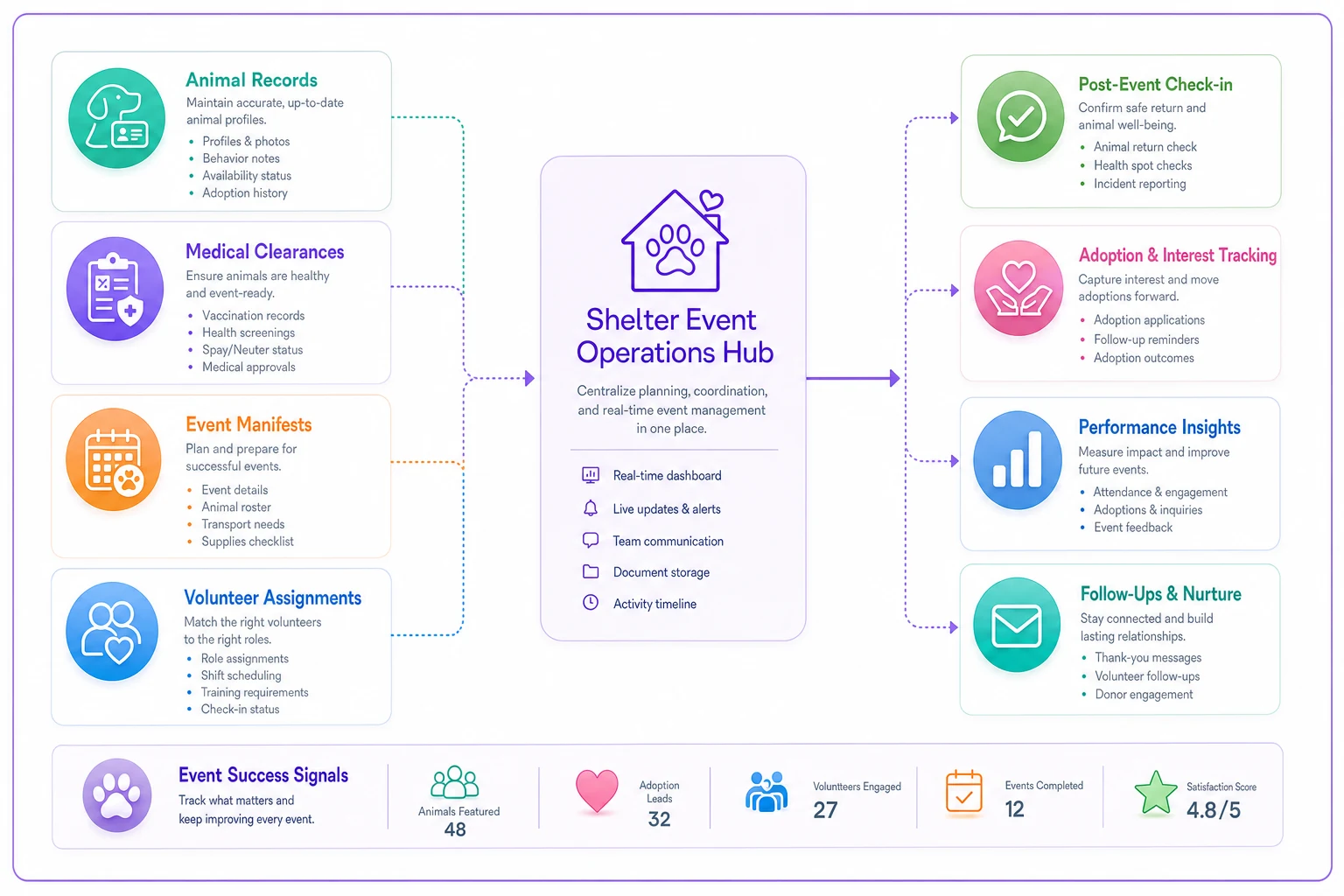
This is where an operational platform earns its keep. When your animal records, medical clearances, event manifests, volunteer assignments, and post-event follow-ups all live in one connected system, the readiness gate becomes something you can actually enforce — an animal can't get added to an event roster if its medical clearance flag isn't green. AI-assisted operational tools can flag mismatches automatically: the dog scheduled for an event that's still mid-treatment, the manifest missing a record, the returned animal that hasn't had a follow-up scheduled. It doesn't run your event. It just makes the upstream prep and downstream cleanup far harder to fumble.
The point isn't the tool. It's that the systems above are only as strong as your ability to keep them consistent event after event — and consistency is exactly what breaks down when everything lives in someone's memory and a group chat.
A real scenario
A small municipal-partner shelter running roughly one off-site event a month kept hitting the same wall: decent turnout, around 6–9 adoptions per event, but a return rate on those event adoptions sitting somewhere around 25–30% within two weeks — noticeably higher than their in-shelter placements.
When they dug in, two causes surfaced. Animals were being selected based on visibility rather than fit, and there was no structured follow-up on event adoptions specifically. They added a hard readiness gate (no animal on the manifest without a fit-for-events behavioral check), assigned a dedicated Welfare Monitor and a single Event Lead with no other duties, and folded event adoptions into their existing week-one follow-up workflow.
Over the next few months, event adoption volume stayed roughly the same, but returns on those placements dropped to about the same range as their in-shelter numbers — a real improvement, and volunteers reported the events felt calmer and less draining. The animals weren't harder to place. They'd just been placing the wrong animals and not following up.
Off-site adoption events live or die on the unglamorous work that happens before the doors open and after they close. The readiness gate keeps the wrong animals home. The transport SOP protects them during the riskiest hour of the day. The role matrix stops the day from collapsing into confusion. And the contingency plans mean a return or a medical scare becomes a handled situation instead of a parking lot crisis.
Get those four systems consistent, run them the same way every event, and the event itself becomes the easy part — which is exactly how it should be.
Ready to enhance your shelter’s impact?
Join 500+ shelters using Animlly to improve care coordination, increase adoptions, and engage communities effectively.