

Most shelter rollouts don't fail loudly. There's no dramatic meltdown, no big meeting where someone declares the new intake system dead. What happens is quieter and more frustrating: two weeks after launch, half the volunteers are back to the paper clipboard "just for now," the kennel staff never fully switched over, and the coordinator who championed the change is spending her evenings manually reconciling two versions of the truth.
That's the pattern worth understanding before you touch a single SOP. Change in a shelter isn't a technology problem or even a training problem. It's a coordination problem across a group of people who mostly aren't paid, don't share the same shifts, and have wildly different comfort levels with anything on a screen. A vet tech, a Saturday-morning dog walker, a retired bookkeeper doing your intake data, and a 19-year-old kennel attendant are all supposed to adopt the same workflow — and they'll each hit different walls.
So this is less a "how to install a system" guide and more a look at how adoption actually spreads (or stalls) inside a volunteer-driven operation, and how to build a shelter change management playbook that survives contact with real shifts, real turnover, and real chaos.
Why volunteer teams break the normal change playbook
Corporate change management assumes a captive audience. People show up daily, they report to someone, and if a manager says "we're using the new system starting Monday," there's a paycheck attached to compliance. Shelters have almost none of that leverage.
A few things make shelter adoption genuinely different:
-
Fragmented exposure. A volunteer who works one four-hour shift a week might touch the new system three times before they're expected to be fluent. That's not enough reps for anything to become muscle memory.
-
No enforcement mechanism. You can't really discipline a volunteer for skipping a field. Your only levers are clarity, ease, and social pressure.
-
Knowledge lives in people, not documents. The person who "just knows" how intake works is often a long-tenured volunteer, not a written SOP. When you change the process, you're competing with years of habit.
-
Uneven tech comfort. In practice, this usually shows up as a small cluster of volunteers who quietly avoid anything digital and route around it — which fractures your data.
What tends to happen across small operations is that the rollout doesn't fail because the new SOP is bad. It fails because it got dropped on everyone at once, with no staging, no fallback, and no real way to tell whether it was working until the data was already a mess.
Phased rollout: stop launching to everyone
The single biggest correction most shelters need is to stop treating go-live as one event. A phased rollout means the change reaches your team in deliberate waves, each with a clear purpose.
Streamline your shelter operations effortlessly.
Animlly helps you manage every pet, volunteer, and adoption step with ease and accuracy.
- Comprehensive pet profiles
- Volunteer scheduling & communication
- Adoption tracking & reporting
No credit card required
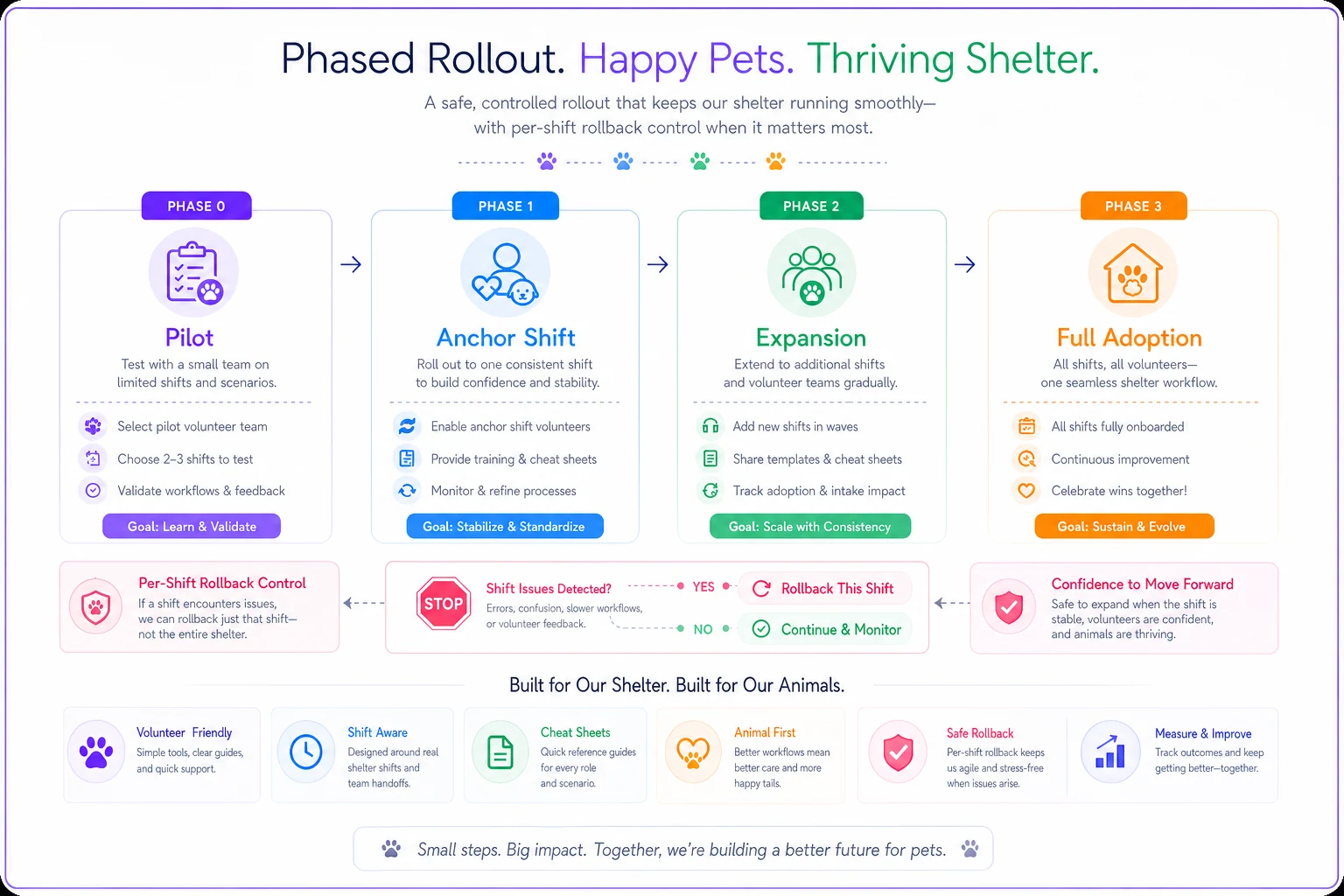
| Phase | Who's involved | Duration | Goal | What "done" looks like |
|---|---|---|---|---|
| Phase 0 – Pilot | 2–4 core staff/lead volunteers | 1 week | Break the process on purpose | Workflow survives a normal week without a workaround |
| Phase 1 – Anchor shift | One reliable shift (e.g., weekday AM) | 2 weeks | Prove it works with real volunteers, not just leads | 80%+ of that shift's records go through the new system |
| Phase 2 – Expansion | 2–3 more shifts | 2–3 weeks | Test coordination across handoffs | Clean handoffs between shifts, no dual record-keeping |
| Phase 3 – Full adoption | Everyone, including weekend/occasional | 2–4 weeks | Absorb the low-frequency volunteers | Paper fallback retired, single source of truth |
Phase 0 exists because leads will find failure points that a general audience never articulates — regular volunteers just silently abandon the tool instead. Your pilot group's job isn't to praise the new process. It's to try to break it: What happens during a surprise owner-surrender at 4:55 PM? What if the WiFi's down in the intake room? What about the dog that comes in with no history and a possible bite record?
One pattern worth flagging: shelters love to pick their most enthusiastic volunteers for the pilot. That's a mistake. Enthusiastic early adopters mask problems because they'll tolerate friction that a normal volunteer won't. Include at least one person who's mildly skeptical of the change. Their resistance is data.
If you're rolling out a whole set of SOPs rather than a single workflow, sequencing matters even more — the modular shelter operations playbook with editable templates and change-control lets you version each SOP independently so you're not relaunching everything at once.
Visualizing the phased rollout can make it easier to explain stages, responsibilities, and rollback points to the team.
Phase 0 exists because leads will find failure points that a general audience never articulates — regular volunteers just silently abandon the tool instead. Your pilot group's job isn't to praise the new process. It's to try to break it: What happens during a surprise owner-surrender at 4:55 PM? What if the WiFi's down in the intake room? What about the dog that comes in with no history and a possible bite record?
Stakeholder mapping when nobody technically reports to you
Before Phase 0, spend an hour mapping who actually influences adoption. This isn't an org chart. In a volunteer-driven team, influence and authority almost never line up.
The useful frame is sorting people into four buckets based on two questions: How much does this change affect their daily work? and How much do other volunteers listen to them?
-
High impact, high influence — Your make-or-break people. Usually shift leads or long-tenured volunteers. If they're not bought in, nothing spreads. Get them into Phase 0.
-
High impact, low influence — The people whose work changes most but who don't sway others. They need the most training attention, but you don't need them to evangelize.
-
Low impact, high influence — Dangerous to ignore. A beloved weekend volunteer who barely touches intake can still tank a rollout by grumbling about it in the break room. Bring them in early enough to feel consulted.
-
Low impact, low influence — Handle these folks in Phase 3 with simple, minimal training.
The person who informally trains every new volunteer — often not a manager, sometimes not even someone with a title — is your highest-leverage stakeholder. If the new system doesn't match what they teach on day one, new volunteers learn the old way by default, and your adoption curve flattens no matter what the SOP says.
Map these people by name, not role. "The Tuesday and Thursday closing crew listens to Marcus" is more useful than "engage kennel staff."
Short training sprints beat one big training day
The traditional approach — a two-hour Saturday training session where you walk everyone through the new system — is almost perfectly designed to fail with volunteers. People forget most of it within a week, half the team wasn't scheduled that day anyway, and there's no reinforcement built in.
Short training sprints work better because they match how volunteers actually retain information: small, repeated, and tied to real tasks.
-
One narrow skill per sprint. Not "the new system" — instead, "how to log a stray intake." One workflow, start to finish.
-
Ten to fifteen minutes, at the start of a real shift. Teach it right before they'll use it, so the first live rep happens within the hour.
-
One printed cheat sheet taped where the work happens — at the intake desk, by the kennel whiteboard. Not a binder nobody opens.
-
A designated "ask-me" person on shift for the first few times, so nobody gets stuck and reverts to paper out of frustration.
-
A quick check the following week — did the records from that skill come through clean? If not, re-run the sprint, don't escalate.
Adoption is a series of first successful reps, not a knowledge transfer. A volunteer who logs one clean intake, unassisted, on their own shift is more "trained" than someone who watched a flawless 90-minute demo and hasn't touched the system since.
Tape the cheat sheet at the intake desk where people will actually see and use it during the first few shifts.
Space the sprints so each shift covers two or three skills before you expect fluency on the whole workflow. It feels slower on paper. In practice it's faster, because you're not constantly re-teaching people who forgot everything from the big session.
Rollback criteria: decide in advance when to pull the plug
This is the part almost everyone skips, and it's the difference between a controlled experiment and a slow-motion disaster. You need to define — before launch — the conditions under which you'll revert to the old process. Without written rollback criteria, teams do one of two bad things: they abandon the new system in a panic at the first hiccup, or they stubbornly push forward while data quality quietly collapses.
Good rollback criteria are specific, measurable, and tied to a timeframe. Vague ones ("if it's not working") are useless because everyone defines "working" differently.
-
Data completeness drops below ~85% of intake records having required fields for more than one week → pause and diagnose.
-
Duplicate or dual record-keeping appears on a shift and persists past the second week → rollback that shift to the old process, fix the friction, retry.
-
A safety-critical field gets missed — bite history, medical flag, hold status — even once because of the new workflow → immediate stop. This isn't a "let's see" situation.
-
Handoff failures between shifts cause an animal's status to be wrong more than a couple of times → coordination problem, pause expansion.
The critical detail: rollback is per-phase and per-shift, not all-or-nothing. If Phase 2's weekend crew is struggling, you roll them back while your anchor shift keeps running the new process. You almost never need to nuke the entire rollout. Teams that treat rollback as a single big red button end up avoiding it entirely because the cost feels too high.
Write down who has authority to call a rollback. If it requires a committee meeting, it won't happen fast enough to matter. Usually the shift lead plus the coordinator is the right level.
Simple adoption KPIs (and the vanity metrics to ignore)
You can't manage a rollout you can't see. But shelters tend to either track nothing or track the wrong things. "Number of volunteers trained" is a vanity metric — it tells you attendance, not adoption.
The KPIs that actually reflect whether a system is taking hold:
-
Adoption rate per shift — what percentage of records for a given shift went through the new system vs. the old. This is your core number, and tracking it by shift immediately shows you where adoption is stalling.
-
Data completeness rate — percentage of records with all required fields filled. This catches the "technically using it but doing it wrong" problem.
-
Time-to-first-solo-use — how long after training before a volunteer completes the workflow unassisted. Long gaps predict abandonment.
-
Workaround sightings — a qualitative count of how often you spot paper fallbacks or side spreadsheets. Zero-ish is the goal by end of Phase 3.
-
Handoff accuracy — how often an animal's status is correct at shift change. This is the one that tells you the system is actually improving coordination, not just data entry.
Set targets that escalate by phase. Expecting 95% adoption in week one is how you talk yourself into declaring failure. A realistic curve is something like 60% by end of Phase 1, 80% by Phase 2, and steady 90%+ through Phase 3 — with completeness climbing alongside it.
Where a decent management platform earns its keep is here — pulling adoption and completeness numbers automatically instead of someone hand-counting records every Friday. When the system can flag which shift's records are incomplete or which required fields keep getting skipped, you catch a stalling rollout in days instead of discovering it a month later when the data's already tangled. The point isn't the software; it's that you get an honest, low-effort read on whether the change is actually sticking.
A real scenario: a mid-size municipal shelter's intake overhaul
A shelter handling roughly 3,000 intakes a year decided to move from a mixed paper-and-spreadsheet intake process to a single digital intake workflow. Their first attempt, months earlier, had been a classic all-at-once launch: one training day, go-live the following Monday. Within three weeks, adoption had cratered — maybe 40% of records were going through the new system, the rest still on paper, and staff were double-entering everything, which everyone hated.
The second attempt used a phased approach. They ran a one-week pilot with three lead staff who deliberately stress-tested the after-hours and no-history scenarios. Then a single weekday shift for two weeks, which hit around 85% adoption once they fixed a clunky required-field order that had been slowing people down. Expansion to the remaining weekday shifts took another three weeks, and weekends — their most volunteer-heavy, lowest-frequency crews — came last, with extra cheat sheets and an on-shift helper available.
By the end, adoption sat in the low 90s, data completeness went from an estimated 70% under the old mixed system to the mid-90s, and dual record-keeping essentially disappeared. The whole thing took about eight weeks instead of the "one weekend" the first attempt had promised. Slower to start, but it actually stuck.
The lesson wasn't about the tool. Staging the change and defining rollback thresholds gave the team permission to fix friction points instead of forcing through a broken workflow. That's the part that's hard to replicate without the discipline of phases built in from the start.
When phased rollout is overkill — and when it's non-negotiable
Phasing isn't free. It takes longer and requires more coordination up front, so it's worth being honest about when it's the wrong call.
-
When a lighter approach makes sense If you're changing something low-stakes and low-frequency — say, a new format for a monthly donor thank-you — a full phased rollout is bureaucratic overkill. Just switch it and move on.
-
When phasing is non-negotiable Any change that touches intake, medical records, animal status, or anything safety-critical. If getting it wrong means a bite history gets lost or an animal's hold status is inaccurate, you phase it, you set rollback criteria, and you don't skip the pilot. The cost of a botched rollout there isn't inconvenience — it's an animal or a person getting hurt.
-
Who should probably not attempt this alone A brand-new coordinator with no established relationships on the volunteer team. Adoption runs on trust and influence, and if you haven't mapped who actually sways the room yet, spend a few weeks doing that before you launch anything. Pushing a change through a team that doesn't yet trust you tends to harden resistance rather than build habits.
The same phased logic applies well beyond SOPs — it's exactly how you should approach moving data between systems, where a bad cutover can corrupt years of records. The mindset in this phased data migration checklist — audit, mapping, pilot, validation — is the same discipline of staging, testing, and validating before you go all-in.
Pulling it together
The shelters that adopt new systems successfully aren't the ones with the best software or the most motivated volunteers. They're the ones that treat change as something that spreads through people over time, in waves, with off-ramps built in.
Map who really has influence. Pilot with people who'll try to break things, not just cheer. Teach in short bursts tied to real shifts. Decide your rollback thresholds before you launch — per shift, so you can course-correct without nuking everything. Watch a handful of honest adoption KPIs instead of counting who showed up to training.
Do that, and the new system doesn't quietly die in week three. It becomes the way things are done — even for the volunteer who only shows up on alternate Saturdays and swore they'd never touch a screen.
Ready to enhance your shelter’s impact?
Join 500+ shelters using Animlly to improve care coordination, increase adoptions, and engage communities effectively.