

Most small shelters don't fail their animals because someone was careless. They fail because nobody could tell you, on any given Tuesday, who was actually responsible for making sure the diabetic cat got insulin twice a day — and whether the person who gave it was even allowed to.
That gap is what a shelter clinical governance framework is supposed to close. Not more forms. Not a full-time vet you can't afford. A clear, boring system that answers three questions every single day: who can do what, how it gets written down, and what happens when something looks wrong.
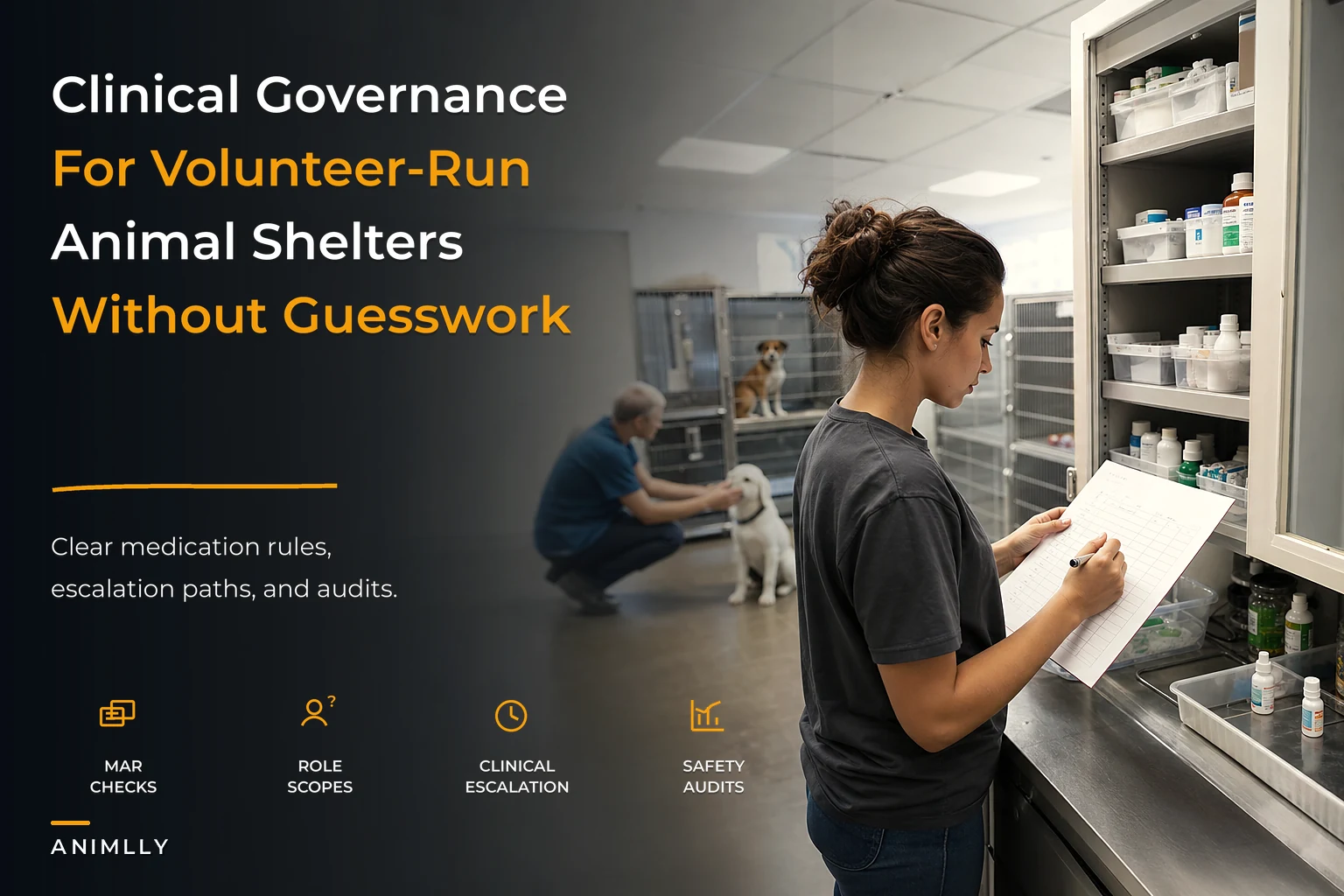
If you run a shelter with three paid staff and forty volunteers, this is the operational spine that keeps medication administration safe and keeps a licensed clinician meaningfully in the loop — without pretending you have a hospital.
Why clinical governance quietly collapses in small shelters
Volunteer-heavy operations have a particular problem: clinical work never disappears, it just gets spread across people who each hold a tiny piece of it. One volunteer knows the senior dog needs his thyroid meds. Another knows the URI cats are on doxycycline but isn't sure which ones finished the course. The vet who does your spay days assumes someone is tracking post-op pain meds. Nobody is wrong, exactly. But no single person can see the whole medication picture.
-
Verbal handoffs replace records. "Oh, I already gave her the pill" becomes the entire audit trail.
-
Scope creep sets in. A confident long-time volunteer starts adjusting doses because they've "seen the vet do it."
-
The clinician goes blind. Your partner vet only hears about problems after they've become emergencies.
None of this shows up until an animal is double-dosed, a controlled substance count doesn't reconcile, or an inspection asks for medication records you can't produce.
The shelters with the fewest medical incidents aren't the ones with the biggest medical budgets. They're the ones where the boundaries are written down and everyone actually knows where they stand. Governance isn't clinical skill. It's clarity.
The three layers that actually make governance work
A workable framework only has three moving parts. Overbuild it and volunteers ignore it. Underbuild it and it fails the moment your animal count doubles. The goal is the smallest system that still holds up when you go from 10 animals to 60.
Streamline your shelter operations effortlessly.
Animlly helps you manage every pet, volunteer, and adoption step with ease and accuracy.
- Comprehensive pet profiles
- Volunteer scheduling & communication
- Adoption tracking & reporting
No credit card required
Layer 1 — Scope of practice. Who is allowed to touch medication, and to what degree. This is the layer most shelters skip entirely, and it's the most dangerous gap. Layer 2 — Documentation. The Medication Administration Record (MAR) that turns "I think someone gave it" into a signed, timestamped fact. Layer 3 — Escalation. A one-page path from "this looks off" to "the clinician has been contacted," with no guessing in between. Everything else — audits, SOPs, training — hangs off these three.
Layer 1: The scope-of-practice matrix
This is the document that ends the "well, I've been doing it for years" argument. It defines exactly what a volunteer, a trained tech, a staff lead, and a licensed clinician may each do. When roles are written down, you also stop the quiet reverse problem — capable people being scared to act because nobody told them they were allowed to.
| Task | General Volunteer | Trained Med-Volunteer / Tech | Staff Lead | Licensed Clinician (Vet/RVT) |
|---|---|---|---|---|
| Feeding, hydration, observation | ✅ | ✅ | ✅ | ✅ |
| Oral meds — pre-packaged, per written order | ❌ | ✅ | ✅ | ✅ |
| Topical / eye / ear meds per order | ❌ | ✅ | ✅ | ✅ |
| Subcutaneous injections (e.g. insulin, fluids) | ❌ | ✅ (with sign-off) | ✅ | ✅ |
| Controlled substances handling | ❌ | ❌ | ✅ (log only) | ✅ |
| Dose changes / new prescriptions | ❌ | ❌ | ❌ | ✅ |
| Diagnosis / treatment decisions | ❌ | ❌ | ❌ | ✅ |
| Euthanasia decisions | ❌ | ❌ | ❌ | ✅ |
Two things make this matrix real instead of decorative.
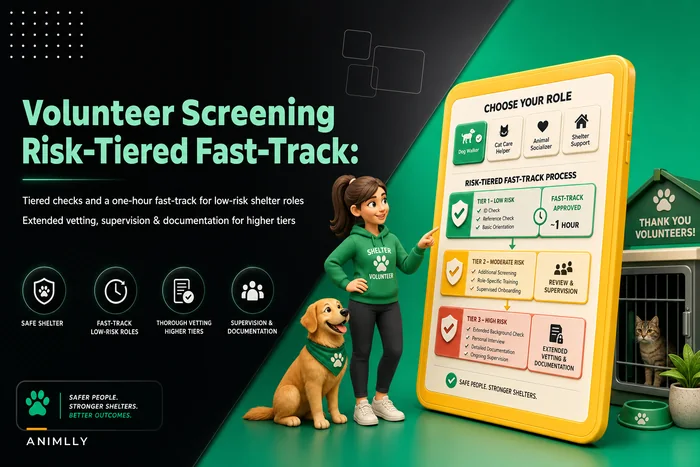
First, the "with sign-off" column matters. A med-volunteer can give subcutaneous fluids only after a named person watched them do it correctly and signed a competency check. The same rigor you'd apply in a risk-tiered volunteer screening and role-matching process belongs here — because "who is allowed to inject an animal" is exactly the kind of decision that shouldn't rest on how friendly someone is or how long they've been around.
Second, the matrix has to be visible where meds happen. Print it, laminate it, tape it to the med cabinet. A scope matrix filed in a binder in the office is a scope matrix nobody obeys.
A common mistake: shelters write the matrix once and never revisit it as volunteers gain skill. Someone who earned subcutaneous sign-off six months ago should be reflected on the current sheet — otherwise trained people get treated like beginners and start ignoring the whole thing.
Layer 2: The MAR template that volunteers will actually use
The Medication Administration Record is the backbone. It's also where most shelters get too fancy and lose the plot. You do not need a clinical EMR. You need a record where a tired volunteer at 7am can see, in five seconds, what's due and check a box.
Here's the minimum a MAR needs to hold:
-
Animal ID + location (kennel/room)
-
Medication name, dose, route
-
Frequency and the exact time windows (e.g. "AM = 6–9, PM = 5–8")
-
Start date and stop/review date — this is the field everyone forgets
-
A box per dose for initials + time given
-
A "not given" reason code (refused, animal not found, held per staff)
-
Prescribing clinician name
The stop date is the single most valuable field on the sheet. Antibiotics get given days past their course because there's no visible end. A hard stop/review date forces someone to check with the clinician instead of running a prescription on autopilot.
A ready-to-use paper MAR row looks like this:
[Room 3 / "Biscuit"] — Doxycycline 50mg PO — BID (AM 6–9 / PM 5–8) — Start 6/2 → Stop 6/12 — Dr. Nguyen
AM: initials / time PM: initials / time Not given? ▢ refused ▢ not found ▢ held
The "not given" codes are what separate a real record from a fake one. When a box is blank, you can't tell if the med was skipped or the volunteer forgot to initial. A checkbox for why turns a gap into information — and it's the first thing to look at when an animal isn't improving.
Whether you keep this on paper or in a shared system, the underlying rule is the same one that governs the rest of your operation: every record needs an owner and a consistent format. This connects directly to a lightweight shelter data governance standard — a MAR is only trustworthy if animal IDs, medication names, and clinician names are recorded the same way every time. Inconsistent naming ("Biscuit" vs "Room 3 cat" vs "the orange one") is how doses get missed during handoffs.
Layer 3: The one-page escalation ladder
When a volunteer notices something wrong, the failure mode isn't panic — it's hesitation. They don't know if this is a "text the lead" situation or a "wait until tomorrow" situation, so they do nothing and mention it in passing hours later.
An escalation ladder removes that judgment call. It should fit on one page and live next to the MAR.
-
Tier 1 — Observe & log (volunteer handles). Mild, expected issues: slightly reduced appetite, soft stool, mild squinting. Action: record in the animal's notes, tell the shift lead at handoff. No urgent contact needed.
-
Tier 2 — Notify shift lead now (within the hour). Refusing food for a full day, vomiting, a med refused two doses in a row, a wound looking worse, a controlled-substance count that doesn't reconcile. Action: stop, find the lead, do not give further meds until directed.
-
Tier 3 — Clinician contact immediately. Difficulty breathing, collapse, seizures, suspected overdose or double-dose, bleeding that won't stop, non-weight-bearing on a limb. Action: call the on-call clinician using the number on the sheet; if no answer within 15 minutes, escalate to the emergency vet listed.
The single most important line on this page is the named contacts with actual phone numbers and hours. An escalation ladder that says "contact the vet" without specifying which vet, at what number, and what to do if they don't pick up is where the whole system stalls.
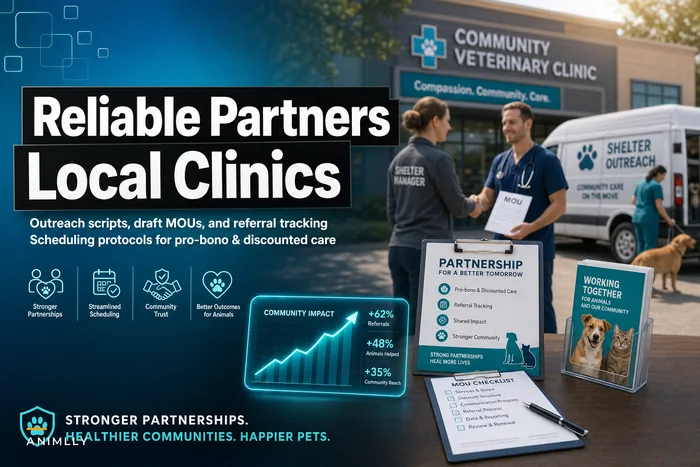
This is exactly why clinical relationships have to be built before you need them. A shelter that has done the work to turn local clinics into reliable partners with clear MOUs has a real Tier 3. A shelter with just a clinic's general phone number has a wish.
How the three layers connect during a normal day
Governance frameworks read like static documents, but the value is in how they move together during a shift. Here's how a routine morning actually flows when the system is working:
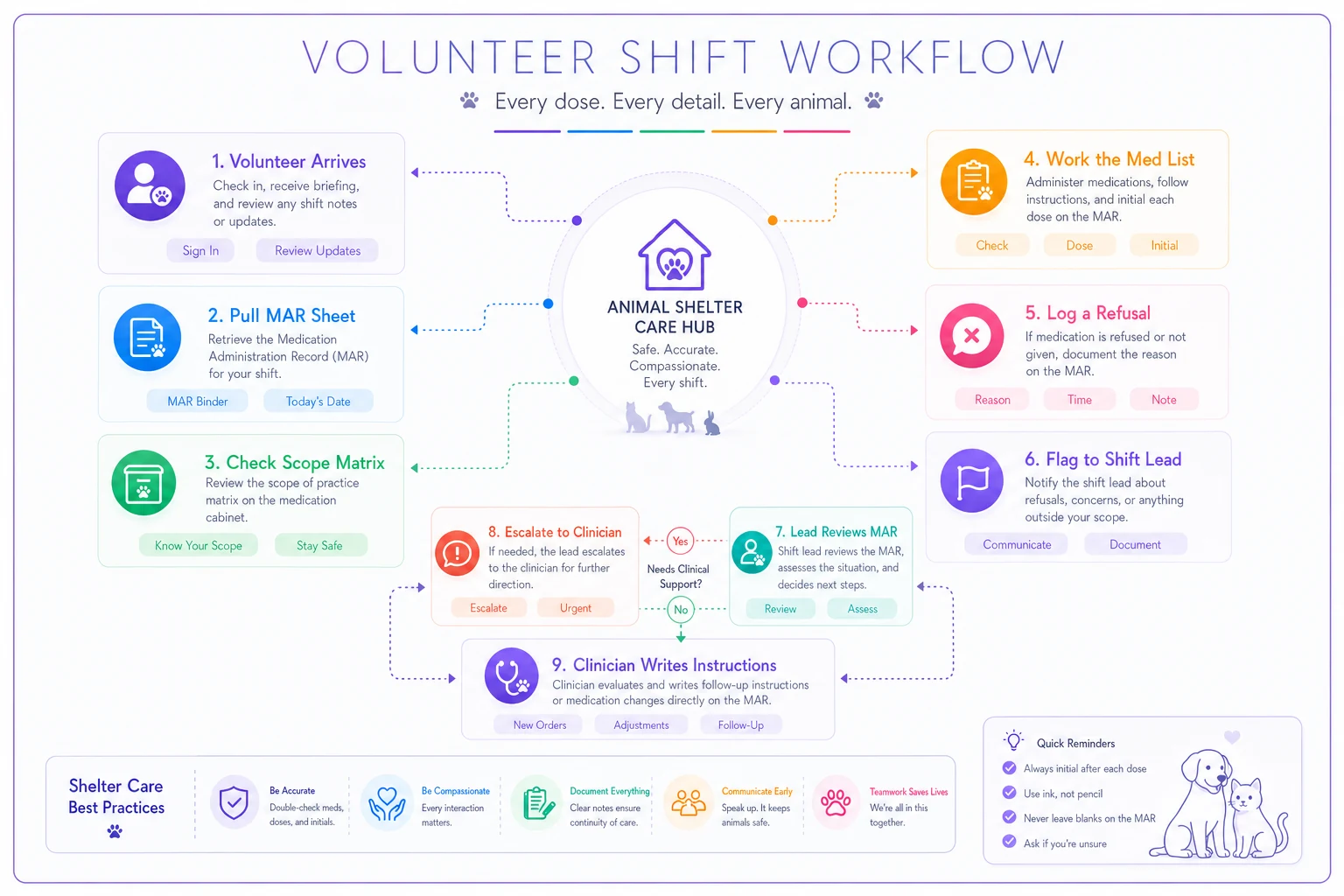
No emergency. No double dose. No animal quietly deteriorating because someone assumed someone else knew. That's what governance buys you — not perfection, but a system where problems surface early and land on the right person.
The coordination point that makes or breaks this is the handoff. A MAR that isn't reviewed at shift change is just a checklist. The lead scanning it — checking for blank boxes, refusals, and near-stop-dates — is the moment oversight actually happens.
Audit cadence: proving the system works without drowning in it
Governance without checking is just hope. But small shelters can't run monthly clinical audits like a hospital, and they shouldn't try. Match audit frequency to risk.
A realistic cadence:
-
Daily (2 minutes) Shift lead scans the day's MAR for blank boxes and unexplained "not given" entries.
-
Weekly (15 minutes) Reconcile controlled substance log against MAR entries. Any mismatch is treated as a Tier 2 incident, full stop.
-
Monthly (30–45 minutes) Spot-check five random animals — do their meds match the clinician's written orders? Are stop dates being honored? Are competency sign-offs current?
-
Quarterly (with clinician) Review any medication incidents, refresh the scope matrix, confirm on-call contacts are still accurate.
The weekly controlled-substance reconciliation is non-negotiable even at tiny scale. It's the one area where a gap isn't just a welfare risk — it's a legal one. What tends to happen at small shelters is the controlled log gets loose because "we only have a couple of things," and then a discrepancy appears with no way to trace it.
The shelters that keep audits alive are the ones that made them short. A 45-minute monthly check gets done. A two-hour "clinical review" gets skipped for four months, then done in a panic before an inspection.
Compact SOPs: the four you actually need
You don't need thirty SOPs. You need four short ones, each fitting on a single page, each written for someone reading it for the first time.
-
Medication administration SOP — how to pull the MAR, verify the five rights (right animal, drug, dose, route, time), initial, and what to do on a refusal.
-
Controlled substance SOP — who has key access, how counts are logged, the two-person reconciliation rule.
-
New order / dose change SOP — how a clinician's instruction gets onto the MAR (written, with clinician name — never verbal-only), and who's allowed to transcribe it.
-
Incident SOP — what a medication error is, how to report it without blame, and how it gets reviewed at the quarterly clinician meeting.
The new-order SOP is the one people underestimate. Verbal dose changes are how errors enter the system. "The vet said bump it to twice a day" — said by whom, heard by whom, written where? Requiring every change in writing, tied to a clinician name, is one rule that prevents a whole category of mistakes.
When a lightweight framework is enough — and when it isn't
This framework makes sense when: you have under roughly 60–80 animals on-site, medication needs are mostly routine (antibiotics, parasite control, chronic maintenance meds), and you have at least one clinician relationship for oversight and emergencies. Most municipal and volunteer shelters live here.
This framework starts to strain when: you're regularly holding critical or post-surgical cases on-site, running your own in-house medical suite, or your daily med volume outpaces what one shift lead can review by eye. At that point the paper MAR and the once-weekly reconciliation aren't enough — you need role-based digital records and a scheduled staff clinician, not a partner arrangement.
Who should NOT rely on this alone: any operation handling euthanasia drugs, complex controlled-substance protocols, or high-volume surgical recovery without a licensed clinician physically present or on formal standing orders. Governance can't substitute for a clinician where the law and the animal's safety both require one.
A real scenario: a 50-animal shelter that stopped guessing
A small volunteer-run shelter — one part-time manager, two staff, around thirty-five active volunteers, roughly 45–55 animals on-site at any time — kept running into the same problem. Meds were tracked on a whiteboard that got wiped daily, so there was no history. Over about three months they'd had two double-dose incidents caught by luck, and their partner vet complained she only found out about problems days late.
They didn't hire anyone. They put in the three layers over about two weeks: a laminated scope matrix on the med cabinet, a paper MAR binder with stop-date and refusal fields, and a one-page escalation ladder with the vet's actual on-call number.
The change over the next quarter was mostly quiet — which is the point. No double-dose incidents. Controlled-substance counts reconciled every week. The refusal codes surfaced two animals whose meds needed switching before they got sicker. The vet, seeing consistent records, agreed to a short monthly review call because it now took her twenty minutes instead of an afternoon of untangling. The manager's own comment was simple: for the first time she could answer "who gave what, when" without having to ask three people.
Nothing about that required more money or more staff. It required boundaries, a record, and a path.
A clinical governance framework isn't a clinical upgrade — it's an operational one. The animals get safer not because your team suddenly knows more medicine, but because everyone knows their edge: what they're allowed to do, where to write it down, and when to raise their hand.
For small and volunteer-heavy shelters, the whole system reduces to three visible documents living where meds are given: a scope matrix that ends the guesswork about roles, a MAR that turns memory into record, and an escalation ladder that turns hesitation into action. Wrap them in a short audit rhythm and four one-page SOPs, and you have oversight that holds up as you grow — without a clinical team you can't afford. Start with the scope matrix taped to the med cabinet. It's the cheapest, fastest fix, and it prevents the errors that scare you most. Everything else builds from there.
Ready to enhance your shelter’s impact?
Join 500+ shelters using Animlly to improve care coordination, increase adoptions, and engage communities effectively.