

Most shelters screen every volunteer the same way. The person who wants to fold laundry and refill water bowls goes through the exact same background process as the person who wants to handle bite-quarantine dogs or drive animals across state lines. Same forms, same waiting period, same reference calls. And then everyone wonders why the volunteer pipeline is clogged and why the woman who signed up in March still hasn't been cleared by June.
That's the core failure. Screening isn't too strict or too loose — it's undifferentiated. And undifferentiated screening does two bad things at once: it slows down the safe, easy placements, and it doesn't give enough attention to the genuinely risky ones because everyone's buried in the same paperwork.
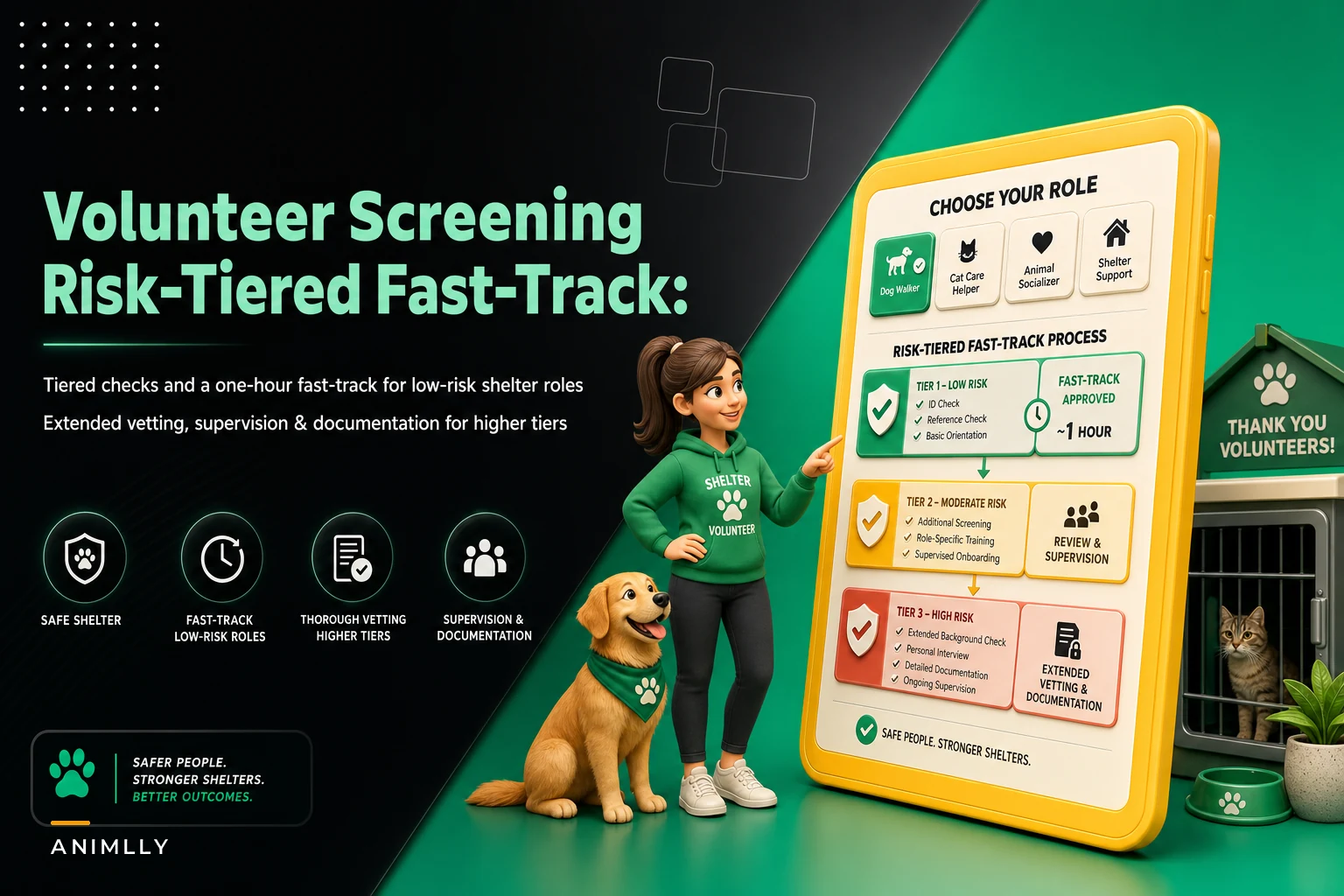
This piece is about fixing that one specific thing. Not volunteer management broadly. Just the screening-to-placement pipeline, and specifically how to build a risk-tiered flow where a low-risk volunteer can be cleared and working in about an hour, while your high-risk roles still get the scrutiny they legally and ethically require.
The problem isn't screening — it's treating all roles as equal risk
Walk through what actually happens at most shelters. A volunteer coordinator has one intake process. Application, ID copy, sometimes a background check, two references, an orientation session, maybe a waiver. Everyone runs the same gauntlet.
The issue is that "volunteer" describes wildly different risk exposures. Someone photographing cats for adoption listings carries almost no liability. Someone doing home visits for foster placements carries a lot. Someone transporting animals is somewhere in between and adds vehicle liability on top of everything else. Treating these as one category means your process is calibrated to the wrong place — usually too heavy for the easy roles and, weirdly, too light for the hard ones because nobody has bandwidth to go deeper on the people who actually need it.
What you see across a lot of shelters is that this sameness creates a backlog that feels like a staffing problem but is really a triage problem. The coordinator isn't slow. The process just doesn't let them move fast on the 70% of volunteers who could be cleared in an afternoon.
What a risk-tiered model actually looks like
The fix is to sort roles into tiers before anyone applies, then attach a different screening depth to each tier. The volunteer's role determines the screening — not a one-size flow that everyone crawls through.
Streamline your shelter operations effortlessly.
Animlly helps you manage every pet, volunteer, and adoption step with ease and accuracy.
- Comprehensive pet profiles
- Volunteer scheduling & communication
- Adoption tracking & reporting
No credit card required
| Tier | Example roles | Credential checks | Target clearance time |
|---|---|---|---|
| Tier 1 — Low risk | Laundry, dishes, photography, event greeter, social media, supply sorting | ID verification, signed waiver, orientation video | Under 1 hour |
| Tier 2 — Moderate risk | Dog walking (green-tagged animals only), adoption-floor support, off-site event handling | Tier 1 + basic background check, in-person handling demo | 3–5 business days |
| Tier 3 — High risk | Fostering, home visits, transport driving, medical assist, behavior-case handling | Tier 2 + driving record or home check, two references, extended background screen | 1–2 weeks |
The point of the table isn't the exact roles. It's that the depth of vetting scales with the exposure. Nobody driving a van full of animals gets fast-tracked. Nobody folding towels waits two weeks.
One thing people miss: the tier is a property of the role, not the person. A Tier 1 volunteer who later wants to foster doesn't get grandfathered in — they re-enter at Tier 3 screening for that new role. Keep those separate or the whole liability logic collapses.
Visualize this workflow:
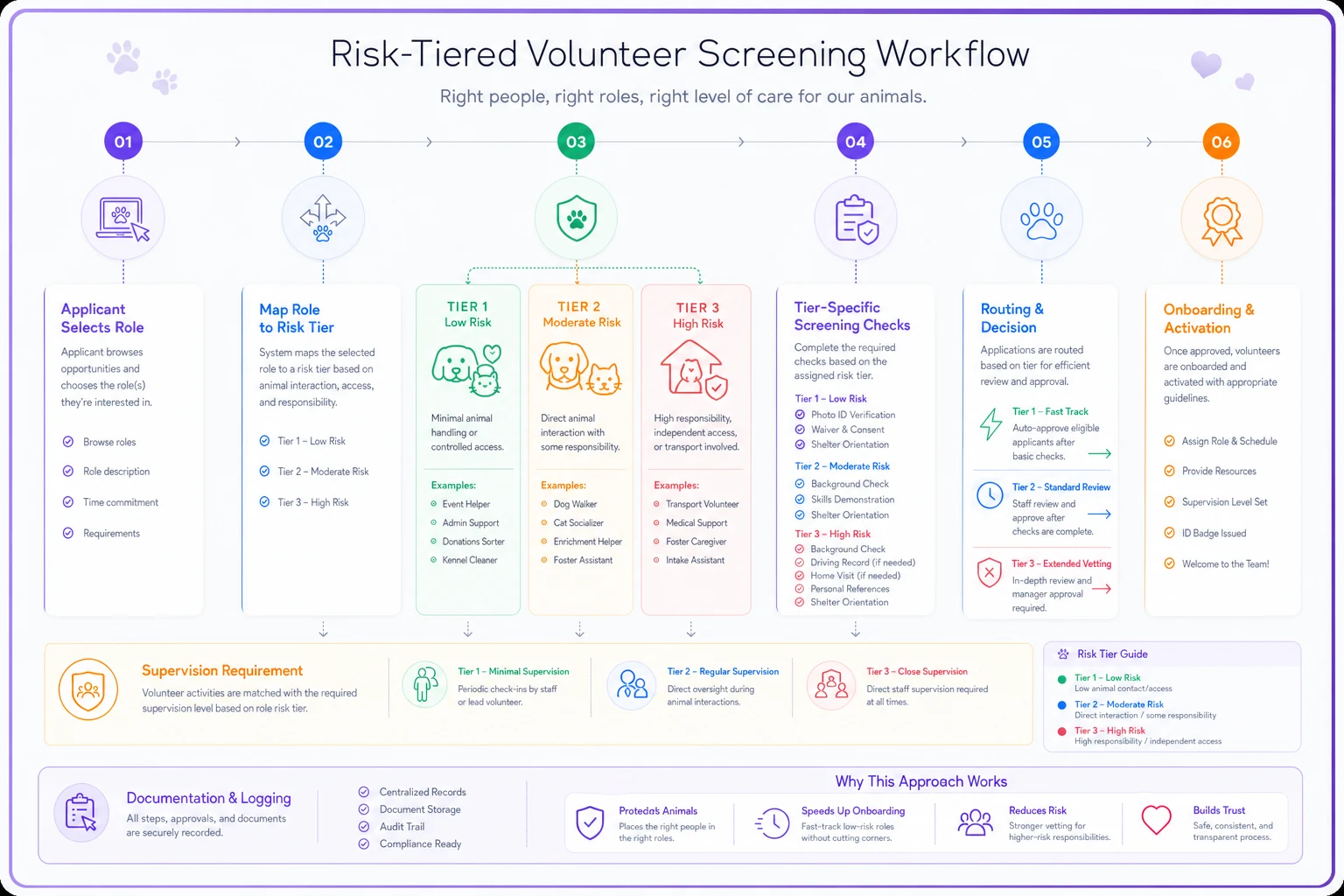
Include an explicit note that tier assignment is done before application processing and that the form routes applicants automatically to the correct flow.
The one-hour fast-track for Tier 1
This is the part that unclogs everything. If most of your applicants want Tier 1 work — and at most shelters they do — getting them productive same-day changes the entire volume math.
-
Applicant selects a Tier 1 role only. The form should make tier obvious. If they check anything Tier 2 or 3, they route to the slower flow automatically. No exceptions, no manual judgment call at the desk.
-
ID verification. Photo ID checked against the application. This is your minimum credential check — you at least know who's in the building.
-
Signed liability waiver and code of conduct. Digital signature is fine. This is the document that matters most for the low-risk tier.
-
Short orientation. A 15–20 minute video or walkthrough covering safety basics, where things are, and who to ask. Recorded once, reused forever.
-
Role-specific micro-briefing. Two minutes from whoever they're shadowing. "Here's the laundry flow, here's where clean bedding goes."
-
Cleared to work, logged, done.
The whole thing fits in an hour because you deliberately stripped out everything that doesn't reduce Tier 1 risk. No reference calls for someone doing dishes. No background check for someone photographing kittens in a public area with staff present.
The mistake is padding the fast-track "just in case." Every extra step you add is a step you're now applying to your highest-volume, lowest-risk group. That's where hours disappear across a whole season.
Where the liability protection actually comes from
Fast doesn't mean careless. The liability protection in this model doesn't come from screening everyone heavily — it comes from matching screening depth to actual exposure and documenting that you did.
If something goes wrong and you're asked why a volunteer was placed, the defensible answer is: "That role carries low exposure, here's the tier definition, here's the screening they completed for that tier, here's the signed waiver, and here's the log showing they were supervised." That's a much stronger position than "we screen everyone the same" — because "everyone the same" means you can't demonstrate you gave the risky roles extra attention.
-
Supervision as a substitute for screening depth. Tier 1 roles should never be unsupervised solo work. A photographer works during open hours with staff nearby. That supervision is why you can skip deeper checks. Write that link into your SOP explicitly.
-
Hard routing rules. The moment someone touches an animal in a way that could bite, injure, or go home with them, they're out of Tier 1. Green-tagged dog walking is arguably Tier 2 for a reason. Don't let "helping out" quietly drift into handling.
The pattern that gets shelters in trouble isn't fast placement. It's scope creep — the Tier 1 laundry volunteer who gradually starts walking dogs because they're around and helpful. Your SOP needs a line that says re-screening is required before role changes, and someone has to actually enforce it.
Keeping the tiers from turning into paperwork chaos
Here's the operational catch. A tiered system means you're now tracking which volunteer cleared which tier, when their background check expires, which roles they're approved for, and whether anyone drifted out of scope. Done on paper or in a spreadsheet, this falls apart fast — usually right when you scale up for an event or a seasonal push.
A shelter management platform earns its keep here, and honestly it's less about automation magic and more about just not losing track. A decent system lets you tag each volunteer with their cleared tiers, flag expiring credentials before they lapse, and route new applicants automatically based on the role they selected. The routing piece matters most: when the form itself sends a Tier 3 applicant into the slower flow without a coordinator having to catch it manually, you stop relying on someone remembering the rules under pressure.
Tag volunteers with their cleared tier and set automated expiry alerts so coordinators get reminders before credentials lapse.
Some platforms with AI-assisted workflows can also pre-check application completeness — flagging a missing ID upload or an unsigned waiver before it hits the coordinator's desk — which keeps the one-hour clock honest. But the real value is boring: a single place where "who's approved for what" is always current, so nobody's guessing at the door.
If you're building this into a broader operational system, it pairs naturally with how you'd structure the rest of your SOPs. Our modular shelter operations playbook covers the RACI mapping that makes clear who owns tier approvals and role-change re-screening — which is exactly the kind of thing that falls through cracks when responsibility isn't assigned to anyone specific.
When the fast-track makes sense — and when it doesn't
When it makes sense: You have steady inbound volunteer interest, a high proportion of low-risk work, and a supervised environment during open hours. Most shelters fit this. The fast-track turns interested people into helping hands before their enthusiasm fades — and anyone who's managed volunteers knows that window closes faster than you'd expect.
When it's a bad idea: If your facility runs a lot of unsupervised shifts, or your "low-risk" roles routinely involve unmonitored animal contact, the tier boundaries get blurry and the fast-track loses its safety rationale. Fix the supervision structure first, then add the fast-track.
Who should NOT use this as-is: Shelters handling a high volume of bite-quarantine or aggressive-behavior cases where even floor support carries real exposure. Your Tier 1 might need to be smaller, or your supervision requirements heavier, before any hour-long clearance makes sense. Tier the roles to your actual risk, not the example table above.
A real scenario
A mid-sized municipal shelter — around 40–50 active volunteers, big seasonal swings — was running everyone through a single process that took roughly two to three weeks start to finish. During their spring intake surge they'd get 30-plus new applicants and clear maybe a third of them before the wave passed. The rest drifted off.
They split roles into three tiers and built a Tier 1 fast-track almost exactly like the one above. The change wasn't dramatic in any single number — it was the compounding. Low-risk volunteers were clearing same-day instead of over weeks, so their spring surge suddenly had bodies for laundry, photography, and event support during the exact window they were needed. Coordinator time freed up got redirected to properly vetting the Tier 3 foster and transport applicants, which is where it should have been going all along.
The honest downside they hit: for the first month, staff kept letting Tier 1 volunteers drift into dog walking because it was busy and the person was helpful. They had to add a physical reminder at the walking area — a laminated "green-tag walkers must be Tier 2 cleared" sign — before scope creep stopped. The SOP wasn't the problem. Enforcing the boundary was.
Bringing it together
The reason volunteer screening at shelters feels broken usually isn't the rigor — it's the sameness. When the person doing dishes and the person doing home visits move through identical steps, you get a slow pipeline and, quietly, under-vetted high-risk placements. Sorting roles by exposure fixes both ends at once.
Build your tiers around your actual risk, make Tier 1 genuinely fast, keep supervision as the tradeoff for speed, and enforce re-screening whenever someone changes roles. If you're staffing up for a seasonal peak, this pairs directly with a seasonal ramp-up and cross-training plan — because a fast-track only helps if you've got the shifts and supervision ready to absorb the people it clears.
Do it right and the outcome is quiet but real: safe placements happen faster, your coordinator spends attention where the liability actually lives, and the person who wanted to help in March is folding towels by that same afternoon instead of giving up in June.
Ready to enhance your shelter’s impact?
Join 500+ shelters using Animlly to improve care coordination, increase adoptions, and engage communities effectively.