

Most shelters don't set out to be inequitable. They inherit rules. A dollar amount for adoption fees that hasn't changed since 2016. An income verification step someone added after a bad adoption years ago. A landlord-approval requirement that quietly screens out a third of your applicant pool. Layer these together and you end up with an access system nobody designed on purpose but everyone follows anyway.
The tricky part is that "expanding access" and "protecting animals" are usually framed as opposites. Loosen the rules and you're accused of being reckless. Tighten them and you're accused of gatekeeping. Both accusations sting, and both are sometimes fair. The way out isn't picking a side — it's building a system where fair-screening rules, diversion pathways, and outcome tracking all feed each other. That's what an equity community access shelter framework actually is: not a policy statement, but a connected set of workflows that can defend a decision, redirect a denial into help, and measure whether any of it is working.
This piece is about how those pieces fit together, where they break as you scale, and what a workable version looks like day to day.
The real problem isn't the rules — it's that the rules can't explain themselves
A shelter gets criticized for turning away an applicant. Someone pulls the file. And the answer to "why was this person denied?" is some version of "the coordinator had a bad feeling" or "they didn't seem stable" or "we've been burned before."
That's not a defensible decision. Not legally, not ethically, not operationally. And it's not because the staff are biased people — it's because the screening logic lives in their heads instead of in a written, applied-the-same-way-every-time rule.
-
Similar applicants get different outcomes depending on who's working the desk
-
Denials cluster around certain zip codes, income levels, or housing types without anyone intending it
-
You have no record showing you applied criteria consistently, which is exactly what you'd need if a decision were ever challenged
The insight most shelters miss: you don't reduce legal and reputational risk by having stricter rules. You reduce it by having consistent, documented rules. A shelter with generous access criteria applied identically to everyone is far more defensible than one with strict criteria applied on gut instinct.
What a defensible fair-screening rule actually looks like
A defensible rule has four properties. It's written down, it's tied to a specific welfare risk, it's applied the same way to every applicant, and it has a documented exception pathway. Miss any one of those and the rule becomes a liability rather than a protection.
Streamline your shelter operations effortlessly.
Animlly helps you manage every pet, volunteer, and adoption step with ease and accuracy.
- Comprehensive pet profiles
- Volunteer scheduling & communication
- Adoption tracking & reporting
No credit card required
Compare how the same concern gets handled with and without structure:
| Concern | Weak (indefensible) version | Defensible version |
|---|---|---|
| Fenced yard | "Denied — no fence" | "Yard fencing noted; for high-energy breeds we discuss exercise plans. Not an auto-denial." |
| Renting | "We don't adopt to renters for large dogs" | "Landlord contact requested; if unavailable, applicant signs pet-policy attestation." |
| Prior surrender | "They gave up a pet before, hard no" | "Surrender reason reviewed; medical/financial surrenders weighted differently than neglect." |
| Income | "Didn't look like they could afford it" | "No income minimum. Cost-of-care conversation + resource pack offered." |
Notice what the defensible column has in common. Every rule converts a hard filter into a conversation or condition. That's the core move. You're not removing judgment — you're forcing it to be specific, repeatable, and recorded.
The mistake shelters make when they first try this: they write beautiful new criteria and then never track whether staff actually follow them. Six months later the desk has quietly drifted back to gut calls. Written rules without a check are just suggestions.
Diverted-assistance pathways: where "no" turns into "here's how"
The single biggest lever in an equity framework isn't the screening rule — it's what happens after a screen doesn't clear.
In a normal shelter, a denial is an endpoint. The applicant walks out with nothing. In an equity-first system, most "denials" aren't denials at all; they're a redirect into a support pathway. The person who can't afford the adoption fee this month gets connected to a fee-waived program. The renter without landlord approval gets a template letter to bring to their property manager. The applicant whose home isn't ready gets a checklist and an invitation to come back.
This is the same logic that keeps animals out of the shelter in the first place through community diversion pathways — just pointed at the intake-and-adoption side instead of the surrender side. The tools are nearly identical: decision trees, resource packs, and referral tracking. If you've already built diversion for surrenders, you're two-thirds of the way to building diverted-assistance for access.
-
Screen returns a condition, not a clearance. (e.g., "housing verification pending")
-
Staff select the matching pathway from a short list rather than improvising. ("Renter — landlord attestation")
-
Applicant receives the corresponding resource pack — a letter template, a low-cost vet list, a fee-assistance form, whatever fits.
-
A follow-up date gets set so the person doesn't just disappear into the void.
-
The outcome is logged — did they come back, did they complete the condition, did they adopt.
Here's a simple workflow visualization.
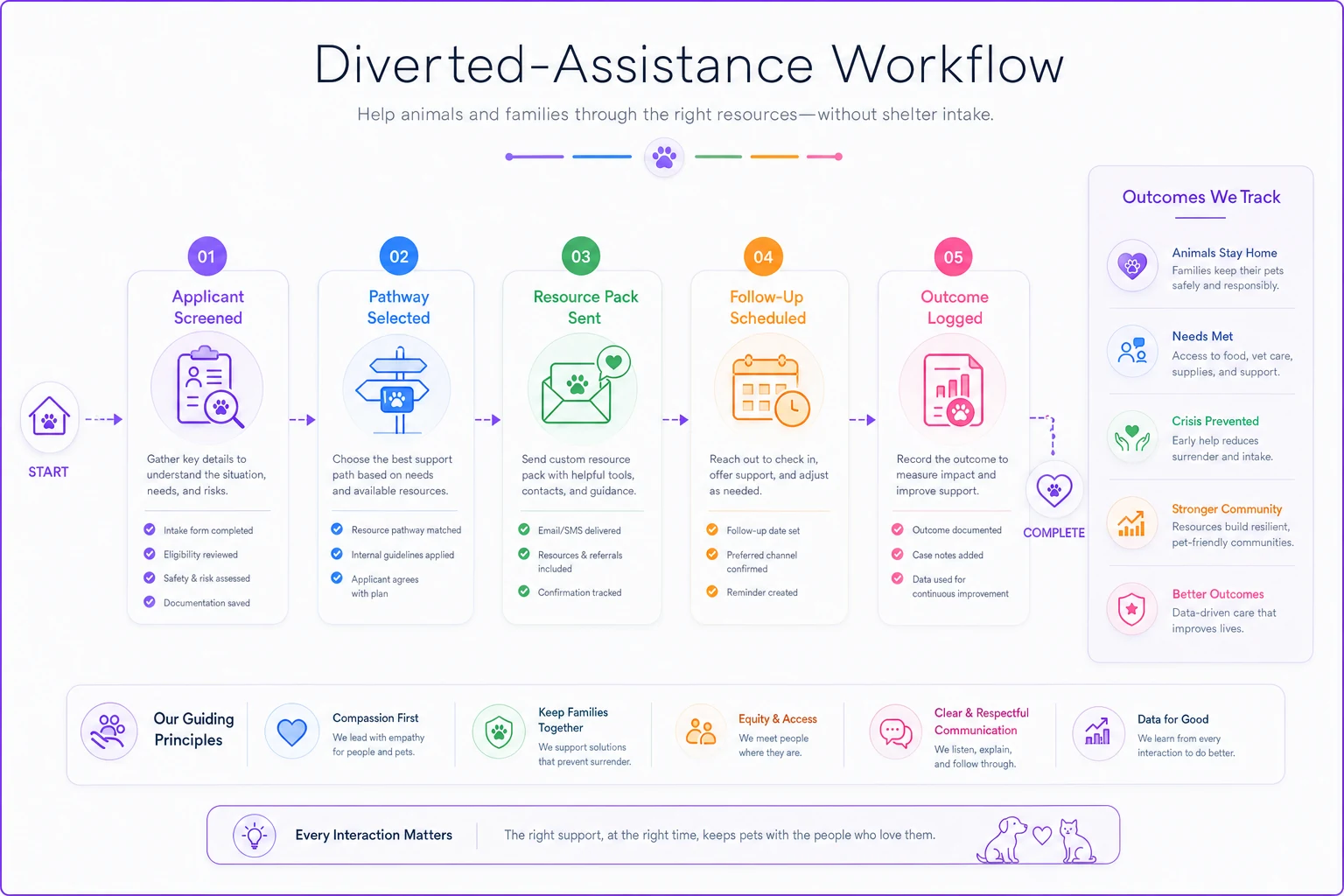
That last step is what almost nobody does, and it's what turns a nice gesture into a measurable system.
Without step 5, you have no idea whether your pathways actually help anyone. You just feel like they do.
What breaks as you scale
A single-location shelter with three staff can run informal access decisions and mostly get away with it, because the same two people make every call and their instincts are at least internally consistent. The system doesn't visibly break until you grow — and it breaks in predictable ways.
More people, more drift. Add weekend volunteers, a second coordinator, an offsite adoption crew, and suddenly "how we do things" splinters into five slightly different versions. The applicant denied on Saturday would've been approved on Tuesday. Your inconsistency is now patterned by staffing schedule, which is both unfair and impossible to defend.
More volume, more invisible bias. At 20 adoptions a month, you can eyeball fairness. At 200, patterns hide in the aggregate. You won't notice that approval rates for one neighborhood dropped 15 points over a quarter unless something is counting.
More partners, more coordination gaps. Once you're running fee-assistance programs, foster-to-adopt, and clinic referrals, the diverted-assistance pathway crosses organizational boundaries. A referral that isn't tracked is a referral that quietly dies. The applicant thinks you dropped them; you think the clinic handled it; nobody follows up.
More scrutiny. Bigger shelters attract more public attention and more formal complaints. The informal "bad feeling" denial that nobody questioned at 20 adoptions a month becomes a front-page problem at 200.
The through-line: every scaling problem here is a coordination and memory problem. The rules aren't the failure point. The system's inability to apply rules identically across people, time, and volume is.
Measurable KPIs — the ones that actually tell you something
Plenty of shelters track adoption totals and call it a day. Totals tell you almost nothing about equity. You need metrics that expose who gets access, not just how many animals move.
-
Approval rate by applicant segment (housing type, income band, geography) — the single most important equity signal
-
Denial-to-diversion conversion — of applicants who didn't clear a screen, what percent entered a support pathway vs. left with nothing
-
Pathway completion rate — of those who entered a pathway, how many finished the condition
-
Time-to-decision — long waits fall hardest on people with the least flexibility
-
Exception frequency and reason — high exception rates mean your baseline rule is probably wrong
-
Return/outcome rate by segment — the check on whether expanded access is actually safe
That last metric matters more than any other, because it's the one that answers the recklessness accusation with data. If you widen access and your 6-month return rate holds steady across segments, you've proven the expanded access is safe. If it spikes in one pathway, you've found a specific thing to fix — not a reason to slam the door on everyone.
Most of these tie directly into a broader shelter outcome measurement framework; the equity metrics are a lens on the same underlying outcome data, sliced by who's being served.
A quick reporting template you can steal
You don't need a fancy system to start. A monthly one-page equity report can carry most of the weight:
-
Applications received / approved / conditionally approved / declined
-
Approval rate by top 3 zip codes (flag any gap over ~10 points)
-
Diversion conversion rate (declined applicants who entered a pathway)
-
Open pathways past their follow-up date (this number should stay near zero)
-
Exceptions logged, with one-line reasons
-
6-month return rate, current cohort vs. prior
-
One narrative note anything a number wouldn't catch
Keep the monthly equity report to one page so it's easy to review and discuss in staff meetings.
Review it as a team. The point isn't the report existing — it's the conversation it forces.
When a coordinator has to explain why zip code A is approving at 82% and zip code B at 61%, you find out fast whether it's a real risk difference or a rule that needs fixing.
A real scenario
A mid-sized municipal-contract shelter — roughly 180–220 adoptions a month, a mix of paid staff and weekend volunteers — kept getting complaints about inconsistent adoption decisions. When they finally pulled six months of records, the numbers were uncomfortable: applicants from two lower-income zip codes were being declined at close to twice the rate of the rest of their service area, and almost none of those declined applicants had received anything on the way out. No referral, no resource pack, no follow-up.
They didn't loosen a single welfare standard. What they did was rewrite their hard filters into conditions, build four standard diverted-assistance pathways — fee assistance, landlord attestation, cost-of-care conversation, and a "home not ready yet" checklist — and start logging what happened to declined applicants.
Over the next four to five months, the denial gap between neighborhoods narrowed to something in the single digits. Their diversion conversion rate went from basically zero to somewhere around 60%. And the number that kept leadership calm: the 6-month return rate barely moved. Expanded access, roughly the same safety outcomes, and for the first time a paper trail that could actually explain any individual decision.
The interesting part wasn't the outcome. It was how little changed operationally. Same criteria, mostly. The difference was structure and memory.
Where software quietly does the heavy lifting
None of this requires software to design — you can sketch every rule and pathway on paper. But the parts that break at scale are exactly the parts software handles well: applying the same screen the same way every time, remembering to follow up on a pathway three weeks later, and counting approval rates by segment so a gap surfaces before it becomes a complaint.
That's the honest role of an AI-assisted operational platform here. It's not making the ethical calls — your team does that. It's making sure the desk on Saturday runs the same decision tree as the desk on Tuesday, flagging the pathway that blew past its follow-up date, and generating the segment breakdown you'd never have time to calculate by hand. The judgment stays human. The consistency and the memory get automated — which matters, because those are exactly what slip first when volume climbs.
When this framework makes sense — and when it doesn't
It makes sense when you're getting inconsistency complaints, when your access decisions live mostly in people's heads, when you've grown past the point where two people make every call, or when you're under contract scrutiny that demands defensible records.
It's overkill when you're a tiny foster-based rescue doing a handful of placements a month where the same person handles everything and every decision is already documented in detail. You don't need a segmented KPI dashboard to manage twelve adoptions.
It's a bad idea to attempt if leadership isn't genuinely willing to act on what the data shows. If you build an equity dashboard, discover a real approval gap, and then explain it away every month, you've created a liability, not a solution — now you have documented evidence that you knew about a disparity and did nothing. Don't measure what you're not prepared to face.
Getting this wrong is more common than getting it right
The most common way this whole effort fails: shelters treat equity as a policy to publish rather than a system to run. They write a values statement, put it on the website, maybe train staff once, and consider it done. Six months later nothing has actually changed at the desk, the same neighborhoods get declined at the same rates, and now there's a public commitment that the operations don't match — which is worse than saying nothing.
Equity access isn't a document. It's the daily loop of screen → divert → track → review, running consistently enough that any single decision can be explained and any pattern gets caught before it becomes a problem. Get that loop working, and the values statement writes itself — because you'll have the numbers to back it up.
Equity access isn't a document. It's the daily loop of screen → divert → track → review, running consistently enough that any single decision can be explained and any pattern gets caught before it becomes a problem. Get that loop working, and the values statement writes itself — because you'll have the numbers to back it up.
Ready to enhance your shelter’s impact?
Join 500+ shelters using Animlly to improve care coordination, increase adoptions, and engage communities effectively.