


The Monday after a large adoption event is where a lot of shelters quietly lose. You did the hard part — got 40 animals out the door over a weekend, ran the transport, staffed the booth, worked the crowd. Then Tuesday through Thursday, five, six, sometimes nine of them come back. Buyer's remorse, an allergic kid, a landlord who said no after the fact, a dog that "isn't what we thought."
And the part nobody plans for: those returns don't slot neatly back into your normal intake flow. They land in a gray zone. Half your staff treats them like new intakes and restarts the whole medical and behavior clock. The other half assumes "we just adopted them out, they're fine" and skips steps. Both are wrong, and both add days to length of stay you didn't need to spend.
This post is specifically about event returns — not general adoptions, not off-site logistics. Just the animals coming back through your door in the 72 hours after an event, and how to get them re-listed fast without cutting corners that create bites, outbreaks, or a second failed adoption.
Why event returns behave differently than normal returns
A return from a two-week adoption looks nothing like a return two days after an event. The animal has barely left. Most of its recent medical and behavior history still lives in your system. The adopter usually hasn't had time to introduce a new food, a new routine, or a meaningful set of stressors.
That's the opportunity. In a normal return you have to re-assess almost everything. In an event return, you're mostly confirming that nothing changed — which is a much faster task, if you have a process built for confirming instead of re-doing.
Most shelters run event returns through the same intake path as a stray off the street. Full re-exam, re-photograph, full behavior hold, back of the queue. That default adds anywhere from 4 to 9 extra days of stay per returned animal, almost entirely from re-processing work that didn't need to happen.
There's also a coordination gap worth naming. Event weekends pull your experienced people off-site. So returns often get handled by whoever's covering the front desk on Tuesday — frequently a newer volunteer or staffer who has no context on which animals went out over the weekend. They can't triage what they can't see.
The 30-second intake triage: sort before you process
The goal of triage isn't to assess the animal. It's to route the animal. Thirty seconds, three questions, one decision. You're deciding which of three lanes this return goes into before anyone touches a medical file.
Streamline your shelter operations effortlessly.
Animlly helps you manage every pet, volunteer, and adoption step with ease and accuracy.
- Comprehensive pet profiles
- Volunteer scheduling & communication
- Adoption tracking & reporting
No credit card required
Whoever receives the animal answers these at the counter:
-
How long was it gone? Under 5 days, or 5+ days? Under 5 days means most prior records are still valid.
-
Is the stated return reason about the animal, or about the person? "We're moving / landlord said no / kid is allergic" is a people reason. "It bit my son / it won't stop resource guarding / it's coughing" is an animal reason.
-
Any visible red flags right now? Coughing, limping, obvious wounds, diarrhea in the carrier, aggressive posture at the counter.
Those three answers drop the animal into a lane:
| Triage lane | Condition | What happens next |
|---|---|---|
| Green – Fast reintegrate | Under 5 days out, people-reason, no visible flags | Skip re-exam. Confirm records, re-photo only if needed, re-list within 24 hrs |
| Yellow – Confirm & hold short | 5+ days out OR minor flag OR uncertain reason | Quick recheck of the flagged item only, 24–48 hr observation, then re-list |
| Red – Full re-eval | Animal-reason return, bite report, or clear medical flag | Standard intake path + incident documentation, no fast-track |
This works because it front-loads the one judgment that actually matters — is this a fast animal or a slow animal — and forces that decision before the animal disappears into a kennel where it gets made by default two days later.
A quick workflow visual of the 30-second triage can help teams follow the three-lane decision.

One thing to watch: staff will try to be cautious and push everything into Yellow or Red "to be safe." That defeats the purpose. Give them explicit permission to use Green. A dog returned after 3 days because the adopter's apartment didn't allow pets is a Green animal, full stop.
The tagging system: making expedited animals visible
A triage lane only helps if the next three people who walk past that kennel know about it. This is where returns quietly die — the lane gets decided at the counter, then it lives in someone's head, and by Wednesday the fast-track dog is sitting in a run with no note explaining why it's back or what to do with it.
You need a tag that communicates two things at a glance: this is an event return, and this is its lane. Physical and digital.
-
Physical a colored kennel card or clip — green, yellow, or red matching the triage lanes — with the event date written on it. The event date matters because it confirms the "recently adopted" status is real and recent, not someone's assumption.
-
Digital a single status flag in your records, something like
EVENT-RETURN-[date]-GREEN. One searchable field, so a coordinator can pull every Green return from Saturday's event in one query and process them as a batch instead of tripping over them one at a time through the week.
The expedited part is the whole point. Green and Yellow returns should visibly jump the normal re-list queue, because they're cheaper to re-list than a fresh intake and they've already proven adoptable enough to walk out the door once. Letting them sit behind three weeks of strays is backwards economics.
A common mistake: shelters tag the animal but never define who acts on the tag. A green card with nobody assigned to green cards is just decoration.
'The adoptions lead clears all Green returns by end of day Tuesday' is a rule.
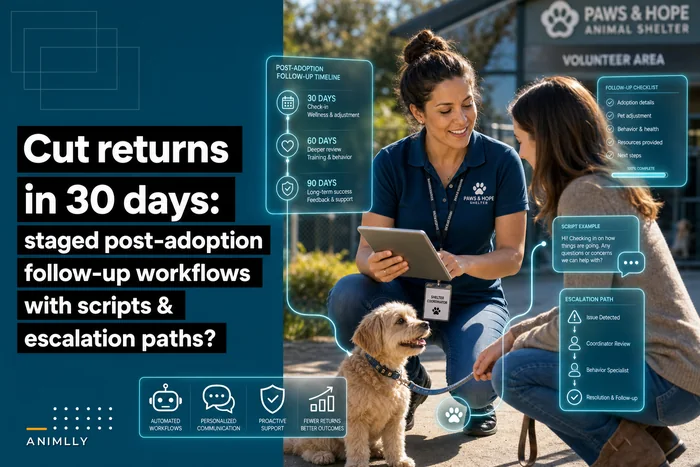
If your event returns are also feeding your longer-term return numbers, it's worth connecting this triage to your broader follow-up work — the staged post-adoption follow-up workflow catches a lot of these before they become physical returns at all, especially the people-reason cases where a check-in call could have saved the placement.
The temporary holding checklist: the 48 hours that decide LOS
Between the counter and the kennel, most returned animals need a short, defined hold. Not a two-week behavior quarantine — a short confirmation window. The trap is that "hold" has no default meaning in most shelters, so a Green animal and a Red animal end up treated identically once they're in a run.
-
Confirm identity against the file — right chip, right animal, records actually match. Event chaos causes real mix-ups.
-
Pull the pre-adoption medical record and confirm nothing on it has lapsed.
-
Note the return reason verbatim in the record — the adopter's exact words, not a paraphrase.
-
Visual health scan — eyes, nose, gait, stool, appetite over the first feeding.
-
Placement — hold Green returns away from your general new-intake population if possible. They're low-risk and there's no good reason to expose them.
-
Set the re-list deadline on the card — an actual date, not "soon."
-
Flag any behavior the adopter reported for the reintegration step, even if it seems minor.
That verbatim return reason line matters more than it looks. When an adopter says "he was too much energy for us," that's a matching problem, not an animal problem, and it tells your next adopter exactly what kind of home this dog needs. When they say "he snapped at the baby," that's a Red flag you may have mis-triaged at the counter, and the hold is your chance to catch it before it becomes a bigger problem. Paraphrased reasons lose all of that nuance.
To put it plainly: animal comes in → triage lane assigned in 30 seconds → tag applied physically and digitally → holding checklist run within a few hours → Green and Yellow cleared on a defined deadline → reintegration → re-listed. Nothing in that chain should require a meeting to happen.
The reintegration SOP: getting them back on the floor without a second failure
Reintegration is where you protect against the return-of-the-return. An animal that comes back twice is a significant LOS and morale hit, and it's usually preventable with two things: honesty in the new listing and matching what you learned to the next adopter.
Update the listing with what you learned. If it came back because of high energy, the new listing should say "needs an active home," not stay identical to the version that already failed once. Re-listing the same description that produced a return is how you produce a second return.
-
Green returns
re-list within 24 hours, no behavior re-hold needed.
-
Yellow returns
re-list after the 24–48 hour confirmation period clears.
-
Any animal-reason return that got upgraded to Red during the hold
out of this fast-track entirely, no exceptions.
Brief your adoptions staff. The person doing meet-and-greets needs to know this animal is a return and why, so they can match it forward instead of repeating the same mismatch. This is a 30-second handoff, not a formal report.
A return is information. The first adoption told you something didn't fit. Reintegration is where you use that information to make the second adoption stick, instead of pretending the first one didn't happen.
A real scenario
A mid-size municipal shelter runs a quarterly adoption event that typically places 35 to 45 animals per weekend. Their return rate in the 72 hours following those events ran around 15–18%, which put roughly 6 to 8 animals back through the door each time. Nothing unusual — that's a pretty normal post-event bounce.
The problem was the handling. Every returned animal went through full re-intake — new exam, new behavior hold, back of the re-list queue. Average post-event length of stay for returns was sitting near 11–12 days before the animal was considered adoptable again. During busy months that meant 6 or 7 kennels tied up for over a week by animals that had, days earlier, been considered ready to go home.
They put in the three-lane triage and the tagging system — colored kennel cards and one status field added to their existing records. The shift was mostly in what they stopped doing: Green returns skipped the re-exam and the behavior re-hold entirely. Post-event LOS for returns dropped to roughly 4–5 days. About two-thirds of returns landed in Green, which is the number that made everything else work — those animals were back on the floor within a day.
The secondary effect surprised them more. Because staff were writing down verbatim return reasons and updating listings before re-posting, the second-return rate dropped noticeably too. Fewer high-energy dogs going home with people who wanted a couch companion.
When this fast-track is a bad idea
This whole system leans on the assumption that a recent, records-intact animal is low-risk. That assumption breaks in a few specific places.
-
Any bite or attempted bite — that animal is Red, event return or not. No fast-track. Full incident documentation, no exceptions.
-
During an active health outbreak in your facility — the logic of holding Green returns away from new intake reverses, and you may need them isolated regardless of how clean they appear.
-
If your records were a mess during the event — if you weren't confident about which animal went where, the identity confirmation step will eat all the time you were trying to save. Better to treat returns as fresh intakes until your data catches up.
And the honest one: if your post-event returns are running above 20–25%, triage speed isn't your real problem. Something upstream in the event itself is producing bad matches — rushed adoptions, no real screening, pressure to hit a placement number. Speeding up returns processing is treating the symptom. The off-site adoption event operations guide is the better place to start if that's your situation.
Where the tagging and status tracking gets easier
The manual version of this — colored cards, a written status field — works fine for a shelter running a few events a year. It gets fragile when you're running events monthly or across multiple sites, because the physical tag and the digital record drift apart and someone ends up chasing paper by Thursday.
Operational software helps here by holding the triage lane, the event date, and the re-list deadline as connected fields in one place. A coordinator can pull "all Green returns from Saturday, due to re-list today" without walking the kennels. When the tag and the record are the same object instead of two separate things you have to keep in sync manually, the fast-track lanes actually stay fast. That's the value — not automating the judgment call, just making sure the judgment you made at intake on Tuesday is still visible and actionable on Thursday.
Bringing it together
Event returns aren't a failure to fix — they're a predictable, recurring event you can build a lane for. The animals coming back 48 hours after your weekend aren't strays and shouldn't be processed like strays. Sort them in thirty seconds, tag them so the next three people can see the lane, run a short confirmation hold instead of a full re-work, and re-list them with what you learned the first time around.
Do that consistently and the Monday-after pile stops being a week-and-a-half backlog. It becomes a couple of days of confirmation work, most of it clearing animals that were adoptable the whole time.
Do that consistently and the Monday-after pile stops being a week-and-a-half backlog. It becomes a couple of days of confirmation work, most of it clearing animals that were adoptable the whole time.
Ready to enhance your shelter’s impact?
Join 500+ shelters using Animlly to improve care coordination, increase adoptions, and engage communities effectively.