

The first 72 hours in a foster home decide a lot. Most early returns don't happen because the animal was a bad match. They happen because the foster inherited a dog or cat with zero context, hit a surprise on day two, panicked, and called the coordinator saying "this isn't working out." By then the stress spike has already happened on both ends.
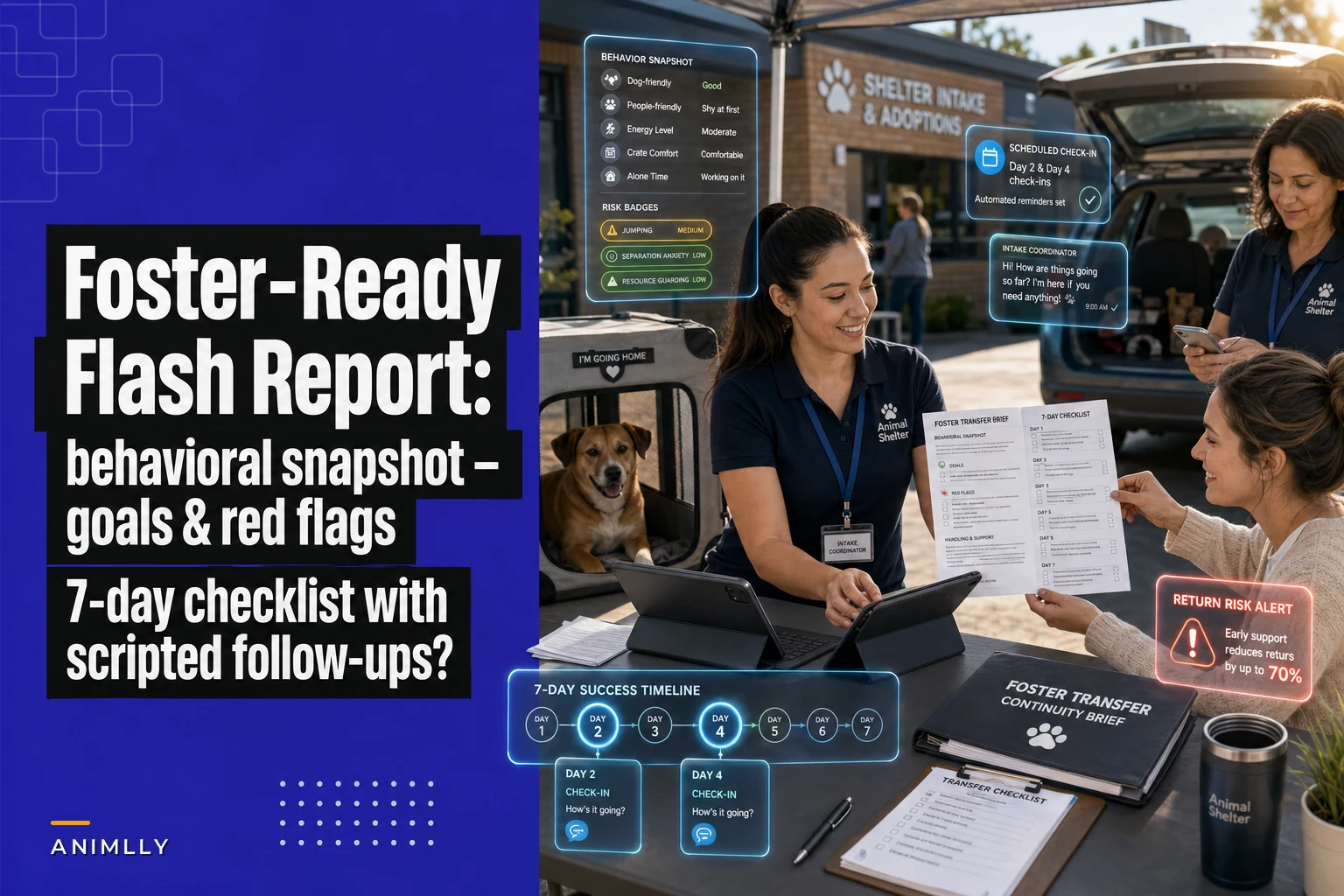
The fix isn't a longer intake form or a thicker manual. It's a tight, two-page foster behavior transfer brief that a shelter team can fill out in under ten minutes and that a foster can actually read before the car pulls out of the lot. One page of snapshot, one page of a 7-day checklist and a follow-up script. That's it.
This post walks through exactly what goes on those two pages, why most briefs fail, and how to structure the handoff so fosters stop getting blindsided.
Why the usual handoff falls apart
The typical foster handoff is verbal. A coordinator walks the foster to the kennel, says a few things about the animal — "she's sweet but a little shy, might need a day to settle" — hands over a leash and a bag of food, and that's the brief. Everything that matters lives in someone's head or buried in a kennel card nobody printed.
Here's where it breaks. The person doing the handoff is usually not the person who's been handling the animal all week. The behavior observations that actually matter — the dog that resource-guards a specific chew toy, the cat that bolts if you reach over the top of her head, the dog that's fine with men but freezes around hats — those details rarely survive the walk from kennel to parking lot.
What tends to happen across a lot of shelter operations is that the information exists. Volunteers noted it. Someone wrote "food aggressive?" on a sticky note. The overnight staff flagged a bite history. But it's scattered across kennel cards, shift logs, a group chat, and three people's memory. None of it makes it into the foster's hands in a usable form.
So the foster gets a clean-slate animal with a hidden landmine, hits it on day two, and returns it on day four. The animal comes back more stressed, harder to place, and the foster — who was ready to help — now feels burned and won't take the next one.
The two-page structure, and why two pages is the hard limit
If the brief is longer than two pages, fosters won't read it. If it's shorter, it won't carry the behavioral detail that prevents the surprise. Two pages, printed front and back on one sheet, is the sweet spot. Page one is a snapshot they can scan in ninety seconds. Page two is what they do over the next week.
Streamline your shelter operations effortlessly.
Animlly helps you manage every pet, volunteer, and adoption step with ease and accuracy.
- Comprehensive pet profiles
- Volunteer scheduling & communication
- Adoption tracking & reporting
No credit card required
Page one is a snapshot they can scan in ninety seconds. Page two is what they do over the next week.
Page one: the behavioral snapshot
This is the "if you read nothing else" page. It should answer three questions fast: what are we trying to achieve, what will go wrong, and how do I handle this animal on day one.
Goals for this foster period. Not a wishlist — one or two concrete objectives. "Decompress and gain weight" is different from "work on crate tolerance for adoption readiness." A foster who knows the goal makes better calls. If the goal is decompression, they won't panic when the dog hides under the bed for three days. They'll expect it.
Red flags — the stuff that causes returns. This is the most important block on either page. Be blunt and specific. Not "may be reactive" — that's useless. Write: "Lunges and barks at other dogs on leash within ~15 feet. Fine off-leash in yard. Do not walk past the dog park." The specificity is the whole point. A vague warning gets ignored; a precise one changes behavior.
Handling basics for the first day. How to approach, how to feed, what to avoid. "Feed in a separate room, close the door, let her finish before entering. She guards the bowl, not treats." That one sentence prevents a bite and a return.
Keep the snapshot to these buckets. The temptation is to add medical history, vaccine dates, microchip numbers — all important, none of it belongs on the behavioral snapshot. Put that on an attachment. Page one is behavior and handling only, because that's what fosters get wrong in the first 72 hours.
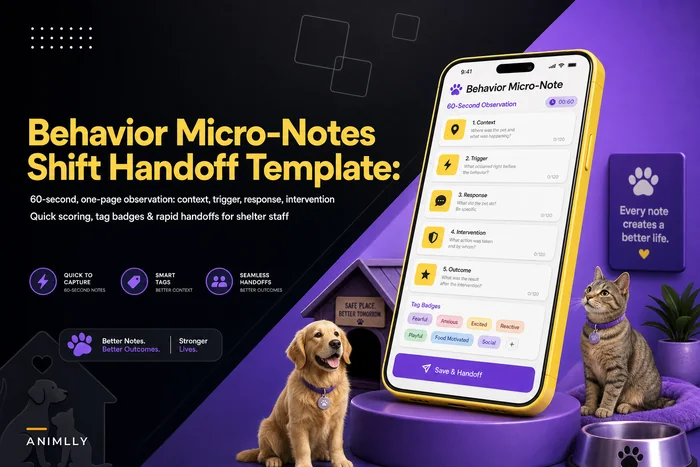
The raw material for this page comes straight from the floor. If your team already runs something like 60-second behavior micro-notes across shifts, the snapshot practically writes itself — you're pulling consistent patterns from a week of observations instead of inventing them at the handoff.
Page two: the 7-day checklist and follow-up script
Page one is what the foster knows. Page two is what the foster does.
The 7-day checklist breaks the first week into daily, low-effort checkpoints. The goal isn't to train the animal — it's to give the foster a rhythm so they don't read normal decompression behavior as a failure.
Here's a workable version:
-
Day 1 Confined space only (one room or crate). No introductions to other pets. Let the animal choose when to come out. Log: did they eat? Drink? Eliminate?
-
Day 2 Same confined space. Short, calm handling. Watch for the red flags listed on page one. Don't force interaction.
-
Day 3 If settling, expand to one more room. Still no other-pet intros. Note energy and appetite changes.
-
Day 4 First short leashed walk if a dog; first structured play if a cat. Watch leash behavior against the red-flag notes.
-
Day 5 Begin slow, barriered introductions to resident pets if applicable. Stop at first sign of stress.
-
Day 6 Normal routine starting to form. Flag anything unexpected to the coordinator now, not later.
-
Day 7 Quick written check-in with the shelter. Confirm what's working, what's not.
The checklist does something subtle but important: it reframes early weirdness as expected. A dog that won't eat on day one isn't a problem — the checklist told the foster to expect it. That alone kills a chunk of panic returns.
The follow-up script that actually surfaces problems early
Most foster follow-up is reactive. The shelter waits for the foster to call. The problem is that fosters who are struggling often don't — they quietly decide it isn't working and schedule a return. By the time you hear from them, the decision is already made.
A proactive script flips that. The point is to catch friction at day two or three, when it's still fixable, instead of day five when the foster's already checked out.
It doesn't need to be complicated. A short message on day two and a slightly longer check on day four covers most cases:
Day 2 (quick, low-pressure): "Hi [name] — just checking in on [animal]. Totally normal if they're still hiding or not eating much yet, that's expected this early. Anything surprising so far, or any of the red flags we talked about showing up?"
Day 4 (opens the door to honesty): "How are you feeling about [animal] so far? Day four is usually when their real personality starts coming out. If anything's harder than you expected, tell me now — we can troubleshoot almost anything if we catch it early. What's going well, and what's not?"
Notice the framing. It normalizes problems, invites honesty, and signals that the shelter will help rather than judge. Fosters who feel they'll be blamed for a "failed" placement hide the struggle until they quit. Fosters who feel supported flag issues early enough to actually solve them.
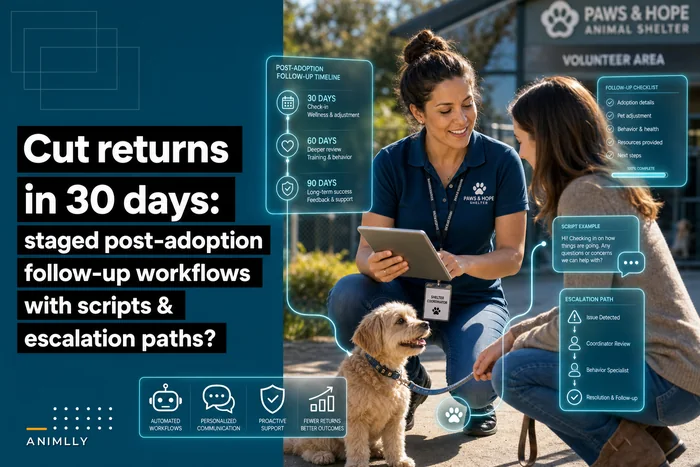
This follow-up rhythm is the foster-side cousin of the staged post-adoption follow-up workflows that cut adoption returns. Same principle: structured check-ins beat waiting for the phone to ring.
What the two approaches look like side by side
Coordinators who've switched from verbal-only handoffs to the two-page brief pretty consistently say the same thing — it's not that the verbal handoff was lazy, it's that it was structurally doomed. One conversation can't carry a week's worth of behavioral observation. The table below shows where the gaps actually show up.
| Aspect | Verbal handoff (typical) | Two-page transfer brief |
|---|---|---|
| Time to prepare | ~2 min | ~8–10 min |
| Behavioral detail retained | Whatever the handler remembers | Written, specific, red-flag-first |
| Foster knows what's "normal" | No | Yes, via 7-day checklist |
| Problems surfaced | When foster calls (often too late) | Day 2 and day 4 proactively |
| Continuity if coordinator is off | Breaks | Holds — it's on paper |
| Early returns | Higher | Noticeably lower |
The extra prep time is real — call it five to eight minutes per foster placement. For most shelters that's a trade worth making, because a single avoided return costs far more than eight minutes once you count the re-intake, the re-stress, and the lost foster relationship.
A realistic example
A mid-size municipal shelter running roughly 40–50 foster placements a month was seeing around 9 or 10 of those come back inside the first week. The returns clustered hard on days 3–5, and the exit reasons were almost always behavioral surprises: "aggressive with my other dog," "won't stop crying in the crate," "snapped when I touched his food."
None of those were secrets to the shelter staff. The resource guarding was noted. The crate stress was in the shift log. The foster just never got the information in a form they could act on.
They built the two-page brief, made the red-flag block mandatory, and added the day-2 and day-4 check-in messages. Within about two months, first-week returns dropped to the 4–5 range — roughly cut in half. Just as useful, the fosters who did return animals came back with better notes, because the checklist had them logging behavior daily. Second placements for those animals went smoother because the brief was already richer.
Nothing exotic happened here. They stopped losing information between the kennel and the car.
Keeping the briefs consistent without creating more admin
The failure mode once you build a brief template is drift. Some coordinators fill it out well, some scribble "good dog" in the red-flag box, and within a month the quality is all over the place. A brief is only as good as the discipline behind it.
A few things keep it honest:
-
Make the red-flag box non-optional. If it's blank, the placement doesn't go out. "No known red flags" is an acceptable answer — a blank box is not.
-
Pull the content from existing shift notes, not from memory. The person writing the brief should be reading the week's observation logs, not recalling them.
-
Version it after returns. When an animal comes back, update the brief before the next placement. The brief should get sharper with each cycle.
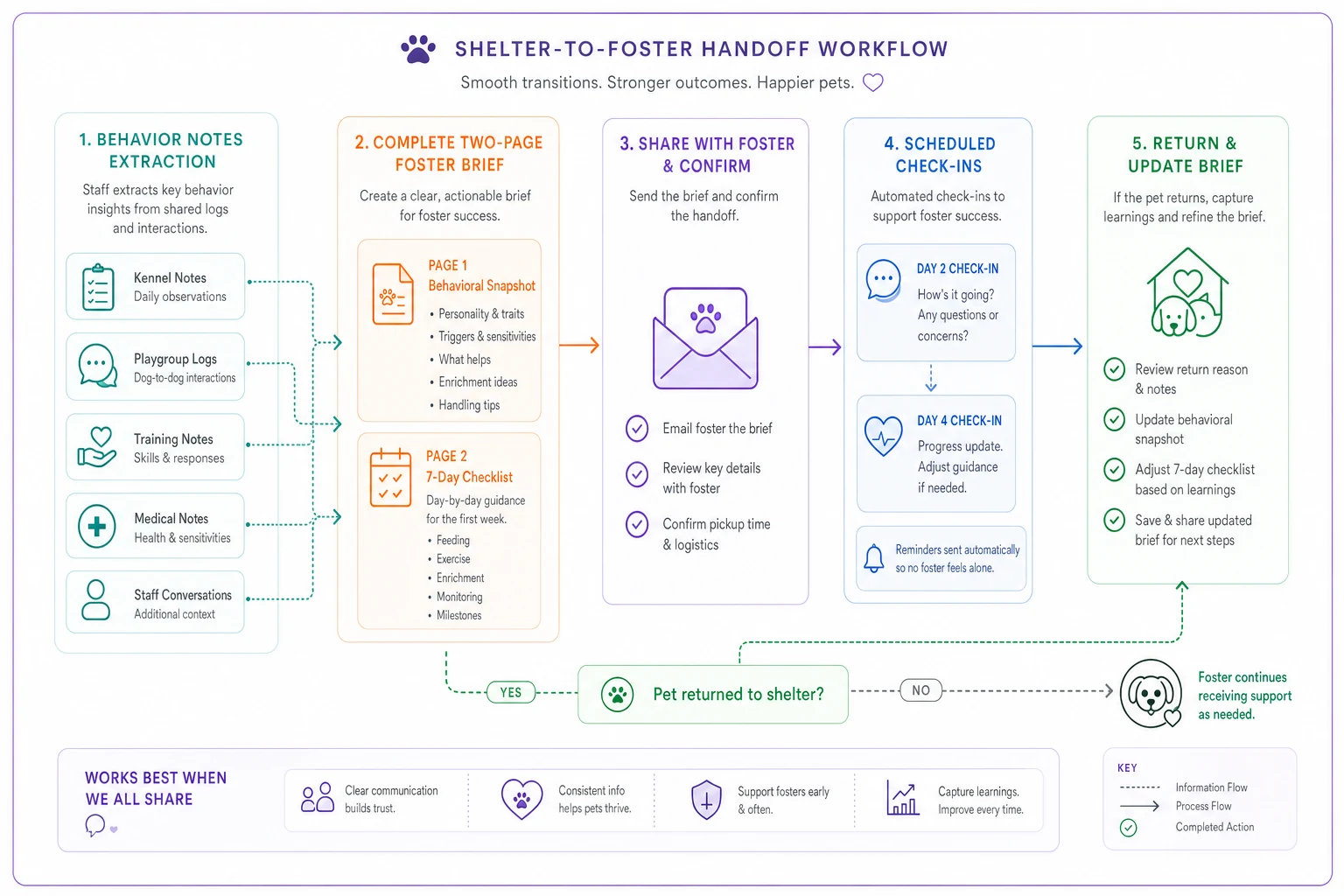
Shelters that keep behavioral observations in a shared operational system — rather than on paper kennel cards and a group chat — have a much easier time here, because the transfer brief becomes an extract of data that already exists rather than a fresh document someone builds from scratch. When behavior notes, red flags, and follow-up check-ins live in one place, generating the two-pager is mostly pulling the right fields and sending the scheduled day-2 and day-4 messages. That's where some workflow automation earns its keep — not by replacing the coordinator's judgment, but by making sure the notes that already exist actually reach the foster.
When a full brief is overkill
Not every placement needs the whole two pages. A healthy, well-socialized kitten going to an experienced foster for a two-week weight-gain stay doesn't need a 7-day behavioral checklist. Forcing the full brief on simple placements just trains people to skip it.
Use judgment. The full brief earns its place when:
-
The animal has any bite history, resource guarding, or reactivity.
-
The animal is going to a newer or first-time foster.
-
There's a documented stress or medical-behavioral component.
-
The goal is behavioral rehab, not just boarding.
For low-risk placements, the one-page snapshot alone is plenty. The point is matching the depth of the handoff to the actual risk — not drowning every foster in paperwork.
Early foster returns are mostly an information-transfer problem wearing a behavior costume. The animal didn't change between the kennel and the foster's living room. What changed is that all the context the shelter had quietly disappeared at the handoff, and the foster met a surprise alone.
A two-page brief — a sharp behavioral snapshot, a 7-day checklist that normalizes decompression, and a short proactive follow-up script — closes that gap. It's not a big project. It's eight minutes of prep and two short messages, built on observations your team is probably already making. Do that consistently, and the day-3-to-day-5 return cluster starts shrinking on its own.
Ready to enhance your shelter’s impact?
Join 500+ shelters using Animlly to improve care coordination, increase adoptions, and engage communities effectively.