
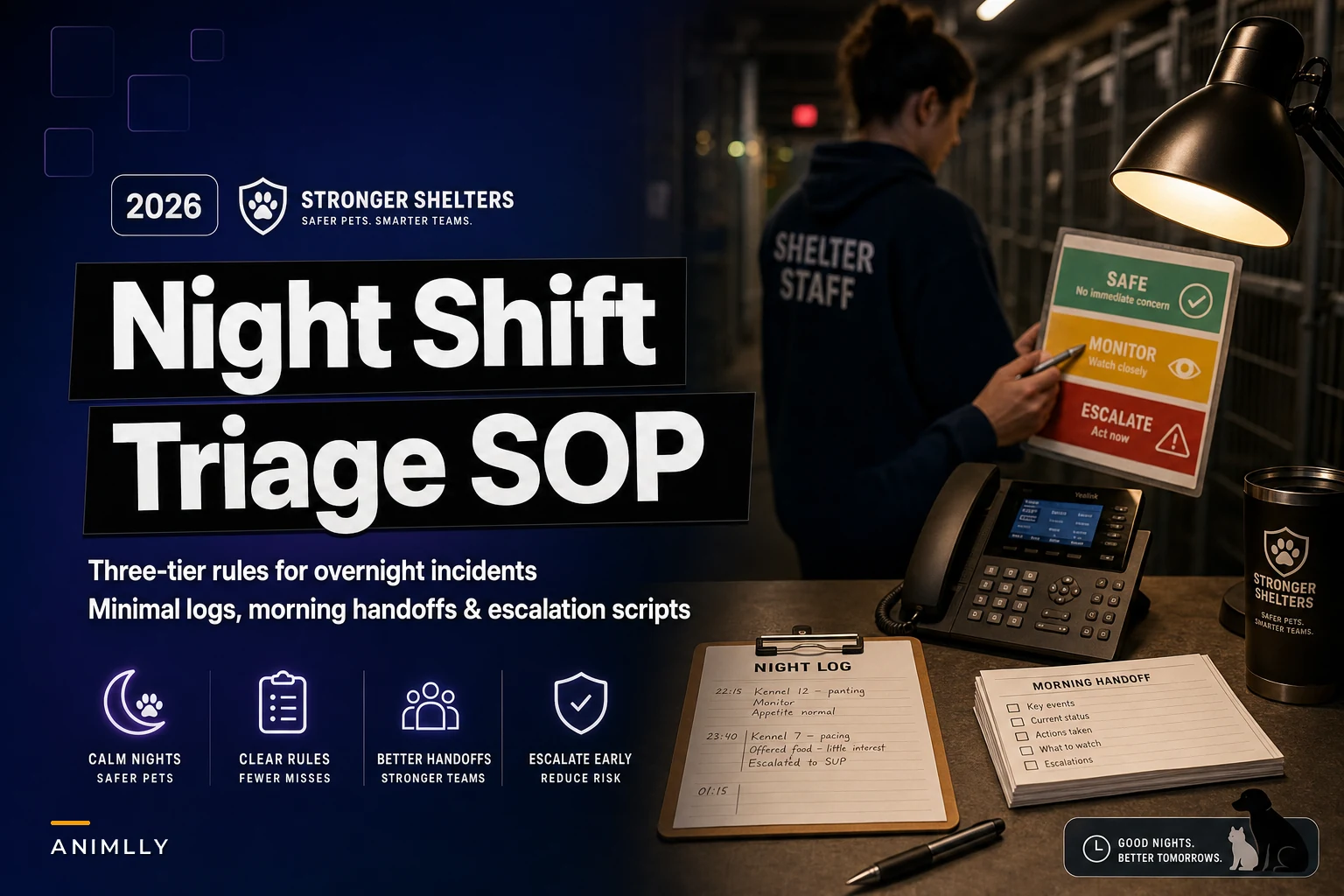

The overnight problem in most shelters isn't that people don't care. It's that the person walking the kennels at 2 a.m. is often the least experienced staff member, working solo, with no one to ask. So when a dog starts pacing and drooling, or a cat that ate fine at 9 p.m. is now flat and unresponsive at 3 a.m., that single person has to decide: is this a wait-until-morning thing, a keep-watching thing, or a wake-someone-up-right-now thing?
Get that wrong in either direction and you pay for it. Escalate too much and your on-call vet stops answering by month two. Escalate too little and an animal that needed intervention is found dead at the 7 a.m. handoff. The whole point of a night shift triage shelter SOP is to remove that judgment burden from a tired, under-supported person and replace it with a matrix anyone can follow.
This piece is narrow on purpose. It covers three things: a three-tier incident classification (safe / monitor / escalate), the bare-minimum documentation that actually survives a night shift, and the handoff and escalation scripts you hand to someone who might be six weeks into the job.
Why overnight judgment breaks down
Daytime staff make decisions in a rich environment. There's a supervisor two rooms over, a vet tech who's seen this before, three other people who can glance at the animal and confirm your read. Overnight, all of that collapses to zero. The staffer is alone, the building is quiet, and every ambiguous symptom feels either like an overreaction waiting to happen or a disaster they'll be blamed for.
Two failure modes show up constantly. The cautious person calls the on-call manager for a cat that vomited once — reasonable-sounding, but by the fourth call that week the manager starts screening. The confident person decides not to call about labored breathing because "it seemed okay" — and the morning crew inherits a crisis. Same root problem either way: no shared definition of what each tier actually means.
The other quiet failure is documentation. A solo overnight person is not going to fill out a two-page incident form at 3 a.m. while managing a distressed animal. If your documentation requires more than about 45 seconds, it won't get done, and the morning team walks in blind.
The three-tier matrix
The core of the SOP is a classification that fits on a single laminated card by the phone. Three tiers, plain language, with the deciding question being what action does this trigger rather than how serious does it feel.
Streamline your shelter operations effortlessly.
Animlly helps you manage every pet, volunteer, and adoption step with ease and accuracy.
- Comprehensive pet profiles
- Volunteer scheduling & communication
- Adoption tracking & reporting
No credit card required
| Tier | What it means | Action | Documentation |
|---|---|---|---|
| Safe | Normal variation, minor issue, animal comfortable | Log it, continue rounds | One line in the night log |
| Monitor | Something's off but stable; needs a recheck within a set window | Recheck at defined interval, note trend | Short note + recheck times |
| Escalate | Actual or potential emergency; can't wait for morning | Call on-call per script, act on their direction | Timestamped note + who was called |
The trick that makes this work is anchoring each tier to concrete examples that match your population. Generic "signs of distress" language fails overnight. Specific triggers don't.
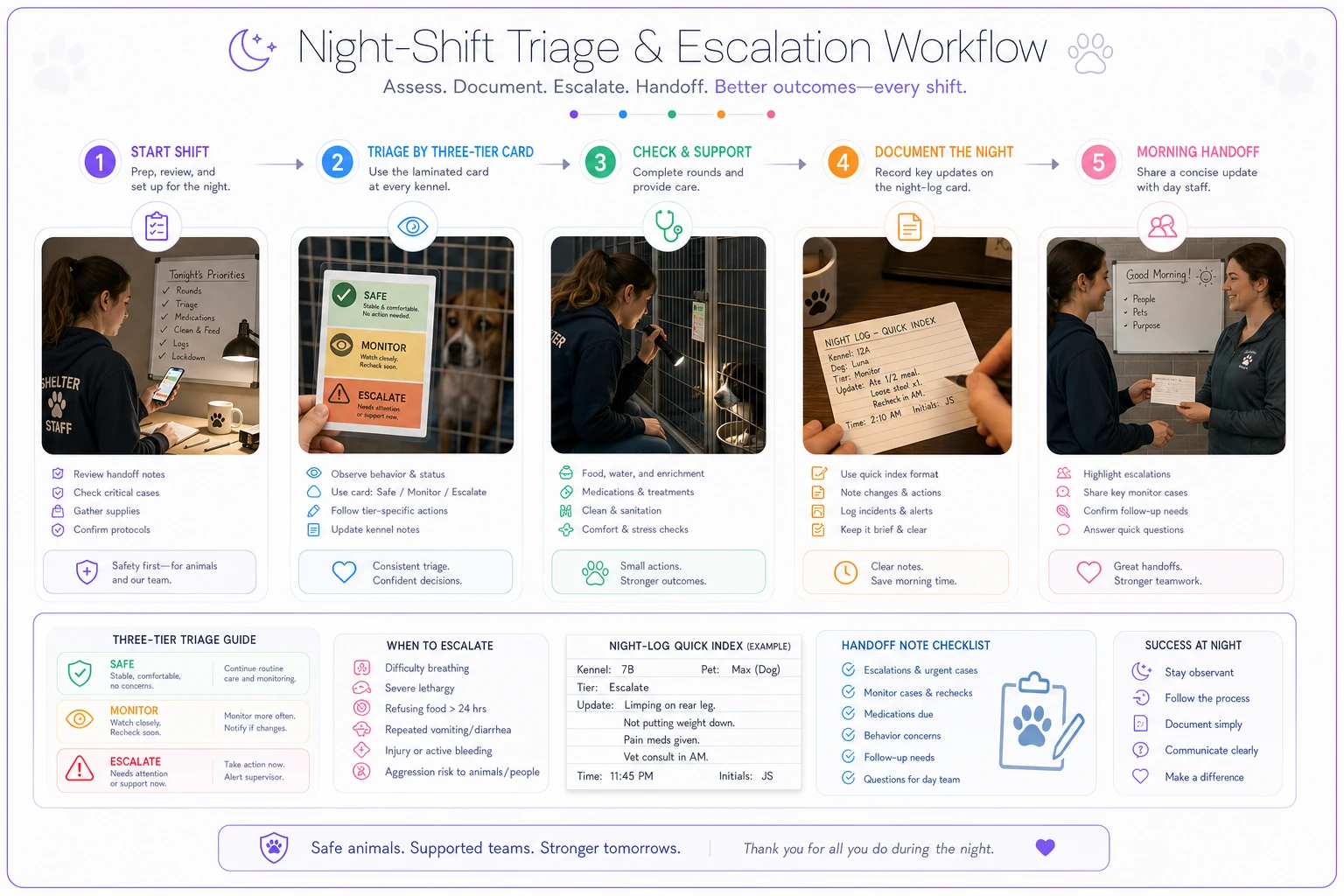
For a typical mixed shelter, a starter set looks like this:
-
Safe ate less than usual but drinking and alert; one soft stool; mild kennel stress (pacing that settles); a single vomiting episode in an otherwise bright animal.
-
Monitor not eating at all across the shift; repeated soft stool or mild diarrhea; a wound that's clean but the animal keeps licking; new limp but bearing weight; a cat hiding but responsive when touched.
-
Escalate difficulty breathing or open-mouth breathing in a cat; unproductive retching or a swollen, hard belly (possible bloat); seizure; collapse or non-responsiveness; heavy bleeding that doesn't slow with pressure; any animal that "just crashed" between rounds.
You'll refine this list over a few weeks. The first version doesn't have to be perfect — it just has to be specific enough that two different overnight people would classify the same animal the same way.
The one rule that keeps escalation honest
Add a single override line: when in genuine doubt between Monitor and Escalate, escalate. But pair it with a real Monitor tier that gives the staffer permission to not call. Most over-calling happens because the person has only two mental buckets: "fine" and "emergency." The Monitor tier absorbs the ambiguous middle so the escalate line stays credible.
Minimal documentation that actually gets filled out
The mistake shelters make is designing overnight forms as if the person has a desk and ten minutes. They don't. Design for the phone-in-one-hand, distressed-animal-in-front-of-you reality.
Keep the night log to a single running sheet with these fields per entry:
-
Time (they'll write this fast, keep it first)
-
Animal ID / kennel — use whatever ID scheme your intake already uses so it links back cleanly
-
Tier (S / M / E — just the letter)
-
What I saw (one short line, plain words)
-
What I did (recheck, called on-call, gave nothing, etc.)
For a Monitor case, add a recheck time and a second line when they go back. That's it. If it doesn't fit in the width of an index card line, it's too long.
Use the same animal ID format your intake uses so overnight notes match morning records without extra work.
This connects directly to how you track animals during the day. If your intake and ID conventions are sloppy, overnight notes float free and nobody can match them to the animal by morning. Getting the underlying data set right — consistent IDs, kennel labels, minimum fields — is what makes these quick notes usable. It's worth building your night log on top of the same foundation you'd use in a modular shelter operations playbook with editable SOP templates rather than inventing a parallel system.
A quick note on Monitor recheck discipline: the trend is the signal, not the single reading. A cat hiding at midnight and still hiding but now unresponsive at 2 a.m. is a different animal than one that came out to eat. The recheck times force the staffer to capture that direction of travel — exactly the information the morning team and vet need.
The morning handoff note
Everything the night person logs is worthless if the morning team has to reconstruct it from a wall of timestamps. The handoff note is a deliberate summary written in the last 15 minutes of the shift — not the raw log, a distilled version.
A workable handoff has three sections:
-
Overnight escalations any animal that hit the Escalate tier — what happened, who was called, what was decided, current status. This goes at the top, always.
-
Watch list every Monitor animal, with kennel ID and the specific thing to keep an eye on ("Kennel 14, not eating since 9pm, recheck appetite first thing").
-
Everything else normal a single line confirming rounds were completed and nothing else stood out.
The "everything else normal" line matters more than it seems. If the note only lists problems, the morning team doesn't know whether a quiet log means a quiet night or an incomplete one. An explicit "rounds done, all clear" closes that gap.
This handoff runs on the same logic as other shift-continuity habits in the building. The same discipline that makes a fast, structured 3-minute lost-pet intake checklist work — capture the essentials, skip the ceremony, hand off cleanly — is exactly what a night handoff needs.
On-call escalation scripts
Scripts exist for two reasons. A tired staffer calling a half-asleep vet at 3 a.m. tends to ramble, which burns the vet's patience and buries the actual problem. And a scripted call gives the on-call person the information they need to make a decision without being there.
A tight escalation call has a fixed order:
-
Who and where "This is Marcus at Riverside Shelter, overnight."
-
Animal ID, species, rough age/size. "Kennel 8, adult male dog, about 60 pounds."
-
What changed and when "Fine at last rounds around 12:30. Now it's 2:15 and he's got a hard, swollen belly and he's trying to vomit but nothing's coming up."
-
What I've done "Haven't given anything. He's still standing but restless."
-
The ask "Is this a come-in-now, or is there something I should do and recheck?"
That structure gets a decision in under 90 seconds. Post it next to the phone with the triage card.
Also script the no-answer path, because it happens. Something like: "If on-call doesn't answer within two attempts and 10 minutes, call [backup name/number]. If both fail and it's a true emergency, call [24-hour emergency vet clinic] and transport per the emergency transport steps." A staffer managing an active emergency should never be stuck wondering who to call next.
A realistic scenario
A mid-size municipal shelter — somewhere around 80 to 110 animals on any given night, one overnight staffer covering roughly 10 p.m. to 6 a.m. — had a recurring morning-handoff problem. The overnight person was newer, and over about six weeks there were two near-misses: a bloat case caught late and a cat in respiratory distress that got logged as "seems stressed."
The fix wasn't more training hours, which they didn't have budget for. It was the laminated three-tier card, the five-field night log, and the scripted call. Within the first month, escalation calls to the on-call vet actually went down — from several low-value "just checking" calls a week to almost none — while genuinely urgent cases got flagged faster because the staffer no longer hesitated at the Escalate line. The morning team stopped starting their day by decoding what happened overnight, because the handoff note told them in about 30 seconds. No dramatic turnaround story here — just fewer 6 a.m. surprises and an on-call vet who started answering on the first ring again.
When this SOP makes sense — and when it doesn't
This setup is built for minimal overnight rosters: one, maybe two people, limited experience, no supervisor on site. That's exactly where a rigid, low-judgment structure earns its keep.
If your overnight shift already has a licensed tech on duty with authority to treat, you don't need the escalation scripts in this form — you need a different tool that governs what they can do independently. And if you have no overnight staff at all, this whole discussion is premature; the first problem is coverage, not triage.
The one group that should be careful: shelters that use this to replace a real on-call relationship. The matrix helps a solo staffer classify and communicate, but it doesn't diagnose. If your on-call arrangement is unreliable or nonexistent, fix that before you fine-tune the card. A perfect escalation script that dials a number nobody answers is theater.
Making it stick
Three practical things determine whether this survives past week two. Print the triage card and the call script and physically mount them by the phone — not in a binder, not in a shared drive, on the wall. Second, review the actual night logs weekly for the first month and adjust the Safe/Monitor/Escalate examples based on what really came up; the first list will misclassify a few things and that's expected. Third, have the morning team give the night person quick feedback when a Monitor call should have been an Escalate, or vice versa — that closes the loop and calibrates judgment faster than any training module.
If you already keep your SOPs in a central, editable system rather than scattered documents, fold the night-shift matrix and handoff templates in there so they get versioned and updated alongside everything else. The overnight shift is usually the least-documented part of a shelter's operation, which is exactly why a small, well-designed SOP does the most good there.
Three practical things determine whether this survives past week two. Print the triage card and the call script and physically mount them by the phone — not in a binder, not in a shared drive, on the wall. Second, review the actual night logs weekly for the first month and adjust the Safe/Monitor/Escalate examples based on what really came up; the first list will misclassify a few things and that's expected. Third, have the morning team give the night person quick feedback when a Monitor call should have been an Escalate, or vice versa — that closes the loop and calibrates judgment faster than any training module.
If you already keep your SOPs in a central, editable system rather than scattered documents, fold the night-shift matrix and handoff templates in there so they get versioned and updated alongside everything else. The overnight shift is usually the least-documented part of a shelter's operation, which is exactly why a small, well-designed SOP does the most good there.
Ready to enhance your shelter’s impact?
Join 500+ shelters using Animlly to improve care coordination, increase adoptions, and engage communities effectively.