


Most small shelter boards don't fail because they lack smart, caring people. They fail because the people running the kennels and the people sitting around the board table are speaking two completely different languages. The manager lives in live-release rates, length-of-stay, foster capacity, and a medical budget bleeding faster than expected. The board lives in fiduciary duty, risk exposure, and whether the 990 is going to raise eyebrows. Nobody translates between the two, so board meetings turn into either a financial recap nobody questions or a two-hour emotional discussion about one hard euthanasia case.
The gap isn't about intelligence. It's about artifacts. Boards govern through documents — dashboards, agendas, registers, checklists. If those don't exist, or if they're just raw operational data dumped into a slide, the board can't do its job. And when a board can't govern properly, the shelter inherits the consequences: cash crunches nobody saw coming, a vendor contract that auto-renews at a terrible rate, a volunteer incident that becomes a lawsuit, a grant clawback because reporting fell apart.
This is a system problem. The frontline SOPs, the KPIs, the board's fiduciary responsibilities, and the legal guardrails all connect — or they're supposed to. This playbook is about building that connective tissue so a small board, often with little or no dedicated legal counsel, can govern well without drowning in process.
Why the SOP-to-board handoff breaks
Here's the pattern that shows up again and again in small shelters. Operations tracks dozens of metrics because the shelter software spits them out — intake numbers, outcomes, foster counts, donation totals, medical spend. All of it is real. None of it is organized for governance.
So the executive director walks into the quarterly board meeting with a 14-tab spreadsheet or, worse, a printout of last month's dashboard. The board scans it, nods, and approves. What they don't do is govern — because governing requires seeing trends, risks, and exceptions, not raw counts.
A few structural reasons this keeps happening:
-
Operational metrics aren't the same as board metrics. A kennel manager cares about today's available cages. A board member needs to know if capacity is trending toward a crisis over two quarters.
-
Risk lives in people's heads. The manager knows the walk-in freezer is on its last legs and the insurance renewal is coming up. None of that is written down where the board can see it.
-
Nobody owns the translation layer. There's no standing document that converts "we had three bite incidents this quarter" into "here's our liability exposure and what we're doing about it."
What breaks at scale is coordination. A shelter taking in 400 animals a year can survive on verbal updates and a trusting board. Push that to 1,500–2,000 intakes with multiple paid staff, a foster network, and six-figure grants, and the informal approach collapses. Decisions get made without the board understanding the risk. Then something goes wrong and the board asks, "Why didn't we know about this?" The honest answer is usually: because nobody built the artifact that would have told you.
The one-page annual dashboard
The single most useful thing you can build for a small board is a dashboard that fits on one page. Not twelve KPIs. Not a color-coded monster. One page that a busy board member can absorb in ninety seconds before the meeting.
Streamline your shelter operations effortlessly.
Animlly helps you manage every pet, volunteer, and adoption step with ease and accuracy.
- Comprehensive pet profiles
- Volunteer scheduling & communication
- Adoption tracking & reporting
No credit card required
The discipline here is ruthless selection. You're picking the handful of numbers that actually signal organizational health, and you're showing them as trends against targets — not as isolated monthly snapshots. This connects directly to how you measure outcomes operationally; if you've already built a solid outcome measurement framework for welfare, adoption and community impact, the board dashboard is just the executive summary of that work.
A workable annual dashboard for a small shelter might include:
| Metric | Target | Why the board cares |
|---|---|---|
| Live release rate | 90%+ | Core mission outcome; also reputational and grant-tied |
| Average length of stay | Under 18 days | Drives capacity and cost per animal |
| Months of cash on hand | 3–6 months | Fiduciary survival metric |
| Adoption revenue vs. medical spend | Trending ratio | Early signal of financial strain |
| Foster capacity utilization | 70–85% | Flexibility buffer before overcrowding |
| Volunteer retention (annual) | 60%+ | Hidden operating cost if it drops |
| Serious incidents (bite/escape/injury) | Tracked, not zero | Liability and safety exposure |
Notice what's not on there: daily intake counts, individual animal stories, social media numbers. Those matter operationally, but they clutter a governance document. The board's job is to watch the dials that signal whether the whole organization is drifting.
One pattern worth naming: the most dangerous metric on this list is usually months of cash on hand, and it's the one small boards examine least carefully. A shelter can be hitting a 93% live release rate and be four months from insolvency at the same time. The dashboard has to hold both truths on the same page. For the financial side of this, it's worth grounding the dashboard targets in a real financial resilience framework for small animal shelters so the numbers aren't arbitrary.
The quarterly risk-review agenda
Most small shelter board meetings don't have a risk conversation at all. They have a financial report, a director's update, and new business. Risk gets discussed only when it's already a fire.
A quarterly risk-review agenda fixes this by carving out a standing 20–30 minute block where the board looks at the risk register and asks a consistent set of questions. The goal is to make risk boring and routine so it surfaces before it becomes a crisis.
A simple recurring agenda block:
-
Top three risks this quarter — pulled directly from the risk register, ranked by likelihood × impact.
-
Movement since last quarter — what got better, what got worse, what's new.
-
Mitigation status — for each top risk, who owns it and what's actually been done.
-
New exposures — anything operations flagged
a failing facility system, a staffing gap, a vendor issue, a regulatory change.
-
One decision — the board makes or defers one concrete risk decision each quarter.
That last item matters. A risk review that produces no decisions trains everyone to treat it as theater. Forcing at least one decision per quarter — approve a reserve transfer, authorize a facility repair, request legal review of a contract — keeps the muscle alive.
The quiet win here is that this agenda also protects the executive director. When risks are on the table every quarter and the board signs off on priorities, the ED isn't carrying every judgment call alone. Shared visibility becomes shared responsibility.
A simple risk register small boards can maintain
The risk register is where most small shelters overbuild. You do not need enterprise risk software. You need a shared document — a spreadsheet is fine — with a handful of columns that anyone can update.
Keep it to these fields:
-
Risk description (plain language
"walk-in freezer is 12 years old and failing")
-
Category (financial, operational, legal, reputational, facility, personnel)
-
Likelihood (low / medium / high)
-
Impact (low / medium / high)
-
Current mitigation (what's already in place)
-
Owner (one named person)
-
Review date
The owner column is the one people skip, and skipping it is why registers die. A risk with no owner is a risk nobody is actually managing. Every entry needs exactly one name — not "the team," not "staff," one person accountable for watching it.
Where this connects to the rest of your operation: if your records are messy, your risk register will be too. Having a lightweight data governance standard with clear ownership makes it far easier to populate risk entries with real numbers instead of gut feelings.
A realistic register for a small shelter usually runs 10–15 active entries. More than 20 and the board can't meaningfully engage with all of it; fewer than 8 and you're almost certainly missing things. The quarterly review trims and promotes entries so the list stays honest.
Vendor-contract guardrails without a lawyer on retainer
This is where small shelters get quietly hurt. Contracts with vets, cleaning suppliers, software vendors, waste disposal, and transport partners get signed by whoever's available — often with no board visibility and no standard checks. Then an auto-renewal locks you into a bad rate, a liability clause turns out to be one-sided, or a software vendor owns your animal data in ways nobody read.
You don't need a general counsel to put basic guardrails in place. You need a short checklist that every contract over a threshold — say, anything above $2,500 annually or any multi-year commitment — has to pass before signature.
A vendor-contract guardrail checklist:
-
[ ] Total annual cost and full contract term are written down and understood
-
[ ] Auto-renewal terms identified; renewal reminder set 60–90 days before deadline
-
[ ] Cancellation terms and any early-termination penalties reviewed
-
[ ] Liability and indemnification clauses read (flag anything one-sided for review)
-
[ ] Data ownership and access confirmed for any software vendor
-
[ ] Insurance/COI requirements met for anyone on-site or transporting animals
-
[ ] Spending authority confirmed — is this within the ED's limit or does it need board approval?
-
[ ] One person owns the relationship and the renewal date
The auto-renewal line alone pays for the entire checklist. A shelter spending roughly $6k–$8k a year on a software platform or waste contract that quietly renewed at a worse rate — because the 30-day cancellation window passed unnoticed — is a completely avoidable loss. It happens constantly.
Tie renewal reminders to the named owner and set the calendar reminder 60–90 days out to avoid accidental auto-renewals.
Set a dollar threshold so you're not bureaucratizing the $200 purchases. The guardrails exist for the contracts that can actually hurt you.
The fiduciary red-flag checklist
Fiduciary duty sounds abstract until a board realizes it personally approved something it shouldn't have. The point of a red-flag checklist is to give non-expert board members a concrete set of signals to watch for — things that need a harder look before they become a problem.
Red flags a small shelter board should check regularly:
-
Cash on hand dropping below two months without a documented plan
-
Restricted grant funds being used for general operations
-
No reconciliation between the bank statement and the books for more than a month
-
A single person controlling both spending and record-keeping with no second set of eyes
-
Related-party transactions (a board member's business getting shelter contracts) with no documented conflict-of-interest process
-
Late or missing filings — the 990, state charity registration, payroll taxes
-
Insurance lapses or coverage that hasn't been reviewed against current operations
-
Board minutes that don't record how major decisions were actually made
The single-person-controlling-money flag is the one that sinks small nonprofits most often. It's rarely fraud — it's usually a trusted bookkeeper or long-time ED where "we've always done it this way." The board's fiduciary job is to require separation of duties regardless of trust. The checklist makes that a routine check instead of an accusation.
Run this checklist at least twice a year. It takes fifteen minutes and it's the cheapest insurance a board will ever buy.
A 90-day governance sprint to put it all in place
You can't build all of this at once, and you shouldn't try. Small boards burn out on governance initiatives that demand everything upfront. A 90-day sprint sequences the work so each piece builds on the last.
Days 1–15: Dashboard. Pick the 6–8 board-level KPIs. Pull historical numbers so you can set honest targets. Build the one-page layout. Get the ED and board chair to agree it's the right page.
Days 16–35: Risk register. Run one working session where the ED and two board members brainstorm every risk they can think of. Categorize, rate, assign owners. Trim to 10–15 active entries. This session is usually eye-opening — a lot of "someone should really deal with that" gets written down for the first time.
Days 36–55: Contract guardrails. Inventory every active vendor contract over your threshold. Log costs, terms, renewal dates, and owners in one place. Adopt the guardrail checklist for all future contracts. You'll likely find at least one contract that's quietly costing more than it should.
Days 56–75: Fiduciary checklist and agenda. Adopt the red-flag checklist and run it once as a baseline. Rewrite the standing quarterly meeting agenda to include the risk-review block.
Days 76–90: First real cycle. Run one full board meeting using the new artifacts. Dashboard reviewed, risk register discussed, one risk decision made. Then debrief — what was useful, what was noise, what to cut. The debrief matters as much as the meeting. Governance tools that don't get pruned become the clutter you were trying to escape.
A simple visual of the 90-day sprint workflow can help keep the sequence clear for the ED and board.
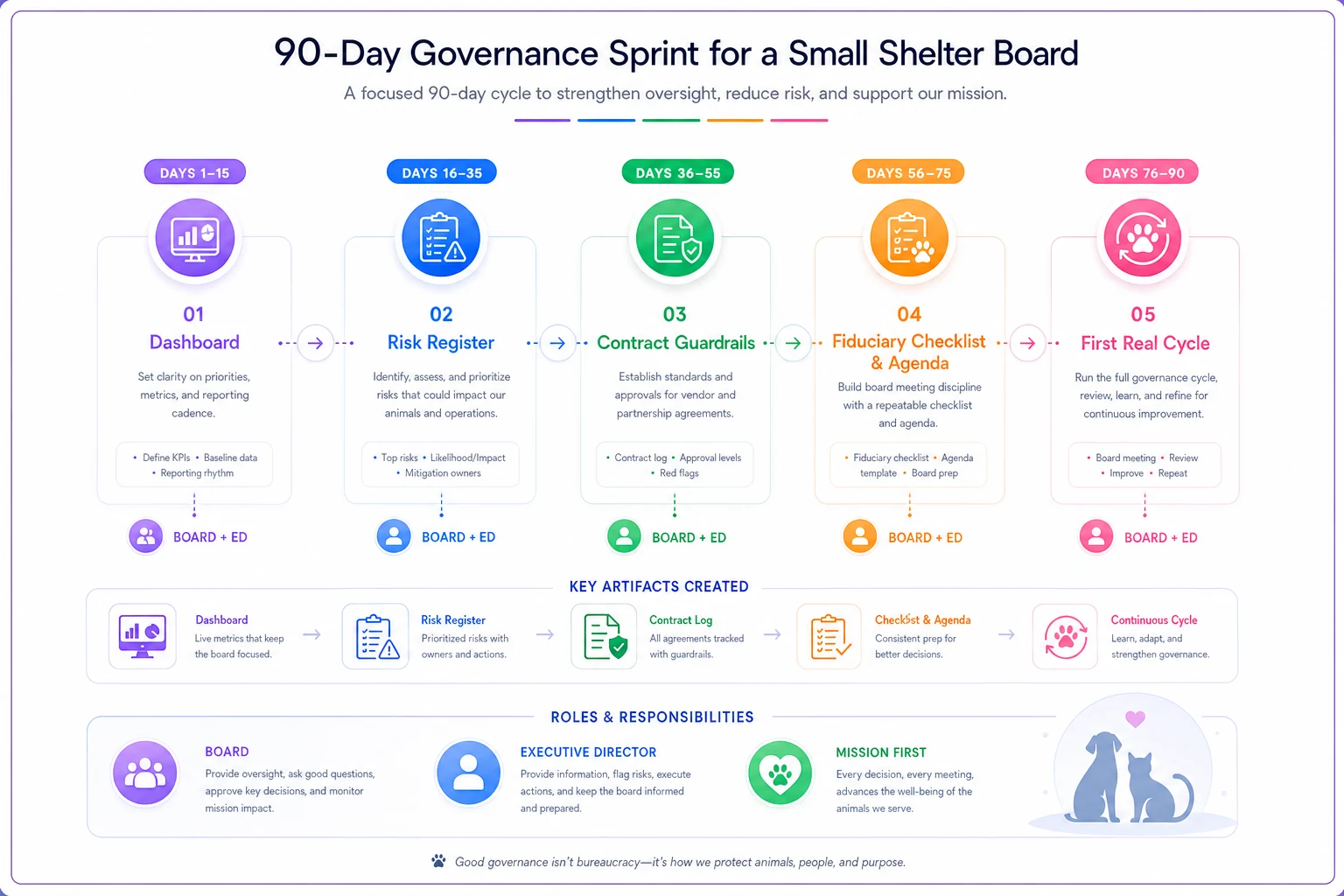
The sprint works because it produces usable artifacts at each stage rather than a giant deliverable at the end. By day 30 the board already has a dashboard; by day 90 it has a full governance rhythm.
A real scenario: what changes when the artifacts exist
Consider a shelter taking in around 1,200 animals a year, run by one executive director, two part-time paid staff, and a board of seven. Before any of this, their board meetings were a financial report plus whatever crisis was loudest that month. They'd had two surprises in eighteen months — a $9k emergency HVAC replacement nobody had reserved for, and a software contract that renewed at a higher rate because the cancellation window passed.
After running a governance sprint, things shifted. The one-page dashboard flagged that medical spend was outpacing adoption revenue two quarters before it became a cash problem, which gave the board time to launch a targeted appeal instead of scrambling. The risk register had the aging HVAC on it with an owner and a flagged review date, so the eventual replacement was budgeted rather than an emergency. The contract log caught two auto-renewals and renegotiated one, saving somewhere in the range of $1,500–$2,000 a year.
Nothing about the shelter's mission changed. The animals, the volunteers, the intake flow — all the same. What changed was that the board could see around corners. The surprises stopped being surprises. That's the entire point of governance artifacts: they convert tribal knowledge trapped in the ED's head into shared visibility the board can actually act on.
When this level of structure makes sense — and when it doesn't
When it makes sense: You've got paid staff, annual intake above roughly 800–1,000 animals, grant funding with reporting obligations, or multi-year vendor contracts. At that scale, informal governance is a liability waiting to happen. You also need it the moment you've had one "why didn't we know about this" board moment — that's the signal the informal system already failed.
When it's overkill: A tiny all-volunteer rescue placing 100 animals a year through foster homes doesn't need a 15-entry risk register and a quarterly risk-review block. A single shared document tracking cash, insurance, and the two or three real risks is plenty. Building enterprise-style governance onto a kitchen-table operation just creates process that nobody maintains.
Who should not do this: Boards that won't commit to the quarterly rhythm. Artifacts are worthless if they're built once and abandoned. If the board won't spend 30 minutes a quarter on risk and won't prune the dashboard annually, don't build the system — you'll just create documents that give a false sense of control. An honest, minimal process the board actually uses beats an impressive one it ignores.
Where tooling helps — and where it doesn't
A quick, honest note on software, because small shelters get sold a lot of it. Most of these artifacts live fine in shared spreadsheets and documents. The dashboard, the risk register, the contract log — none of that requires a dedicated platform.
Where operational software earns its keep is in feeding the artifacts. If your shelter management system can reliably export clean outcome and financial data, building the dashboard each quarter takes minutes instead of hours. If it can flag contract renewal dates or surface incident counts automatically, the risk register stays current instead of going stale between meetings. The value isn't in some governance module — it's in not having to hand-assemble the numbers every single cycle. When the underlying operational data is clean and accessible, governance becomes a ten-minute pull rather than a dreaded afternoon of copy-pasting.
The order matters, though. Build the governance rhythm first with simple tools. Add automation only to remove the friction you've actually felt. Buying software to create a governance process you don't yet have is how shelters end up with expensive platforms and no better oversight.
Pulling it together
A small shelter board doesn't govern through meetings — it governs through artifacts. The one-page dashboard, the quarterly risk agenda, the simple register, the contract guardrails, and the fiduciary checklist are the connective tissue between frontline operations and board-level responsibility. Build them in a 90-day sprint, keep them lean, prune them every year, and the board stops being surprised.
The shelters that handle growth well aren't the ones with the most sophisticated governance. They're the ones where the manager's knowledge and the board's oversight are actually connected — where the freezer that's about to die, the grant that's about to be misspent, and the contract that's about to auto-renew all show up on a page before they turn into a crisis. That translation layer is the whole job. Build it once, maintain it quarterly, and a seven-person volunteer board can govern a complex operation without a lawyer on retainer or a finance degree in the room.
Ready to enhance your shelter’s impact?
Join 500+ shelters using Animlly to improve care coordination, increase adoptions, and engage communities effectively.