

Most shelters don't have a data problem. They have a handoff problem. The intake system holds one version of an animal's record, the medical spreadsheet holds another, the foster coordinator keeps a third on her phone, and the city wants a monthly report that matches none of them. Every time that data crosses a boundary—into a partner's system, into a grant report, into a regional network's dashboard—something gets lost, retyped, or quietly broken.
An interoperability roadmap isn't about buying better software. It's about deciding, ahead of time, how your data describes itself so that any system, person, or partner receiving it knows exactly what they're looking at. Get that right and your monthly municipal report becomes a ten-minute task instead of a two-day scramble. Get it wrong and you'll keep paying the tax of manual reconciliation indefinitely.
This is the system-level view: how the pieces connect, where they tend to break as you grow, and what a small team can actually build without a developer on staff.
Why interoperability breaks before you notice it
The failure almost never announces itself. It just builds up quietly.
A shelter running one shared spreadsheet and a whiteboard can survive on tribal knowledge. Everyone knows "status: pending" means the vet hasn't cleared the animal yet, even though nothing in the system says so. The data works because the people around it carry the missing context in their heads.
-
"Altered" in your system, "spayed/neutered" in theirs, "fixed" on the paper form
-
Dates stored as
3/4with no year, so nobody knows if that's March or April depending on who typed it -
Breed free-text fields with 40 different spellings of "Chihuahua"
-
Outcome codes that longtime staff understood but the new municipal analyst reads completely differently
This usually surfaces the first time someone outside your building asks for data and you realize you can't export it without cleaning every row by hand. The underlying taxonomy was never written down—it lived in people. The moment data crosses an organizational boundary, undocumented meaning gets expensive fast.
If you haven't already pinned down how your fields are named and owned, that groundwork comes first. A lightweight shelter data governance standard is the foundation this whole roadmap sits on—interoperability without an agreed taxonomy is just faster chaos.
The roadmap, in the order that actually works
You don't build interoperability by picking APIs first. You build it from the inside out. Here's the sequence that holds up for small teams:
Streamline your shelter operations effortlessly.
Animlly helps you manage every pet, volunteer, and adoption step with ease and accuracy.
- Comprehensive pet profiles
- Volunteer scheduling & communication
- Adoption tracking & reporting
No credit card required
-
Agree on your internal field definitions. Every field gets one name, one data type, one allowed set of values. This is boring and it's the most important step.
-
Write a shareable schema. A plain description of your data structure that any partner can read—JSON or CSV, depending on who's receiving it.
-
Build export mappings per audience. Your internal fields rarely match what the city or a grantor wants. You map once, reuse forever.
-
Pick the lightest integration pattern that works. Most shelters need scheduled file exports, not live APIs. Don't over-engineer.
-
Automate the schedule. The report that has to be built by hand is the report that gets late and sloppy.
-
Lock down retention and privacy. Decide what gets shared, what gets redacted, and how long you keep it—before you send anything.
Software integration is step four, not step one. Teams that start with "which system talks to which" almost always end up rebuilding when they realize their fields didn't mean the same thing on both ends.
Your schema is a contract—write it like one
A schema is just a description of your data: what fields exist, what type each one is, and what values are allowed. When you share it with a partner, you're handing them a contract. "Here's exactly what you'll receive, every time."
{ "animalid": "A-2024-0481", "intakedate": "2024-03-04", "species": "dog", "breedprimary": "chihuahua", "sex": "female", "altered": true, "intaketype": "owner_surrender", "status": "available", "microchip": "985141000123456" }
The same record, flattened to CSV for a municipal upload, might look like this:
animalid,intakedate,species,breedprimary,sex,altered,intaketype,status A-2024-0481,2024-03-04,dog,chihuahua,female,true,owner_surrender,available
-
Dates are always ISO format (
YYYY-MM-DD). This single choice eliminates an entire category of errors—no ambiguous3/4, no locale mismatches, no guessing whether it's day-first or month-first. -
Controlled values are lowercase and fixed.
speciesis always one ofdog,cat,other.intake_typepulls from a short fixed list. The moment you allow free text, interoperability starts leaking.
A small data dictionary should travel alongside the schema—one line per field: the name, the type, the allowed values, and a plain-English note. A partner should never have to call you to ask what status: hold means.
The mistake small teams make is treating the schema as a one-time document. It's a living contract. When you add a field, the schema changes, and everyone consuming your data needs to know. Version it—v1, v2—and date it.
Export mappings: where your data meets the outside world's demands
Your internal fields will almost never match what a grantor or city form wants. The city wants "disposition" where you store "outcome." A grant report wants age bucketed into ranges where you store exact birth dates. This gap is normal, and the fix is a mapping table—probably the single most reusable artifact in this whole roadmap.
Here's a worked example mapping internal fields to two different external audiences:
| Internal field | Internal values | Municipal export field | Grant report field |
|---|---|---|---|
outcome | adopted, rto, transfer, euth | Disposition (Adoption, Return to Owner, Transfer Out, Euthanasia) | final_outcome (Live Release / Non-Live) |
intake_type | stray, ownersurrender, transferin | Intake_Source (Stray, Owner, Transfer) | intake_category (Public / Partner) |
altered | true / false | SpayNeuterStatus (Altered / Intact) | — (not required) |
intake_date | ISO date | DateIn (MM/DD/YYYY) | report_month (YYYY-MM) |
The same internal field feeds different shapes depending on who's asking. Municipal reporting wants a formatted date; the grant wants just the month. Your internal data stays clean and canonical; the mapping does the translation work.
Build one mapping per recipient and store them together. When the city changes its form next fiscal year—and it will—you edit one mapping, not your entire database. This separation is what lets a two-person team support five different reporting relationships without losing their minds.
The integration patterns that fit small teams
There's a persistent myth that interoperability means live APIs humming between systems in real time. For most shelters, that's expensive overkill and a maintenance burden you can't sustain.
Scheduled file export (best for most shelters). On a set cadence, your system generates a CSV or JSON file matching an agreed schema and drops it somewhere the partner can retrieve it—a shared folder, an email, an SFTP drop. Simple, auditable, and it fails loudly when something's off. This covers municipal reporting, most grant reporting, and transfer partners.
Pull-based API read. A partner's system requests your data on demand through a defined endpoint. Useful when a regional network needs current capacity numbers, but someone has to maintain that endpoint and its security.
Push webhooks. Your system notifies a partner the instant something changes—an animal becomes available, a hold is placed. Useful for real-time lost-and-found matching across a network, but genuinely overkill unless you're coordinating live across multiple organizations.
Below is the workflow for the pattern that covers the majority of real needs—the scheduled export:
> On the 1st of each month, the system queries all records with outcomes in the prior month → applies the municipal mapping table → redacts fields flagged as private → generates a CSV named cityname_YYYY-MM.csv → validates row count and required fields → saves to the reporting folder → emails the coordinator a confirmation with the record count.
Here's a visual of that scheduled export workflow.
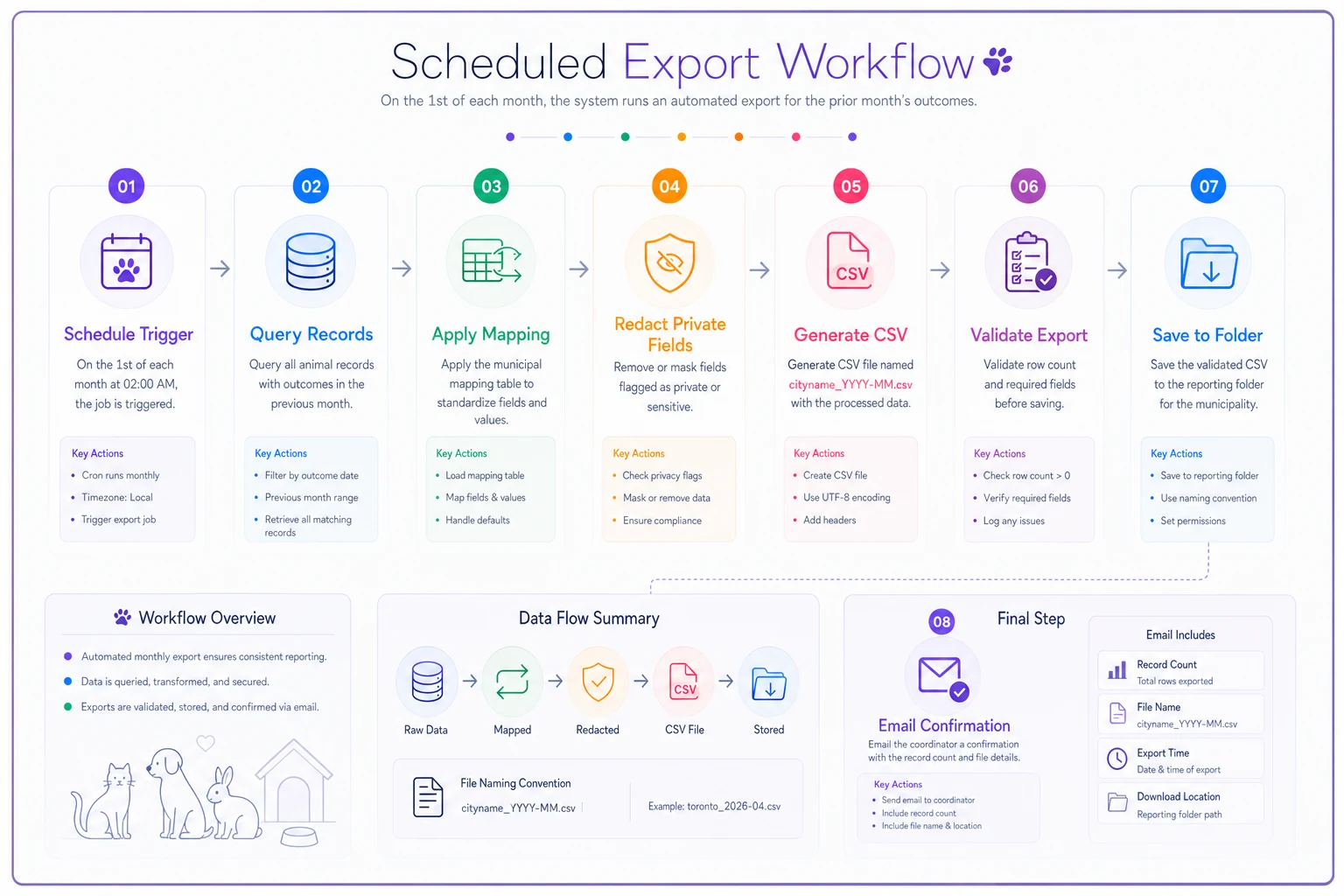
That entire chain can run on a schedule without anyone touching it. The human only gets involved when validation flags a problem—a missing required field, a count that looks wrong. That's the right division of labor: the system handles the repetitive assembly, the person handles the exceptions.
When live APIs actually make sense
-
You're part of a regional network that needs current, not monthly, data
-
Multiple partners pull the same data frequently enough that manual exports become a daily chore
-
Real-time matching (lost pets, available transfers) directly changes outcomes
When it's a bad idea
-
You're reporting to one or two recipients on a monthly cycle
-
Nobody on your team can respond when the integration breaks
-
The partner can't actually consume a live feed anyway and will just export it to a spreadsheet on their end
If the answer is "we send a report once a month to the city," you want scheduled file exports and nothing fancier. Over-building here is how small teams end up with brittle systems nobody can explain six months later.
Automating the schedule without automating the mistakes
The report that depends on someone remembering to build it is the report that shows up late. Automation here isn't about sophistication—it's about removing the human from the assembly so they can focus on the review.
-
Daily quiet internal snapshot for backup and rollback
-
Weekly capacity and available-animals file for any regional network
-
Monthly (1st–3rd) municipal disposition report, auto-generated and held for one human sign-off before sending
-
Quarterly grant outcome rollups mapped per funder
The design principle worth keeping: automate the build, keep a human on the send. The system assembles, validates, and stages the file. A person spends a couple minutes checking the record count and scanning a sample of rows, then approves. You get the speed of automation with a sanity check that catches the weird months—the ones after a hoarding case or a transport surge where the numbers look off for real reasons.
This is where good operational shelter platforms earn their keep. The better tools can run these mapped, validated exports on a set schedule and surface only the exceptions for review—so a coordinator isn't rebuilding the same municipal CSV by hand every month. Tie that to your outcome measurement framework and the same clean data feeds both your internal dashboards and your external reports from a single source.
Retention and privacy: decide before you send
The fastest way to turn an interoperability win into a liability is to share data you shouldn't, or keep data longer than you need to. This needs to be settled before the first automated export runs, not after someone asks an uncomfortable question.
A practical retention and privacy checklist for shelter exports:
-
[ ] Classify every field. Public, internal-only, or sensitive. Surrenderer names, addresses, and phone numbers are almost always sensitive.
-
[ ] Define redaction per recipient. The city needs disposition data, not the surrenderer's home address. Your mapping should drop or hash those fields on the way out.
-
[ ] Set retention windows. How long do you keep adopter contact info? Surrender records? Write the number down and enforce it in the system, not in someone's memory.
-
[ ] Log every export. What went out, to whom, when, and how many records. If a partner asks or a dispute arises, you can reconstruct exactly what you shared.
-
[ ] Agree on the partner's handling. A one-page data-sharing note covering what they can and can't do with it. Not a legal epic—just clarity.
-
[ ] Separate identifiers from analytics. Outcome reporting rarely needs names attached. Strip identity from aggregate stats wherever you can.
The pattern that goes wrong most often: a shelter sets up a clean automated export, then months later realizes it's been quietly including a surrenderer_phone column in a file that gets forwarded around a partner network. Nobody intended it. The redaction step just wasn't part of the mapping. Build privacy into the mapping table itself and it happens on every export, automatically, instead of depending on someone remembering to catch it each time.
None of this works in isolation from your broader tech decisions. How you store, secure, and control access to data upstream shapes what you can safely share downstream—the shelter technology governance side of the house sets the guardrails this roadmap operates within.
A real scenario: the two-day report that became ten minutes
A small municipal-contract shelter—two paid coordinators, a rotating volunteer base—was spending close to two full days every month assembling its city disposition report. Intake data lived in one system, medical outcomes in a spreadsheet, transfers in a shared doc. Someone had to pull all three, match records by hand, translate outcome labels into the city's format, and hope the row count matched.
A few things went wrong routinely. Breed spellings didn't match the city's list. Dates occasionally landed in the wrong month because of ambiguous formatting. Every third or fourth month, a surrenderer's phone number made it into the file, and someone caught it only because they happened to scroll far enough to the right.
They didn't buy new software. They did the groundwork in the order described above: locked field definitions, wrote one schema, built a single municipal mapping table with redaction baked in, and set the export to auto-generate on the 1st with a human sign-off before sending.
The monthly report dropped from roughly two days to about ten minutes of review. The privacy leak stopped completely because redaction was now part of the mapping, not a human's job to catch. When the city tweaked its form the next fiscal year, the fix was one edited mapping—not a panicked rebuild. The coordinators got two working days a month back, which in a two-person shop is not a small thing.
Who should not rush into this
If you're a brand-new shelter still figuring out your own intake process, hold off on partner integrations. Interoperability assumes your internal data already means something consistent. Build the taxonomy and the habits first—schemas and mappings are worthless on top of inconsistent data.
If you have exactly one reporting relationship and it's a simple monthly spreadsheet the city is happy with, you don't need the full roadmap. You need a clean mapping table and maybe a scheduled export. Don't build regional-network machinery to serve a single recipient.
And if nobody on your team can respond when something breaks, don't stand up live APIs. A scheduled file export that fails loudly is far safer than a live integration that fails silently at the worst possible moment.
The system view, pulled together
Interoperability isn't a feature you turn on. It's a sequence of decisions that compound: name your fields consistently, describe them in a schema, map them to each audience, move them with the lightest pattern that works, automate the assembly, and bake privacy into the mapping so it happens every time without anyone having to remember.
Each piece reinforces the others. A clean taxonomy makes schemas trivial. A good schema makes mappings reusable. Reusable mappings make automation safe. Baked-in redaction makes automation trustworthy. Pull any one piece out and the rest gets fragile—which is exactly why the shelters that treat this as a connected system, rather than a pile of separate reporting tasks, are the ones that stop losing days to manual reconciliation.
The goal was never fancier technology. It was to make your data describe itself clearly enough that it can travel—to a partner, to a funder, to the city—without a human having to escort it every step of the way.
Ready to enhance your shelter’s impact?
Join 500+ shelters using Animlly to improve care coordination, increase adoptions, and engage communities effectively.