

Most small shelters don't lose data to hackers. They lose it to a well-meaning volunteer who exported the intake spreadsheet to their personal laptop, then stopped showing up. Or to a software vendor that quietly changed its export format, so the medical history you thought you owned now lives inside a system you can't leave without paying a "data migration fee." Or to a board member who signed a three-year contract because the demo looked nice and the salesperson was friendly.
None of those are technical failures. They're governance failures. And that's actually good news, because governance is something you can fix without hiring an IT person or understanding a single line of code.
This is a policy-first guide — no firewalls, no server jargon. The point of shelter technology governance isn't to make you paranoid about technology. It's to make sure that when a tool breaks, a vendor disappears, or a volunteer leaves, your animals' medical records and your adoption pipeline keep working anyway.
Why small shelters end up trapped by their own tools
Here's the pattern: a shelter grows past the point where one person can hold everything in their head. Someone adopts a software platform to fix the chaos. It works — for a while. Then the shelter becomes completely dependent on it, and nobody ever wrote down what happens if that dependency fails.
The trap isn't the software. It's the unexamined software. A tool becomes load-bearing without anyone deciding it should be. Vaccination schedules, foster assignments, adopter contact info, spay/neuter dates — all of it flows through a system that was chosen in an afternoon and never governed since.
What makes shelters especially vulnerable:
-
Turnover is constant. Volunteers, foster coordinators, even managers rotate. Institutional knowledge walks out the door regularly.
-
Budgets are thin. You can't afford redundant systems or a paid IT consultant, so you tolerate risk you'd never accept if you saw it clearly.
-
The data is life-critical. A lost medical record isn't an inconvenience — it can mean a missed booster, a duplicated surgery, or an animal placed with the wrong behavioral flags.
-
Decisions get made by whoever's enthusiastic. The most tech-comfortable volunteer often picks the tools, and their preferences quietly become policy.
Governance, for a shelter, is really about answering a few boring questions before they become emergencies: Who owns this data? Can we get it out? What happens if this breaks tonight? Who's allowed to sign what?
What actually breaks as you scale
A shelter handling 20 animals a month can run on a shared spreadsheet and a group text. A shelter handling 150 can't — and the failure modes change completely as volume grows.
Streamline your shelter operations effortlessly.
Animlly helps you manage every pet, volunteer, and adoption step with ease and accuracy.
- Comprehensive pet profiles
- Volunteer scheduling & communication
- Adoption tracking & reporting
No credit card required
At small scale, the risk is loss: one file, one login, one person who knows the system. At medium scale, the risk becomes fragmentation: intake data in one tool, medical in another, adoptions in a third, and no agreement on which one is the source of truth. You end up with three versions of the same dog's weight and nobody sure which is right.
A typical example looks like this. A shelter adds an online adoption application because a volunteer set up a free form builder. Six months later, applications live in that tool, adoption decisions live in a spreadsheet, and follow-up calls live in someone's personal notebook. When that volunteer takes a job out of state, the form builder account goes with them — including weeks of pending applications nobody else can access.
That's not a rare horror story. That's the default outcome when integration and ownership aren't governed. The systems don't need to be fancy. They need to connect in a predictable way, and someone needs to own each connection point.
This is why a shared vocabulary matters. If you haven't already, a lightweight shelter data governance standard with a taxonomy and ownership matrix is the foundation everything else in this article sits on. Governance without agreed definitions is just guessing with extra steps.
Minimum integration patterns (the non-technical version)
You don't need integrations to be elegant. You need them to be survivable. Here's the practical hierarchy, from most fragile to most resilient.
| Integration pattern | What it means in plain terms | Risk level | When it's acceptable |
|---|---|---|---|
| Manual re-typing | Someone copies data from one tool into another by hand | High (errors, delays, gaps) | Very low volume only, temporary |
| Scheduled export/import | You export a file weekly and load it elsewhere | Medium | Common and fine for most small shelters |
| Shared login / single tool | Everything lives in one platform | Medium (concentration risk) | Good if the tool exports cleanly |
| Direct API connection | Tools talk automatically | Low (if maintained) | Worth it once volume is steady |
The mistake shelters make is chasing the fanciest pattern when the real fix is much simpler: decide which single system is your source of truth for each data type, and make everything else feed into or pull from that one place.
A workable minimum looks like this. Your intake system is the master record for animal identity and history. Medical events get logged against that same animal ID — not in a separate disconnected sheet. Adoptions reference that same ID so the animal's full history travels with them. When those three touchpoints share one identifier, you can reconstruct any animal's story even if two of the three tools disappear.
Getting intake right at the source makes all of this possible. If your intake fields are inconsistent, every downstream integration inherits the mess — which is exactly why a minimum shelter intake data set with ready-to-use forms is a governance issue, not just a paperwork one.
The one rule that protects you: export or walk away
If you take nothing else from this article, take this: any tool holding your data must let you export all of it, in a usable format, without paying extra, at any time.
This single requirement solves more problems than any security feature. It's your insurance policy against vendors going out of business, raising prices, changing terms, or simply becoming unusable. A tool you can leave is a tool that can never hold you hostage.
Your export requirements checklist — put this in writing and check it before adopting anything:
-
[ ] Can we export all data types (animals, medical, people, adoptions, notes), not just some?
-
[ ] Is the export in a common format (CSV, Excel, or clearly documented) that another system could read?
-
[ ] Does the export include the linking IDs so relationships between records survive?
-
[ ] Can we run the export ourselves, on demand, without contacting support?
-
[ ] Is there no fee for exporting or for leaving the platform?
-
[ ] Does a real export actually work when we test it — not just in the sales promise?
That last point matters more than it sounds. Test the export during your trial period, not after you've committed. What comes up often with smaller operations is that the export button exists but produces something useless — a PDF nobody can import, or a file missing the medical notes. Verify it with real data before you trust it.
Backup and rollback cadence
Backups are where good intentions go to die. Everyone agrees they matter. Almost nobody actually schedules them. Then a tool glitches, someone deletes the wrong batch of records, and there's no clean copy from before the mistake.
Rollback is the part people forget entirely. A backup lets you recover data. A rollback plan lets you undo a bad change — a botched software update, a mass edit gone wrong, an import that duplicated 200 records. These are different problems and they need different answers.
-
Weekly full export of all critical data, saved somewhere the tool itself doesn't control (a shelter-owned cloud drive or dedicated account).
-
Monthly "can we actually restore this?" test — open one backup, confirm it's readable and complete. Untested backups are just hope.
-
Before any major change (software update, bulk import, tool switch), take a fresh export first. This is your rollback point.
-
Two named people who both know where backups live and how to restore. Never one person. One person means one point of failure.
-
A retention rule — keep at least the last 8–12 weekly backups so you can go back further than last week if a slow-building error surfaces.
Put the monthly restore test on a shared calendar with a reminder so it doesn't get skipped.
The reason step 3 gets skipped is that changes feel low-risk in the moment. They rarely are. A shelter once ran an "update all vaccine records" batch that accidentally overwrote due-dates for the whole population — and because there was no pre-change export, staff spent the better part of a week reconstructing schedules from paper files and memory. A thirty-second export beforehand would have made it a five-minute fix.
The data-owner role matrix
If everyone is responsible for the data, no one is. Governance falls apart the moment ownership is fuzzy. So you assign it explicitly — by data type, not by tool.
| Data type | Owner (decides & maintains) | Who can edit | Who can only view |
|---|---|---|---|
| Animal identity & history | Intake coordinator | Intake + medical staff | All active volunteers |
| Medical records | Medical/clinical lead | Vet, vet techs, medical lead | Foster coordinator |
| Foster assignments | Foster coordinator | Foster coordinator | Medical lead, manager |
| Adopter/applicant info | Adoption coordinator | Adoption team | Manager only |
| Donor & financial data | Manager/board treasurer | Treasurer | No general access |
Two things worth flagging. First, medical and financial data should have the tightest access — not because volunteers are untrustworthy, but because narrow access limits how far a single mistake (or a compromised login) can spread. Second, ownership should follow the role, not the person. When the foster coordinator changes, the new one inherits the ownership. Write it as a role in your policy, not a name, so it survives turnover.
This matrix also connects directly to your adoption workflow. Adopter agreements, medical disclosures, and post-adoption commitments all depend on records being accurate and access being controlled — which is a big part of why an operational adoption contract checklist and retention SOP works so much better when the underlying data ownership is already sorted out.
Vendor-risk checklist and contract guardrails
Small shelters sign bad software contracts for an understandable reason: they're evaluating the product when they should also be evaluating the relationship. A great tool from a shaky vendor on a punishing contract is still a bad decision.
-
Month-to-month or short terms first. Avoid multi-year lock-in until the tool has proven itself over several months of real use. A vendor confident in their product doesn't need to trap you.
-
Price-change protection. Get in writing how much notice you get before a price increase, and cap surprise jumps. "We reserve the right to change pricing" with no notice period is a red flag.
-
Data ownership clause. The contract should state plainly that the shelter owns its data, not the vendor. This should never be ambiguous.
-
Exit terms. What happens to your data when you cancel? How long can you still export it? Is there any fee? Get specifics.
-
Uptime and support reality. Not the marketing promise — ask what happens when the tool is down during a Saturday adoption event. What's the actual response time?
-
Vendor stability signals. How long have they been around? Do they serve other shelters? A vendor that vanishes takes your workflow with it.
-
Security basics in writing. Who can see your data on their end? Is it backed up on their side too? You don't need to audit their servers — you need their commitments documented.
The guardrail people skip most often is the exit clause. Nobody wants to plan the breakup while signing up. But the exit terms tell you everything about how a vendor sees the relationship. A vendor who makes leaving easy is confident you'll stay for the right reasons.
When lightweight governance is enough — and when it isn't
Not every shelter needs the same rigor, and over-engineering governance is its own failure mode. A tiny all-volunteer rescue placing a handful of animals a month shouldn't build an enterprise policy binder. It should nail the basics: one source of truth, weekly exports, two people who know where things live.
Lightweight governance makes sense when: your volume is low and stable, one or two people can hold the operational picture, and your tools are simple with clean exports. A two-page policy and a recurring backup reminder covers most of your risk.
You need to level up when: you're running multiple connected tools, handling medical care at real volume, coordinating a large foster network, or managing enough turnover that no single person holds continuity. At that point, informal governance quietly stops working — usually right when you can least afford it.
Who should not try to solve this with more technology: shelters whose real problem is undefined roles and no written policies. Adding another integration or a fancier platform on top of unclear ownership just gives you a more expensive version of the same chaos. Governance is policy first. The tools come after.
A real scenario
A volunteer-run shelter placing roughly 60–70 animals a month was running on four disconnected tools: a form builder for applications, a spreadsheet for animals, a free scheduling app for fosters, and a separate system the vet used for medical notes. Nothing shared an ID. Reconstructing a single animal's full history meant checking four places and hoping they agreed.
The breaking point came when a foster coordinator left abruptly and took the only login to the scheduling app. Around 15 active foster placements went temporarily invisible — the shelter knew the animals existed but couldn't quickly see who had them or when they were due back.
They didn't buy new software. They did governance. They picked the animal spreadsheet as the single source of truth and required every animal to have one ID that every other tool referenced. They wrote a one-page data-owner matrix. They set a weekly export routine with two people who both knew where backups lived. And they added a rule: no tool gets adopted unless it passes the export checklist.
Six months later, onboarding a new volunteer to the record system took under an hour instead of the better part of a day. When they later switched their medical tool, the migration was almost boring — they exported, imported, and verified against the master IDs. The animals' histories survived the change intact, which is the entire point.
How a shared animal ID flows through your core systems
The simplest way to visualize why a single identifier matters so much is to trace what happens to an animal record from intake through adoption.
[Intake Form] → assigns Animal ID ↓ [Medical Log] → references Animal ID (vaccines, surgeries, notes) ↓ [Foster System] → references Animal ID (placement, return dates) ↓ [Adoption Record] → references Animal ID (adopter match, contract, disclosure) ↓ [Archive / Export] → full history reconstructable by Animal ID alone
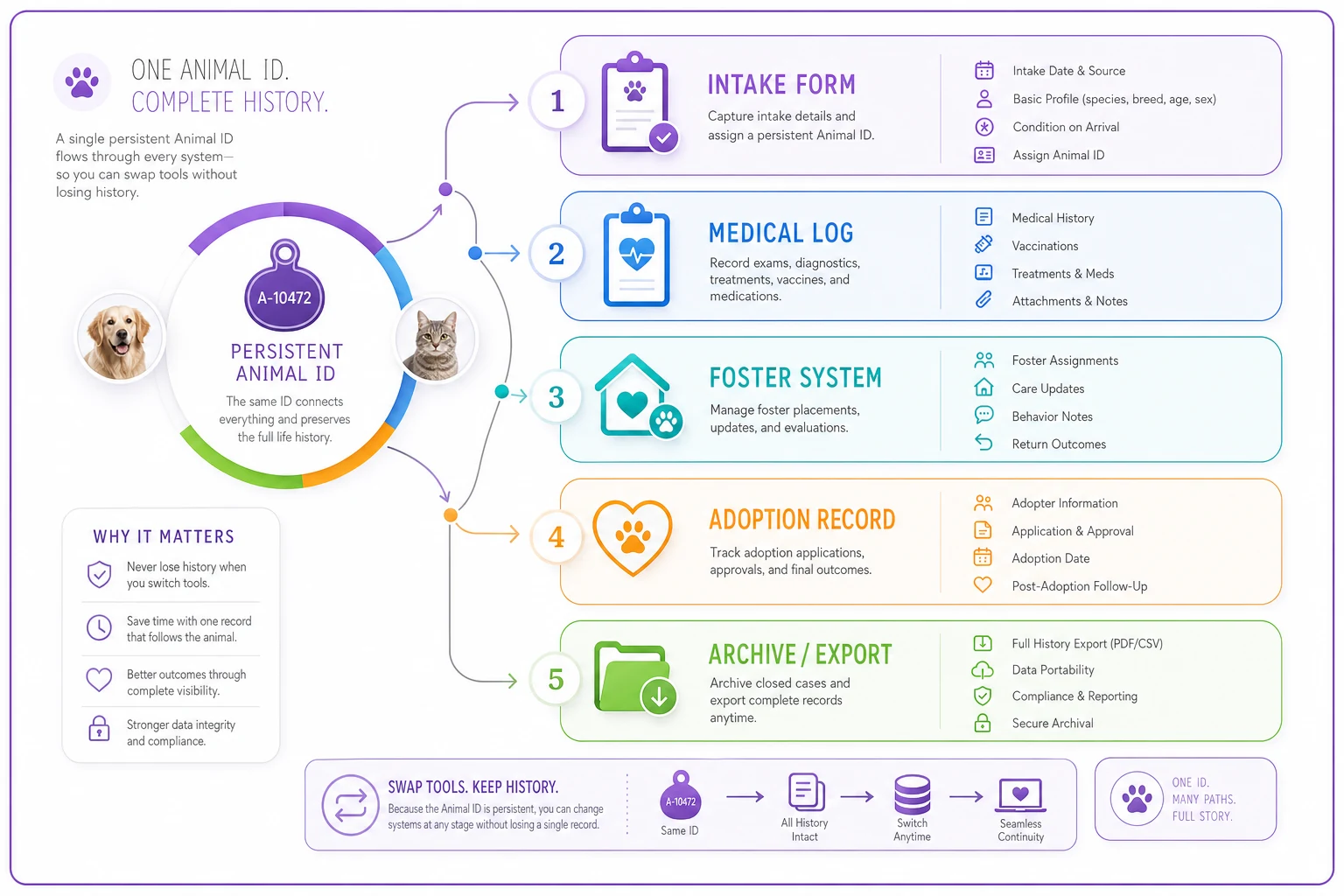
Every tool in that chain can be swapped out individually as long as it carries the same ID forward. That's the whole architecture. It doesn't require expensive software or technical integrations — it requires a policy that says every system must use the same identifier, enforced consistently from day one.
The mindset shift that makes all of this stick
The shelters that get technology governance right aren't more technical than the ones that don't. They've made one mental shift: they treat their tools as replaceable and their data as permanent.
Once you believe that, the rest follows naturally. Of course you'd require clean exports — the data outlives the tool. Of course you'd assign owners — someone has to protect what's permanent. Of course you'd back up before changes and read the exit clause before signing.
Start small — write down your source of truth for each data type, set a weekly export, name your data owners, and run the export checklist before your next tool decision. That's a real governance foundation, and it takes an afternoon. Far less time than you'll lose the day a tool fails and nobody planned for it.
Ready to enhance your shelter’s impact?
Join 500+ shelters using Animlly to improve care coordination, increase adoptions, and engage communities effectively.