
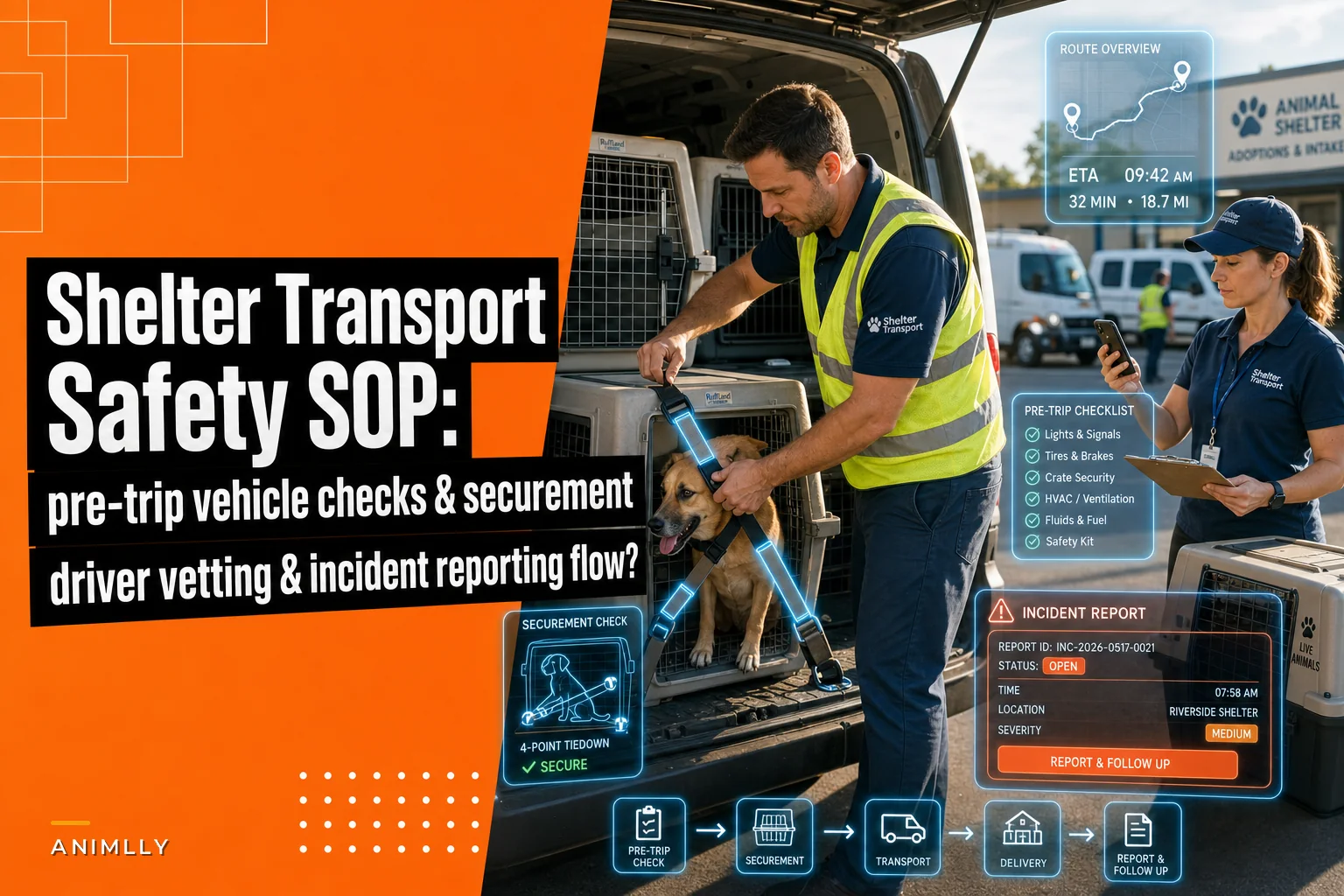

Most shelter transport incidents don't happen on the highway. They happen because something got skipped in the parking lot before anyone backed out. A crate that wasn't strapped down. A volunteer who'd never actually driven a cargo van full of dogs before. A ferret whose carrier latch was one bump away from popping open.
Transport is one of those shelter operations where everything looks fine right up until it isn't. And when it isn't, you're dealing with an escaped animal on I-95, a bite report, or a volunteer who quietly never signs up again. A real shelter transport safety SOP isn't a binder that sits in a drawer — it's the specific, repeatable set of checks that happens every single time, whether it's a 15-minute clinic run or a 6-hour interstate relay.
This post stays narrow on purpose. Three things: the pre-trip vehicle checklist that actually catches problems, how to secure animals by size and behavior, and the driver vetting plus incident reporting flow that protects both your animals and the people volunteering their weekends.
Where transport SOPs quietly fall apart
The failure pattern is almost always the same, and it's not dramatic. Shelters running 30–40 transports a month tend to build tight informal systems that work great until a new coordinator takes over or a regular driver goes on vacation. The knowledge lived in one person's head, and now nobody knows that the older Transit van's rear latch needs a double-check, or that a particular foster's shepherd mix redirects when startled.
-
The "it's just a quick run" exception. Short trips get treated as low-risk, so the pre-trip check gets skipped. A 12-minute run to a partner clinic is exactly when a crate gets tossed in unsecured because "we're barely going anywhere."
-
New volunteers copying whatever the last person did. Without a written securement standard, a driver watches someone bungee a crate once and assumes that's the method.
-
Behavior notes that never make it to the driver. Intake staff know the dog is a flight risk. The transport volunteer finds out when the leash goes slack.
None of these are people failing. They're process gaps. The animals getting transported are, by definition, often stressed, unfamiliar with the handler, and in an unpredictable environment — which is the worst possible time to be improvising.
The pre-trip vehicle checklist that catches real problems
Generic vehicle checklists tell you to check the oil. That's not what causes transport incidents. Here's the version built specifically around moving animals — done properly it should take about 10–15 minutes.
Streamline your shelter operations effortlessly.
Animlly helps you manage every pet, volunteer, and adoption step with ease and accuracy.
- Comprehensive pet profiles
- Volunteer scheduling & communication
- Adoption tracking & reporting
No credit card required
1. Climate and airflow first. Before anything else, run the vehicle and confirm the AC or heat actually reaches the cargo area, not just the driver's face. In older vans, rear airflow is often terrible. On a summer transport, the back of a cargo van can run 15–20°F hotter than the cab. If you can't verify rear temps, you don't load animals into that space.
2. Securement points. Physically pull on every anchor point, D-ring, and seat-belt loop you plan to use. Anchor hardware fails in exactly the way you don't expect — it looks fine and then shears under load. Tug hard on each one.
3. Crate and carrier inventory. Count them, check every latch and door, and confirm sizes match the manifest. A crate with a bent door that "mostly closes" is a future escape.
4. Load-area condition. No loose objects that can slide into crates. Non-slip surface or mats down. Confirm nothing blocks the rear doors from opening if you need to get an animal out fast.
5. Emergency kit check. Slip leads, a spare carrier, water, a towel or two for covering carriers, basic first aid, and a phone charger. The spare carrier matters more than people think — if a crate fails mid-trip, you need somewhere to put that animal that isn't your lap.
6. Fuel and route. Full tank before loading, not after. Confirm the driver has the route including any planned handoff points, because pulling over on a shoulder to check a phone with a stressed dog in the back is how things go wrong.
Have the driver sign the completed pre-trip checklist to confirm they performed the checks themselves.
The part most shelters miss: the checklist only works if it's completed by the person driving, not by a coordinator who then hands off the keys. The driver needs to have personally tugged those anchor points, because they're the one dealing with a failure at 60 mph.
Securement by size and behavior — not one method for everything
This is where most SOPs are dangerously vague. "Secure all animals" means nothing. A 4-pound kitten and an 80-pound reactive dog do not get secured the same way, and treating them the same creates risk on both ends.
The two variables that actually matter are size and behavior, and behavior usually outranks size. A calm 90-pound senior lab is easier to transport safely than a panicking 25-pound terrier mix.
Here's the working framework:
| Animal profile | Primary method | Key risk | Notes |
|---|---|---|---|
| Small animals (cats, kittens, small mammals, birds) | Hard-sided carrier, anchored so it can't slide | Carrier tipping or latch failure | Cover with a towel to reduce stress; never stack carriers unsecured |
| Small-medium calm dogs | Secured crate or crash-tested harness on a bench seat | Sliding during braking | Crate is preferred over harness for unknown-history dogs |
| Large calm dogs | Crate sized to stand and turn, anchored at 2+ points | Crate shifting, weight load on anchors | Confirm crate rated for the dog's weight |
| Reactive / flight-risk dogs | Fully enclosed crate, double-latched, slip lead attached before opening any door | Escape during load/unload | Two handlers for load and unload, always |
| Underweight / medical animals | Padded crate, minimal jostling, closest to climate control | Temperature and stress | Flag for shortest possible transport time |
The behavior piece deserves its own rule: the load and unload are the highest-risk moments, not the drive. An animal that's been calm for two hours can bolt the second a door opens in an unfamiliar parking lot. For any animal flagged as a flight risk, the standard is a slip lead attached before the crate door opens and a second person positioned to block. This one rule prevents the majority of transport escapes.
Shelters that pull behavior notes from intake directly onto the transport manifest have dramatically fewer surprises than those relying on verbal handoffs. If the driver reads "startles and redirects, use two handlers" on the manifest, they prepare for it. If they hear it shouted across the lot while loading, they usually don't.
Driver vetting: the part that gets skipped because you're desperate for help
Shelters are chronically short on transport volunteers, so the vetting process gets compressed to "do you have a car and a pulse." That's how you end up with a well-meaning volunteer who's never driven anything larger than a sedan behind the wheel of a loaded cargo van.
-
Valid license and current insurance, verified, not just claimed. Ask for a copy for your files.
-
Driving record check for transport roles, especially anyone driving your vehicles or handling long routes.
-
Vehicle appropriateness if they're using their own car — a two-door coupe is not a transport vehicle.
-
A short ride-along or supervised first transport. This is the single most valuable step and the most often skipped. You learn more from watching someone load and drive once than from any intake form.
-
Comfort level, honestly assessed. Some volunteers are great with animals and nervous drivers, or vice versa. Match the person to the route difficulty.
Your best long-term transport volunteers are usually the ones who took the vetting seriously and felt supported on their first run. Rushing someone through onboarding and then having a bad incident is how you lose them permanently. A slightly slower start produces drivers who stick around for years. It's the same logic that makes structured partner outreach with clinics work — the upfront investment in clear expectations pays back in reliability.
Incident reporting: turning a bad moment into a fixable problem
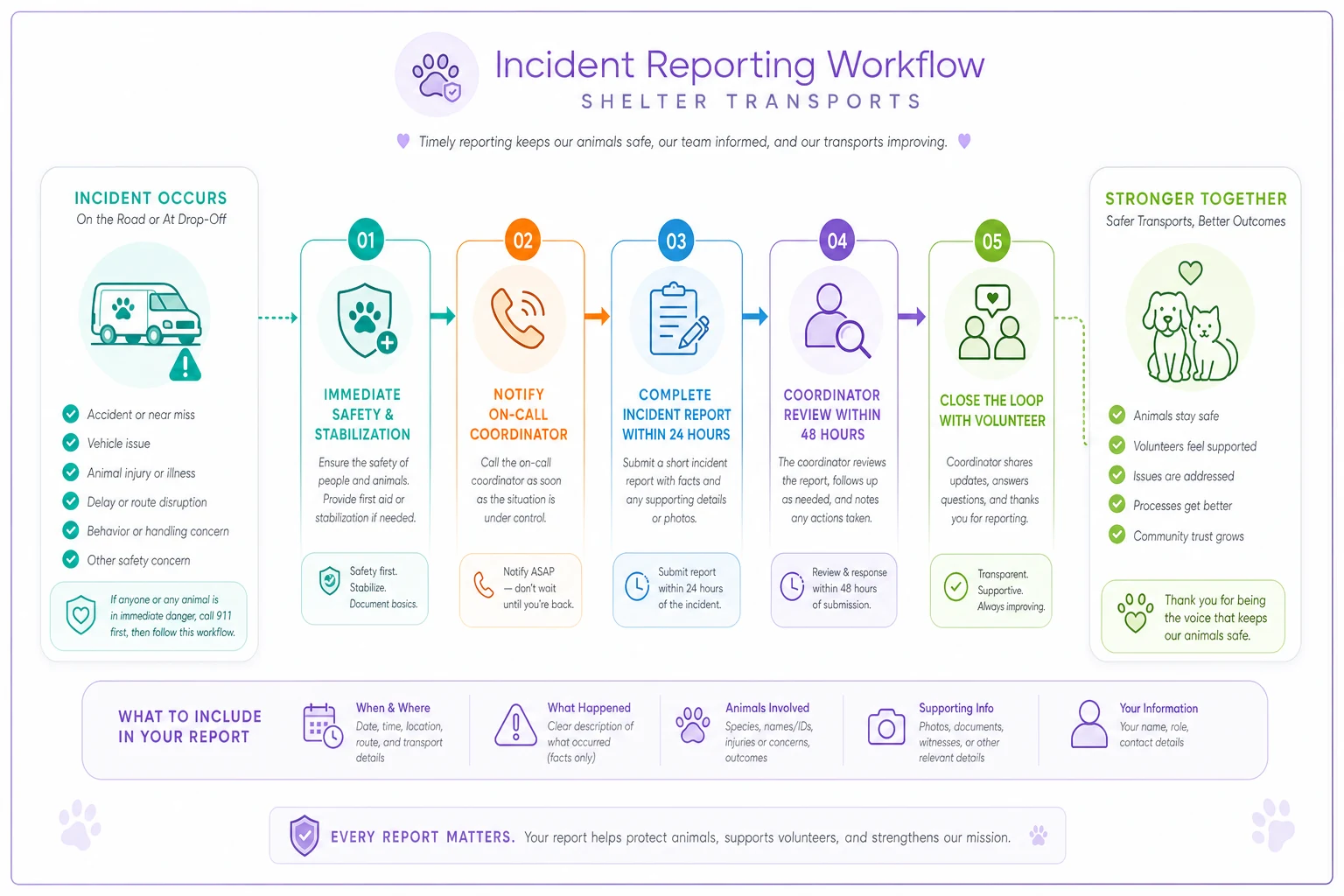
Incidents will happen. A minor bite during unload, a crate latch that failed, a fender bender, an animal that got loose and was recovered. The goal isn't zero incidents — that's not realistic — it's making sure every incident gets reported honestly and fast, and that you actually learn from it.
-
Immediate safety and stabilization. Secure the animal, address any injury to person or animal, call for veterinary help if needed. Safety before paperwork, always.
-
Notify the on-call coordinator by phone, not text buried in a group chat. For any injury, escape, or vehicle accident, this happens the same day — ideally within the hour.
-
Complete a short incident report within 24 hours. Keep it short — what happened, when, who was involved, what animal, current status, and what the driver thinks contributed. If it takes 20 minutes to fill out, people won't do it.
-
Coordinator review within 48 hours to decide whether it's a one-off or a pattern. Was it this specific van? This route? A behavior note that didn't get passed along?
-
Close the loop with the volunteer. Tell them what changed because of their report. This is what makes people report the next one.
Here's a simple visual of the reporting flow to keep people on the same page.
The near-miss rule matters most: encourage reporting of the things that almost happened. A crate that shifted but didn't fail. A latch that felt loose. Those reports are early warnings, and shelters that treat them as valuable — not complaints — catch equipment problems before they become injuries.
When a lighter process actually makes sense
Not every shelter needs the full version of all of this. If you're running 3–5 transports a month, all short local runs with a handful of regular volunteers you know well, a heavy multi-page vetting process is overkill and will just annoy the people helping you.
-
Low-volume, short-run, stable volunteers Keep the pre-trip check and securement standards firm, but keep vetting lightweight — license, insurance, one supervised run.
-
Medium volume with rotating volunteers This is where written standards matter most, because knowledge can't live in one head anymore.
-
High volume or long-distance relays Full vetting, mandatory manifests with behavior flags, and a formal incident flow are non-negotiable. The risk exposure is real.
Where it genuinely doesn't make sense to cut corners, regardless of size: securement by behavior, and the two-handler rule for flight-risk animals during load and unload. Those prevent the incidents that actually hurt animals and end volunteer relationships.
A real scenario
A mid-sized shelter running roughly 30 transports a month — mostly clinic runs and partner transfers — had two escapes and one bite incident over a quarter. Nothing catastrophic, but enough that a couple of volunteers stopped signing up.
When they dug in, the pattern was clear: no consistent securement standard and behavior notes that lived on intake cards the drivers never saw. The fixes were unglamorous. They built a one-page pre-trip check the driver signs, added a securement-by-behavior standard, and started printing behavior flags directly onto the transport manifest so drivers knew before loading.
Over the following months, escapes dropped to zero and near-miss reports actually went up — which was the point. Volunteers started flagging loose latches and shifting crates instead of staying quiet. Two vans got minor hardware fixes because of those reports. The bite incidents stopped once the two-handler unload rule became standard for flagged dogs. Volunteer retention on the transport team noticeably improved, mostly because people felt like the process had their back.
Keeping the SOP alive instead of letting it rot in a drawer
The hardest part isn't writing this SOP. It's keeping it in use after the enthusiasm fades. Shelters that succeed treat transport safety like any other tracked operation — behavior flags flow from intake to the transport manifest, driver vetting status is logged so nobody accidentally sends out an un-vetted volunteer, and incident reports get reviewed on a schedule rather than whenever someone remembers.
Whether you manage that in a spreadsheet, a shared form, or operational software that connects intake behavior notes to transport manifests automatically, the principle is the same: the information the driver needs has to reach them before they load, not after something goes wrong. When your systems carry that information instead of relying on someone to remember to mention it, the whole operation gets safer without anyone working harder. The same backbone applies to your broader movement operations — the transport safety and readiness checklists used for off-site adoption events run on this exact logic.
Transport safety comes down to a boring truth: the checks happen every time, the securement matches the animal in front of you, and the people driving feel safe telling you when something almost went wrong. Get those three right and most transport incidents simply stop happening.
Ready to enhance your shelter’s impact?
Join 500+ shelters using Animlly to improve care coordination, increase adoptions, and engage communities effectively.