

Most shelters have a plan for the animal after a critical incident. Almost none have a plan for the people.
A cruelty seizure with 40 animals pulled from a hoarding case. A euthanasia that goes sideways emotionally because the dog was young and healthy but out of options. A volunteer bitten badly enough to need stitches. A parvo outbreak that wipes out a kennel row in a week. These aren't rare events in shelter work — they're Tuesday. And the standard response, where someone says "take a breather if you need it" and everyone goes back to cleaning kennels, is exactly how good staff quietly burn out and leave.
The gap isn't that managers don't care. It's that there's no process. Nobody wants to improvise emotional support in the middle of a crisis, so they don't do it at all. This post gives you the actual paperwork: a one-page debrief form, a peer-support checklist, two-week follow-up templates, and a referral list built for the reality that many shelter staff can't afford or won't use traditional EAP counseling.
Why the "informal check-in" approach quietly fails
There's a specific pattern that shows up in shelters that lose people. It's not the incident itself. It's the 72 hours after.
Right after something bad happens, adrenaline carries everyone. People are functional, even sharp. The manager sees this and assumes the team is fine. Then two or three days later, the crash hits — someone snaps at a coworker, calls in sick, or goes unusually quiet. By then nobody connects it to the incident, because the incident "already got handled."
Informal check-ins fail because they depend on the most stressed person in the building to raise their hand and admit they're struggling. That almost never happens in shelter culture, which tends to reward toughness. "It's part of the job" is the phrase that kills more good employees than any single bad day.
A structured debrief flips the responsibility. Instead of waiting for someone to ask for help, you build a short, mandatory, low-drama process that treats everyone the same. Nobody has to out themselves as the one who couldn't handle it.
The one-page incident debrief form
Keep it to one page. This matters more than it sounds. A three-page form after a rough shift feels like punishment and gets skipped. A single page that takes eight to ten minutes to fill out actually gets used.
Streamline your shelter operations effortlessly.
Animlly helps you manage every pet, volunteer, and adoption step with ease and accuracy.
- Comprehensive pet profiles
- Volunteer scheduling & communication
- Adoption tracking & reporting
No credit card required
This form is not a therapy session and not an incident report. Your standard incident documentation — dates, animals involved, actions taken — lives elsewhere, probably inside your operational SOPs. This form is purely about the humans who were there.
Here's what goes on it:
Header (30 seconds)
-
Date, time, location
-
Type of incident (dropdown
euthanasia, injury, aggression event, mass intake, animal death, cruelty case, client/public confrontation, other)
-
Staff and volunteers present
-
Debrief facilitated by
Facts, briefly (2 minutes)
-
What happened, in 2–3 sentences. Just enough context. No blame language.
Individual check-in (per person, 3–4 minutes)
-
On a 1–5 scale, how are you doing right now?
-
Is there anything about how this was handled you'd change?
-
Do you want a follow-up check-in in two weeks? (yes / no / unsure)
Immediate needs (1 minute)
-
Anyone need to go home early or swap a shift?
-
Anyone want the peer-support contact info?
-
Anything the team needs before next shift — supplies, coverage, a heads-up for the incoming crew?
Facilitator notes
-
Flags for follow-up
-
Referral offered? (yes/no)
That's it. The 1–5 self-rating is the single most useful field on the page. It gives you a number to track over time and gives quieter people a way to signal "I'm at a 2" without having to make a speech about it.
One thing worth flagging: the person facilitating should not also be the person whose decision is being second-guessed. If the shelter director made the euthanasia call, the director shouldn't run the debrief about it. That's a recipe for silence.
Visual workflow:
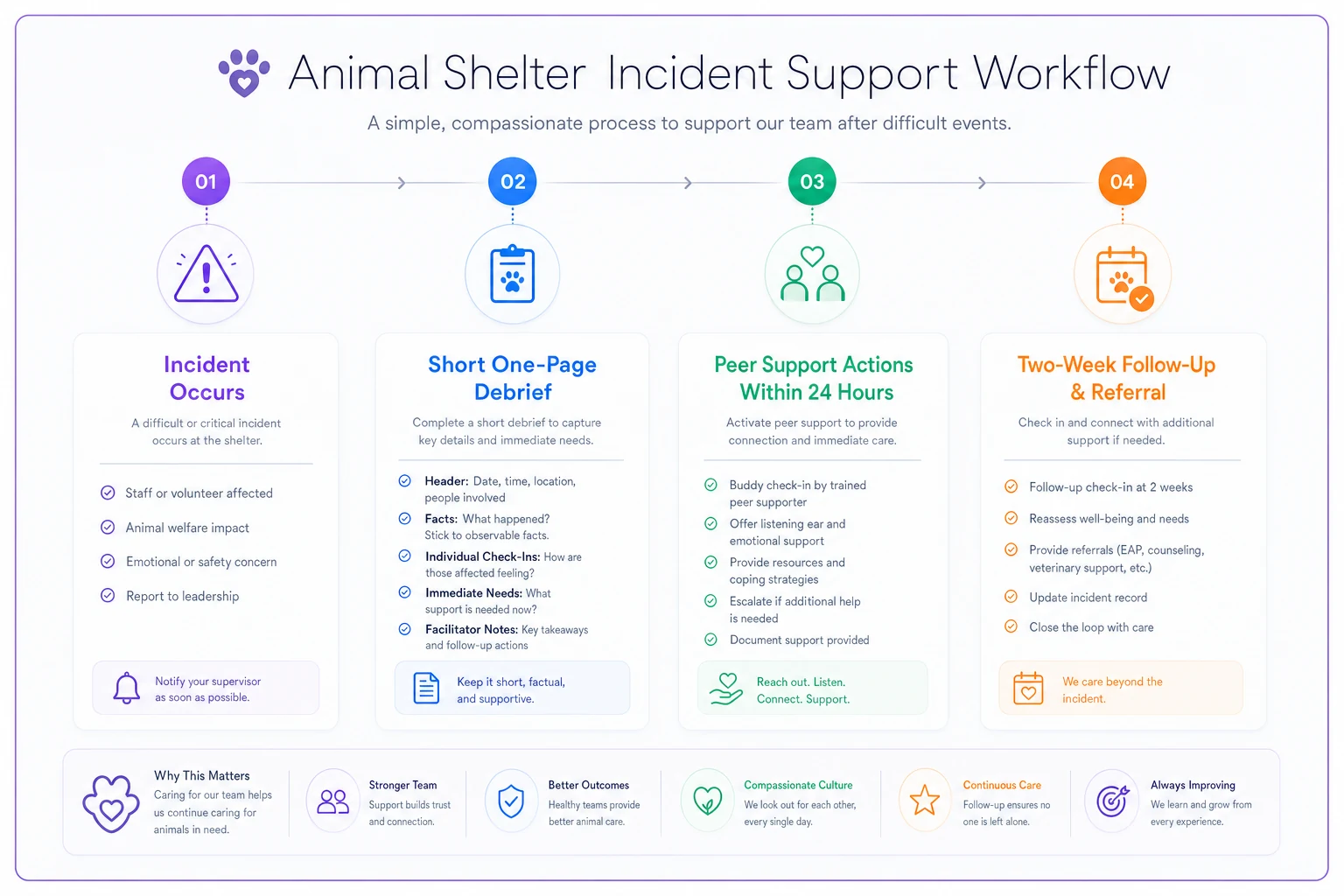
The graphic shows the flow from incident recognition to debrief, peer support, and two-week follow-up, making roles and timing obvious.
When to run a debrief (and when not to)
Not every hard day needs a formal sit-down. Over-triggering the process makes people roll their eyes, and then it's dead. Under-triggering it means the process only exists on paper.
Here's a rough guide for what actually warrants a debrief:
| Situation | Debrief? | Timing |
|---|---|---|
| Routine euthanasia (medical, expected) | Optional / group temperature check | End of shift |
| Euthanasia of healthy/young animal for space | Yes | Same day |
| Staff or volunteer injury requiring medical care | Yes | Same day |
| Serious bite or aggression event | Yes | Same day |
| Mass intake / cruelty seizure | Yes, and again after cleanup | Day of + 1 week |
| Disease outbreak with multiple deaths | Yes | Within 24 hrs |
| Public confrontation / threat to staff | Yes | Same day |
| A "normal" busy stressful day | No — use regular shift check-ins | — |
The line worth drawing: if a reasonable person would still be thinking about it on the drive home, it earns a debrief.
When this is a bad idea
Don't run a debrief in the first 30 minutes if the situation is still active or people are physically shaken. Stabilize first — get the injured volunteer cared for, get the kennels handled, let heart rates come down. A debrief while adrenaline is still running hot produces either flat numbness or misdirected anger. Give it a couple of hours, or push it to end of shift.
The peer-support checklist
Managers can't be the emotional backbone for everyone, and honestly, staff often won't be fully honest with a supervisor who controls their schedule and writes their reviews. Peer support fills that gap — but "we support each other" as a vibe doesn't hold up under real stress. It needs a checklist so the designated peer knows exactly what their job is, and what it isn't.
Pick one or two people per shift who volunteer for this role. Never assign it as a default or dump it on the newest hire. Give them this:
-
[ ] Check in with each person present within 24 hours — a real conversation, not a group text
-
[ ] Ask open questions, not yes/no ("what was that like for you?" beats "you okay?")
-
[ ] Listen more than you talk. Resist the urge to fix or minimize
-
[ ] Do NOT say "at least" ("at least it was quick," "at least you tried") — it shuts people down
-
[ ] Watch for the delayed reaction — the person who was fine day-of but is off by day three
-
[ ] Know the referral list and hand it over without making it a big deal
-
[ ] Flag anyone you're genuinely worried about to a manager — support is not the same as clinical care
-
[ ] Protect your own limits. You're a peer, not a counselor. Passing someone up the chain is doing the job right, not failing at it
Rotate peer supporters so no single person ends up carrying the role for too long.
The mistake most shelters make here is loading peer supporters with responsibility they aren't trained for. The checklist's real job is to draw a clear line: notice, listen, refer. That's the whole role. When peer supporters try to be therapists, they burn out too, and then you've lost two people instead of one.
Two-week follow-up templates
This is the part almost everyone skips, and it's the part that matters most. The debrief handles the immediate hit. The two-week follow-up catches the slow bleed.
The timing is deliberate. Acute stress fades in a few days, but delayed reactions and cumulative fatigue often surface one to two weeks later — especially after cases involving animals people had bonded with. A check-in at day 14 lands right when someone might be quietly deciding whether this job is still worth it.
-
"Hey, wanted to circle back on [the incident] from a couple weeks ago. How are you sitting with it now?"
-
"Same 1–5 as before — where are you today?"
-
"Anything still bugging you, or anything we could've done differently?"
-
"Still good, or want me to point you toward the support list?"
Then compare the two numbers. Someone who was a 3 during the debrief and is now a 2 or 1 needs attention today, not next month. Someone who was a 2 and is now a 4 is recovering and you can close the loop.
Log the follow-up somewhere it won't get lost. This is where things fall apart in busy shelters — the incident happens, the debrief gets done, everyone means to follow up, and 14 days later nobody remembers. If you're running operations on paper or scattered spreadsheets, follow-ups die in the shuffle. This is one of those small operational tasks where a shared system with reminders and simple templates — the same kind of setup covered in a modular shelter operations playbook — quietly prevents the thing you'd otherwise forget. The point isn't fancy software. It's that "I'll remember" is not a follow-up plan.
The referral list: EAP alternatives that shelter staff will actually use
Standard advice is "refer them to your EAP." For a lot of shelter workers, that's useless. Small nonprofits and municipal shelters often don't have a real EAP, or if they do, staff won't use it because they don't trust it's confidential from their employer. And a $150-per-session private therapist is a non-starter on a $16-an-hour kennel wage.
Your referral list needs real, accessible options — not just a phone number nobody calls.
-
Compassion-fatigue specific resources. There are hotlines and support communities built specifically for animal care workers who deal with euthanasia and cruelty cases. This matters — generic therapists sometimes don't get why a shelter worker is grieving a dog they knew for three days.
-
Sliding-scale and community mental health. Local clinics that charge based on income. Do the legwork once and list actual names, addresses, and cost ranges. A referral list that just says "look up a therapist" gets ignored.
-
Crisis lines. 988 and any local crisis text lines. On the list, always, no exceptions.
-
Peer and online communities. Moderated groups for animal welfare workers. Free, anonymous, available at 2am when the shift feelings hit.
-
Anything your org actually offers. A few paid mental health days, a stipend, flexible scheduling after a hard case. If it exists, name it specifically so people know it's real and not just HR language.
Keep this list printed, laminated, in the break room, and attached to every debrief form. The whole point is that when someone finally decides they need help, the next step is right in front of them and requires zero research.
A real scenario
A mid-sized municipal shelter — roughly 25 staff and a rotating crew of about 40 volunteers — was losing kennel staff at a rate that made no sense on paper. Pay was competitive for the area. Turnover was running somewhere around 45–50% a year in kennel roles, and exit conversations kept surfacing the same theme: "the emotional stuff just wears you down and nobody talks about it."
They didn't do anything dramatic. They put the one-page debrief form into use after any qualifying incident, assigned rotating peer-support volunteers per shift, and — the part that actually moved the needle — committed to logging and completing every two-week follow-up instead of letting them evaporate.
Over the following year, kennel turnover dropped into the high 20s. Not zero, and not because the work got any less hard. What changed was that people felt the shelter noticed. A couple of staff who'd have quietly quit used the referral list and stayed. The manager's read afterward was simple: "We weren't paying people to leave. We were letting them leave because we never checked on them after the worst days."
Who should not overthink this
If you run a two-person rescue out of a converted garage, you don't need a formal SOP with facilitator rotations. Just make the two-week check-in a habit and keep the referral list somewhere visible. The structure here scales up for teams big enough that a hard day can happen to someone the manager doesn't see for three shifts.
If your team is already stretched thin — mid-surge, short-staffed, everyone doing three jobs — don't launch a heavy new process on top of that. Build it during a calmer stretch so it's already in place when things get hard. It pairs naturally with the kind of planning in a seasonal ramp-up and cross-training checklist, where you're already thinking through staffing for peaks. Wellbeing planning and staffing planning are really the same conversation.
The one thing to take away
The debrief form, the peer checklist, the follow-ups — none of it is complicated. The reason shelters don't do it isn't difficulty. It's that emotional aftermath feels like something you can't systematize, so it gets left to chance.
It can be systematized, and it should be, precisely because the alternative is leaving your most compassionate people to quietly decide they can't keep doing this. You already document what happens to the animals. Spend ten minutes documenting what happens to the humans who cared for them. The staff you keep will be the ones who'd otherwise have been gone by spring.
It can be systematized, and it should be, precisely because the alternative is leaving your most compassionate people to quietly decide they can't keep doing this. You already document what happens to the animals. Spend ten minutes documenting what happens to the humans who cared for them. The staff you keep will be the ones who'd otherwise have been gone by spring.
Ready to enhance your shelter’s impact?
Join 500+ shelters using Animlly to improve care coordination, increase adoptions, and engage communities effectively.