

Most shelters already have the three things an operating model needs. There's a binder or shared drive full of SOPs. There's a dashboard or monthly spreadsheet with live release rate, length of stay, intake counts and returns. And there's an org chart, or at least a loose sense of who's in charge of what.
The problem is that these three almost never reference each other.
Try it. Pick any number on your dashboard, say average length of stay for adult dogs. Now ask three questions. When that number moves the wrong way, who is allowed to do something about it without asking permission? What exactly are they allowed to do? Which SOP changes when they do it? In most shelters the honest answers are "probably the operations manager," "depends," and "none of them, we'd just talk about it at the staff meeting."
A shelter outcomes operating model closes that gap. It isn't another layer of paperwork. It's the wiring between the paperwork you already have, so a change in a KPI changes what people do on the floor, and the people doing it know they're allowed to.
Below: how the pieces connect, where they usually come apart, what changes as your shelter grows, and a 12-month sequence for building it in stages.
Where it actually breaks: following one dog through the building
Abstract frameworks hide the real failure points, so follow a single animal instead.
A medium-sized adult dog comes in as a stray on a Tuesday afternoon. Intake staff scan for a chip, find nothing, take a photo, enter the basics, assign a kennel. Vaccines go in at intake per the SOP. So far, fine. Intake SOPs tend to be the best-written documents in any shelter, because intake is where things go wrong loudly.
The dog now sits in stray hold, and the hold ends Friday at close. This is the first quiet failure point. Nobody's job is "notice that the hold expired." The kennel card has a date on it, and the shelter software might show it in a list, but the next step needs a person and none is named. Usually the dog gets moved forward whenever someone with authority walks past the kennel and happens to think about it. Saturday, maybe. Maybe the following Wednesday.
Next is medical clearance. The vet or vet tech does a full exam and decides whether the dog needs treatment before going up for adoption. But the vet tech works three days a week. If the hold expired Friday and the tech isn't in until Tuesday, that's four days of waiting that show up nowhere as a problem. The dog is just "in the building."
Then behavior. Someone decides whether this dog goes to general adoption, needs a foster, needs a rescue partner, or needs a more experienced adopter. In a lot of shelters, three different people believe that call is theirs: the behavior lead, the operations manager, and whichever senior kennel staffer knows the dog best. When three people own a decision, it often gets made twice in contradictory ways, or not at all, because everyone assumes someone else handled it.
Then listing. Photos, a bio, an online profile. That's often a volunteer task, so it depends on volunteer schedules, and a fully cleared dog can stay invisible to the public for days.
Then adoption counseling, then the adoption, then whatever happens afterward.
Now count the waits in that walkthrough, the handoffs where the animal is ready for the next step but the next step hasn't started. I call these unowned waits. They're nearly always the biggest driver of length of stay, and they almost never appear in an SOP, because SOPs describe how to do a task, not how the task gets started. Your dashboard shows total time. It doesn't show that something like half of it was the dog waiting for someone to realize it was their turn.
Any serious attempt to align intake with adoption ends up being about these waits. Better SOPs for each task help a little. Owning the gaps between tasks is where most of the gain is.
Why SOPs, KPIs and decision rights drift apart
They get built by different people, at different times, for different reasons. Nobody plans the drift.
Streamline your shelter operations effortlessly.
Animlly helps you manage every pet, volunteer, and adoption step with ease and accuracy.
- Comprehensive pet profiles
- Volunteer scheduling & communication
- Adoption tracking & reporting
No credit card required
SOPs get written by the people doing the work, usually right after something went wrong. The cleaning protocol gets rewritten after an outbreak scare. The adoption counseling script changes after a messy return. So SOPs are practical and task-focused, but reactive. They describe the task in detail and say almost nothing about why it matters or what number it's supposed to move.
KPIs get chosen from the top, often for outside audiences. The board wants live release rate. The municipal contract requires intake and disposition counts. A funder asks for adoptions per month. All legitimate, but they're lagging outcomes that tell you what happened last month, and nobody on the kennel floor can do anything about "live release rate" on a Thursday morning.
Decision rights mostly come from tenure. In small shelters, whoever has been there longest makes the calls, whether or not that's anyone's official role. It works fine until that person goes on vacation or burns out or leaves, and suddenly nobody's sure who can approve a transfer to a rescue partner or pull a dog off the adoption floor.
One pattern deserves a name because it does a lot of quiet damage: the escalation default. When decision rights are unclear, people escalate, so every unclear call goes up to the manager. The manager becomes the bottleneck for dozens of small decisions a week, most of which a frontline person could handle if someone had told them they were allowed to. Then the manager has no time for the bigger calls, like capacity planning or partner relationships, that actually need them. It looks like a workload problem. It's a decision-rights problem.
The other common mistake is treating the RACI chart as if it settles decision rights. It doesn't.
RACI tells you who does the work. Decision rights tell you who can say yes.
A RACI map answers: who's Responsible for doing the task, who's Accountable for it being done right, who gets Consulted, who gets Informed. It's useful, and if you don't have one yet, the modular shelter operations playbook has editable templates built for small teams.
What a RACI doesn't do well is spell out authority boundaries. It can say the kennel lead is Accountable for daily enrichment. It won't say whether the kennel lead can move a dog showing kennel stress into a foster placement today, or has to wait for the behavior lead to sign off. That's exactly the kind of call that determines length of stay.
-
Frontline (any trained staff or designated volunteer lead) Can act immediately, inform after. Example: flag a dog for fast-track listing once medical and behavior are both marked clear.
-
Coordinator Can act within defined limits, inform the manager same day. Example: approve a foster placement for an animal with a green or yellow behavior status.
-
Manager Required for anything that commits money above a set amount, changes an animal's pathway to transfer or euthanasia review, or overrides another role's call.
-
Director or board Policy changes, new partner agreements, changes to the outcome targets themselves.
The tiers themselves aren't the important part. What matters is that every recurring decision in the intake-to-adoption flow is written onto one tier, plus a named backup. Most shelters skip the backup, and it's why decisions stall the minute one person takes a day off.
Also watch for making everyone "Consulted" on everything to keep people happy. A pathway decision for a dog with a bite history might honestly need input from behavior, medical and operations. But if the SOP says all three must be consulted before any pathway decision, routine dogs end up waiting on three calendars too. Keep the consultation requirement for hard cases and let routine ones move on a single signature.
The binding layer: how SOPs, KPIs and decision rights connect
This is the core of the model. Each stage of the animal's path gets five things tied together:
-
The outcome it ultimately serves (live release, LOS, return rate, welfare)
-
A leading indicator that frontline people can actually influence this week
-
A trigger, meaning a threshold that means "act now"
-
A decision owner, plus backup, who acts when the trigger fires
-
The SOP that governs what they do
If you've already worked out which outcomes matter for your shelter using something like our shelter outcome measurement framework, this is where those outcomes stop being report items and become operational. Here's what the map looks like for a typical shelter with both dogs and cats:
| Stage | Outcome it serves | Leading indicator | Trigger (example) | Decision owner (backup) | SOP that governs action |
|---|---|---|---|---|---|
| Intake & diversion | Intake volume, community retention | Owner-surrender appointments booked vs. walk-ins | Walk-ins over half of surrenders in a week | Intake coordinator (ops manager) | Surrender appointment & diversion SOP |
| Intake exam | Welfare, disease control | Hours from arrival to full exam | Any animal over 24 hrs without exam | Vet tech (shelter vet / ops manager) | Intake medical SOP |
| Stray hold | LOS, return-to-owner | Animals past hold date without next step | Any animal 1+ day past hold | Kennel lead (coordinator) | Hold expiry & pathway handoff SOP |
| Medical clearance | LOS, welfare | Animals awaiting clearance | Queue over ~8 animals or any wait over 3 days | Vet tech (shelter vet) | Medical clearance SOP |
| Behavior assessment | LOS, return rate | Days from hold end to behavior status | Over 2 days | Behavior lead (named senior staff) | Behavior assessment SOP |
| Pathway assignment | Live release, LOS | Animals with no assigned pathway | Any cleared animal without pathway at 24 hrs | Coordinator (ops manager) | Pathway decision SOP |
| Listing | LOS | Hours from "available" to live profile | Over 48 hrs | Marketing volunteer lead (front desk lead) | Listing & photo SOP |
| Adoption counseling | Return rate, adopter experience | Applications pending over a day | Backlog over ~5 or any over 48 hrs | Adoption coordinator (front desk lead) | Adoption counseling SOP |
| Post-adoption | Return rate | Follow-ups completed on schedule | Below 80% completion in a week | Adoption coordinator (volunteer lead) | Follow-up SOP |
What goes into the SOP
The practical change is small. Every SOP linked to the map gets a short header block at the top, before any of the step-by-step content:
-
Stage which part of the animal's path this covers
-
Moves the leading indicator this SOP affects
-
Starts when the event or trigger that kicks it off (this is the line that kills unowned waits)
-
Owner / backup by role, not by name
-
Can decide without escalation the specific calls this role is allowed to make
-
Escalate when the conditions that push it up a tier
"Starts when" matters more than anything else in the header. Most SOPs open with "Step 1: Gather supplies" and never say what tells you it's time to begin. One sentence like "Starts when an animal's stray hold date passes" turns a reference document into part of a workflow.
Triggers need default actions, or they turn into meetings
A trigger that fires and only says "investigate" will mostly get ignored after a few weeks. It works much better to attach a default action that happens unless the owner decides otherwise.
For example: "If the medical clearance queue goes over 8 animals, the vet tech's next scheduled shift is blocked for clearances only, and routine non-urgent rechecks get pushed one day." The owner can override it if there's a reason. But the default happens without a conversation, so things keep moving even on a chaotic day.
Shelters tend to resist this at first because it feels rigid. It ends up being the opposite. Default actions take the small decisions off people's plates so they have energy left for the hard ones.
One more design note: give every trigger a review date. Some will turn out noisy, firing constantly for reasons that don't matter. Others will never fire because the threshold was set too loose. Plan on tuning maybe a third of them in the first few months.
Here's a simple workflow diagram showing triggers, decision owners and default actions.
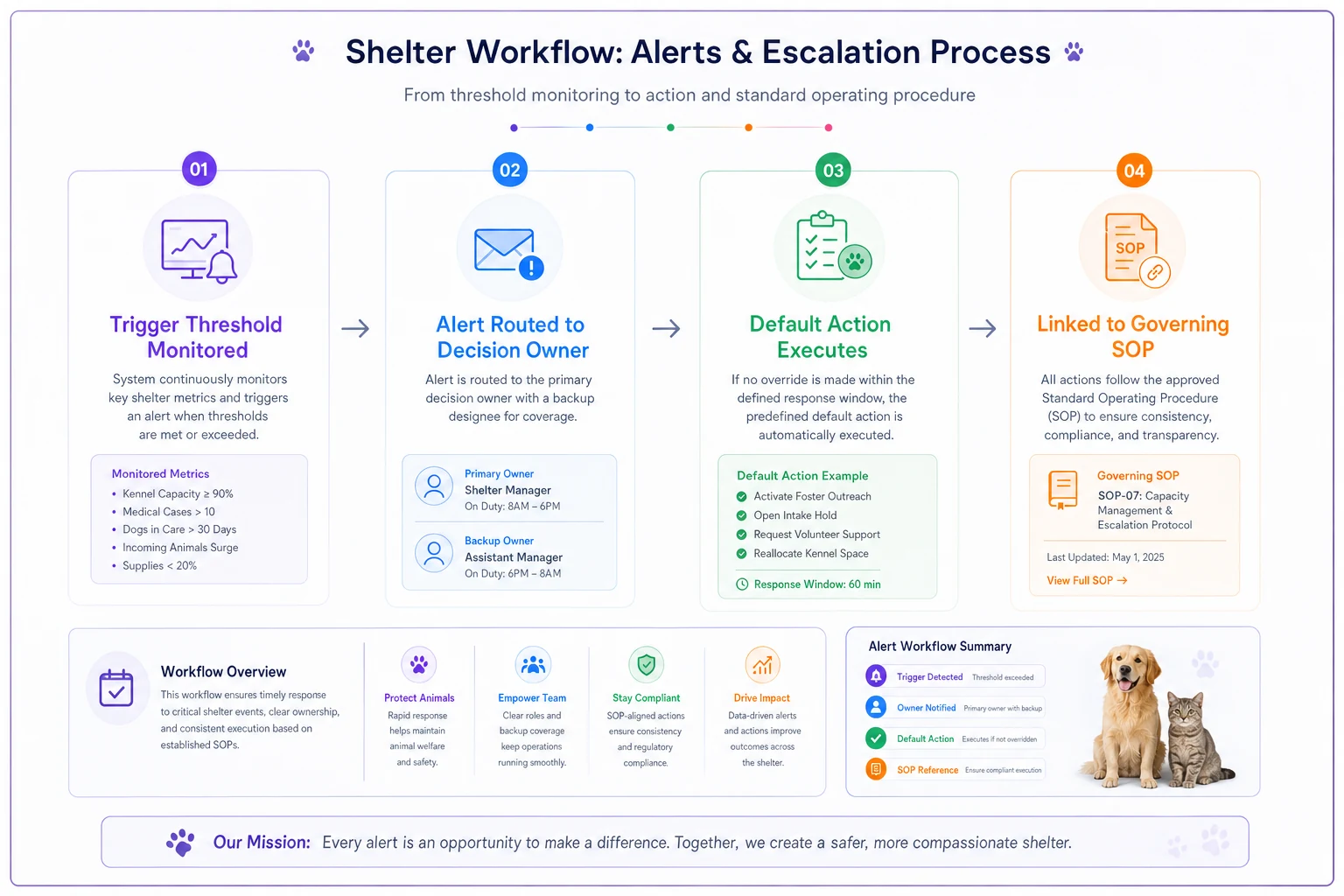
A trigger that fires should suggest the default next step and show who is expected to act, so the system keeps moving without meetings.
What changes as the shelter grows
The principles hold at every size, but what breaks first changes.
Small volunteer-run shelters (often under 30 animals in care at a time). The risk here isn't complexity. It's that one or two people hold every decision right in their heads. The table above can probably shrink to four or five rows, and the decision owner column may have the same two names in it over and over. That's fine. The real value at this size is the backup column, since one person's flu can freeze the whole flow. Triggers can mostly be checked by eye at a daily huddle, no automation needed.
Mid-sized shelters with paid staff (roughly 60–150 animals in care, maybe a municipal contract). This is where the model pays off most, and where things fail most often without it. There are enough people that informal coordination stops working, but not enough management layers to absorb the escalations. Unowned waits multiply because there are more handoffs, and shift patterns mean the person who knows a dog best often isn't on when a decision about that dog is needed. Written decision rights and stage triggers stop being nice-to-have.
Larger or multi-site operations, or shelters with big foster networks. A new failure point shows up: animals outside the building. Foster animals often fall entirely outside the stage map. They're "in foster," and nobody tracks whether they've been listed, whether the foster has adoption inquiries, or whether the foster is quietly burning out. At this size you need a separate set of rows for foster-held animals, with their own triggers (days in foster without an adoption inquiry, days since last foster check-in) and a clear owner. Multi-site shelters also have to decide whether decision rights are per site or shared, and that should be written down before the first disagreement, not after.
The jump from small to mid-size is where things tend to break hardest. Habits that worked when everyone could talk across one room don't survive a second shift, and most shelters only realize it after LOS has crept up for six months with no obvious cause.
The 12-month implementation sequence
Trying to build the whole thing at once is the most reliable way to make sure it never gets used. Staff get handed a 40-page binder, nod, and keep doing what they did before. A staged rollout works better because each phase produces something visible before the next one starts.
Time your pilot so trial months avoid peak intake season to get clearer results from the stress test.
-
Month 1 — Pick and freeze your outcome KPIs. Choose three, maybe four, outcomes the whole model points at. A common set is live release rate, average LOS (by species), 30-day return rate, and one welfare measure. Freeze them for the year. Changing outcome targets mid-build is the fastest way to confuse everyone.
-
Month 2 — Map the stages and find the unowned waits. Walk five to ten recent animals through your records, the way we did with the dog earlier. Note every gap between "ready for next step" and "next step started." Most shelters find three or four gaps that account for the bulk of the delay.
-
Month 3 — Run a decision-rights inventory. List every recurring decision in the intake-to-adoption flow. For each, write down who actually makes it in practice (not on paper), then assign a tier and a backup. Expect some arguments. That's useful, since it surfaces disagreements that have been slowing things down for years.
-
Months 4–5 — Rewrite SOP headers for your highest-impact stages. Don't rewrite whole SOPs. Add the header block (stage, moves, starts when, owner/backup, can decide, escalate when) to the five or six SOPs sitting on the worst unowned waits. Leave the step-by-step parts alone unless they're genuinely wrong.
-
Month 6 — Pilot triggers on two stages only. Pick the two with the biggest waits, usually hold expiry and pathway assignment. Set thresholds, owners and default actions, and run them for a full month. Track how often each trigger fires and whether the default action actually happened.
-
Month 7 — First tuning review. Kill or adjust noisy triggers. Ask frontline staff which decisions still feel unclear. This is usually when a couple of decision rights get moved down a tier, because it becomes obvious the coordinator was escalating calls they could have just made.
-
Months 8–9 — Extend to the remaining stages and cross-train backups. Roll triggers out to the other rows. Make sure every named backup has done the task at least twice under supervision. A backup on paper who has never made the call is not a backup.
-
Month 10 — Stress test under load. This should line up with your busier season. Watch which triggers fire constantly and which owners get overwhelmed. Surge periods show whether your decision tiers hold up or collapse back into everything going to the manager.
-
Month 11 — Connect it to governance. Bring the stage map and a summary of trigger activity to the board or leadership team. They don't need the operational detail. They need to see which outcomes moved, which stages are still weak, and which resource decisions (more vet tech hours, a foster coordinator) the data now supports.
-
Month 12 — Retrospective and version 2. Review the whole map. Retire SOPs nobody used, merge overlapping ones, reset thresholds, and decide whether to change outcome KPIs for year two.
After year one, the model needs a maintenance rhythm, not another build. The cross-functional annual operating rhythm we've written about covers how to keep quarterly reviews, SOP change cycles and board reporting on a schedule, so the model doesn't slowly slide back into three disconnected binders.
A real scenario: a county-contract shelter with a hidden pre-adoption backlog
Business type: A shelter running a county animal services contract, roughly 2,000–2,200 intakes a year, about 11 paid staff and around 60 active volunteers. Dogs and cats, with a small foster program.
The problem: Their adoption numbers looked healthy. Once a dog was listed as available, it typically got adopted within two to three weeks, and they were proud of that. But their dog population kept sitting in the high 60s to low 70s, and they were doubling up kennels most weeks in summer. Leadership assumed they needed more adoption events.
When they traced animals stage by stage, the adoption side turned out to be fine. The trouble was before it. Dogs were taking somewhere between 9 and 14 days from intake to "available," even though the stray hold was only 3 days. The gap was almost entirely unowned waits: hold expiry nobody acted on, a medical clearance queue that only moved on vet tech days, and a pathway decision three different people thought belonged to them.
What they changed: They added the header block to five SOPs, assigned pathway decisions to the coordinator with the ops manager as backup (the behavior lead stayed consulted only for dogs with a flagged behavior history), and set two triggers. One fired when any dog was a day past hold with no next step. The other fired when the clearance queue went over eight, and its default action blocked part of the vet tech's next shift for clearances.
What happened: Over about five months, intake-to-available for dogs dropped to around 5–6 days. Average dog population drifted into the low 60s, and kennel doubling went from most summer weeks to occasional. They didn't add any adoption events. They also tried a third trigger on behavior assessment timing, which fired so often it was being ignored within three weeks. They scrapped it and folded behavior timing into the pathway trigger.
The part leadership cared about most wasn't the LOS number. The ops manager stopped getting pulled into 15–20 small pathway questions a week, and finally had time to renegotiate the transfer partner agreements that had been sitting untouched for a year.
When this makes sense
This model earns its effort when your problems are coordination problems, not capacity problems. Signs you're in that position:
-
Your LOS is creeping up but you can't point to one cause
-
Your manager is the default answer to most questions
-
Animals regularly sit "ready" for something with nobody acting
-
Two people sometimes make conflicting decisions about the same animal
-
Things fall apart when one particular person is away
It also makes sense right before growth: a new municipal contract, a second site, a bigger foster program. Building the wiring at 80 animals is much easier than retrofitting it at 150.
When this is a bad idea
If your shelter is in genuine crisis, like an active disease outbreak, a staffing collapse, or a sudden intake surge, don't start a 12-month redesign. Stabilize first. A model built in the middle of chaos produces SOPs written for an abnormal situation, and those end up wrong for normal operations.
It's also a bad idea if leadership isn't willing to actually hand over decision rights. If the director still wants to approve every transfer and every foster placement, writing tiers on paper just creates a document everyone knows is fiction. That's worse than no document, because it teaches staff that written processes don't mean anything.
Who should NOT do this (yet)
Very small rescues, think a handful of fosters and a couple of coordinators with no physical facility, generally don't need the full model. A shared list of who decides what and a weekly check-in will cover most of it. The full stage map would just feel like overhead.
Shelters without basic data capture shouldn't start here either. If intake dates, hold dates and status changes aren't recorded reliably, your triggers have nothing to fire on. Fix that first, then come back.
And if you're midway through a software migration, wait until it settles. Building triggers around a system you're about to replace means doing the work twice.
Where software fits, and where it doesn't
You can run the first version of this on paper and a spreadsheet, and plenty of shelters should, because it forces you to understand the model before automating any of it.
Spreadsheets start failing at the trigger layer. Somebody has to check every stage every day, notice a threshold has been crossed, figure out who the owner is today (or the backup, if the owner's off), and confirm the default action happened. That's a lot of watching, and in a busy week it's the first job to get dropped.
This is where AI-assisted operational software earns its place. A good platform can watch stage timestamps, notice when an animal crosses a threshold, route the alert to whichever decision owner is on shift, and link straight to the current version of the right SOP. Some can also flag patterns people miss, like one stage that consistently slows down on certain weekdays, or a trigger firing so often it's become noise. That kind of AI automation cuts out manual monitoring without changing who makes the decisions. The software handles the noticing, and people still do the deciding.
What software can't do is fix unclear decision rights. Automate alerts before you've settled who owns each call and you just get faster confusion. Get the map right first.
A quick readiness check before you start
Before kicking off month one, see where you actually stand:
-
Can you name your three or four outcome KPIs without looking them up?
-
Do your intake records reliably capture arrival date, hold expiry and status changes?
-
Could you list the five most common decisions in your intake-to-adoption flow right now?
-
For each of those decisions, is there one person everyone agrees owns it?
-
Does each of those owners have a backup who has actually made that call before?
-
Do any of your current SOPs say what event starts them?
-
When a KPI goes the wrong way, is there a defined next action, or just a conversation?
-
Is leadership prepared to let coordinators make calls without sign-off?
If most of those are "no," that's normal, and it's basically your month 1–3 work plan. If the last one is "no," have that conversation before anything else, because the rest of the model depends on it.
Closing thoughts
Most shelters aren't short on documentation or data. They're short on connections between them. An SOP that doesn't know which number it's meant to move, a KPI nobody is allowed to act on, a decision three people think is theirs: each looks minor alone. Stack them across nine stages and a few hundred animals, and that's where your length of stay comes from.
The model here isn't glamorous. Most of the work is adding a header block to SOPs, writing down who decides what, and setting a few thresholds that turn into actions. Spread over a year in small pieces, a team that's already stretched can absorb it. And the payoff mostly shows up in things that don't make the dashboard, like a manager who isn't drowning in small questions, or a weekend where nothing stalls because the person who usually decides was off.
Start with the unowned waits. Trace a few animals, find where they sat waiting for someone to notice, and give those gaps an owner. Everything else in the model builds from there.
Ready to enhance your shelter’s impact?
Join 500+ shelters using Animlly to improve care coordination, increase adoptions, and engage communities effectively.