

Most shelters don't fail because they lack good people or good intentions. They fail because the organization runs on reaction. Something breaks, everyone scrambles, a fix gets patched in, and three months later the same thing breaks again because nobody wrote down what actually happened or scheduled the follow-up.
What separates a shelter that steadily improves from one that just survives isn't a bigger budget. It's a shelter operational governance annual rhythm — a predictable cadence where the right people look at the right numbers at the right time, make decisions, and hand those decisions down to the frontline where they actually change behavior.
The problem is that "governance" in most small shelters means a board meeting every other month and a staff huddle whenever the manager remembers. Finance lives in one person's spreadsheet. Clinical audits happen when an inspector is coming. KPIs get pulled together the night before the board meeting. None of it connects. That disconnection is the real failure point, and it gets worse as the shelter grows — not better.
This article lays out how the whole system fits together: a one-page annual rhythm, the meeting templates that make each cycle runnable, role cards so people know what they own, KPI-to-decision tables so numbers trigger action instead of discussion, and a 90-day governance sprint for shelters starting from scratch.
Why the rhythm breaks down (and why scale makes it worse)
There's a pattern that shows up across small, volunteer-heavy shelters. Early on, the shelter is small enough that the manager holds everything in their head. Intake trends, which fosters are reliable, the vet bill situation, who's burning out — it's all informal, and informal works at ten animals and four volunteers.
Then the shelter grows. Intake doubles. Volunteer headcount triples. Two sites open. A grant comes with reporting requirements. Suddenly the manager's mental model can't hold it anymore, but no formal rhythm has replaced it. So the gaps start showing:
-
Finance only gets reviewed when cash is tight, which means it's reviewed too late.
-
Clinical issues surface as outbreaks instead of as trends caught in a monthly audit.
-
The board asks for numbers that take three days to assemble because nobody owns the dashboard.
-
Frontline SOPs drift because nobody closes the loop between "we decided X" and "the kennel team actually does X now."
In real operations, this usually happens when decision-making and execution live in separate orbits. Leadership talks about strategy in quarterly meetings. The frontline reacts to whatever's in front of them that shift. There's no connective tissue carrying decisions down or carrying signals up. A good annual rhythm is that connective tissue.
One thing worth sitting with: the shelters that struggle most aren't the disorganized ones. They're the ones that are busy. Busy shelters mistake activity for progress. They're always doing something, so it feels like things are handled. A rhythm forces the uncomfortable pause where you ask, "Is the thing we keep doing actually working?"
The one-page annual rhythm
The whole point of a one-page rhythm is that it fits on a wall and anyone can glance at it and know what's happening this month. If your governance plan needs a 20-page document, nobody will follow it.
Streamline your shelter operations effortlessly.
Animlly helps you manage every pet, volunteer, and adoption step with ease and accuracy.
- Comprehensive pet profiles
- Volunteer scheduling & communication
- Adoption tracking & reporting
No credit card required
| Cadence | Who's in the room | Primary focus | Output |
|---|---|---|---|
| Weekly (15 min) | Shift leads + manager | Frontline signals, incidents, animal flow | Flagged issues, SOP triggers |
| Monthly (60 min) | Ops manager, clinical lead, finance owner, volunteer coord | KPI review, finance snapshot, audit findings | Decisions + owners + due dates |
| Quarterly (half day) | Leadership + board liaison | Trends, capacity, budget, strategic adjustments | Reprioritized plan, budget shifts |
| Annual (full day) | Board + leadership | Mission alignment, budget, major goals | Next-year rhythm + targets |
The magic isn't any single meeting. It's that each layer feeds the next. Weekly signals roll up into the monthly KPI review. Monthly trends roll up into the quarterly strategic view. Quarterly learnings shape the annual plan. And decisions flow back down the same ladder. When one layer is missing — in most small shelters it's the weekly-to-monthly handoff — the whole thing becomes disconnected.
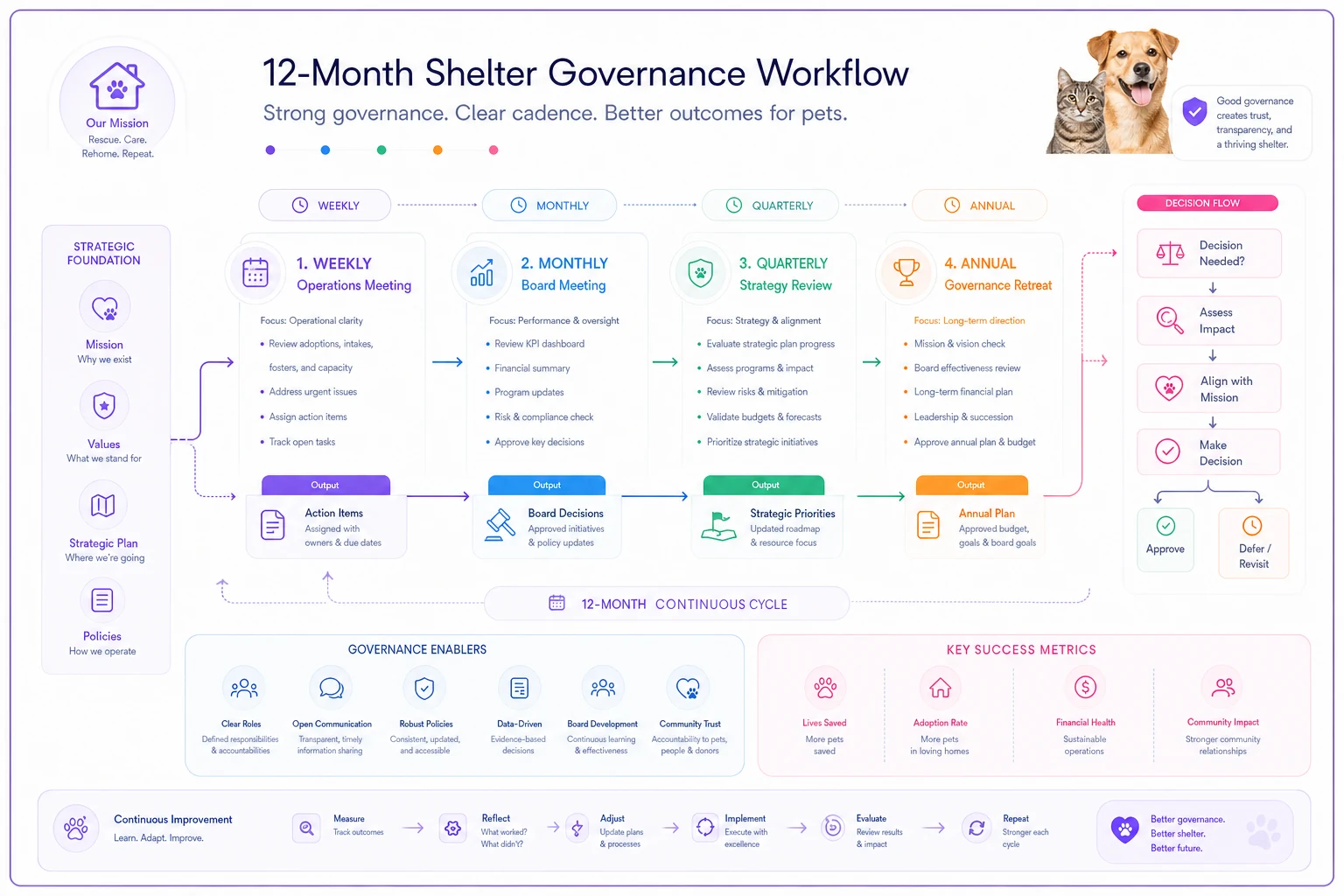
This visual shows how each layer feeds the next.
-
Jan — Annual kickoff, set targets, lock the year's rhythm
-
Feb–Mar — First quarter execution, monthly reviews
-
Apr — Q1 review + budget reforecast
-
May–Jun — Clinical and safety audit cycle (ahead of summer intake surge)
-
Jul — Mid-year review, capacity check
-
Aug–Sep — Peak-season operations, tighter weekly cadence
-
Oct — Q3 review + fundraising/grant planning
-
Nov — Data and compliance audit, year-end prep
-
Dec — Annual review, debrief, plan next year
The audit timing is deliberate. You run your clinical audit before summer intake, not after an outbreak. That's the difference between a rhythm and a calendar — a rhythm sequences things so prevention lands before the pressure.
Meeting templates that actually get used
The failure mode for meetings isn't that shelters don't have them. It's that the meetings are unstructured, run long, and produce talk instead of decisions. A template fixes this by forcing the same shape every time, so the muscle memory builds.
Monthly ops review (60 minutes, hard stop):
-
KPI scan (10 min) — Walk the dashboard. Red/yellow/green only. No storytelling yet.
-
Red/yellow deep dive (20 min) — Only the metrics outside their threshold get discussed. Green metrics get zero airtime.
-
Audit + incident findings (10 min) — What did last month's audits or incidents surface?
-
Decisions + owners (15 min) — Every issue gets an owner, an action, and a due date. Written down live.
-
SOP trigger check (5 min) — Does any decision require a frontline SOP change? If yes, who updates it and when does the kennel team hear about it?
Make a live note-taker and hard stop part of the template so decisions are recorded and owners are clear.
That last step is the one most shelters skip, and it's the most important. A decision that never reaches the frontline isn't a decision — it's a wish.
The quarterly meeting uses a different shape because it's about trends, not this month's fires. It opens with the three-month trend lines, moves into capacity and budget, and closes with reprioritization. The structure of your prioritized dashboard matters enormously here — if you haven't built one yet, the work in prioritizing which shelter KPIs should trigger action is a prerequisite, not a nice-to-have. The rhythm only works if the numbers feeding it are the right numbers.
Role cards: who owns what
A pattern that quietly kills governance rhythms: everyone is responsible, so no one is. A meeting "owns" the KPI review, but no single person is accountable for the dashboard being accurate and ready.
Role cards fix this. A role card is a short, blunt statement of what one role owns in the rhythm. Not a job description — just the governance slice.
-
Ops Manager — Owns the monthly review agenda. Ensures every decision has an owner and due date. Chases open items before the next meeting.
-
Clinical Lead — Owns the audit cycle and surfaces clinical trends monthly, not just when something goes wrong. (The audit discipline here mirrors what a proper clinical QMS and audit rhythm establishes.)
-
Finance Owner — Brings a one-page finance snapshot to every monthly review and a reforecast each quarter.
-
Volunteer Coordinator — Owns workforce signals
fill rates, burnout flags, training compliance.
-
Board Liaison — Carries the quarterly summary up to the board and carries board priorities back down.
The board liaison role is where a lot of shelters leak. The board and the operation speak different languages, and without a dedicated translator, board priorities get lost and operational realities never reach the board. If your board structure itself is shaky, the board governance playbook for small nonprofit boards covers how the board side of this handshake should work.
KPI → decision tables: making numbers trigger action
A dashboard full of numbers nobody acts on is just decoration. The fix is to pre-decide what each number means before you're staring at it under pressure. That's a KPI-to-decision table: for each metric, you define the thresholds and the action that automatically triggers.
For each metric, define Green, Yellow (watch), Red (act), and the Triggered action.
| KPI | Green | Yellow (watch) | Red (act) | Triggered action |
|---|---|---|---|---|
| Kennel occupancy | <80% | 80–92% | >92% | Activate foster surge + diversion scripts |
| Avg length of stay | <18 days | 18–28 days | >28 days | Review stuck animals individually; escalate to adoptions |
| Live release rate | >90% | 85–90% | <85% | Clinical + behavior case review of outcomes |
| Volunteer fill rate | >85% | 70–85% | <70% | Recruitment push + shift consolidation |
| Days cash on hand | >90 | 45–90 | <45 | Freeze non-essential spend; board notified |
The power here is removing the debate from the moment of crisis. When occupancy hits 93%, nobody argues about whether to act — the table already decided. You just execute. This is especially critical for finance, because by the time a shelter feels a cash problem, it's usually weeks past when the yellow flag should have fired. The thresholds connecting finance signals to continuity actions are worth building carefully; the finance, surge and cyber continuity resilience framework goes deeper on where those lines should sit.
One mistake to avoid: don't put twenty metrics in this table. Five to eight is the ceiling for a small team. Every metric you add dilutes attention on the ones that actually matter. If a number doesn't have a clear triggered action, it doesn't belong in the governance rhythm — it belongs in a reference report somewhere else.
The 90-day governance sprint runbook
If you're starting from nothing, don't try to stand up the full annual rhythm at once. You'll overwhelm the team and it'll collapse within six weeks. Run a 90-day sprint to build the foundation, then let it mature.
Days 1–30 — Build the skeleton:
-
Pick your 5–8 KPIs and define green/yellow/red thresholds
-
Assign role cards (no role without a name on it)
-
Schedule the recurring meetings and put them on everyone's calendar
-
Run the first monthly review even if the data is messy
Days 31–60 — Close the loops:
-
Add the SOP-trigger step to every monthly meeting
-
Build the KPI-to-decision table and start using it live
-
Run the first clinical/safety audit on the new cadence
-
Track open decisions and measure how many actually close on time
Days 61–90 — Add the escalation ladder:
-
Define what gets escalated, to whom, and how fast
-
Run a quarterly review to pressure-test the trends
-
Debrief
what in the rhythm is working, what's being skipped, what's missing
An escalation ladder is the piece that makes the rhythm safe under pressure. It answers: when a red flag fires between meetings, who hears about it and when? A simple three-rung ladder works — shift lead handles routine, manager handles within-24-hour issues, board liaison gets looped on anything threatening finances, safety, or compliance. The ladder keeps small problems from waiting for the next scheduled meeting to get attention.
Audit triggers worth building in
-
Scheduled clinical audit before summer, data/compliance audit at year-end, finance deep-dive each quarter.
-
Event-triggered any outbreak, any incident involving staff or public safety, any single metric sitting red for two consecutive months, any grant or municipal reporting deadline.
The event-triggered ones catch what the calendar misses.
When this rhythm makes sense — and when it doesn't
When it makes sense: You're past the point where one person can hold the whole operation in their head. You have multiple functions — ops, clinical, finance, volunteers — that need to coordinate. You have external accountability: a board, grants, municipal contracts. If two or more of those are true, you need the rhythm yesterday.
When it's overkill: A tiny all-volunteer rescue with five animals and three people doesn't need quarterly strategic half-days. For them, a solid weekly huddle and a simple monthly money check is the whole rhythm. Forcing enterprise-style governance on a micro-operation just creates meetings nobody values.
Who should NOT start here: If your shelter is mid-crisis — a cash emergency, a disease outbreak, a staffing collapse — stabilize first. Governance rhythm is a system for steady improvement, not a fire extinguisher. Put out the fire, then build the thing that prevents the next one.
A note on rollout: introducing a new rhythm is a change-management project, and change projects fail when they're dropped on a tired team all at once. Phasing it in — the way the change management playbook for small shelters describes — with clear rollback criteria and a few adoption KPIs, is what keeps the rhythm from quietly dying in month two.
A real scenario
A two-site municipal-contract shelter, roughly 40 intakes a month across both locations, about 50 active volunteers and six paid staff. They had a board that met quarterly and a manager who ran everything else by instinct. It worked until it didn't — a summer where occupancy hit the low 90s, length of stay crept past 30 days, and nobody noticed the finance strain until days-cash-on-hand had slipped under 40.
They ran a 90-day sprint. Picked six KPIs, built the decision table, assigned role cards, and started monthly reviews with a hard SOP-trigger step. The first few months were rough — decisions kept slipping past their due dates, and roughly half of what got "decided" wasn't actually closing.
By month four, the open-decision close rate had climbed from around 50% to the mid-80s, mostly because someone finally owned chasing them. The bigger shift came earlier: average length of stay drifted back under 25 days once stuck animals got individually reviewed every month instead of being noticed only when the kennels filled. And the finance yellow flag fired before the crisis the next time cash tightened, which gave them about six weeks of runway to adjust instead of scrambling.
Nothing dramatic. No new building, no big grant. Just the same people making the same decisions earlier and actually following through.
Where software fits — quietly
None of this requires software. You can run a perfectly good annual rhythm on a whiteboard, a shared spreadsheet, and discipline. Plenty of shelters do.
Where a workflow platform earns its place is in the parts that are tedious by hand: pulling KPIs together automatically instead of someone assembling them the night before, tracking open decisions so nothing quietly falls off, and firing audit or escalation triggers when a metric crosses a threshold without a person having to remember to check. Operational software enhanced with AI automation can watch thresholds continuously and flag the yellow-before-red moments that humans miss between meetings — which is exactly where small shelters tend to get hurt.
But the tool is downstream of the rhythm. If you don't have the cadence, the role clarity, and the decision tables, software just gives you a prettier version of the same disconnected mess. Build the system first. Automate the tedious parts second.
Pulling it together
The core idea is simple even if the execution takes discipline: decisions and execution have to live in the same system. Weekly signals feed monthly reviews. Monthly reviews feed quarterly strategy. Quarterly strategy shapes the annual plan. And every decision flows back down to the frontline where behavior actually changes. The KPI-to-decision tables remove the debate from crisis moments. The role cards make sure someone owns each piece. The escalation ladder keeps small problems from waiting for the next meeting.
Start with the 90-day sprint. Don't try to build the whole thing at once. Get five KPIs, five role cards, and one recurring meeting that actually produces decisions with owners and due dates. That's the seed. Everything else grows from a team that trusts the rhythm because they've seen it close the loop a few times. A shelter that runs on rhythm instead of reaction doesn't just survive its busy seasons — it gets a little better every quarter, which over a year adds up to quite a lot.
Ready to enhance your shelter’s impact?
Join 500+ shelters using Animlly to improve care coordination, increase adoptions, and engage communities effectively.