

Most shelters already have pieces of a resilience plan. There's a reserve account someone promised not to touch. There's a vague understanding that when kennels fill up, you call the shelter two counties over. There's an IT volunteer who set up backups "a while ago." The problem isn't that these pieces don't exist — it's that they live in separate heads, separate spreadsheets, and nobody has connected the dots between them.
That disconnection is where things break. A parvo outbreak hits during a donation slump, and suddenly you're deciding whether to draw reserves and call for transfer help and you can't access your medical records because the one person who knew the login is on vacation. Three separate problems become one compounding crisis, and you're improvising under pressure.
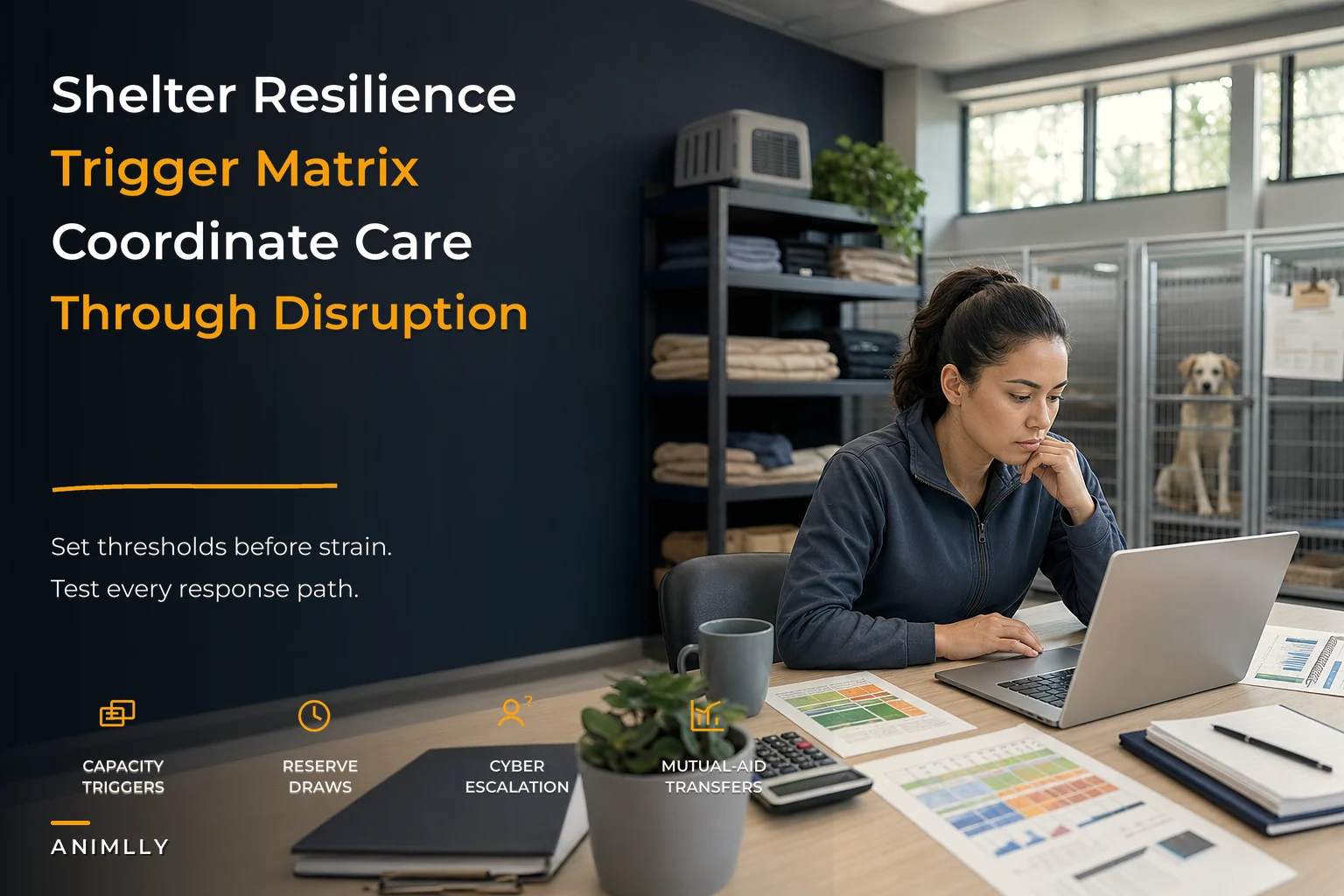
A real shelter resilience framework treats finance, surge capacity, mutual aid, and cyber readiness as one connected system with shared triggers. Not four binders. One operating plan where a signal in one area automatically tells you what to do in the others. This article walks through how to build that — the trigger ladders, the reserve-draw tables, sample MOU language, and a lightweight annual test calendar that actually gets used.
Why the pieces usually live in separate silos
The silos happen for a predictable reason: each piece gets built in response to a different crisis, by a different person, at a different time.
Your reserve policy probably came out of a bad December when donations dried up. Your mutual-aid contacts came from a regional meeting someone attended. Your cyber backups got set up after a ransomware article scared the board. None of these were designed to work together because they were never designed at the same time.
What you see across a lot of small shelters is that the person who understands the finances isn't the person managing kennel capacity, and neither of them talks regularly to whoever handles the tech. So when a situation crosses all three — which real emergencies almost always do — there's no shared language for "how bad is this" or "what do we do now."
The second reason is that thresholds rarely get written down as actual numbers. People say "we'll transfer animals when we're full." But full means different things depending on who's in the building. One coordinator panics at 85%; another keeps intaking at 110% because "we've managed before." Without a shared trigger, the response depends entirely on who's on shift, which means it's inconsistent and usually too late.
The core idea: one threshold ladder, four response tracks
The fix is a single resilience matrix built around escalation levels — call them Green, Amber, Red, and Black. Every part of your operation maps its own triggers onto those four levels. When any one area tips into Amber, the whole organization moves to Amber, and the pre-agreed responses in the other tracks activate automatically.
Streamline your shelter operations effortlessly.
Animlly helps you manage every pet, volunteer, and adoption step with ease and accuracy.
- Comprehensive pet profiles
- Volunteer scheduling & communication
- Adoption tracking & reporting
No credit card required
| Level | Capacity signal | Financial signal | Cyber/continuity signal | Default posture |
|---|---|---|---|---|
| Green | Under 80% of working capacity | Reserves at or above 3 months operating costs | Backups verified in last 30 days, no incidents | Normal ops |
| Amber | 80–95% capacity, intake pace rising | Reserves dipping toward 2 months, donation shortfall 2+ weeks | Suspicious login, failed backup, or vendor breach notice | Heightened monitoring, prep transfers, freeze non-essential spend |
| Red | 95–110%, no open kennels projected within 72h | Reserves under 6 weeks, or sudden revenue loss | Confirmed intrusion, data access blocked, systems down | Activate mutual aid, controlled reserve draw, incident response |
| Black | Over 110%, animals in temporary housing | Reserves under 3 weeks, payroll at risk | Ransomware, full lockout, or data breach confirmed | Emergency board activation, external help, public comms |
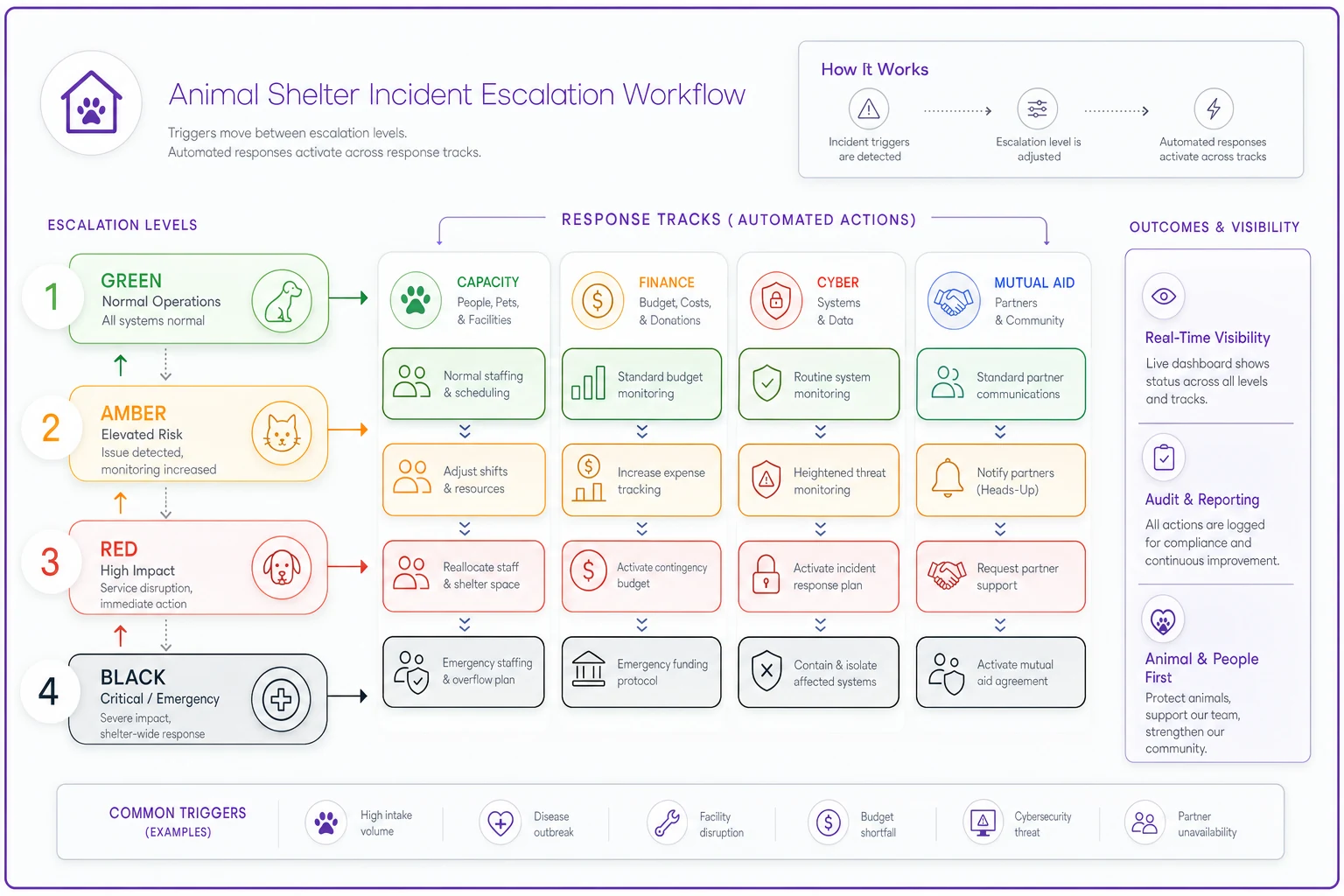
The point isn't the exact percentages — yours will differ based on your building and budget. The point is that one shared ladder forces coordination. A finance problem at Red tells your capacity coordinator to stop non-urgent intake even if kennels aren't full yet, because the money to feed and treat more animals isn't there. That's the kind of cross-track decision that gets missed when these systems are separate.
This diagram helps teams see who acts when a trigger fires and which other tracks must change posture automatically.
Building your trigger ladders (the part people skip)
A trigger ladder is the specific, numbered conditions that move you from one level to the next in a given track. The mistake most shelters make is writing triggers that are too vague to act on. "Low on funds" isn't a trigger. "Unrestricted reserves below six weeks of operating costs" is.
Here's how to build each one so it actually works:
-
Pick the single clearest metric for that track. For capacity, it's usually working kennel occupancy as a percentage, not total animals. For finance, it's weeks of operating costs covered by unrestricted reserves. For cyber, it's a short list of named events — failed backup, unauthorized access, system outage.
-
Set the number where you'd realistically start worrying, then move it earlier. Almost everyone sets triggers too late. If you'd panic at 95% capacity, set Amber at 80%. The whole value of a ladder is buying reaction time.
-
Write who confirms the trigger. A trigger nobody is responsible for checking is decorative. Name the role, not the person.
-
Define what automatically happens at that level. No deliberation required. When the trigger fires, the response is already decided.
Your capacity-planning framework should feed directly into the capacity track here — the surge buffers and scenario templates you've already built are exactly what defines your Amber and Red kennel thresholds. Don't rebuild them; pull them in.
Reserve-draw decision tables
The reserve conversation is where good intentions go to die. Everyone agrees reserves are for emergencies, but nobody agrees on what counts as an emergency, so the money either never gets touched (and animals suffer) or gets drained on things that weren't true emergencies.
A decision table removes the argument. It pre-answers "can we draw, how much, and who approves" before you're in the stressful moment.
| Trigger condition | Max draw | Approval needed | Replenishment deadline |
|---|---|---|---|
| Amber finance + Amber capacity (surge requiring extra medical) | Up to 10% of reserve | Director + one board member | 90 days |
| Red capacity, confirmed overcrowding welfare risk | Up to 20% | Director + board chair | 120 days |
| Red finance, revenue gap threatening core care | Up to 25% | Full board vote (can be electronic/24h) | Documented recovery plan required |
| Black level, payroll or critical operations at risk | Board-determined | Emergency board session | Immediate recovery plan |
Two things worth flagging. First, notice the replenishment deadline is part of the table. A reserve draw without a written path to refill it is how shelters quietly go insolvent over two or three "emergencies." Second, keep the approval chain short enough to actually function in a real crisis. If your bylaws require a full board meeting with two weeks notice to touch reserves, you've designed a reserve you can't use when you need it. Fix that now, not during the crisis.
If you haven't built out the underlying reserve tiers yet, the financial resilience framework for small shelters covers how to structure the tiers themselves — this matrix is about connecting those tiers to the capacity and cyber triggers that should set them in motion.
Mutual-aid and transfer protocols that hold up under stress
Informal "we help each other out" arrangements work fine until two shelters in the same region hit Red simultaneously — which, during a regional disaster or a bad intake season, is exactly when it happens. Then you discover the handshake deal had no agreed terms on who pays for transport, who covers medical costs on a transferred animal, or how long another shelter will hold your animals.
A lightweight MOU fixes this without turning into a legal project. Here's sample language you can adapt: > Transfer Capacity: Each party agrees to accept up to [X] animals from a partner shelter that has declared Red or Black status, subject to the receiving shelter's own available capacity at time of request. A partner at Red status retains priority over routine transfers. > > Cost Allocation: The sending shelter covers transport costs and provides current medical records and food for a minimum of [7] days. The receiving shelter covers routine care thereafter. Extraordinary medical costs over [$X] require sending-shelter approval before treatment, except in emergencies. > > Duration and Return: Transferred animals may be held by the receiving shelter for up to [30] days, after which ownership and outcome decisions transfer to the receiving shelter unless otherwise agreed in writing. > > Activation: Either party may request aid by contacting the designated coordinator listed in Appendix A. A response confirming or declining must be provided within [12] hours. > > Data Handling: Animal records shared under this agreement will be transmitted via [agreed secure method] and used only for the care and placement of transferred animals.
That last clause matters more than people realize. When you transfer animals, you're also transferring medical and sometimes adopter data between organizations, which connects your mutual-aid plan directly to your cyber-readiness track. For the governance side of running these arrangements across a network — coordinators, decision rights, dispute handling — the regional mutual-aid governance guide goes deeper than the MOU language here.
The minimal cyber-incident readiness layer
Shelters tend to treat cyber as a separate, intimidating topic reserved for big organizations. But for resilience purposes, you only need a handful of things in place, and they connect directly to your ability to keep functioning during any crisis. The reason cyber belongs in this matrix is simple: the moment you can't access animal records, medical histories, or adopter contacts, every other response slows down.
-
Verified, tested backups. Not "we have backups." Backups you've actually restored from in a test within the last 90 days. Untested backups fail at the worst moment more often than people expect.
-
A written access list. Who can log into what, with no single person holding sole access to any critical system. The "only Dave knows the password" situation is a continuity risk, full stop.
-
Offline copies of what you'd need in a total outage. A printed or offline list of animals in care, mutual-aid contacts, and key medical cases. If your system goes dark during a surge, you can still operate.
-
A simple incident trigger. Define the three or four events that move you into Amber or Red on the cyber track — failed backup, suspected unauthorized access, system outage, breach notification from a vendor.
-
A named first responder and a short call tree. Who gets called first, and who they escalate to. Thirty minutes of planning here saves hours of chaos later.
One thing worth noting: cyber incidents rarely happen in isolation from operational stress. System failures and attacks tend to surface during your busiest, most understaffed periods — the same periods when capacity and finance are already strained. That's exactly why it belongs in the unified ladder rather than its own forgotten binder.
When a unified matrix actually makes sense (and when it doesn't)
This approach pays off for shelters that have crossed a certain level of operational complexity — multiple staff or coordinators, a real budget with reserves, partnerships with other organizations, and enough intake volume that surges happen regularly rather than once in a while.
If you're a small all-volunteer operation handling a dozen animals with one decision-maker who holds everything in her head, a four-track matrix is overkill. There's no need for escalation levels when one person is making every call. Write down your reserve rule and two mutual-aid contacts and move on.
Where this becomes genuinely problematic is when shelters build the matrix as a document and never test it. An untested resilience plan creates false confidence. Staff believe there's a system, so they stop improvising — but the system has never been stress-tested, so it fails in unexpected ways during the real event. A plan you haven't tested is arguably worse than no plan, because it replaces healthy caution with misplaced trust.
A short annual test calendar
Testing is the part everyone agrees is important and nobody schedules. The fix is a fixed calendar with small, specific drills — none of them taking more than an hour or two.
| Quarter | Test | What you're checking |
|---|---|---|
| Q1 | Reserve-draw tabletop | Can the approval chain actually execute a draw in 24 hours? |
| Q2 | Backup restore test | Can you restore animal/medical records from backup? |
| Q3 | Mutual-aid activation drill | Does your partner respond within the agreed window? |
| Q4 | Full matrix tabletop | Run a combined scenario touching all four tracks |
A worked example of the Q4 tabletop: You stage a scenario where a respiratory outbreak pushes capacity to 100% (Red), forcing extra medical spending that pulls finance to Amber, during a week when your database is unexpectedly down (Red cyber). You walk the team through it in real time.
What a drill like this surfaces is almost always the gaps between tracks. A shelter running this for the first time typically discovers something like: the reserve draw needs board-chair approval, but the board chair is the only person with access to the system showing the financial picture — and that system is the one that's down in the scenario. You can't approve the draw because you can't confirm you need it. That kind of cross-dependency is invisible on paper and obvious the moment you run it.
A worked example of the Q3 mutual-aid drill: You send a real activation request to your partner shelter's designated coordinator and time the response. One shelter ran this and found their partner's listed coordinator had left six months earlier and nobody had updated the contact. The 12-hour response window in their MOU was meaningless because the request went to a dead inbox. A five-minute drill caught a failure that would have cost them a full day during an actual emergency.
Keeping the whole thing current without it becoming a burden
The hardest part of a unified framework isn't building it — it's keeping the thresholds, contacts, and access lists current as staff turns over and budgets shift. People leave, reserve targets change, a new partner joins the network, and the matrix quietly drifts out of date until it's fiction.
The teams that keep it alive tend to do one simple thing: they tie a review to something that already happens. The annual budget cycle is the natural anchor — when you set next year's budget, you recalibrate the financial triggers and reserve tiers at the same time. When you onboard or offboard a staff member, the access list gets updated as part of that process, not as a separate task someone has to remember.
Tie the matrix review to the annual budget cycle so triggers stay updated.
Using a shared operations platform where capacity numbers, reserve status, contacts, and trigger definitions live in one place — rather than scattered across spreadsheets and individual memory — makes this a lot easier, because triggers can read from live data instead of a number someone updates manually once a year. But the tool matters far less than the discipline. A well-maintained shared spreadsheet beats a sophisticated system nobody updates.
Bringing it together
The shelters that weather compounding crises aren't the ones with the biggest reserves or the most elaborate documentation. They're the ones where finance, capacity, mutual aid, and continuity speak the same language and move together. When kennels fill, the finance track already knows what that means for spending. When a cyber incident hits, the mutual-aid plan already accounts for how data moves safely. When reserves dip, capacity decisions adjust before the money runs out.
That coordination is the entire point of a unified shelter resilience framework. Not four plans that each work in isolation, but one ladder that makes sure a problem in any corner of your operation triggers the right response everywhere else — before you're improvising it at 2 a.m. with animals in the hallway and a crisis coming from three directions. Build the thresholds, write them as real numbers, keep the approval chains short enough to actually use, and test the whole thing four times a year. The first tabletop will embarrass you a little. That's exactly what it's for.
Ready to enhance your shelter’s impact?
Join 500+ shelters using Animlly to improve care coordination, increase adoptions, and engage communities effectively.