

Most shelters don't lose clinical quality in one dramatic failure. They lose it slowly — a skipped surgical log here, a vaccine given to the wrong kennel card there, a volunteer tech who "just knows" how to handle a particular protocol but never wrote it down. Then the person who held it all together burns out or moves on, and suddenly nobody can tell you whether your spay/neuter complication rate is normal or quietly climbing.
A clinical quality management system is what catches those slow leaks. Not the binder of SOPs sitting on a shelf — the rhythm of checking, sampling, and fixing that keeps the binder honest. And in a volunteer-run clinic, that rhythm has to survive the reality that the person doing today's audit might be a retired dental hygienist who gives four hours a week.
Most governance writeups skip this entirely. They tell you what a good standard looks like but not how a shelter clinical quality management system actually runs when you have three paid staff, forty volunteers, and a vet who's on-site twice a week. That's what this covers.
If you've already set up your clinical governance framework, think of this as the operating layer on top of it — governance decides what good looks like, the QMS proves you're actually doing it.
Why clinical quality drifts in volunteer clinics specifically
The core problem isn't competence. It's continuity. In a normal veterinary practice, the same four people see the same patients and notice when something's off. In a shelter clinic, the animal in Kennel 12 might be assessed by one volunteer on Monday, medicated by another on Wednesday, and checked out for adoption Saturday by someone who never saw the original intake note.
Quality lives in the gaps between those handoffs — and those gaps are where a rotating volunteer workforce is weakest:
-
Nobody owns the full timeline of a single animal's care
-
"Standard practice" varies depending on who trained the volunteer
-
The vet signs off on outcomes but rarely sees the process that produced them
-
Documentation feels like overhead when you're short-staffed, so it's the first thing dropped
A typical example: a shelter runs a Saturday vaccine clinic, moves 60 animals through in four hours, and feels great about the throughput. Three weeks later a URI outbreak hits a cohort, and when they try to reconstruct who was vaccinated when, half the records are initials-only and two cats have no lot numbers logged at all. Now they can't tell the difference between a vaccine failure, a handling error, and a cohorting mistake — so they can't fix the actual cause.
That's what a QMS exists to prevent. Not more paperwork. Reconstructable care.
The minimum standards layer: start smaller than you think
The instinct when building a clinical QMS is to write standards for everything. Don't. A volunteer clinic that tries to audit 40 protocols audits none of them well. The shelters that maintain quality over years are the ones that defined a tight set of minimum clinical standards and enforced those relentlessly before expanding.
Streamline your shelter operations effortlessly.
Animlly helps you manage every pet, volunteer, and adoption step with ease and accuracy.
- Comprehensive pet profiles
- Volunteer scheduling & communication
- Adoption tracking & reporting
No credit card required
A workable minimum standard set for a shelter clinic usually covers:
-
Intake medical exam completed and documented within a defined window (often 24–72 hours)
-
Vaccination protocol by species/age, with lot number and site recorded
-
Parasite treatment given and logged on schedule
-
Surgical records including pre-op check, procedure, and post-op monitoring
-
Medication administration logged with dose, route, time, and initials
-
Isolation/quarantine criteria and the decision that placed an animal there
-
Euthanasia documentation tied to the decision pathway
Each standard needs one thing most shelters forget: a clear definition of compliant vs. non-compliant. "Vaccine recorded" isn't a standard. "Vaccine recorded with product, lot, expiry, site, and administering initials" is. The difference matters because your audits are only as sharp as the line you're measuring against.
Keep minimum standards limited to what a volunteer auditor can judge — if it needs the vet, it's not an auditable minimum standard.
A useful discipline: for every standard, write the one sentence a volunteer auditor can read and immediately judge pass/fail without clinical training. If judging it requires the vet, it's not an auditable minimum standard — it's a clinical review, which is a different process.
One-page audit rhythms and how to sample without drowning
This is where volunteer clinics either hold together or quietly fall apart. You can't 100%-audit everything. You also can't audit once a year and call it a QMS. The answer is sampling on a rhythm — small, frequent checks that are actually light enough to happen.
The rhythm that holds up in practice looks roughly like this:
| Audit type | Frequency | Sample size | Who runs it | Time needed |
|---|---|---|---|---|
| Daily record spot-check | Every operating day | 3–5 records | Shift lead | ~10 min |
| Weekly protocol audit | Weekly | 10–15 records across standards | QMS coordinator | ~45 min |
| Monthly deep audit | Monthly | 25–30 records, full timeline | Coordinator + vet | ~2 hrs |
| Quarterly system review | Quarterly | KPI trends + CAPA status | Leadership | ~90 min |
The one-page audit sheet is the whole trick. If your audit tool runs longer than a page, volunteers will shortcut it. One page, one standard area per audit cycle, clear pass/fail boxes, a single line for "what was off."
On sampling: don't just grab the easy records. The ones sitting on top of the pile are usually the clean ones. A simple approach that actually works — pull records using a rotating rule (every 7th intake this week, surgical cases from a specific day, all animals currently in isolation). Randomize enough that staff can't predict which files get checked, because the moment they can, audits only ever see the good files.
The daily 3–5 record spot-check catches more problems than the monthly deep audit, even though it's shorter. Small frequent sampling finds drift while it's still a trend, not after it's already become an outbreak.
From a finding to a fix: the RCA → CAPA workflow
Finding problems is easy. Most shelters have no shortage of findings. What breaks is the loop between noticing something wrong and changing the thing that caused it. That's what root cause analysis (RCA) feeding into corrective and preventive action (CAPA) is for — and in a shelter, it has to be lightweight or it won't survive a busy week.
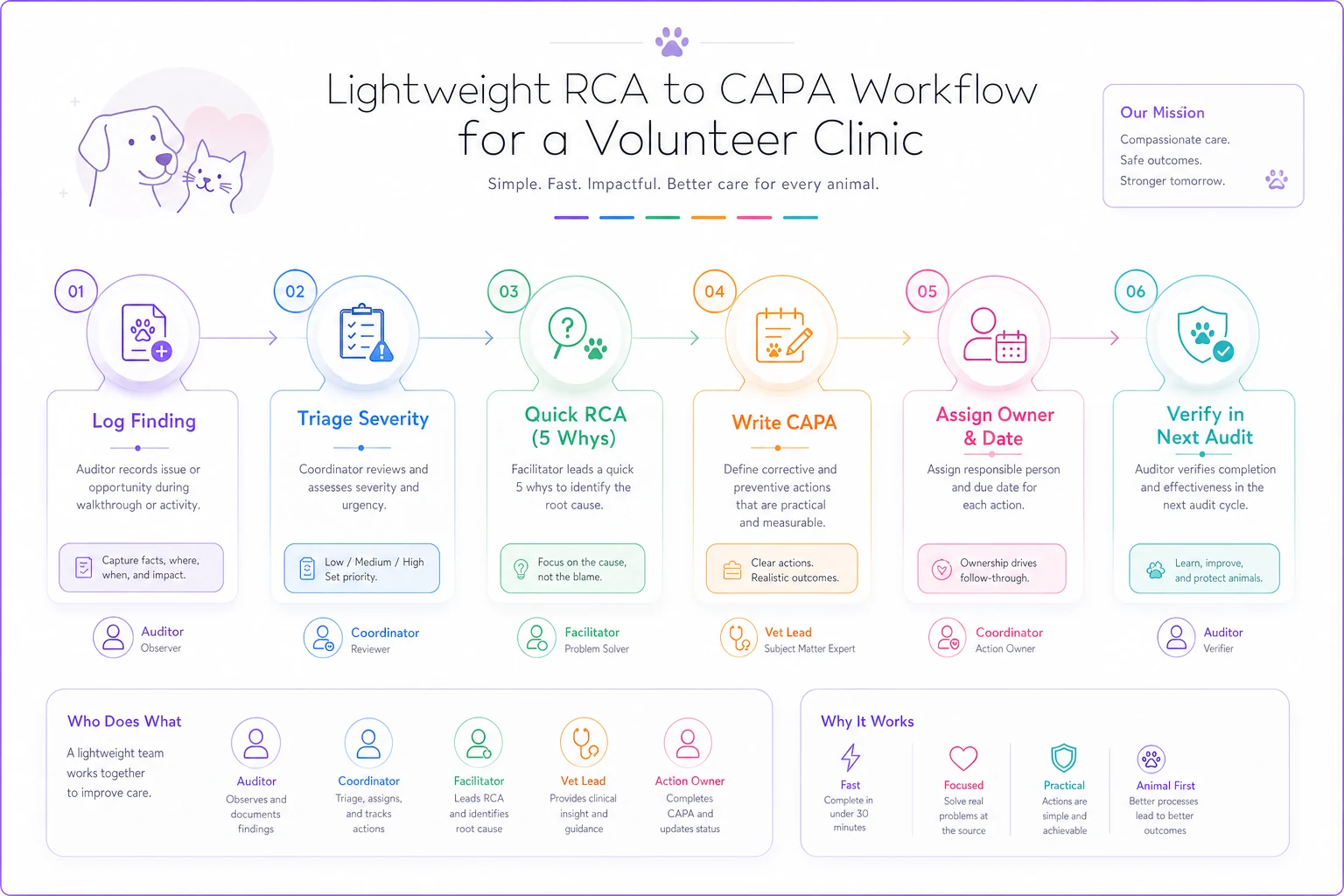
The workflow that actually runs in a small clinic:
-
Log the finding. Audit turns up a non-compliance — say, three surgical records missing post-op monitoring notes. Record it plainly: what, when, how many.
-
Triage severity. Is this a paperwork gap or a patient-safety gap? A missing initial is minor. A missing post-op check where an animal was actually at risk is not. This decides urgency.
-
Run a quick RCA. Ask "why" until you hit something you can change. Missing post-op notes → because the recovery volunteer didn't know it was required → because the surgical SOP assumes the surgeon documents it → because nobody owns the recovery handoff. Now you've found the real cause: an undefined handoff, not a careless volunteer.
-
Write the CAPA. Corrective
fix the three records if possible. Preventive: assign recovery documentation explicitly in the surgical SOP and add it to the one-page audit. This is the part that stops it recurring.
-
Assign an owner and a date. A CAPA with no name and no deadline is a wish.
-
Verify it worked. Next month's audit checks the same standard. Consistent post-op notes? Close it. Still missing? The root cause was wrong — go back to step 3.
Nearly everyone stops at step 1 and treats the finding itself as the fix. They correct the record and move on. Three weeks later the same gap appears because the cause was never touched. RCA is what separates a QMS from a complaint log.
A quick visual of this lightweight RCA→CAPA workflow:
And because so many clinical findings trace back to people being stretched thin, the preventive side often overlaps with workload and morale — which is why your CAPA process and your staff wellbeing and debrief routines should be connected. A documentation gap after a hard euthanasia week isn't a discipline problem. It's a capacity problem wearing a paperwork disguise.
Role-based credentialing: who's actually allowed to do what
This is the layer shelters avoid because it feels bureaucratic, and then it's the exact gap behind the worst incidents. In a volunteer clinic, the question "is this person authorized to draw up and administer this injection?" often has no clear answer. Someone was shown once, months ago, and has been doing it since.
A role-based credentialing matrix fixes this by mapping tasks to proven competencies — not to seniority or vibes. It's a simple grid: rows are tasks, columns are roles, and each cell shows status — not trained, trained-observing, signed-off, or trainer-level.
A realistic slice:
| Task | New volunteer | Trained tech | Lead tech | Vet |
|---|---|---|---|---|
| Vaccine administration | Observe only | Signed off | Signed off + trains | Signed off |
| SQ fluids | — | Observe only | Signed off | Signed off |
| Controlled drug handling | — | — | Signed off | Signed off |
| Surgical recovery monitoring | Observe only | Signed off | Signed off + trains | Signed off |
| Euthanasia assist | — | — | Signed off | Performs |
Two things make this work. First, credentials expire. A "signed off" from eighteen months ago on a task someone hasn't touched since isn't a credential — it's a liability. Build in a review date. Second, the matrix is a living document that lives next to the schedule, not in a drawer. When the shift lead builds Saturday's roster, they should be able to glance and confirm every assigned task has a credentialed person on it.
Shelters with a visible credentialing matrix have fewer "I didn't know I wasn't supposed to" incidents, because the boundary is explicit. The ones without it tend to find out where the gaps are only after something goes wrong.
KPI dashboards: measuring the system, not just the outcomes
Most shelters that track clinical numbers track outcomes — live release rate, average length of stay, outbreak counts. Those matter, but they're lagging indicators. By the time your outbreak count spikes, the process that caused it broke weeks earlier.
A clinical QMS dashboard needs both leading and lagging indicators. The leading ones are where the real value is:
-
Process health (leading) - Audit completion rate (are the rhythms actually happening?)
-
Documentation compliance % by standard
-
Open CAPAs past their due date
-
% of credentialed tasks with a current sign-off
-
Clinical outcomes (lagging) - Surgical complication rate
-
Treatment-related incidents
-
Isolation/quarantine protocol adherence
-
Vaccine-preventable disease cases post-admission
The number that tells you the most about a shelter's actual clinical safety isn't a medical metric — it's audit completion rate. If audits aren't happening, every other number on the board is unverified. A clinic reporting a 2% complication rate with 30% audit completion doesn't have a 2% complication rate. It has an unknown rate and an optimistic guess.
For how clinical metrics should slot into your broader operational picture, it's worth connecting this to your prioritized KPI dashboard rather than running clinical numbers in a silo. A rising complication rate should be as visible to leadership as a capacity warning — not buried in a separate spreadsheet nobody opens between board meetings.
A real scenario: the Saturday surgery clinic
A mid-sized municipal-contract shelter ran a high-volume spay/neuter clinic every Saturday — roughly 25–30 surgeries a day, mostly staffed by rotating volunteer techs under one contract vet. Records were "fine" in the sense that outcomes looked okay, but they had no way to prove it and no early warning system.
The trouble surfaced when they noticed a cluster of post-op incision complications over about six weeks — somewhere around 8–9 cases, which felt high but they couldn't benchmark against anything because they'd never tracked a baseline. No RCA process meant each case got handled individually and forgotten.
They put in a minimal QMS: a one-page daily spot-check on surgical records, a weekly audit of post-op monitoring notes, and a basic RCA on every complication. The first month of real sampling showed the pattern immediately — complications clustered on days when a specific recovery handoff got skipped because the clinic ran long and volunteers left before the last animals fully recovered. Not a surgical skill issue. A handoff and staffing-tail problem.
The CAPA was unglamorous: a defined recovery-coverage rule (no animal left in recovery without a credentialed monitor) and a hard stop on booking the last surgery slot too late in the day. Over the following two months the complication cluster dropped back to a low, stable level — and more importantly, they now had a baseline. The next drift would show up in weeks instead of being noticed by accident. The dashboard turned complications from a vague worry into a number they could actually watch.
When a full QMS makes sense — and when it doesn't
When it makes sense: You're running regular clinical operations — surgery days, vaccine clinics, ongoing treatment of a shelter population — with a rotating workforce and a part-time vet. The more people touch an animal's care, the more you need a system that makes that care reconstructable. If you can't currently answer "who vaccinated this cat and with what lot," you're past due.
When it's overkill: A small foster-based rescue that sends every animal to an outside clinic for all medical care doesn't need an internal clinical QMS — they need good referral tracking and records from their vet partner. Building audit rhythms for clinical work you don't actually perform in-house is motion without value.
Who should not try to build this all at once: A shelter in active crisis — outbreak, flooding, sudden intake surge. Stabilize first. A QMS is a discipline you build during calm periods so it holds during chaotic ones. Trying to stand up full audit rhythms while you're underwater just adds a failing process to track.
The honest middle path for most small shelters: start with two minimum standards and one daily spot-check. Prove the rhythm survives a hard week. Then add a standard. A small QMS that actually runs beats a comprehensive one that lives in a shared drive nobody opens.
Where the manual version breaks — and what to centralize
Everything above works on paper and spreadsheets. It just gets heavier as you grow. At 10 surgeries a week, tracking credentials, CAPAs, and audit rhythms by hand is manageable. At 40, with volunteers rotating and credentials expiring on different dates, the tracking itself becomes a job — and when the tracking is manual, it's the first thing that slips.
This is where AI-assisted operational platforms earn their place, not as a flashy add-on but by removing the quiet administrative drag. Flagging credentials about to expire before they lapse, surfacing overdue CAPAs before they get buried, auto-selecting audit samples so nobody cherry-picks the clean records, pulling documentation-compliance trends into a dashboard without someone rebuilding a spreadsheet every week. The clinical judgment stays human. The remembering, flagging, and tallying — the parts that fail under volunteer workload — are exactly what's worth automating.
The point isn't the software. It's that a QMS lives or dies on whether the boring recurring steps actually happen. Anything that makes the rhythm harder to skip strengthens the whole system.
Bringing it together
A shelter clinical quality management system isn't a document — it's a loop. Minimum standards define the line. Audit rhythms sample against it often enough to catch drift early. RCA finds the real cause instead of the surface symptom. CAPA changes the thing that caused it. The credentialing matrix keeps the right people on the right tasks. The dashboard tells you whether the whole loop is actually turning or just looks good on paper.
Volunteer clinics don't fail at quality because they lack skill or care. They fail because quality lives in the handoffs, and handoffs are where a rotating team is thinnest. A QMS is how you make care reconstructable, drift visible, and fixes permanent — even when the person running today's audit gives four hours a week. Start small, keep the rhythm honest, and let the system hold the line.
Ready to enhance your shelter’s impact?
Join 500+ shelters using Animlly to improve care coordination, increase adoptions, and engage communities effectively.