

Most shelters don't have a recruitment problem. They have a retention and coordination problem that looks like a recruitment problem.
The pattern shows up constantly: a shelter runs a volunteer drive, gets 40 signups, onboards maybe 25, and six months later has 9 people doing real work. So they run another drive. The churn is invisible on the surface because the roster still shows "80 active volunteers," but ask who actually showed up last Tuesday and the real number is closer to a dozen reliable people carrying the whole operation.
A shelter volunteer workforce strategy isn't a recruiting poster or a sign-up sheet. It's the connected system that moves someone from "interested stranger" to "trained, reliable, long-term contributor" — and keeps them there. When that system is missing, every other operational improvement you make leaks out through the gaps. You can't fix intake bottlenecks or infection control or adoption throughput if the people executing those processes rotate out every few months.
This article covers the whole machine: the lifecycle, the progression ladders, how you staff surges without panic-texting, and how to actually measure whether retention is improving. Not a list of "ways to thank your volunteers."
Why the volunteer workforce quietly breaks
The core issue is that volunteer labor behaves nothing like paid labor, but most shelters manage it as if it does — a schedule, a list of tasks, and a hope that people keep showing up.
Paid staff come in because they need the paycheck. Volunteers come in because the experience is worth their time. The moment it stops being worth their time — they feel useless, they're confused about what to do, they got caught in a chaotic shift with no support, they trained for weeks and still got stuck folding laundry — they just stop. There's no exit interview. They don't quit. They fade.
-
The onboarding cliff. People sign up with energy, then wait three weeks for an orientation, then get handed to nobody in particular on their first shift. The gap between signup and first meaningful task is where you lose most people.
-
No path forward. A volunteer who's been walking dogs for a year the exact same way they did on day one gets bored. No ladder, no new responsibility, no sense of growing into something.
-
Surge chaos. During a big intake day or an adoption event, coordination collapses. Experienced volunteers burn out covering for no-shows, and the whole experience sours.
-
Invisible burnout. The reliable core — the 10 to 15 people who do 70% of the work — quietly hit their limit because the shelter leans on them harder every time there's a gap.
What breaks at scale is coordination, not willingness. A 20-volunteer shelter can run on texts and a shared spreadsheet because one coordinator holds everything in their head. At 60+ volunteers across multiple shifts and roles, that same informal system turns into missed shifts, double-booked tasks, and a coordinator who spends their entire week chasing people instead of improving anything.
The volunteer lifecycle map (the backbone everything hangs on)
Before you touch rostering or KPIs, you need a shared map of how a person moves through your shelter. Most places have never written this down, which is exactly why volunteers fall through cracks — nobody owns the handoffs between stages.
Streamline your shelter operations effortlessly.
Animlly helps you manage every pet, volunteer, and adoption step with ease and accuracy.
- Comprehensive pet profiles
- Volunteer scheduling & communication
- Adoption tracking & reporting
No credit card required
A workable lifecycle has six stages:
-
Inquiry — someone expresses interest. Goal
respond within 48 hours, not three weeks.
-
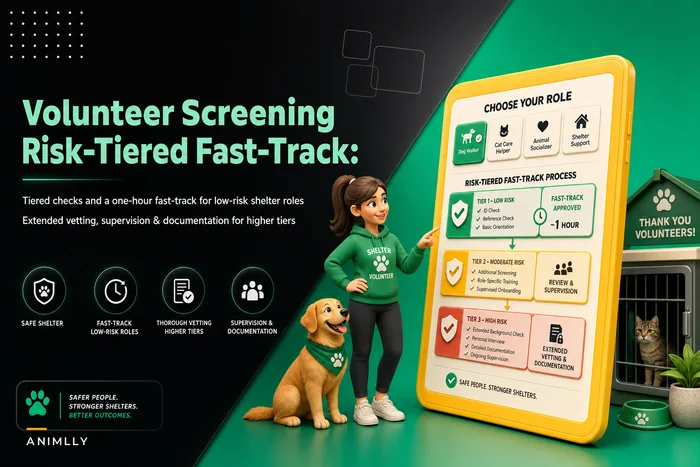
Screening & matching — background checks and role fit. This is where safe placement lives, and it deserves real structure rather than a gut call. A risk-tiered approach to volunteer background screening and rapid role-matching lets you fast-track low-risk roles while applying deeper vetting to the ones that need it.
-
Onboarding — orientation plus a first real shift with a buddy. The buddy part is non-negotiable; solo first shifts are where confidence dies.
-
Active contribution — the person is reliable in at least one role.
-
Progression — they take on more skill, more responsibility, or mentoring.
-
Offboarding or dormancy — people leave or go quiet. How you handle this determines whether they ever come back.
The most useful thing about writing this out is that each stage gets an owner and a maximum time-in-stage. If "inquiry" has no owner, inquiries sit. If "onboarding" has no time limit, people wait weeks and evaporate. A rule that tends to work: nobody sits in a stage longer than 10 days without contact.
One thing worth naming — shelters obsess over stage 1 (recruiting) and almost entirely ignore stage 6 (dormancy). A volunteer who left on good terms and gets a warm "we'd love to have you back for the summer surge" message converts far better than a cold stranger from a flyer. Your lapsed volunteers are your best recruiting pool and almost nobody works them.
Nobody should sit in a stage longer than 10 days without contact.
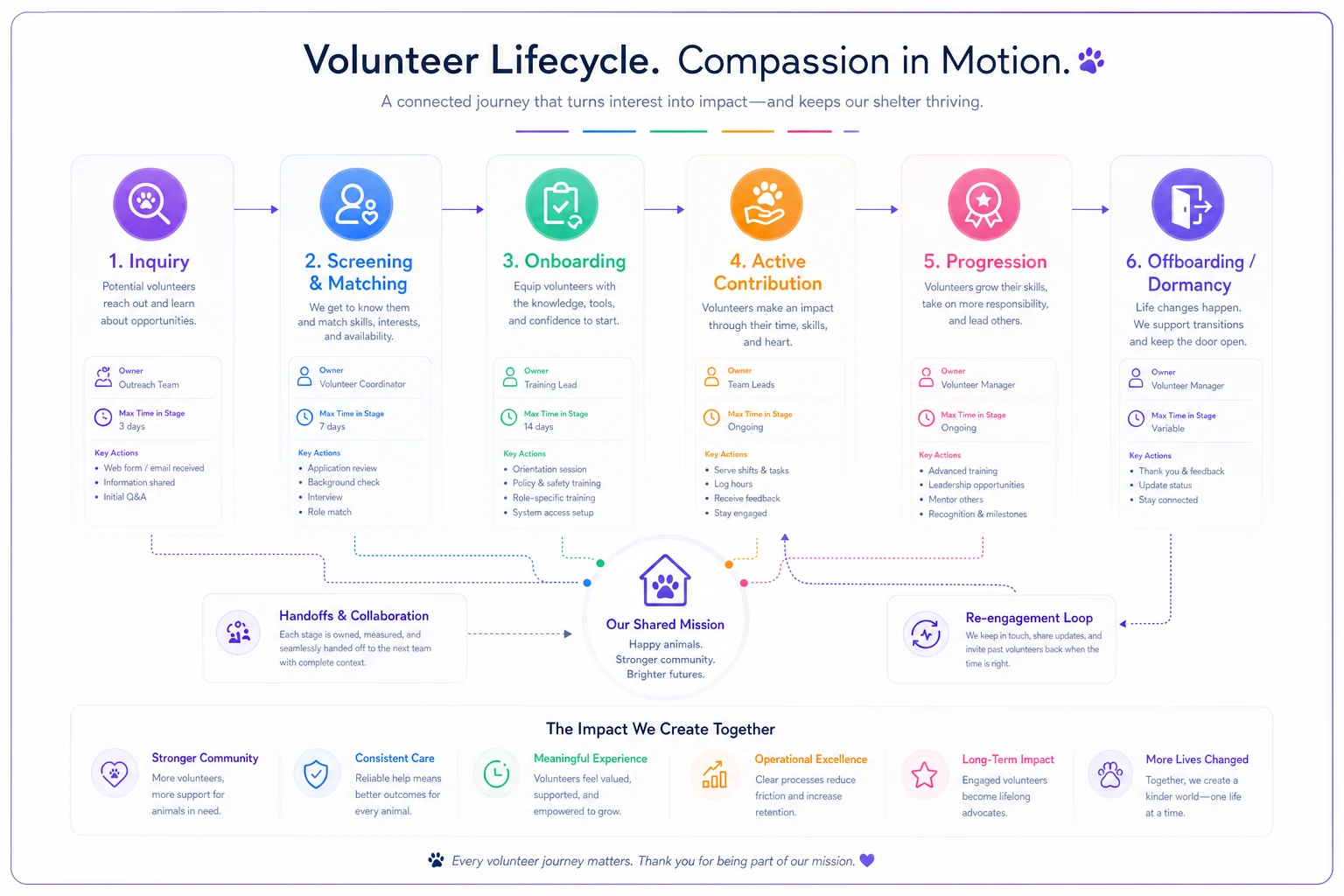
This diagram shows the lifecycle and the re-engagement loop.
Competency-based progression ladders
This is where retention is actually won or lost. People stay when they feel like they're getting better at something and being trusted with more.
A progression ladder is simple: define levels within each role, and define what unlocks the next one. It turns a vague volunteer experience into something with visible forward motion.
A dog-handling track might look like:
| Level | Title | Can do | Unlocks when |
|---|---|---|---|
| 1 | Walker | Walk green-rated dogs, basic kennel care | Completed orientation + 3 buddy shifts |
| 2 | Handler | Walk yellow-rated dogs, assist intake | 15 logged shifts + handling check-off |
| 3 | Lead Handler | Handle behavior-flagged dogs, run playgroups | Behavior module + 40 shifts + staff sign-off |
| 4 | Volunteer Mentor | Train and buddy new volunteers | Lead level + mentor shadowing |
The magic isn't the titles — it's that progression is tied to demonstrated competency, not time served. Someone who shows up twice a week for two months can earn Level 2 faster than someone who comes monthly for a year. That feels fair, and it rewards exactly the behavior you want more of: reliability.
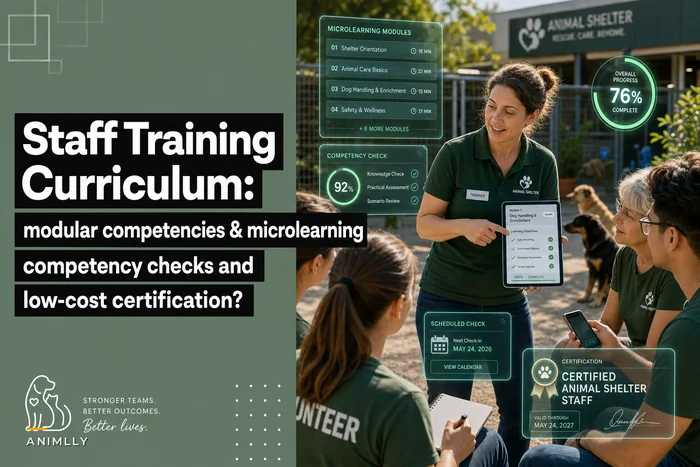
Tying the ladder to a real training structure keeps it from becoming arbitrary. A modular competency-based training curriculum gives you the check-offs each level depends on, so advancement is based on something concrete instead of whether the coordinator happens to like someone.
A mistake people make: building a ladder with no top mentoring rung. If your most experienced volunteers have nowhere to go but "keep doing the same thing," they plateau and leave. The Mentor tier solves two problems at once — it retains your best people and fixes your onboarding bottleneck, because experienced volunteers become the buddies that new people desperately need.
Surge rostering rules
Surges are where good volunteer systems prove themselves and bad ones fall apart. Intake spikes, adoption events, a hoarding case, a weather event — suddenly you need double the people and the usual "who can come in?" group text produces chaos.
Rostering by panic doesn't scale. What works is a small set of pre-agreed rules decided before the surge, so during it you're executing, not negotiating.
-
Tiered call-up order. You don't blast everyone. You have a Tier 1 surge list (people who opted in and are competency-cleared for high-pressure shifts), then Tier 2, then general. This protects less-experienced volunteers from being thrown into situations they're not ready for.
-
Role caps per shift. A surge shift that's all Level 1 walkers and no Level 3 leads is a disaster waiting to happen. Set minimums — no surge shift runs without at least 2 Lead Handlers present.
-
Hard shift ceilings for your core. Your reliable people will volunteer for everything. Cap them — no more than X surge shifts per week — or you'll burn out the exact people you can't afford to lose.
-
A known fallback position. If you can't hit minimums, you pre-decide what gets paused: intake slows, playgroups cancel, non-urgent tasks drop. You don't wing it.
Worked rostering decision table: intake surge
Say you get a surge of 25 intakes in a day and your standing shift is built for around 8 animals. Here's a decision table that turns "oh no" into a known sequence:
| Condition | Volunteers available | Lead Handlers present | Action |
|---|---|---|---|
| Surge < 15 animals | ≥ 6 | ≥ 1 | Run normal + 1 extra floater |
| Surge 15–25 animals | ≥ 8 | ≥ 2 | Activate Tier 1 surge list, pause playgroups |
| Surge 15–25 animals | 4–7 | ≥ 1 | Activate Tier 1 + 2, slow non-urgent intake |
| Surge > 25 animals | < 6 | any | Fallback mode: emergency foster call, hold non-critical intake, notify partners |
The point of a table like this is that nobody has to make a judgment call at 7am with a parking lot full of carriers. The decision was made in a calm meeting weeks earlier.
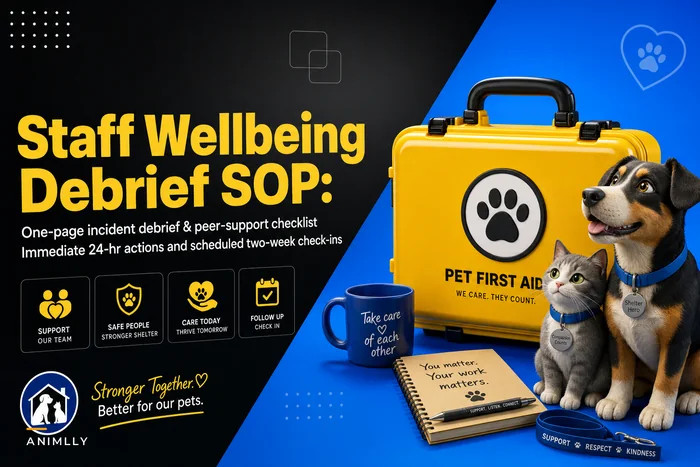
Surge shifts are also the highest-stress environment for your people, which is why pairing surge planning with a real critical-incident debrief and wellbeing process matters. Shelters that debrief after a brutal surge day keep their volunteers. The ones that just move on lose three good people quietly over the next month.
A simple TCO model: volunteer vs paid coverage
There's a dangerous assumption baked into most shelter budgets: that volunteers are "free." They're not. They're cheaper, but the total cost of ownership includes recruiting, screening, training, coordination time, and the operational risk of unreliability.
Running a rough TCO comparison helps you make honest decisions about which roles should be volunteer and which should really be paid.
Consider a role covering roughly 20 hours a week of kennel care across a year (around 1,000 hours):
| Cost factor | Volunteer coverage | Part-time paid |
|---|---|---|
| Direct wages | $0 | ~$16–18k |
| Recruiting (to cover churn) | ~$600–1,200/yr | one-time hire cost |
| Screening & onboarding | ~$400–800/yr | ~$300 once |
| Coordination overhead | High — ~4–6 hrs/wk of staff time | Low |
| Reliability | Variable; no-show risk | Dependable |
| Effective coverage of planned hours | ~65–80% | ~95%+ |
The honest takeaway: volunteers are dramatically cheaper in direct dollars, but they carry real coordination cost and a reliability discount. For flexible, enrichment, and front-facing roles, volunteers win easily. For critical, must-be-covered-every-single-day roles — medical support, opening/closing, controlled drug access — the hidden cost of volunteer unreliability often makes a part-time paid position the smarter choice once you factor in what a missed critical shift actually costs.
When volunteer-heavy coverage makes sense
-
The role tolerates variability (walking, socializing, events, admin support).
-
You have a working progression ladder and coordination system.
-
The work is rewarding enough to sustain people long-term.
When it's a bad idea
-
The role is single-point-of-failure critical with no real backup.
-
It requires licensure or legal accountability.
-
Your coordination capacity is already maxed and adding volunteers just adds chaos.
The real mistake isn't choosing one or the other — it's never doing the math at all and assuming volunteers scale infinitely for free. Every new volunteer adds coordination load, and past a certain point that load needs either a paid coordinator or a system that absorbs it.
Retention KPIs you can actually track
"We have 80 volunteers" is a vanity number. Here's what actually tells you if your workforce is healthy:
-
90-day retention rate — of volunteers who complete onboarding, how many are still active at 90 days? This is your single most predictive number. Below around 50% means your onboarding or first-shift experience is broken.
-
Time-to-first-meaningful-shift — days from signup to first real contribution. Keep it under two weeks. Every extra week drops conversion.
-
Active-vs-roster ratio — what percent of your "active" roster worked a shift in the last 30 days? If it's under 40%, your roster is fiction.
-
Core-dependency ratio — what percent of total hours comes from your top 10 volunteers? Over 60% means you're one burnout away from a crisis.
-
Surge fill rate — when you activate a surge call, what percent of needed slots fill within 24 hours?
-
Progression rate — how many volunteers advanced a level in the last quarter? Zero movement predicts future churn.
Track the first three if you track nothing else. A shelter that moves 90-day retention from 45% to 65% effectively gains dozens of working volunteers a year without running a single new drive — they just stop losing the ones they already have.
A real scenario
A mid-sized municipal-contract shelter — around 70 animals on average, roughly 85 names on the volunteer roster — was stuck in a constant recruiting loop. Despite that roster, only about 18 people showed up regularly, and two coordinators were spending most of their week chasing schedules and re-explaining basic tasks to volunteers who never came back.
They made three changes over about four months. First, they mapped the lifecycle and set a hard rule: every inquiry got a response within two days and a buddy-paired first shift within ten. Second, they built a three-rung progression ladder for dog and cat care tied to actual competency check-offs. Third, they split the roster into a Tier 1 surge list and set shift caps on their core people.
The numbers didn't explode overnight, but they moved in the right direction. Ninety-day retention went from somewhere around 40% to roughly 60–65%. Active-vs-roster climbed from the low 20s to about 45%. The surge fill rate — which had basically been a coin flip — got reliable enough that they stopped canceling playgroups on busy intake days. They didn't recruit dramatically more people. They just stopped losing the ones they had, and the coordinators got hours back every week.
Where coordination tooling fits
All of this — lifecycle stages with owners, competency check-offs, tiered surge lists, retention metrics — is runnable on spreadsheets at small scale. Plenty of shelters do it that way. The problem is that spreadsheets don't remind anyone. They don't flag that a volunteer has been stuck in onboarding for 12 days, or that your core-dependency ratio is creeping toward dangerous, or that three people cleared Level 2 and should be invited to mentor.
That's the real argument for AI-powered operational software built for shelter workforces: not flashy automation, but a system that holds the connective tissue so a human coordinator isn't the single point of failure. Shift self-scheduling with competency rules baked in, automatic reminders that cut no-shows, surge call-ups that go out by tier instead of a mass text, retention KPIs that update without requiring a monthly spreadsheet archaeology session. The coordinator stops being a human database and goes back to doing the relationship work that actually keeps volunteers around.
The tooling doesn't replace the strategy. It just means the strategy survives a coordinator getting sick, or quitting, or the roster doubling in size. That's the whole point of building a system instead of relying on one person's memory.
Pulling it together
A shelter volunteer workforce strategy works when the pieces connect: a lifecycle that doesn't leak people, a ladder that gives them somewhere to grow, surge rules that protect your core instead of grinding them down, honest TCO math about what should be paid versus volunteer, and KPIs that tell you the truth about your roster instead of flattering it.
Shelters that struggle usually have each of these pieces in isolation — a sign-up form here, a training doc there, a panicked group text when things get busy. The ones that thrive have wired them into a single system where improving one part strengthens the others. Fix onboarding and your retention climbs. Build a mentor rung and your onboarding gets easier. Track the core-dependency ratio and you catch burnout before it costs you your best people.
Start with the one number that matters most — 90-day retention — and build backward from there. You almost certainly don't have a recruiting problem. You have a system problem wearing a recruiting problem's clothes.
Start with the one number that matters most — 90-day retention — and build backward from there. You almost certainly don't have a recruiting problem. You have a system problem wearing a recruiting problem's clothes.
Ready to enhance your shelter’s impact?
Join 500+ shelters using Animlly to improve care coordination, increase adoptions, and engage communities effectively.